
The annual frenzy of the 48 Hour Film Project is over, and I am catching up on submissions. One of interest to readers is the Thomas Crone-directed Tales of Templar, in which a villain plots to melt all of the brick in St. Louis. Tales of Templar includes scenes filmed at the fire-damaged Fourth Baptist Church in Old North St. Louis and the Nord St. Louis Turnverein in Hyde Park. If only Templar had been around to stop the blazes that struck those buildings!
Showing posts with label onsl. Show all posts
Showing posts with label onsl. Show all posts
Saturday, June 19, 2010


Saturday, May 8, 2010
A New Flounder House in Old North
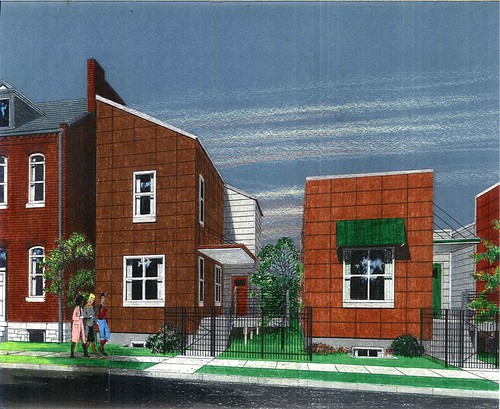
After nearly 120 years since the last documented flounder house was built in the city of St. Louis -- and so many have gone undocumented, so who knows when the last was built -- the flounder house is back! A new flounder house is under construction in Old North St. Louis on Hebert Street just west of 19th Street. Habitat for Humanity is building the house, continuing its commitment to both green construction and smart modern design. The rendering above shows what the house will look like when completed.
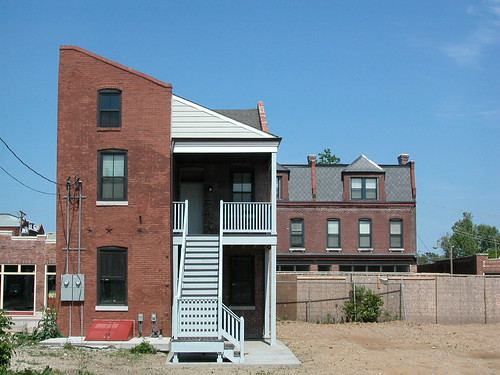
The house prominently displays the characteristic that makes a flounder house a unique building type: a roof that slopes from one side of the building to the other with no offset. Many flounders display this plain, simple slope, a roof form that has been traced back to southern European architecture of the Renaissance. Other flounders have a front hip with part of the roof sloping down toward the front. In the United States, the flounder form has been found mostly in the south. New Orleans, Savannah and Alexandria all have documented flounders. Philadelphia has flounders. St. Louis has as many as 160, but probably had many more at the end of the 19th century. All surviving local examples are brick, but there are frame flounders remaining in New Orleans. For a long time, architectural historians studied the flounder as a phenomenon but recent study has found traceable historic roots and has turned up more examples in a diverse range of cities. Still unknown is why flounders are found some places but not others, and why St. Louis has so many.
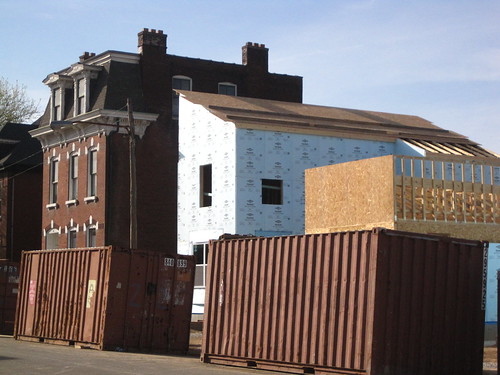 Here is what the flounder looked like under construction last week. The juxtaposition with the stately Second Empire home to the west is provocative. Cities need such diversity of forms.
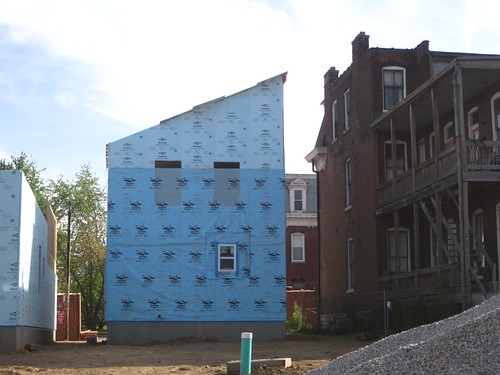 Here's the view of the back. The finish will be a concrete board, so this house will be one of the only frame flounder houses in the city when completed.
There are other flounder houses remaining in Old North. This selection leaves a few out, so go take a look around for yourself to see more.
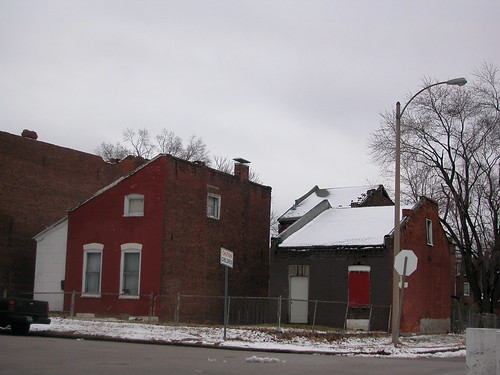 The one-and-a half-story flounder at 1422 Hebert Street is owned by Paul J. McKee's Northside Regeneration LLC, as is the small side-gabled home next door and a larger brick house at the alley behind 1422. The future of all three sadly remains uncertain.
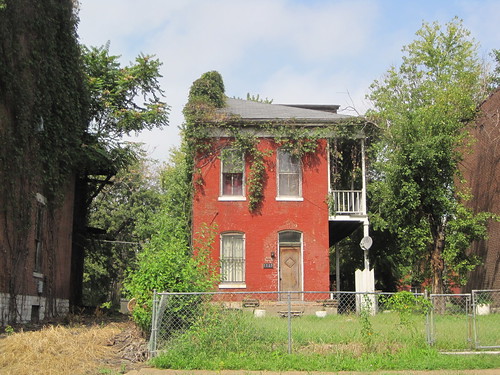 At 1115 Tyler is a flounder house with a front hip. The roof overhangs an intact two-story gallery porch on the east elevation. The house sits back from the street.
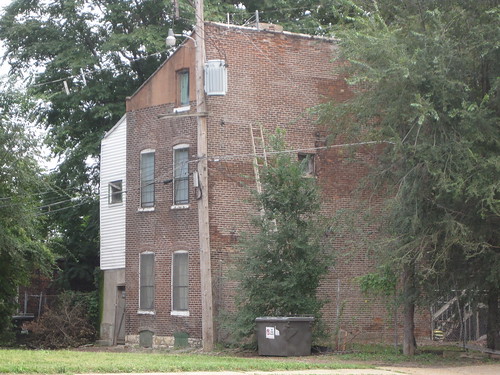 This tall flounder sits on the alley at 1455 Clinton Street. The brown-painted area at top is mortar parging (or covering) over the brick.
 The owner of the flounder house at 1905 Dodier applied for a demolition permit last year, but agreed to defer an appeal to the Preservation Board to work on a preservation solution.
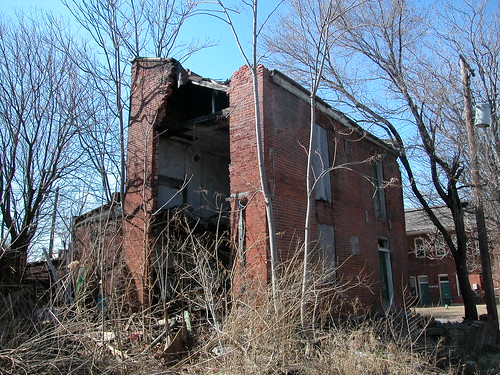 This flounder house at 1453 Monroe Street is not long for this world. The south elevation is largely missing and the north elevation has several large holes. The joists have started descending.
Monday, April 19, 2010
14th Street Mall: Almost History
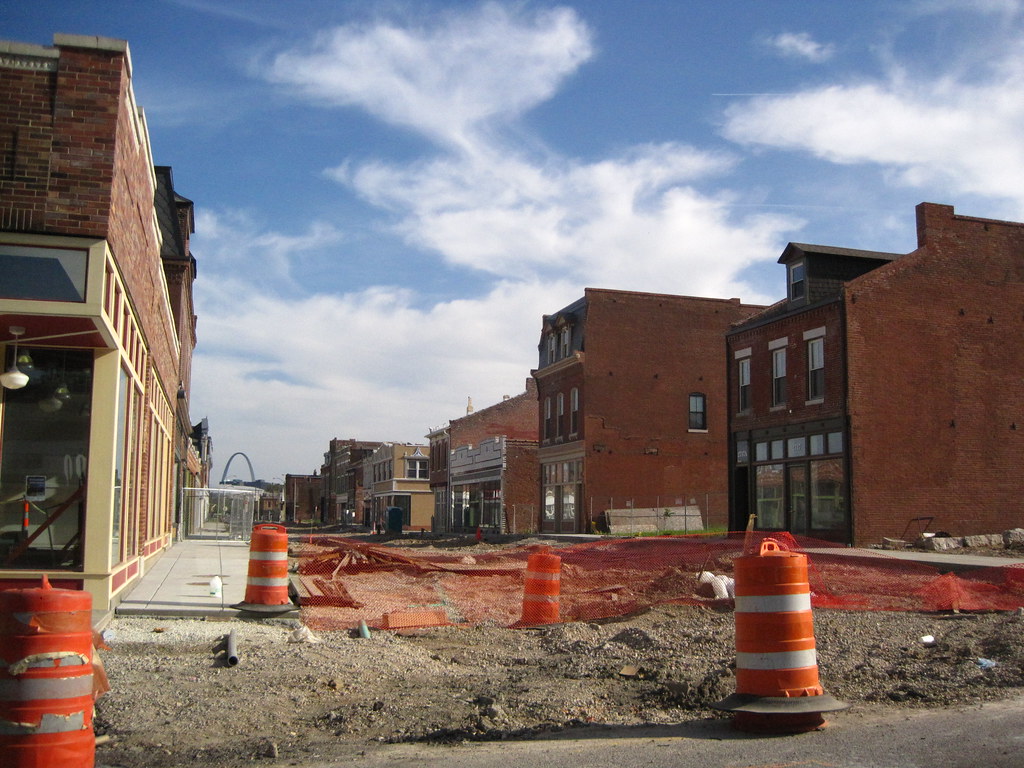 Here's the current view from St. Louis Avenue looking south down the two commercial blocks of 14th Street that once composed the "14th Street Mall." Sidewalks nearly done: check. Street under construction: check. Reopening of 14th Street by the fall: check and double check.
Friday, April 9, 2010
Mullanphy Emigrant Home, Four Years Later
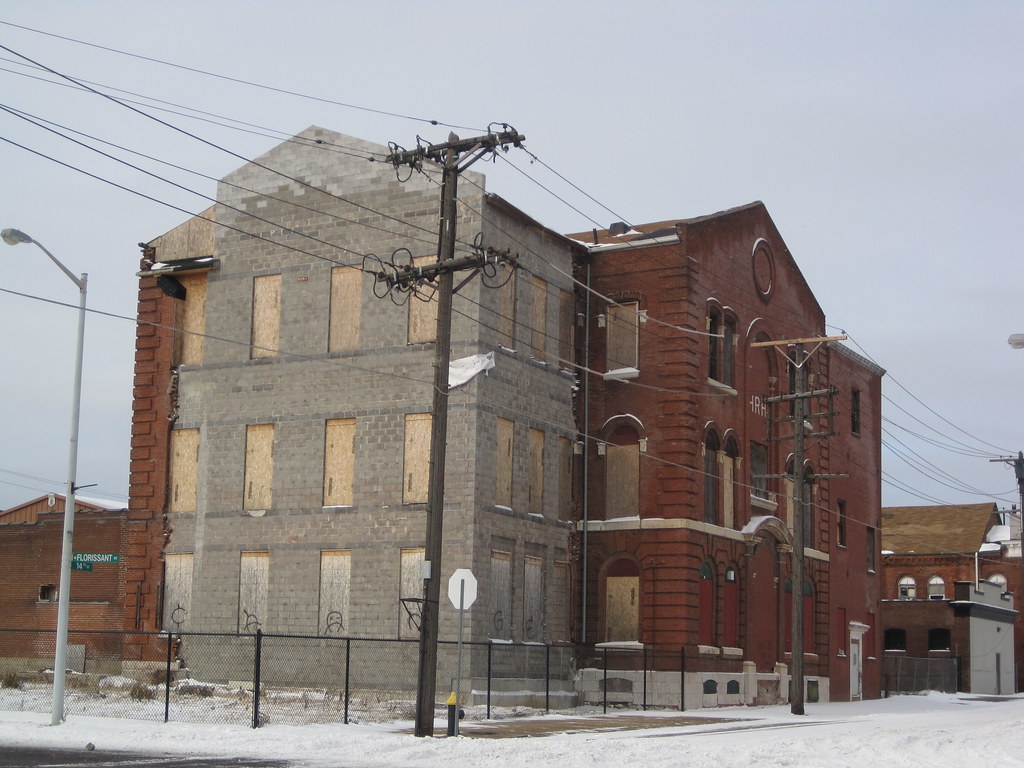 The fact that this city still has the Mullanphy Emigrant Home is testament to the amazing mobilization of dedicated Old North St. Louis residents, preservationists and civic leaders across the city. This week's victory for Proposition A in St. Louis County brought much jubilation to advocates for sustainable urban development, and its close coincidence with the anniversaries of the dates that the venerable north side landmark was struck by storms crossed my mind.
The tale of the Mullanphy Emigrant Home, located at 1609 N. 14th Street at the south end of Old North, is no less remarkable than the overwhelming passage of Proposition A. In the dark days after the storm wrecked the south wall in April 2006, many observers conceded its loss. The Building Division pushed for emergency demolition, the owner was not certain that he wanted to preserve it or even sell it and the neighborhood had so many other pressing needs that taking on a possible lost cause seemed unlikely. Yet residents of Old North rallied around the battered landmark, which defines the south entrance to the neighborhood and has great historic significance. While only used as a transitional home for westward-moving immigrants for ten years after its 1867 construction date, the Emigrant Home was pivotal in that period. Its Italianate masonry design, by celebrated architects George I. Barnett and Alfred Piquenard, is one of the city's finest surviving 19th century examples of the style.
Cultural Resources Office Director Kathleen Shea helped fend off demolition to buy time. Swift mobilization of the Old North St. Louis Restoration Group allowed for a building sale. Then the hard part: raising money for stabilization and repair. Of course, things would get worse before getting better when a storm inflicted more damage almost one year later in 2007. Still, the preservation effort proceeded against daunting odds and with the generosity of E.M. Harris Construction Company and the Masonry Contractors Association, not to mention countless individual donors. Now, the building is effectively mothballed awaiting reuse as a hostel planned by the Hostelling International Gateway Council.
Here's a look back at the building's plight.
 On March 31, 2007, the Mullanphy Emigrant Home suffered a second collapse due to heavy winds. The south wall already had a gaping hole, but then the east side and north wall were also partly collapsed. Bracing installed after the first damage held the building together although the open southern end created a wind tunnel effect that probably caused the blow-out damage.
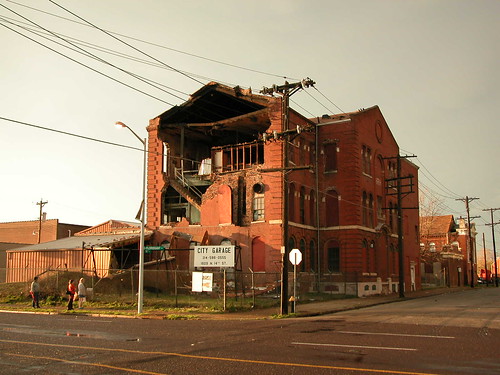 The building was already in rough shape following the south end collapse on April 2, 2006.
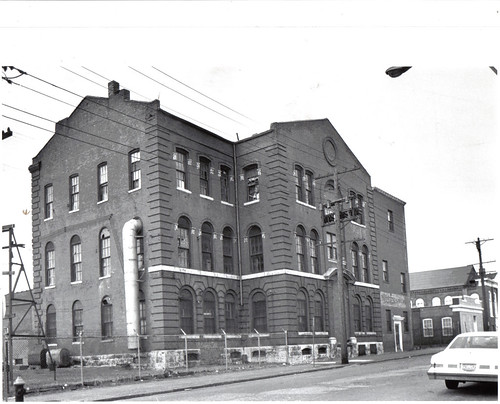 From 1900 through the 1980s, the Absorene Company occupied the building and used it to manufacture wallpaper adhesives, cleaners and removers. Absorene altered the building considerable, adding the bump-out stairwell in 1927, removing the cupola and main entrance, and changing the original profile of the front gable. The photograph above was taken by Landmarks Association of St. Louis in 1982 as part of the documentation for the Mullanphy Historic District, a National Register of Historic Places district.
 Artist Pat Baer's drawing presents the original appearance of the Mullanphy Emigrant Home. The outpouring of civic good will and hard work that saved the building -- twice, no less -- will hopefully restore this appearance some day.
Wednesday, March 31, 2010
Street and Sidewalk Work Started on 14th Street
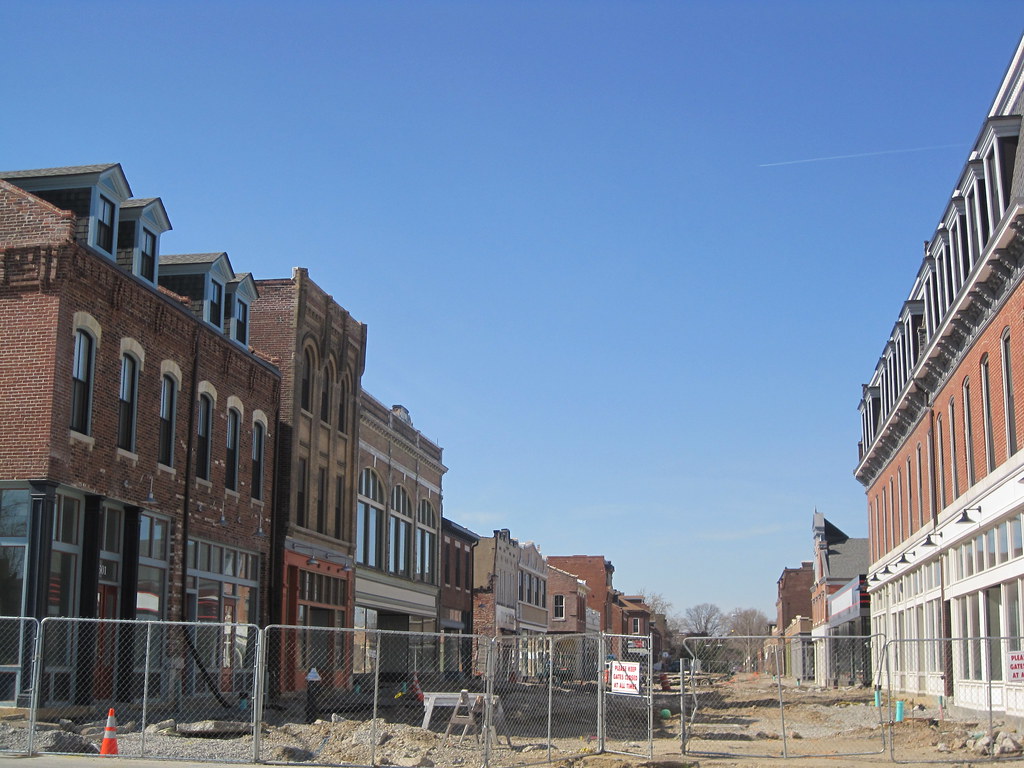
On Friday, after long-awaited approval from the Missouri Department of Transportation, street and sidewalk work began on the two blocks of 14th Street once known as the 14th Street Mall. Work should be completed by the fall. Building rehabilitation is nearly complete. Read more on What's New in Old North.
Wednesday, March 24, 2010
Architect Discusses Crown Square Project Tomorrow Night
 14th Street rehabilitation underway in May 2009.
What: Discussion on the Crown Square Redevelopment
When: Thursday, March 25 at 7:00 p.m.
Where: St. Louis Artists Guild, 2 Oak Knoll Park (directions/map)
The new Architecture Section of the St. Louis Artists' Guild hosts its next meeting tomorrow night.
The featured speaker is architect Rob Wagstaff of Rosemann Associates, who will speak about the challenges faced in the Crown Square project (better known as the 14th Street Mall).
Wednesday, February 3, 2010
Old North, Infill and Historic Reference
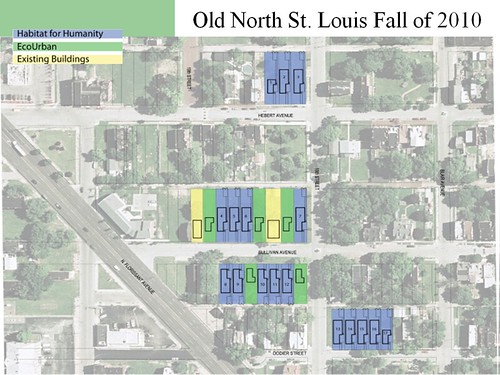
Last week, residents of the Old North St. Louis neighborhood got a look at a preliminary site plan and renderings for 17 new homes to be built by Habitat for Humanity and five homes to be built by EcoUrban homes. As the plan above shows, these houses will be built on Dodier, Sullivan and Hebert streets between Blair and Florissant Avenue. All will take the place of vacant lots owned by the city's Land Reutilization Authority in a part of Old North adjacent to the neighborhood's most dense northern section.
Amid deep recession, this is great news. Old North will get its first-ever major wave of new construction not developed with the Old North St. Louis Restoration Group as a partner. This private market activity is essential for the neighborhood, and the timing is hopeful that even more development will arrive when the economy recovers. Most important, the new development expands homeownership without compromising the economic diversity of Old North.
On top of the other positive aspects of the development, the design of the new Habitat homes is most certainly contemporary. (EcoUrban has yet to submit elevations.) The homes at left above are two-story, narrow, modified flounder houses. The others are basic modern flat-roofed, single-story homes. The houses share a design vocabulary, eschewing any historic reference or even material use. The lines are rectilinear and crisp. The cladding for all of the new houses will be concrete fiber board on the front sections in a jack-on-jack layout, with concrete weatherboard on the rear elevations. My one concern is that the deep recess of the entrances makes each home's connection with the sidewalk needlessly remote.
There is nothing about the designs that make them inappropriate to Old North. In fact, their juxtaposition with existing historic brick buildings will make for a pleasant realization of the neighborhood's aspirations of continued development. If Old North is to grow in the 21st century, it will grow with 21st century architecture. To date, save for the handful of Section 235 houses built there in the 1970s, neighborhood infill efforts there have relied on historical reference that has been pleasant if not progressive.
Historic reference is infill is not necessarily undesirable or inappropriate in Old North or other city neighborhoods. Perhaps the lack of solid materials and smart use of historic elements has soured referential infill to many critics and designers. There certainly are few examples of "faux" historic homes in the city worth their architectural salt. However, the anti-replica argument ignores the fact that the city's prized 19th century styles, such as Italianate or Second Empire, were in their heyday referencing European styles. Early 20th century styles like Georgian Revival or William B. Ittner's Jacobethan school style were attempts to renew and reinterpret older styles. Few today complain about the results.
Still, the Habitat and EcoUrban homes bring architectural sensibility that is of its own time. While many city neighborhoods have local historic district ordinances that forbid minimalist infill, Old North does not. The loss of historic fabric there makes any such design code unworkable. A neighborhood with more vacant lots than buildings cannot hold new construction to standards set by its buildings -- they will some day be outnumbered by new. The new buildings might as well be good work from their time, as the proposed buildings are. The remote possibility that someone might intelligently revive a historic style found within Old North, however, should not be foreclosed by current fashion.
Tuesday, December 22, 2009
Year Ends for the Better in Two North St. Louis Commercial Districts
St. Louis Public Radio aired my latest commentary this morning. Listen to it here. The extended script follows.
This year ends with positive changes for two of north St. Louis' most distressed neighborhood commercial districts – the 14th Street district in Old North St. Louis and a section of Martin Luther King Drive in the Wellston Loop area.
In Old North, the $35 million Crown Square redevelopment project has transformed two blocks that once were the commercial center of the neighborhood. In 1977, using federal funds, the city of St. Louis closed the street to create a pedestrian mall. Eventually that mall killed the foot and vehicle traffic necessary to sustain the businesses.
Thankfully and improbably, most of the buildings fronting 14th Street on the two blocks between St. Louis and Warren streets survived abandonment. Now, these buildings have been beautifully rehabilitated into residential and commercial spaces. 14th Street is set to reopen to traffic early next year. Old North will regain a vital center.
The good news in the Martin Luther King Drive in the Wellston Loop area comes from an earlier chapter in the renewal story than the news from Old North. In November, a state review council approved a National Register of Historic Places nomination for 65 buildings on or around the north side thoroughfare from Clara Avenue west to the city limits.
The designation honors the cultural and architectural significance of what was in the late 1940s the city’s busiest shopping district. However, the designation also makes available rehabilitation tax credits long sought by building owners in the area. Such credits were crucial in rebuilding Crown Square.
Commercial districts are barometers of neighborhood health. Once they die, a neighborhood may be gone forever. By all indications, Old North and the Wellston Loop have a lot of life left in them.
This year ends with positive changes for two of north St. Louis' most distressed neighborhood commercial districts – the 14th Street district in Old North St. Louis and a section of Martin Luther King Drive in the Wellston Loop area.
In Old North, the $35 million Crown Square redevelopment project has transformed two blocks that once were the commercial center of the neighborhood. In 1977, using federal funds, the city of St. Louis closed the street to create a pedestrian mall. Eventually that mall killed the foot and vehicle traffic necessary to sustain the businesses.
Thankfully and improbably, most of the buildings fronting 14th Street on the two blocks between St. Louis and Warren streets survived abandonment. Now, these buildings have been beautifully rehabilitated into residential and commercial spaces. 14th Street is set to reopen to traffic early next year. Old North will regain a vital center.
The good news in the Martin Luther King Drive in the Wellston Loop area comes from an earlier chapter in the renewal story than the news from Old North. In November, a state review council approved a National Register of Historic Places nomination for 65 buildings on or around the north side thoroughfare from Clara Avenue west to the city limits.
The designation honors the cultural and architectural significance of what was in the late 1940s the city’s busiest shopping district. However, the designation also makes available rehabilitation tax credits long sought by building owners in the area. Such credits were crucial in rebuilding Crown Square.
Commercial districts are barometers of neighborhood health. Once they die, a neighborhood may be gone forever. By all indications, Old North and the Wellston Loop have a lot of life left in them.
Saturday, December 12, 2009
Second Anti-Wrecking Ball: Success
Toby Weiss has already posted an excellent recap of last night's Anti-Wrecking Ball, but here's another. In short, we raised more money than we thought that we could, had more people attend than we expected and had a lot more dancing than usually seen at preservation fundraisers!
Video by Toby Weiss.
Dozens of people came to Old North St. Louis to support the cause of citizen preservation action and to enjoy a party inside of the spacious, lovely new Old North St. Louis Community Gallery. The venue was perfect, and not simply spatially. While the event's focus was raising money for the Friends of the San Luis' appeal of a circuit court ruling against citizen standing in preservation battles, it was also a celebration of all that we can do together. The gallery is smack dab in the middle of the revitalized 14th Street commercial district, until recently a horrid pedestrian mall. The rebirth of the mall and Old North have come through the dedication of scores of people working against tough odds. Citizens, acting on the belief that we can make our neighborhoods better places and save our irreplaceable landmarks.
The attendance was a great example of the wide support for preservation. There were north side residents, young urbanists, veteran preservationists, architects, artists, anti-eminent domain activists, and even a Preservation Board member. Up the street at the Urban Studio Cafe there was an art opening, and crowds migrated back and forth throughout the evening.
DJ Darren Snow kept a wonderful flow of music going. Emily Beck created a powerful slide show that weaved together the past year of Friends of the San Luis events, architectural images and photographs of people across the city celebrating the historic architecture of our neighborhoods. The Chase Park Plaza Cinemas, STL Style and Toby and I provided raffle items. Volunteers too numerous to mention pitched in, and the party went well past the advertised midnight close. Bravo!
Video by Toby Weiss.
Dozens of people came to Old North St. Louis to support the cause of citizen preservation action and to enjoy a party inside of the spacious, lovely new Old North St. Louis Community Gallery. The venue was perfect, and not simply spatially. While the event's focus was raising money for the Friends of the San Luis' appeal of a circuit court ruling against citizen standing in preservation battles, it was also a celebration of all that we can do together. The gallery is smack dab in the middle of the revitalized 14th Street commercial district, until recently a horrid pedestrian mall. The rebirth of the mall and Old North have come through the dedication of scores of people working against tough odds. Citizens, acting on the belief that we can make our neighborhoods better places and save our irreplaceable landmarks.
The attendance was a great example of the wide support for preservation. There were north side residents, young urbanists, veteran preservationists, architects, artists, anti-eminent domain activists, and even a Preservation Board member. Up the street at the Urban Studio Cafe there was an art opening, and crowds migrated back and forth throughout the evening.
DJ Darren Snow kept a wonderful flow of music going. Emily Beck created a powerful slide show that weaved together the past year of Friends of the San Luis events, architectural images and photographs of people across the city celebrating the historic architecture of our neighborhoods. The Chase Park Plaza Cinemas, STL Style and Toby and I provided raffle items. Volunteers too numerous to mention pitched in, and the party went well past the advertised midnight close. Bravo!
Monday, November 23, 2009
Today's Preservation Board Meeting: Old North and Hyde Park Buildings, But No Southwest Avenue
UPDATE 12:09 p.m.: The Old North item has been pulled from the agenda.
The final agenda of today's Preservation Board meeting is online.
The two buildings on Southwest Avenue that this blog covered on November 14 are no longer on the agenda.
However, one of the several city-proposed demolitions in Old North St. Louis remains on the agenda on preliminary review: demolition of the building at 1942-44 Hebert Street. Typically, requests from the Building Division to demolish city-owned buildings appear on the preliminary agendas of the Preservation Board but get denied by the staff of the Cultural Resources Office prior to Board meetings.
On this building, the staff is seeking direction from the Preservation Board rather than making a recommendation. The direction needs to be denial. Last month, a contributing building in the Murphy-Blair Historic District collapsed. Others are vulnerable. In light of the ongoing near north building depletion and possible wave of demolitions for the NorthSide project, preservation in Old North has become very important. The condition of 1942-44 Hebert Street is rough, but certainly not fatal. Perhaps the city can apply the $25,000 paid by the Haven of Grace to demolish building at 2619-21 Hadley Street in Old North toward the stabilization of this fine building on Hebert.
Another item on today's agenda is the appeal of CRO denial of a demolition permit for the building at 3959 N. 11th Street in Hyde Park. The Preservation Board heard this item in October, and upheld denial. Not sure why the item is back.
As usual, the meeting begins today at 4:00 p.m. on the 12th floor of the building at 105 Locust Street. Citizens may send comments to Preservation Board Secretary Adona Buford at BufordA@stlouiscity.com. Note that in a preliminary review, the Board is not required to review e-mailed comments before making a decision.
The final agenda of today's Preservation Board meeting is online.
The two buildings on Southwest Avenue that this blog covered on November 14 are no longer on the agenda.
However, one of the several city-proposed demolitions in Old North St. Louis remains on the agenda on preliminary review: demolition of the building at 1942-44 Hebert Street. Typically, requests from the Building Division to demolish city-owned buildings appear on the preliminary agendas of the Preservation Board but get denied by the staff of the Cultural Resources Office prior to Board meetings.
On this building, the staff is seeking direction from the Preservation Board rather than making a recommendation. The direction needs to be denial. Last month, a contributing building in the Murphy-Blair Historic District collapsed. Others are vulnerable. In light of the ongoing near north building depletion and possible wave of demolitions for the NorthSide project, preservation in Old North has become very important. The condition of 1942-44 Hebert Street is rough, but certainly not fatal. Perhaps the city can apply the $25,000 paid by the Haven of Grace to demolish building at 2619-21 Hadley Street in Old North toward the stabilization of this fine building on Hebert.
Another item on today's agenda is the appeal of CRO denial of a demolition permit for the building at 3959 N. 11th Street in Hyde Park. The Preservation Board heard this item in October, and upheld denial. Not sure why the item is back.
As usual, the meeting begins today at 4:00 p.m. on the 12th floor of the building at 105 Locust Street. Citizens may send comments to Preservation Board Secretary Adona Buford at BufordA@stlouiscity.com. Note that in a preliminary review, the Board is not required to review e-mailed comments before making a decision.
Thursday, November 19, 2009
Reconnection in Old North, and a Suggestion for McEagle
 Days that came, years again
Came in here once again
-- John Cale, "Big White Cloud"
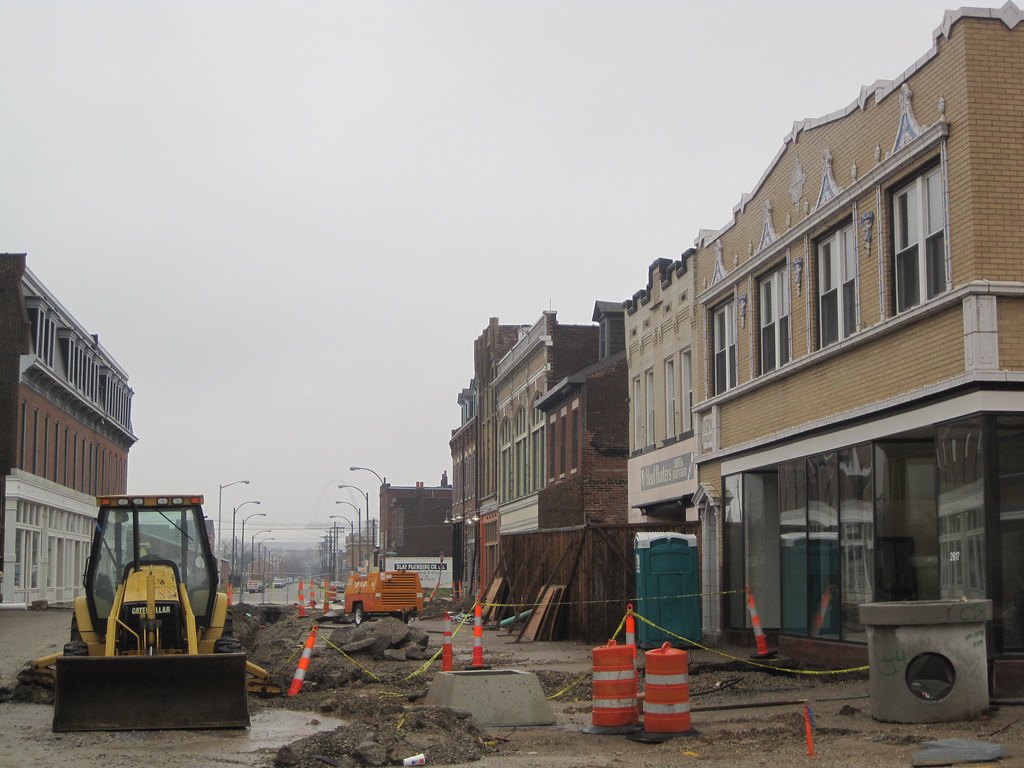
One of the highlights of this gloomy week has been a look at one of the north side's biggest development stories: the removal of the failed pedestrian mall on 14th Street in Old North. As part of the $35 million Crown Square project, the city has removed the street closures and is working on reconstructing both the two closed blocks of 14th Street between St. Louis Avenue and Warren Street and the two closed blocks of Montgomery Street between Blair Avenue and 13th Street. While work on the 27 historic buildings being rehabilitated has been underway since September 2007 and is nearing completion, delays forced the actual street work to this fall. The streets should be reopened in the spring.
Already the removal of the mall's pavement, trees and light posts has opened views around the now-rehabilitated historic buildings. The sense of connection to the surrounding neighborhood slowly lost after the pedestrian mall opened in 1977 has returned. All that awaits are actual sidewalks, street lights and the centerpiece street.

People are already there. Headhunters Salon has remained open on the mall during construction, and Peter Sparks has been working on his building at the northwest corner of Montgomery and 14th. Sparks envisions a gallery and art studios. More recently, residents have moved into many of the units in the buildings on 14th Street. For now, they enter through rear entrances. In the future, the residents will be able to walk up and down 14th Street.
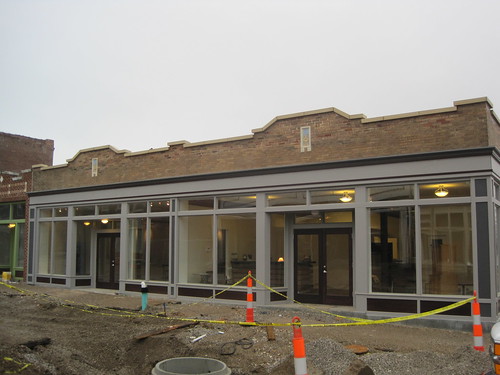 One of the first storefront spaces to be occupied is the new office of the Old North St. Louis Restoration Group at 2700 N. 14th Street. Built in 1925, the one-story commercial building had been robbed of its shaped parapet and clad in enamel panels in 1955. Through design by Rosemann Associates and historic research by Matt Bivens of the Regional Housing and Community Development Alliance (RHCDA), the building has been returned to historic appearance. Inside is both the office of the Restoration group and a large community exhibit and meeting space, shown below.
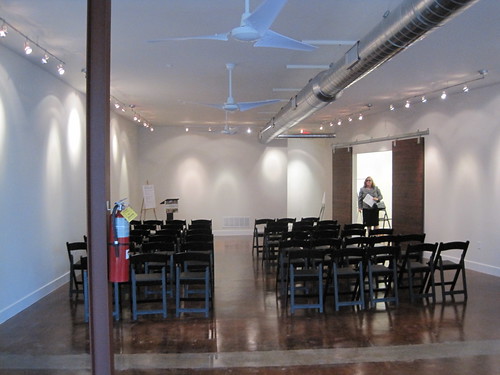 The office features sliding doors made of slavaged floor boards and a reception desk made of timbers that once were part of the floor system in the building.
 The view from that desk shows the fruits of the organization's hard work. The Restoration Group is a development partner with RHCDA in Crown Square. The community development corporation spent over a decade trying to spur redevelopment of the pedestrian mall area. Now that the redevelopment is almost done, the organization appropriately has moved into a new space in the heart of the project and at the center of the neighborhood. Once the street reopens, the office will be easy to find. Large windows provide a visual connection to neighborhood.
Another north side development story this week involved the formal announcement of a redevelopment agreement for the Northside Regeneration project. That project's developer, McEagle Properties, has a long way to go before it completes its first $35 million is actual redevelopment. Meanwhile, McEagle needs the support and good will of the north side residents and businesspeople its project aims to serve. Why not open a field office like the new Old North St. Louis Restoration Group office? McEagle's physical presence has been limited to vacant buildings, orange construction fencing and hired lawn mowing crews. That's quite a contrast to a pleasant office and community space with big storefront windows, a friendly staff and a welcome mat. Presence in the community doesn't happen at press conferences, on Twitter or through fancy websites -- it happens on the street, where eveyone can find it.
Wednesday, November 11, 2009
Near North Neighborhoods Standing Strong
My latest commentary for St. Louis Public Radio of the same title aired today; read and listen to it here.
Wednesday, September 30, 2009
McEagle Picks Up Seventeen Parcels Including Six Historic Buildings
On September 25, the St. Louis Recorder of Deeds recorded the purchase of 17 parcels at Sheriff's land tax auction by McEagle Properties shell holding company Union Martin LLC. McEagle's companies had been dormant for several months.
Among the purchase are seven residential buildings, of which six are historic. Here they are, with purchase price in parentheses if reported:
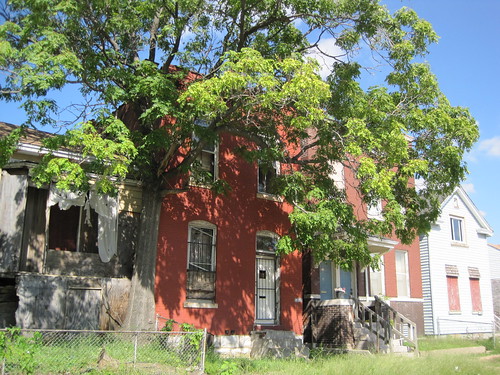 2823 University Street, brick house at left
 2625 Palm Street in St. Louis Place
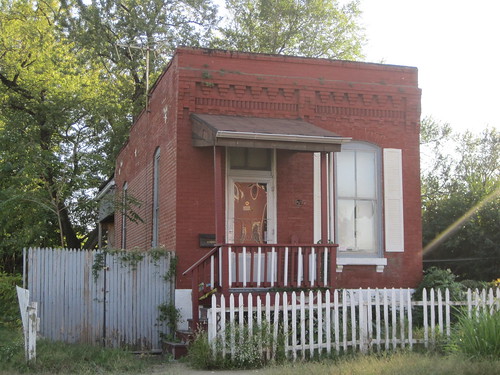 2212 Howard Street in St. Louis Place ($1,103.00)
 2718 Stoddard Avenue in JeffVanderLou ($1,666.00)
 2834 Thomas Street in JeffVanderLou, shown at right
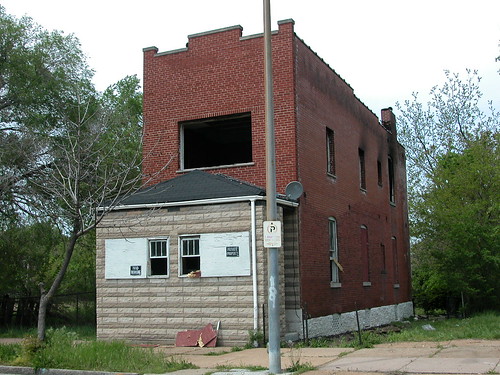 2571 Hebert Street ($1,561.00)
Why do I mention the purchase prices? I want to impress upon readers how easy it would be for other buyers to compete at the Sheriff's auctions for these properties. Community development corporations, neighborhood associations and other that want to keep out large-scale acquisition would do well to get some money together and head to the Sheriff's auction. Every month, dozens of north side parcels -- and historic buildings -- sell to speculators for low, low prices.
These acquisitions illustrate the thorniness of preservation planning in the NorthSide project. A week ago, preservationists thought they knew the pool from which the list of buildings to be rehabilitated would be drawn. In one day, that pool expanded. However, these buildings are in good shape and will be around for awhile. McEagle need not fear that preservationists have immediate demands beyond simply keeping these buildings from falling until there is a solid plan.
The remaining parcels recently purchased by Union Martin are located at 2516, 2518-20 and 2526 Slattery Avenue, 2930 James Cool Papa Bell (nee Dickson) Avenue, 2524 Coleman Street and 2832 Cass Avenue in JeffVanderLou; 3244 Knapp Street in Old North St. Louis; 2561 Hebert Street, 2231 and 2236 Benton Street and 1947-51 Wright Street in St. Louis Place.
Among the purchase are seven residential buildings, of which six are historic. Here they are, with purchase price in parentheses if reported:
2823 University Street, brick house at left2625 Palm Street in St. Louis Place2212 Howard Street in St. Louis Place ($1,103.00)2718 Stoddard Avenue in JeffVanderLou ($1,666.00)2834 Thomas Street in JeffVanderLou, shown at right2571 Hebert Street ($1,561.00)Why do I mention the purchase prices? I want to impress upon readers how easy it would be for other buyers to compete at the Sheriff's auctions for these properties. Community development corporations, neighborhood associations and other that want to keep out large-scale acquisition would do well to get some money together and head to the Sheriff's auction. Every month, dozens of north side parcels -- and historic buildings -- sell to speculators for low, low prices.
These acquisitions illustrate the thorniness of preservation planning in the NorthSide project. A week ago, preservationists thought they knew the pool from which the list of buildings to be rehabilitated would be drawn. In one day, that pool expanded. However, these buildings are in good shape and will be around for awhile. McEagle need not fear that preservationists have immediate demands beyond simply keeping these buildings from falling until there is a solid plan.
The remaining parcels recently purchased by Union Martin are located at 2516, 2518-20 and 2526 Slattery Avenue, 2930 James Cool Papa Bell (nee Dickson) Avenue, 2524 Coleman Street and 2832 Cass Avenue in JeffVanderLou; 3244 Knapp Street in Old North St. Louis; 2561 Hebert Street, 2231 and 2236 Benton Street and 1947-51 Wright Street in St. Louis Place.
Monday, September 28, 2009
Old North Still Part of NorthSide Project Until Holdings Are Sold
Despite removing over half of the Old North St. Louis neighborhood from the NorthSide project boundary, McEagle Properties retains a strong presence in the neighborhood. In a future article, I will write about McEagle's plans for the portion of the neighborhood that is included in the project. For now, here is a catalog of the 27 historic buildings owned by McEagle's holding companies in that part of Old North for which the developer has no plans.
McEagle and elected officials repeat the line that "Old North is no longer a part of the project." That's not true. Over one-third of the neighborhood remains within the project boundary and the developer has yet to commit to a definite plan to either developing or selling properties that it owns in Old North. Maintenance is abysmal, and many buildings in need of structural repairs.
All of the twenty-seven buildings shown here are contributing resources to the Murphy-Blair Historic District, the National Register of Historic Places listing for most of Old North. All qualify for use of the historic rehabilitation tax credits at the state and federal level. Some are adjacent to rehabilitation projects ranging from owner-occupant work to the $35 million Crown Square redevelopment project.
The efforts of good people in Old North will rise the property values of McEagle's holdings. However, long-term speculation is not fair to Old North. If old North is "out," then McEagle needs to sell. The NorthSide redevelopment agreement must include binding language to compel McEagle to sell its holdings in Old North outside of the project boundary.
Publicly and privately, Paul J. McKee, Jr. complains about his reception in Old North (exemplified by the feisty meeting there last Monday). There is good reason for that reception, as the condition of these buildings and McEagle's vague plans for the future show. Old North is hardly different from any neighborhood in resenting the presence and impact of a large-scale nuisance owner. I'm sure that WingHaven residents would be up in arms if a speculator started buying up residential foreclosures and left the houses vacant and untended for five years.
Last November, I offered free advice to McKee: "In preservation-minded Old North, there is a clear way to gain respect and built support: save buildings." Not interested? Then it's time to sell.
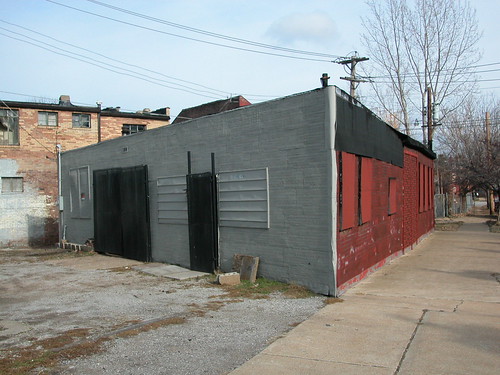 2900 N. 14th Street
Owner: Dodier Investors LLC
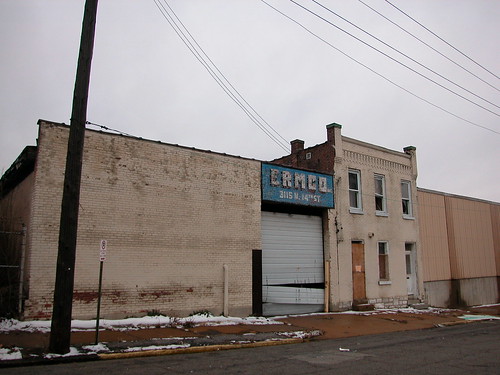 3115 N. 14th Street
Owner: Blairmont Associates LC
 3236 and 3238 N. 20th Street
Owner: Sheridan Place LC
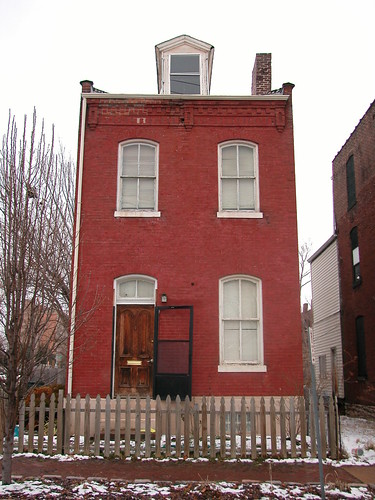 3237 N. 20th Street
Owner: Sheridan Place LC
Had been largely rehabbed by owner who sold to McEagle.
 1415 Benton Street
Owner: Dodier Investors LLC
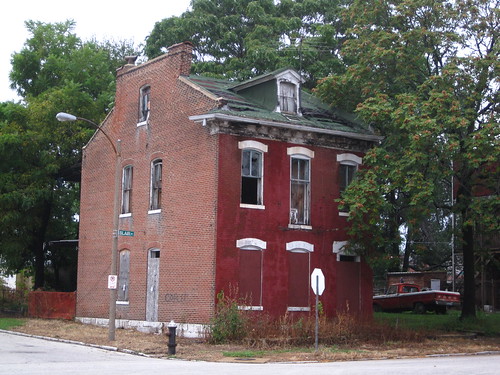 2701 Blair Avenue
Owner: Dodier Investors LLC
Located at the intersection of Blair and Montgomery -- Blairmont!
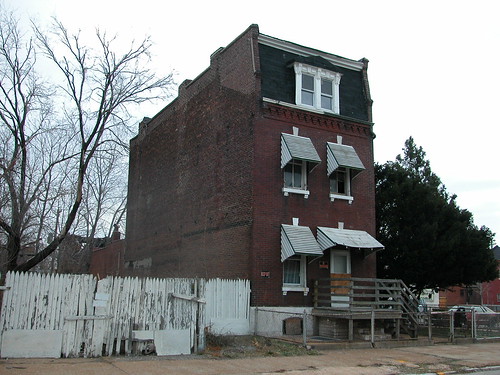 2710 Blair Avenue
Owner: VHS Partners LLC
Located adjacent to Crown square redevelopment. Photo shows a fence now removed and replaced by tenant parking for a rehabilitated building.
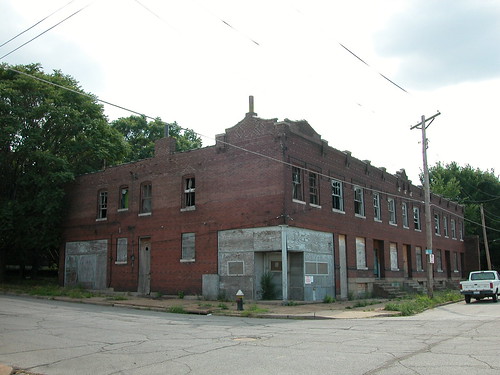 1500 Branch Street
Owner: Blairmont Associates LC
The entire two-part commercial row is included.
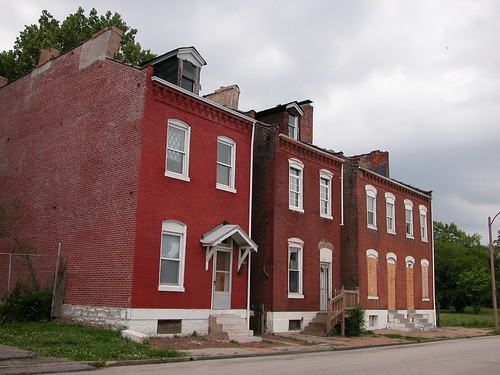 1449 Clinton Street
Owner: Noble Development Company LLC
Shown at right above.
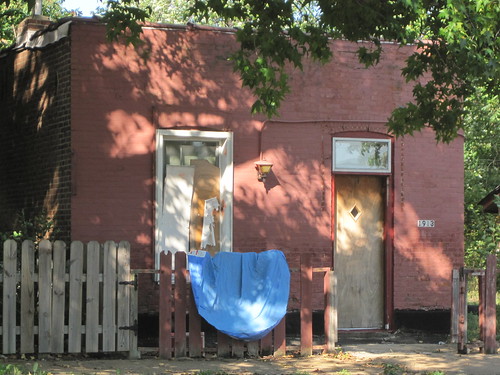 1913 Dodier Street
Owner: MLK 3000 LLC
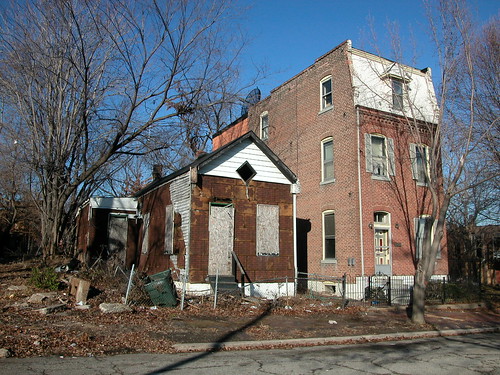 3211 Blair Street
Owner: Blairmont Associates LC
At left next door to owner-occupied home.
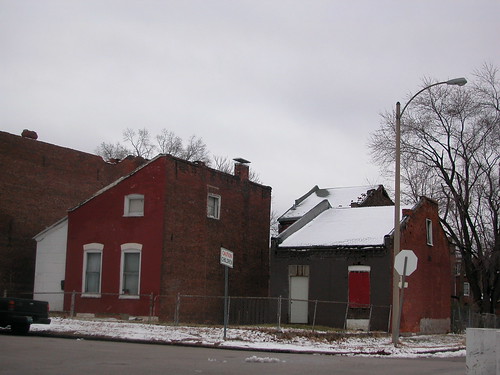 1420 and 1424 Hebert Street
Owner: Dodier Investors LLC
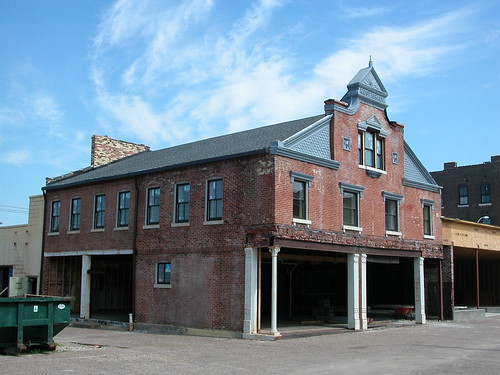
Two cool small houses. The house at 1422 Hebert (left) is a flounder house.
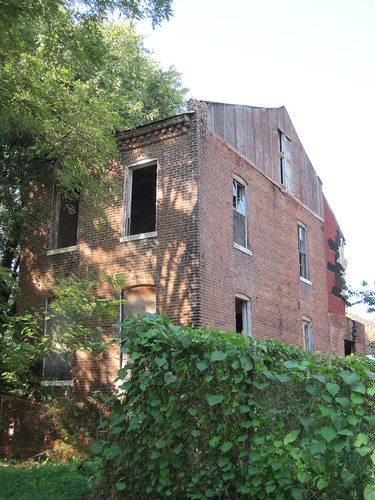 1420 Hebert Street, Rear
Owner: Dodier Investors LLC
Two-and-a-half story alley house next door to fully-rehabilitated alley house.
 3240 and 3242 Knapp Street
Owner: Dodier Investors LLC
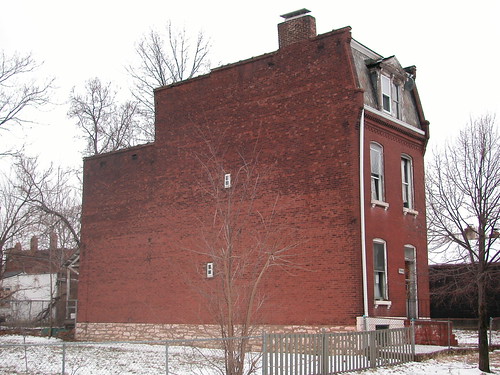 3248 Knapp Street
Owner: N & G Ventures LC
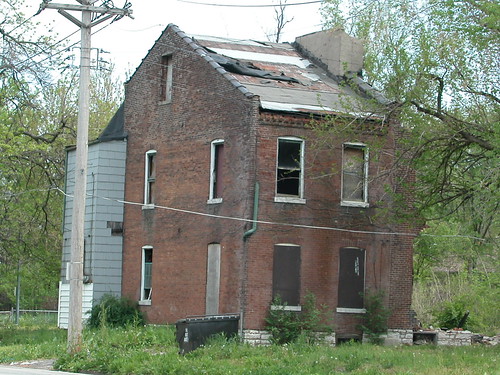 3261 Knapp Street
Owner: Dodier Investors LLC
Alley house. Adjacent neighbor demolished.
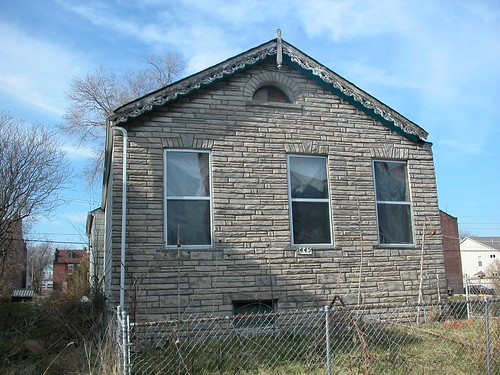 1445 Monroe Street
Owner: Noble Development Company LC
Permastone covers brick. Great vergeboard!
 1119 Montgomery Street
Owner: Union Martin LC
Just the left side of the first building in the row of houses. Purchased by agent Harvey Noble at a tax sale in 2008 apparently "by mistake."
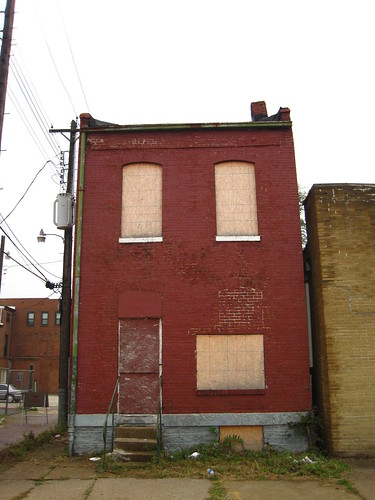 1416 Montgomery Street
Owner: Noble Development Company LLC
Located between occupied business and the Crown Square redevelopment project, in which it could have been included.
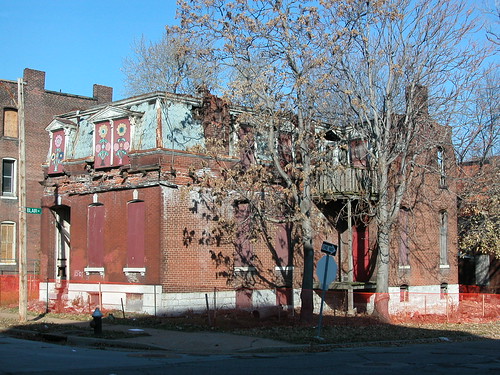 1501 Palm Street
Owner: Blairmont Associates LC
More coverage here and here.
 1523 Palm Street
Owner: Blairmont Associates LC
Just the left side of the left building is owned by McEagle. Building at right being fully rehabilitated.
 1311 St. Louis Avenue
Owner: Blairmont Associates LC
Photograph taken before McEagle purchase; second floor now boarded most of the time. Directly across the street from the Crown Square redevelopment.
 1437 Warren Street
Owner: Dodier Investors LLC
Building adjacent to a church.
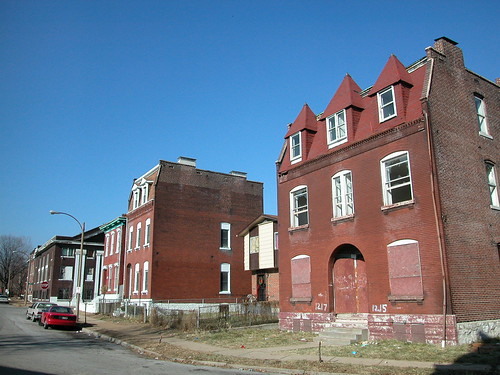 1215 Wright Street
Owner: Blairmont Associates LC.
At right. Shown here before McEagle boarded the second floor windows.
McEagle and elected officials repeat the line that "Old North is no longer a part of the project." That's not true. Over one-third of the neighborhood remains within the project boundary and the developer has yet to commit to a definite plan to either developing or selling properties that it owns in Old North. Maintenance is abysmal, and many buildings in need of structural repairs.
All of the twenty-seven buildings shown here are contributing resources to the Murphy-Blair Historic District, the National Register of Historic Places listing for most of Old North. All qualify for use of the historic rehabilitation tax credits at the state and federal level. Some are adjacent to rehabilitation projects ranging from owner-occupant work to the $35 million Crown Square redevelopment project.
The efforts of good people in Old North will rise the property values of McEagle's holdings. However, long-term speculation is not fair to Old North. If old North is "out," then McEagle needs to sell. The NorthSide redevelopment agreement must include binding language to compel McEagle to sell its holdings in Old North outside of the project boundary.
Publicly and privately, Paul J. McKee, Jr. complains about his reception in Old North (exemplified by the feisty meeting there last Monday). There is good reason for that reception, as the condition of these buildings and McEagle's vague plans for the future show. Old North is hardly different from any neighborhood in resenting the presence and impact of a large-scale nuisance owner. I'm sure that WingHaven residents would be up in arms if a speculator started buying up residential foreclosures and left the houses vacant and untended for five years.
Last November, I offered free advice to McKee: "In preservation-minded Old North, there is a clear way to gain respect and built support: save buildings." Not interested? Then it's time to sell.
2900 N. 14th StreetOwner: Dodier Investors LLC
3115 N. 14th StreetOwner: Blairmont Associates LC
3236 and 3238 N. 20th StreetOwner: Sheridan Place LC
3237 N. 20th StreetOwner: Sheridan Place LC
Had been largely rehabbed by owner who sold to McEagle.
1415 Benton StreetOwner: Dodier Investors LLC
2701 Blair AvenueOwner: Dodier Investors LLC
Located at the intersection of Blair and Montgomery -- Blairmont!
2710 Blair AvenueOwner: VHS Partners LLC
Located adjacent to Crown square redevelopment. Photo shows a fence now removed and replaced by tenant parking for a rehabilitated building.
1500 Branch StreetOwner: Blairmont Associates LC
The entire two-part commercial row is included.
1449 Clinton StreetOwner: Noble Development Company LLC
Shown at right above.
1913 Dodier StreetOwner: MLK 3000 LLC
3211 Blair StreetOwner: Blairmont Associates LC
At left next door to owner-occupied home.
1420 and 1424 Hebert StreetOwner: Dodier Investors LLC
Two cool small houses. The house at 1422 Hebert (left) is a flounder house.
1420 Hebert Street, RearOwner: Dodier Investors LLC
Two-and-a-half story alley house next door to fully-rehabilitated alley house.
3240 and 3242 Knapp StreetOwner: Dodier Investors LLC
3248 Knapp StreetOwner: N & G Ventures LC
3261 Knapp StreetOwner: Dodier Investors LLC
Alley house. Adjacent neighbor demolished.
1445 Monroe StreetOwner: Noble Development Company LC
Permastone covers brick. Great vergeboard!
1119 Montgomery StreetOwner: Union Martin LC
Just the left side of the first building in the row of houses. Purchased by agent Harvey Noble at a tax sale in 2008 apparently "by mistake."
1416 Montgomery StreetOwner: Noble Development Company LLC
Located between occupied business and the Crown Square redevelopment project, in which it could have been included.
1501 Palm StreetOwner: Blairmont Associates LC
More coverage here and here.
1523 Palm StreetOwner: Blairmont Associates LC
Just the left side of the left building is owned by McEagle. Building at right being fully rehabilitated.
1311 St. Louis AvenueOwner: Blairmont Associates LC
Photograph taken before McEagle purchase; second floor now boarded most of the time. Directly across the street from the Crown Square redevelopment.
1437 Warren StreetOwner: Dodier Investors LLC
Building adjacent to a church.
1215 Wright StreetOwner: Blairmont Associates LC.
At right. Shown here before McEagle boarded the second floor windows.
Subscribe to:
Posts (Atom)


 Posts
Posts

