
This week, Missouri Preservation announced its 2010 Most Endangered Properties list. St. Louis area listings are the Route 66 Bridge over the Meramec River as well as the adjacent Fairfax House and Rock Hill Presbyterian Church in Rock Hill.
Rock Hill Presbyterian Church is in urgent need of a preservation plan. From Missouri Preservation's announcement:
After being moved several times because of increasing commercial and residential development, the Fairfax House has ended up on another former Marshall property. In February 2010, it was discovered that the Giddings-Lovejoy Presbytery was seeking to sell the Rock Hill Presbyterian Church, presenting a threat to the historic church building and an additional threat to Fairfax House. This property is now situated at the intersection of two busy St. Louis county roads. It is a target for commercial development as the City of Rock Hill, which does its own zoning and has no current historic preservation ordinance, has zoned this property “commercial.”
Showing posts with label missouri. Show all posts
Showing posts with label missouri. Show all posts
Wednesday, May 19, 2010


Thursday, May 13, 2010
Tax Credit Battle Almost Over -- For Now
The Missouri General Assembly's session ends on Friday. So far, no proposals to change tax credit programs have been taken up this week in the Senate or House. There may be a last-minute push in the Senate to pass a bill that would include the following changes:
Capping historic tax credits at $75 million per year but retaining the exemption for projects with under $1.1 million in qualified rehabilitation expenditures (the "small deal" exemption);
Create legislative appropriation of funding in future years.
Observers do not expect this measure to make it out of the Senate. If it does, the House Republican leadership has pledged to kill it.
There is no doubt, however, that the reprieve is momentary. Next session Governor Jay Nixon and his allies will get an earlier start on pushing reform, in the sense that they started next session's fight in this session.
Capping historic tax credits at $75 million per year but retaining the exemption for projects with under $1.1 million in qualified rehabilitation expenditures (the "small deal" exemption);
Create legislative appropriation of funding in future years.
Observers do not expect this measure to make it out of the Senate. If it does, the House Republican leadership has pledged to kill it.
There is no doubt, however, that the reprieve is momentary. Next session Governor Jay Nixon and his allies will get an earlier start on pushing reform, in the sense that they started next session's fight in this session.
Wednesday, May 5, 2010
House-Turned-Bank in Daisy, Missouri to be Auctioned on Memorial Day
The so-called Daisy Bank House in Daisy, Missouri (located not far south of Perryville) will be auctioned on Memorial Day. From the website advertising the site:
This historic structure in the tiny town of Daisy, Missouri was built in 1918 as the new home of the Farmers' Bank of Daisy (1913-1924). After the bank closed, the building was vacant until 1939 when Delos Sebaugh purchased it and converted it into Sebaugh's Store selling groceries and other supplies. In 1947 an addition was built on the north side of the building. The original portion of the building was remodeled (modified to allow second floor and dormers added) and converted into a living space for the Sebaugh family. The store closed in 1956, but the commercial space remained open as home of the Delos Sebaugh Insurance Agency for Citizens Mutual Insurance through the late 1970s. Since then the building has functioned as home to the Sebaugh family.
Check out the website for more information and photographs.
This historic structure in the tiny town of Daisy, Missouri was built in 1918 as the new home of the Farmers' Bank of Daisy (1913-1924). After the bank closed, the building was vacant until 1939 when Delos Sebaugh purchased it and converted it into Sebaugh's Store selling groceries and other supplies. In 1947 an addition was built on the north side of the building. The original portion of the building was remodeled (modified to allow second floor and dormers added) and converted into a living space for the Sebaugh family. The store closed in 1956, but the commercial space remained open as home of the Delos Sebaugh Insurance Agency for Citizens Mutual Insurance through the late 1970s. Since then the building has functioned as home to the Sebaugh family.
Check out the website for more information and photographs.
House Committee Does Not Take Up Tax Credit Bill; Action in the Senate?
Yesterday evening the Missouri House Jobs and Economic Development Committee did not take up the substitute to the "economic development" bill HR 2399. Chairman Tim Flook (R) mentioned the bill at the committee meeting but did not call it. Apparently Flook is still working with members of the Senate on getting the Senate to pass a bill that changes the tax credit policies.
One version of reform said to be favored by Flook is capping the historic tax credit program at $100 million and lowering its reimbursement percentage from 25% to 20%. This proposal would be combined with a provision forbidding use of both historic tax credits and low income housing tax credits on the same project.
Expect a version of this proposal to be debated in the Senate before the end of the session.
One version of reform said to be favored by Flook is capping the historic tax credit program at $100 million and lowering its reimbursement percentage from 25% to 20%. This proposal would be combined with a provision forbidding use of both historic tax credits and low income housing tax credits on the same project.
Expect a version of this proposal to be debated in the Senate before the end of the session.
Friday, April 30, 2010
Peter Kinder and Historic Tax Credits
 Yesterday, Missouri Lieutenant Governor Peter Kinder convened a press conference on tax credits on Old Post Office Plaza in downtown St. Louis. (Coverage: St. Louis Business Journal, KWMU, St. Louis Globe-Democrat and St. Louis Beacon.) The location was ironic given that Old Post Office developer Steve Stogel has close ties to Governor Jay Nixon.
The scene was set as if this were an official response to Governor Nixon's tax credit proposal, with Kinder citing statistics between statements of strong support for the state's redevelopment incentives, especially the historic rehabilitation tax credit. Of course, the spate of press conferences by Nixon and Kinder are more prelude to the 2012 governor's race than official actions. Both are shoring up bases, with a twist: Democrat Nixon is pandering to the perceived "Missourah" base that abhors the state's urban areas, and Kinder is aiming to gain support in the urban areas that helped propel Nixon into the governor's mansion.
Kinder was surrounded by St. Louis Democrats, including aldermanic President Lewis Reed, Aldermen Antonio French (D-21st) and Jeffrey Boyd (D-22nd), State Representative Tishaura Jones (D-63rd) and former Carnahan adminstration Director of Revenue Janette Lohman. Also on hand were Reverend Ken McKoy, developers Paul J. McKee, Jr. and Peter George, Landmarks Association of St. Louis Executive Director Jeff Mansell, RHCDA President Stephen Acree, Association of General Contractors of America President Leonard P. Toenjes and others. These people have different reasons for supporting the historic rehabilitation tax credit, but most talked about the importance of using the credits in distressed neighborhoods.
Kinder's words resonated in St. Louis. The press has picked up on his jab about Blagojevich-style politics, but he mostly stuck to reasons why tax credit programs build the state economy. Kinder stated emphatically that Missouri should be proud of how much money it spends on historic preservation. Missouri leads all states in historic preservation-related development due to the tax credit. That's not a bad thing, Kinder said.
Kinder questioned Nixon's recent attempt to tie tax credit expenditures to loss of revenue for public education. According to Kinder, "he leaves out one simple part of the equation in that tax credits create jobs and without jobs there will be no place for our educated workforce to earn a living." Missouri has indeed long suffered from lack of economic opportunity, and the historic rehabilitation tax credit has spurred job creation for skilled labor. Of course, public education should not be underfunded to spur job creation.
Kinder pointed out that leading the country in one type of development has created jobs that Missouri otherwise may not have had. “Nixon’s plan to cut tax credits is a boon to states like Kansas and Tennessee, which are courting our businesses away and taking their hundreds of millions of investment and jobs with them," Kinder said.
Aldermen French and Boyd talked about the difference that the historic tax credit could make in north St. Louis, where use has not been as widespread as in other areas. Boyd talked about the upcoming renovation of Arlington School, which would not have happened without credits. French talked about plans to get most of his ward eligible for use of the credits. Each acknowledged that the credits alone are not the answer, but essential parts of larger strategies.
Surprisingly, Kinder was candid about his support for last year's cap on the historic tax credit, which many who stood behind him opposed. Kinder stated that he might support a lower cap, but not "gutting" the program as proposed by the Nixon administration. While Kinder avoided any specific ideas for changes -- not a good thing to do, I guess, with developers standing behind him -- he did suggest that some changes have to happen. The end of the press conference was a sober reminder that, while there is wide recognition of the benefits of the Missouri rehabilitation tax credit, supporters have to face Missouri's budget reality. After all, Governor Nixon is as right about that point as he is wrong about the solution.
Wednesday, April 28, 2010
Nixon's Tax Credit Explanation
This morning in the St. Louis Post-Dispatch I read the worst-ever explanation of how the Missouri historic rehabilitation tax credit works:
"Right now, if a building is old and somebody in essence wants to develop that, they automatically get certain amounts of these credits,” [Governor Jay] Nixon said. “We want to have an ability to cap that."
Does that sort of knowing oversimplification even play well out-state any more?
This is no the correct way to describe a program that:
1. Requires buildings to be listed in the National Register of Historic Places -- either individually or in historic districts -- before a tax credit application can be approved. The National Register has strict criteria for listing and many buildings do not make the cut;
2. Requires owners to submit up-front through preliminary application itemized expenditures and detailed work descriptions, and then subjects the developers to review by design professionals working for the State Historic Preservation Office;
3. Has rules that reimburse only for "qualified rehabilitation expenses";
4. That last year was capped at $140 million for projects of $1.1 million or more in qualified rehabilitation expenditures (a cap that Nixon supported without stating that he wanted a more drastic cut);
5. Governor Nixon has supported in previous years, including the year he ran for governor.
Nixon also does not mention that last year he signed the economic development bill that increased Missouri's annual obligation in Distressed Areas Land Assemblage tax credits from $10 to $20 million to allow developer Paul J. McKee, Jr. to receive over $19 million in those credits before the end of 2009. Nixon remains silent on the merits of that particular program while attacking a program used mostly for small-scale neighborhood redevelopment.
Nixon's push to make tax credits available for the most politically connected is problematic, because that's a continuation of the worst aspects of Missouri's tax credit policy. There are other ideas for reform that have merit, such as placing caps on existing programs -- including the special-interest programs -- or independent study of the economic impact of all existing programs and the courage to eliminate the bad programs.
"Right now, if a building is old and somebody in essence wants to develop that, they automatically get certain amounts of these credits,” [Governor Jay] Nixon said. “We want to have an ability to cap that."
Does that sort of knowing oversimplification even play well out-state any more?
This is no the correct way to describe a program that:
1. Requires buildings to be listed in the National Register of Historic Places -- either individually or in historic districts -- before a tax credit application can be approved. The National Register has strict criteria for listing and many buildings do not make the cut;
2. Requires owners to submit up-front through preliminary application itemized expenditures and detailed work descriptions, and then subjects the developers to review by design professionals working for the State Historic Preservation Office;
3. Has rules that reimburse only for "qualified rehabilitation expenses";
4. That last year was capped at $140 million for projects of $1.1 million or more in qualified rehabilitation expenditures (a cap that Nixon supported without stating that he wanted a more drastic cut);
5. Governor Nixon has supported in previous years, including the year he ran for governor.
Nixon also does not mention that last year he signed the economic development bill that increased Missouri's annual obligation in Distressed Areas Land Assemblage tax credits from $10 to $20 million to allow developer Paul J. McKee, Jr. to receive over $19 million in those credits before the end of 2009. Nixon remains silent on the merits of that particular program while attacking a program used mostly for small-scale neighborhood redevelopment.
Nixon's push to make tax credits available for the most politically connected is problematic, because that's a continuation of the worst aspects of Missouri's tax credit policy. There are other ideas for reform that have merit, such as placing caps on existing programs -- including the special-interest programs -- or independent study of the economic impact of all existing programs and the courage to eliminate the bad programs.
Thursday, April 22, 2010
What is Governor Nixon Thinking?
One has to wonder what is the point of Missouri Governor Jay Nixon (Democrat)'s tax credit reform proposal and why he is going to such great lengths to push it. The House Republican leadership is stonewalling any changes to tax credits this year, so even if Nixon could get reform passed in the Senate it will never make it to his desk. That fact did not stop Nixon from showboating at a press conference yesterday, where he pitched his tax credit proposal flanked by 75 educators whose presence underscored his point that a dollar toward tax credits is a dollar taken from education.
This is a talking point now being used in debate in the General Assembly by Senator Brad Lager (R-Savannah) and his conservative allies, whose commitment to public education has never been so strongly stated. Strange that Lager, Nixon and company have aimed their strongest attack at the historic tax credit, one of the few tax credits in Missouri that does not require expensive consultants and lawyers to understand and use. The low income housing tax credit is second on the list, although its appropriation system is continually politicized along the lines that Nixon is proposing for all tax credits in the state.
I keep wondering if this Jay Nixon is the same man that I met at a fundraiser hosted by Steven Fitzpatrick Smith back in 2008. That Nixon talked a lot about the importance of education, too, but he also emphasized his commitment to the historic rehabilitation tax credit and urban development. Nixon proclaimed to understand that the historic rehab credit creates jobs. That night nearly two years ago, Nixon told a room of us that he was proud of his days living around Tower Grove Park and being a city resident.
Flash forward and now he's aiming at the state's only citizen's tax credit, knowing he won't hit, because taking aim wins alliances with people who wish that Missouri had no cities larger than Chillicothe. He's doing this at the same time that Lt. Governor Peter Kinder (R) is building up his urban support to unseat Nixon. He's doing this at the same time that House Speaker Ron Richard (R) is calling for independent evaluation of all tax credit programs before making cuts -- a sensible and needed study that could help Missouri get rid of the bad programs. What could Jay Nixon possibly be thinking? Why let Republicans who know very well how to use the opportunity sound urban-minded and reasonable to St. Louis voters?
I'd like Governor Nixon to embrace real tax credit reform, not a gubernatorial power grab that makes tax credits the sole province of the politically connected who can wheedle part of the annual appropriation. All Nixon needs to do is look at the programs and propose getting rid of the ones that aren't creating jobs and spurring revenue returns. He needs to drop his current reform proposal fast. After all, every dollar spent in campaign contributions is a dollar not spent on creating jobs or improving neighborhoods. You don't have to be a teacher to do that math.
This is a talking point now being used in debate in the General Assembly by Senator Brad Lager (R-Savannah) and his conservative allies, whose commitment to public education has never been so strongly stated. Strange that Lager, Nixon and company have aimed their strongest attack at the historic tax credit, one of the few tax credits in Missouri that does not require expensive consultants and lawyers to understand and use. The low income housing tax credit is second on the list, although its appropriation system is continually politicized along the lines that Nixon is proposing for all tax credits in the state.
I keep wondering if this Jay Nixon is the same man that I met at a fundraiser hosted by Steven Fitzpatrick Smith back in 2008. That Nixon talked a lot about the importance of education, too, but he also emphasized his commitment to the historic rehabilitation tax credit and urban development. Nixon proclaimed to understand that the historic rehab credit creates jobs. That night nearly two years ago, Nixon told a room of us that he was proud of his days living around Tower Grove Park and being a city resident.
Flash forward and now he's aiming at the state's only citizen's tax credit, knowing he won't hit, because taking aim wins alliances with people who wish that Missouri had no cities larger than Chillicothe. He's doing this at the same time that Lt. Governor Peter Kinder (R) is building up his urban support to unseat Nixon. He's doing this at the same time that House Speaker Ron Richard (R) is calling for independent evaluation of all tax credit programs before making cuts -- a sensible and needed study that could help Missouri get rid of the bad programs. What could Jay Nixon possibly be thinking? Why let Republicans who know very well how to use the opportunity sound urban-minded and reasonable to St. Louis voters?
I'd like Governor Nixon to embrace real tax credit reform, not a gubernatorial power grab that makes tax credits the sole province of the politically connected who can wheedle part of the annual appropriation. All Nixon needs to do is look at the programs and propose getting rid of the ones that aren't creating jobs and spurring revenue returns. He needs to drop his current reform proposal fast. After all, every dollar spent in campaign contributions is a dollar not spent on creating jobs or improving neighborhoods. You don't have to be a teacher to do that math.
Monday, April 12, 2010
Historic Tax Credits at Work Near the Missouri Capitol
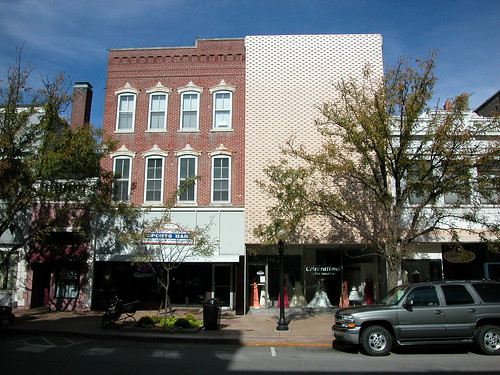 This is how the building at 105-7 East High Street in downtown Jefferson City looked in 2006.
Here's what it looked like on a recent visit. While mid-century slipcovers should not always be removed, here the half-covering was ugly and covered operable windows. Windows allow for light and ventilation and significantly reduce the energy usage of a building -- not to mention the spirits of the people who work or live inside. Underneath, the ornate cast iron lintels are intact. The facade will be restored gracing a block very near our state Capitol.
This project is utilizing Missouri's state historic rehabilitation tax credit, a national model that returns up to 25% of qualified rehabilitation costs back to an owner in transferable credits. This building was in sound condition before, but its street face was not becoming a location right by the seat of state government. Without the tax credit, the owner might have left well enough alone -- and visitors to our capital might have found this block a bit unbecoming.
Tuesday, March 30, 2010
Support for Historic Tax Credits from North Side -- Of Minneapolis
On March 28th, the blog The Adventures of Johnny Northside carried the post "Historic Rehab Tax Credit Means JOBS!". Fine, but is another blog calling for saving the Missouri historic rehab tax credit worth mentioning?
Well, the The Adventures of Johnny Northside blog is published by a resident of Minneapolis, and he is calling for Minnesota to enact a historic rehabilitation tax credit. And Missouri's 25% credit is cited as a model.
Well, the The Adventures of Johnny Northside blog is published by a resident of Minneapolis, and he is calling for Minnesota to enact a historic rehabilitation tax credit. And Missouri's 25% credit is cited as a model.
Study on Missouri Historic Tax Credit: 43,150 Jobs, Most Tax Credit Projects Small
The Missouri Growth Association has released An Evaluation of the Missouri Historic Preservation Tax Credit's Program's Impact on Job Creation and Economic Activity Across the State, a 34-page report by Dr. Sarah Coffin, Rob Ryan and Ben McCall of St. Louis University.
According to the report, the tax credit is responsible for 43,150 new or retained jobs with an average salary of $42,732 as well as $669.8 million in new sales/use and income tax revenues to state and local government.
The report confirms advocates' assertions that the credit enjoys wide usage and largely benefits small developers. Coffin and company found that, as of 2009, the range of historic rehab tax credits issued goes from $399 to $20.1 million.
About 33% of the projects that have received Missouri historic rehab tax credits have used less than $50,000 in credits. Taking the number up to usage of $100,000 or less, there is a majority of 57% of projects. Less than 13% of projects used more than $1 million in credits.
According to the report, the tax credit is responsible for 43,150 new or retained jobs with an average salary of $42,732 as well as $669.8 million in new sales/use and income tax revenues to state and local government.
The report confirms advocates' assertions that the credit enjoys wide usage and largely benefits small developers. Coffin and company found that, as of 2009, the range of historic rehab tax credits issued goes from $399 to $20.1 million.
About 33% of the projects that have received Missouri historic rehab tax credits have used less than $50,000 in credits. Taking the number up to usage of $100,000 or less, there is a majority of 57% of projects. Less than 13% of projects used more than $1 million in credits.
Sunday, March 28, 2010
Video Tour of St. Louis Equity Fund Projects
In January, the Federal Reserve Bank of St. Louis posted this video of a bus tour of affordable housing developed by the St. Louis Equity Fund (SLEFI). SLEFI President John Wuest led a tour that included south city, the Loop, Hillsdale, north St. Louis and downtown. The majority of the projects included are rehabilitation of historic buildings that leveraged state and federal low income housing tax credits with state historic rehabilitation tax credits.
At one point during the tour, Wuest said that after several projects in one area there can start to be serious impact. That's a realistic approach that differs from the large-scale urban renewal projects that have failed again and again. Yet the project-by-project effort to create a community impact is difficult to finance, especially if the end product is affordable housing. The recession has made the work even harder, but changes to the tax credit programs that make this work possible would be disastrous.
At one point during the tour, Wuest said that after several projects in one area there can start to be serious impact. That's a realistic approach that differs from the large-scale urban renewal projects that have failed again and again. Yet the project-by-project effort to create a community impact is difficult to finance, especially if the end product is affordable housing. The recession has made the work even harder, but changes to the tax credit programs that make this work possible would be disastrous.
Friday, March 26, 2010
St. Louis Post-Dispatch: "Dubious Policy Based on False Urgency"
Today the Post-Dispatch has an excellently-titled editorial on Governor Jay Nixon's tax credit proposal: "Tax credit plan advances dubious policy based on false urgency".
The editorial writer makes many good points, but a key observation is the timing of the proposal:
The tax credit debate hardly is new; the Legislature has been debating it for at least two years. Mr. Nixon has had ample time for an orderly, informed public debate on how best to proceed. But he chose to drop this complicated proposal out of the blue, with just six weeks remaining in an otherwise busy and contentious legislative session.
The timing of the proposal has led some observers to view it as a red herring designed to get the legislature to act. However, the resonance of Nixon's views with those of Republican Senators like Jason Crowell and Matt Bartle cannot be underestimated. In past years -- including last year -- the governor stood on the side lines of the tax credit debates in the legislature, frustrating many urban Democrats who has enthusiastically supported his election.
This year, Nixon has aligned with those who view tax credits as "welfare" and who view welfare -- and most government spending -- as stealing. Some tax credits are dubious, but a true overhaul would evaluate the net economic benefit of each program before making cuts. The Rutgers study of state historic rehabilitation tax credits is a model of careful analysis that should guide decision-makers. This writer doubts that every program would show a net benefit if analyzed carefully. In the absence of such study, we are left with the prospect of continued contest of interests. Nixon's proposal would amp up that contest, and create a wholly political tax credit system. Nixon is playing politics, not making policy. And Missouri's legislators should reject his proposal.
Governor Nixon can be reached at:
Office of Governor Jay Nixon
P.O. Box 720
Jefferson City, MO 65102
(573) 751-3222
The editorial writer makes many good points, but a key observation is the timing of the proposal:
The tax credit debate hardly is new; the Legislature has been debating it for at least two years. Mr. Nixon has had ample time for an orderly, informed public debate on how best to proceed. But he chose to drop this complicated proposal out of the blue, with just six weeks remaining in an otherwise busy and contentious legislative session.
The timing of the proposal has led some observers to view it as a red herring designed to get the legislature to act. However, the resonance of Nixon's views with those of Republican Senators like Jason Crowell and Matt Bartle cannot be underestimated. In past years -- including last year -- the governor stood on the side lines of the tax credit debates in the legislature, frustrating many urban Democrats who has enthusiastically supported his election.
This year, Nixon has aligned with those who view tax credits as "welfare" and who view welfare -- and most government spending -- as stealing. Some tax credits are dubious, but a true overhaul would evaluate the net economic benefit of each program before making cuts. The Rutgers study of state historic rehabilitation tax credits is a model of careful analysis that should guide decision-makers. This writer doubts that every program would show a net benefit if analyzed carefully. In the absence of such study, we are left with the prospect of continued contest of interests. Nixon's proposal would amp up that contest, and create a wholly political tax credit system. Nixon is playing politics, not making policy. And Missouri's legislators should reject his proposal.
Governor Nixon can be reached at:
Office of Governor Jay Nixon
P.O. Box 720
Jefferson City, MO 65102
(573) 751-3222
Thursday, March 25, 2010
Americans for Tax Reform: "Governor Nixon is Not a Crook, but His Tax Policy Sure is Criminal"
Missouri Governor Jay Nixon's tax credit proposal is taking heat from the national conservative organization Americans for Tax Reform (ATR). Yesterday, ATR's blog carried the story "Missouri Governor Nixon is Not a Crook, but His Tax Policy Sure is Criminal", which blasted the hypocrisy of Nixon's anti-tax rhetoric and his plan to cut tax credit programs that return money to citizens and create jobs.
ATR even notes the Rutgers study on the economic benefits of historic tax credits:
Yet, according to a study by Rutgers University, at least some of these supposed "hand-outs" are in fact legitimate job-creating policies. The study shows the positive impact of historic tax credits and further notes that Missouri is one of the largest beneficiaries of these credits in terms of jobs and income. This makes sense: putting money back into the hands of the people likely produces jobs…and guess what? Nixon proposes cutting and capping these credits more than any other!
Nixon's move to court the right wing of the Missouri Senate has generated at least one right wing opponent. No wonder -- Nixon's position is already costing him allies on his own side of the political fence. Why shouldn't he also be losing allies on the side that he's trying to placate? In politics, pleasing everyone is impossible, but making everyone upset with you certainly is not.
ATR even notes the Rutgers study on the economic benefits of historic tax credits:
Yet, according to a study by Rutgers University, at least some of these supposed "hand-outs" are in fact legitimate job-creating policies. The study shows the positive impact of historic tax credits and further notes that Missouri is one of the largest beneficiaries of these credits in terms of jobs and income. This makes sense: putting money back into the hands of the people likely produces jobs…and guess what? Nixon proposes cutting and capping these credits more than any other!
Nixon's move to court the right wing of the Missouri Senate has generated at least one right wing opponent. No wonder -- Nixon's position is already costing him allies on his own side of the political fence. Why shouldn't he also be losing allies on the side that he's trying to placate? In politics, pleasing everyone is impossible, but making everyone upset with you certainly is not.
Sunday, March 21, 2010
Light Post in Winfield
 Winfield, Missouri occupies the far end of a flood plain ravaged in 1993 and many other years. On Highway N, behind an athletic field stands this inexplicable two-headed light post -- the last vestige of a phantom gas station.
Thursday, March 11, 2010
Say What, Mr. Governor?
Tim Logan at the Post-Dispatch reports that Governor Jay Nixon (Democrat) is ready to put tax credit programs under the budget axe. That's not all bad, of course, but here's the shocker:
When pressed on what programs he might go after, the governor mentioned historic and low income housing tax credits, both of which are widely used to fund development in the City of St. Louis and its older suburbs. But any specifics would likely need to be negotiated with lawmakers, some of whom have been targeting the historic tax credits program for years.
Of all of the tax credit programs in Missouri, Governor Nixon singles out the two most used in urban areas and one -- the historic rehab tax credit -- that average people can actually use. Hello?
When pressed on what programs he might go after, the governor mentioned historic and low income housing tax credits, both of which are widely used to fund development in the City of St. Louis and its older suburbs. But any specifics would likely need to be negotiated with lawmakers, some of whom have been targeting the historic tax credits program for years.
Of all of the tax credit programs in Missouri, Governor Nixon singles out the two most used in urban areas and one -- the historic rehab tax credit -- that average people can actually use. Hello?
Monday, March 8, 2010
Talk on Missouri Barns This Friday
Barn Again: Efforts to Document and Save Elements of the Rural Missouri Landscape
Noon, Friday, March 12 / Lecture Room / Architecture St. Louis / 911 Washington Avenue, Suite 170
Since joining Missouri Preservation as its Field Representative a little over a year ago, Bill Hart has been advocating for Missouri’s endangered historic resources. His position as Field Representative, a first for Missouri Preservation, is assisted by a Partners in the Field Challenge Grant from the National Trust for Historic Preservation. One of Bill’s outreach activities has included calling attention to the plight of the barn. Realizing that this is one of the most endangered building types not just in Missouri but throughout the nation, Bill has been photographing barns throughout the state (several hundred so far), keeping an eye toward at least providing quick photographic documentation of those that tenuously cling to the rural landscape. Bill has also been instrumental in organizing our state’s first barn alliance, which recently held its first meeting in conjunction with Missouri Preservation’s annual conference in Independence.
Noon, Friday, March 12 / Lecture Room / Architecture St. Louis / 911 Washington Avenue, Suite 170
Since joining Missouri Preservation as its Field Representative a little over a year ago, Bill Hart has been advocating for Missouri’s endangered historic resources. His position as Field Representative, a first for Missouri Preservation, is assisted by a Partners in the Field Challenge Grant from the National Trust for Historic Preservation. One of Bill’s outreach activities has included calling attention to the plight of the barn. Realizing that this is one of the most endangered building types not just in Missouri but throughout the nation, Bill has been photographing barns throughout the state (several hundred so far), keeping an eye toward at least providing quick photographic documentation of those that tenuously cling to the rural landscape. Bill has also been instrumental in organizing our state’s first barn alliance, which recently held its first meeting in conjunction with Missouri Preservation’s annual conference in Independence.
Wednesday, January 27, 2010
Missouri Rural Preservation Organization Launched
 On Saturday, January 23, a group of barn owners, architectural historians and craftspeople met near New Bloomfield, Missouri, to discuss creating a new statewide preservation group focused on rural structures. Bill Hart, Field Representative for Missouri Preservation, called the meeting. Bill and Susan Miller graciously hosted the meeting at their home, a bright red barn that they have converted into a unique home. The group had the honor of the wise counsel of Osmund Overby, the dean of Missouri's preservation movement, and farmer and humorist Lewis Baumgartner, the "World's Worst Farmer."
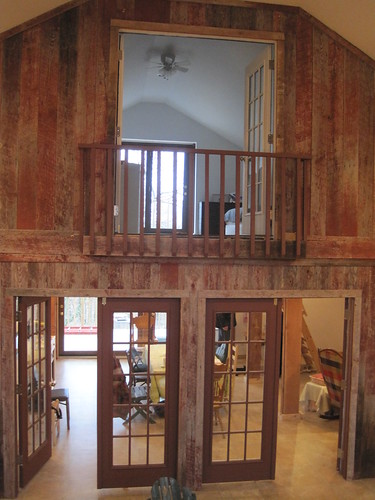 Meeting participants decided to launch a new organization, the Missouri Barn Alliance and Rural Network. Preliminary goals include a statewide survey of barns and farms, educational programs and development of a resource clearinghouse for owners of rural structures in need of technical assistance and skilled contractors.
 The group will meet again in early May. Those wishing to participate should send an e-mail to Bill Hart at billhartxx@aol.com. Additionally, Bill will be discussing the new organization and its goals at a brown bag lunch talk at Architecture St. Louis, 911 Washington #170, starting at noon on Friday, March 12th.
Tuesday, January 19, 2010
News from Route 66
The Route 66 Association of Missouri sends along the following news:
The National Park Service Route 66 Corridor Preservation Program is pleased to announce it is accepting applications for the 2010 cost-share grant cycle.
Applications may be submitted to the program office until April 2, 2010. Awards will be announced on or before May 21, 2010.
Read more here.
Also, the Route 66 Corridor Management Plan meetings are coming up in January and February. Details online here.
The National Park Service Route 66 Corridor Preservation Program is pleased to announce it is accepting applications for the 2010 cost-share grant cycle.
Applications may be submitted to the program office until April 2, 2010. Awards will be announced on or before May 21, 2010.
Read more here.
Also, the Route 66 Corridor Management Plan meetings are coming up in January and February. Details online here.
Thursday, October 8, 2009
New Federal Bills Would Help Neighborhood Preservation Efforts
Public policy has a tremendous impact on the chance that historic buildings have for survival. St. Louisans know well how many buildings are still standing, gloriously rehabilitated, because of the Missouri historic rehabilitation tax credit adopted in 1998. Many remember what happened to rehab efforts here when the 1986 federal tax act removed the major federal rehabilitation tax credit. Some of us have concerns about the impact of the Distressed Areas Land Assemblage Tax Credit Act, which was passed in 2007 to encourage large-scale urban development without any preservation safeguards.
Two bills recently introduced in the U.S. Congress offer smart policy changes that could help us save thousands of historic buildings in St. Louis and communities across the nation. In Missouri, we have had an inverted policy situation where our state's laws are more helpful to preservation efforts than the federal laws. In most states, however, it's the other way around -- and the federal laws are very restrictive, with no practical use to homeowners and small developers. That could change if we work to pass these bills.
Historic Homeowners Revitalization Act (HR 3670)
U.S. Representative Russ Carnahan (D-MO) has long been a supporter of changing federal laws to adopt preservation policies that benefit homeowners instead of just developers. On September 29, our hometown Congressman introduced the Historic Homeowners Revitalization Act (HR 3670), which has already gained 28 co-sponsors. Here's a run-down of the changes it would make to the existing federal historic rehabilitation tax credit:
The bill would create a 20% tax credit -- capped at $60,000 -- for qualified expenses rehabbing primary residences that are certified historic buildings; currently, only income-producing properties are eligible for this credit.
The bill would allow buyers of rehabilitated homes to capture the credits for which sellers are eligible, thus creating a useful form of transfer.
The bill would allow federal historic rehabilitation tax credits to be transferable for homeowners. Without this feature, homeowners would have a tough time trying to use the new credits. Many small developers can't use the existing federal historic rehabilitation credits because they cannot be transferred.
The bill changes the existing tax credit to allow issuance of credits totaling 130% of eligible rehabilitation costs on residential rental buildings in distressed census tracts. Thus, the bill widens the incentive for retention and enhancement of rental housing where it is needed. If an owner can get 100% for a condo conversion or 130% for retaining rental units, that owner just might go with the higher credit amount -- and help neighborhoods retain quality affordable housing.
Representatives William Clay (D-MO) and Ike Skelton (D-MO) are among the co-sponsors, which include a few Republicans. We need to get all of Missouri and Illinois' representatives on board!
Community Restoration and Revitalization Act (H.R. 3715 and S. 1743)
On October 1, Senators Blanche Lincoln (D-AR) and Olympia Snow (R-ME) introduced the Senate version of the Community Restoration and Revitalization Act (S. 1743) and Representative Allyson Schwartz (D-PA) and Pat Tiberi (R-OH) introduced the House companion (H.R. 3715). This bill provides a nice companion to Carnahan's measure.
The Community Restoration and Revitalization Act would amend Section 47 of the U.S. Tax Code to do the following:
The bill would raise from 20% to 30% the percentage of qualified rehabilitation costs that can be returned in credits for projects of $5 million or less. These credits would become transferable under the bill.
The 10% rehabilitation tax credit for non-historic buildings -- the federal rehab tax credit not often mentioned locally -- would be able to be used for residential rental properties. This would allow for mixed-use and apartment buildings to use this credit, instead of only all-commercial buildings.
Very important among the bill's changes is removing the 1986 tax law's provision that set 1936 in place as the cut-off date for buildings eligible for that 10% federal credit. That year marks 50 years back from 1986, but the year itself is codified so now buildings must be 73 years old to use the credit Instead, this bill would change it to a floating 50-year mark.
Energy efficiency would be rewarded, with up to $5 per square foot in extra credits for projects that increase efficiency of historic buildings by 30% of more.
State historic rehabilitation tax credits would no longer be treated as income for federal tax purposes.
The bill would remove restrictions on "disqualified leases" that currently prevent user of the credit from leasing space in rehabilitated buildings to non-profit or civic organizations.
The Community Restoration and Revitalization Act has only one Senate co-sponsor (Snowe, since only one senator can be a sponsor) but 44 House co-sponsors. The Missouri and Illinois delegations need to sign on to this one too -- only Representative Carnahan and Illinois Representatives Jerry Costello (D) and Danny Davis (D) have signed on.
Time to make calls and send letters to your representatives and our senators. Forget bailouts and giant projects. In this recession, the real economic stimulus we need is to widen the amount of money accessible to every citizen that stays at work renewing our homes, shops and communities.
More information on both bills, including full text, is available on the Preservation Action website.
Two bills recently introduced in the U.S. Congress offer smart policy changes that could help us save thousands of historic buildings in St. Louis and communities across the nation. In Missouri, we have had an inverted policy situation where our state's laws are more helpful to preservation efforts than the federal laws. In most states, however, it's the other way around -- and the federal laws are very restrictive, with no practical use to homeowners and small developers. That could change if we work to pass these bills.
Historic Homeowners Revitalization Act (HR 3670)
U.S. Representative Russ Carnahan (D-MO) has long been a supporter of changing federal laws to adopt preservation policies that benefit homeowners instead of just developers. On September 29, our hometown Congressman introduced the Historic Homeowners Revitalization Act (HR 3670), which has already gained 28 co-sponsors. Here's a run-down of the changes it would make to the existing federal historic rehabilitation tax credit:
Representatives William Clay (D-MO) and Ike Skelton (D-MO) are among the co-sponsors, which include a few Republicans. We need to get all of Missouri and Illinois' representatives on board!
Community Restoration and Revitalization Act (H.R. 3715 and S. 1743)
On October 1, Senators Blanche Lincoln (D-AR) and Olympia Snow (R-ME) introduced the Senate version of the Community Restoration and Revitalization Act (S. 1743) and Representative Allyson Schwartz (D-PA) and Pat Tiberi (R-OH) introduced the House companion (H.R. 3715). This bill provides a nice companion to Carnahan's measure.
The Community Restoration and Revitalization Act would amend Section 47 of the U.S. Tax Code to do the following:
The Community Restoration and Revitalization Act has only one Senate co-sponsor (Snowe, since only one senator can be a sponsor) but 44 House co-sponsors. The Missouri and Illinois delegations need to sign on to this one too -- only Representative Carnahan and Illinois Representatives Jerry Costello (D) and Danny Davis (D) have signed on.
Time to make calls and send letters to your representatives and our senators. Forget bailouts and giant projects. In this recession, the real economic stimulus we need is to widen the amount of money accessible to every citizen that stays at work renewing our homes, shops and communities.
More information on both bills, including full text, is available on the Preservation Action website.
Saturday, October 3, 2009
Energy Efficiency Act Snubs Missouri Historic Tax Credit
Missouri State Senator Brad Lager (R-Savannah) won a legislative victory this year when his Energy Efficient Investment Act passed the General Assembly and was signed into law by Democratic Governor Jay Nixon.
The bill's chief purpose is to allow utilities to recover costs of energy efficiency measures to deter construction of new power plants. Lager wisely has opposed public subsidy to power plant construction. The state's Public Service Commission's rule is that Missouri's electric companies only raise rates if the rates are equal to or less than the rates that the companies would have charged if the company had built a new power plant. That rule encourages more energy output without addressing efficiency.
The bill allows utilities to count toward output energy not being consumed and enables utilities to establish programs where customers receive benefits for demand-side efficiency upgrades.
However, Lager could not resist riding his favorite hobby horse into the bill -- opposition to the state's historic rehabilitation tax credit, which was modified for the first time ever this year in response to Lager's efforts to kill it.
Section 14 of the act states:
Any customer of an electrical corporation who has received a state tax credit under sections 135.350 to 135.362, RSMo, or received under sections 253.545 to 253.561, RSMo, shall not be eligible for participation in any demand-side program offered by an electrical corporation under this section if such program offers a monetary incentive to the customer.
Sections 135.350-362 deal with a range of tax credit programs that Lager also opposes, including the state's low income housing tax credit, but sections 253.545-561 enable the state historic rehabilitation tax credit. Vigilance on the rehabilitation tax credit remains crucial in this post-Jeff Smith era.
The bill's chief purpose is to allow utilities to recover costs of energy efficiency measures to deter construction of new power plants. Lager wisely has opposed public subsidy to power plant construction. The state's Public Service Commission's rule is that Missouri's electric companies only raise rates if the rates are equal to or less than the rates that the companies would have charged if the company had built a new power plant. That rule encourages more energy output without addressing efficiency.
The bill allows utilities to count toward output energy not being consumed and enables utilities to establish programs where customers receive benefits for demand-side efficiency upgrades.
However, Lager could not resist riding his favorite hobby horse into the bill -- opposition to the state's historic rehabilitation tax credit, which was modified for the first time ever this year in response to Lager's efforts to kill it.
Section 14 of the act states:
Any customer of an electrical corporation who has received a state tax credit under sections 135.350 to 135.362, RSMo, or received under sections 253.545 to 253.561, RSMo, shall not be eligible for participation in any demand-side program offered by an electrical corporation under this section if such program offers a monetary incentive to the customer.
Sections 135.350-362 deal with a range of tax credit programs that Lager also opposes, including the state's low income housing tax credit, but sections 253.545-561 enable the state historic rehabilitation tax credit. Vigilance on the rehabilitation tax credit remains crucial in this post-Jeff Smith era.
Subscribe to:
Posts (Atom)


 Posts
Posts

