
Now Apartment Therapy casts its keen eye toward St. Louis' Ridgewood subdivision, located in suburban Crestwood. The specific subject is the delightfully rejuvenated ranch home of Nathan and Hannah Wilber, which I had the pleasure of seeing myself last week. Nathan is co-author of the Modern Ridgewood blog and devoted to helping others learn about and appreciate St. Louis' wealth of mid-century modern architecture. Yet Nathan and Hannah's house is no museum -- rather, like the best rehabs we may more often associate with 19th century town houses, it is an effort that balances reverence and the demands of daily life beautifully.
See the Apartment Therapy house tour here.
Showing posts with label st louis county. Show all posts
Showing posts with label st louis county. Show all posts
Monday, June 21, 2010


Thursday, June 10, 2010
Murphy Residence Listed in National Register
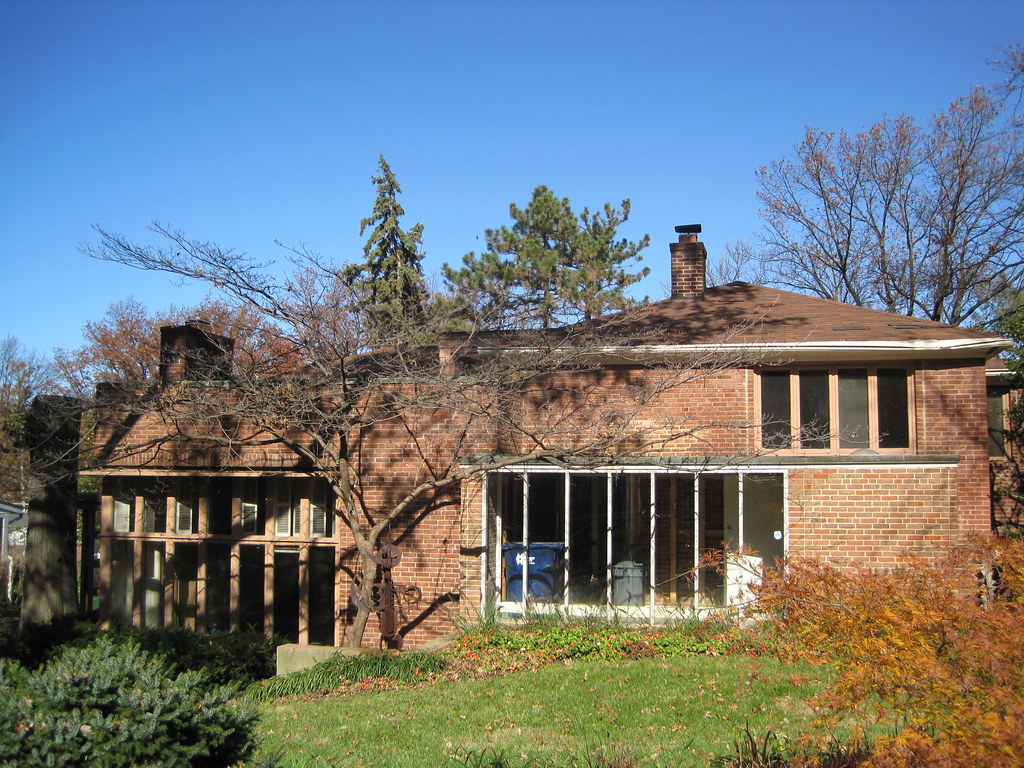 On May 10, the National Park Service listed in the Joseph and Ann Murphy Residence at 7901 Stanford Avenue in University City in the National Register of Historic Places. The Murphy Residence, owned by Joseph Murphy's daughter Caroline and her husband Vincent DeForest, is one of St. Louis' first truly modern residential designs. Completed in 1939 and expanded in 1950 and 1962, the home was key in introducing International Style-inspired modernist design to the St. Louis region. While Murphy became best known for his later work, including the Climatron and Olin Library at Washington University, this house represented an early accomplishment in his career and in the story of modern architecture in St. Louis.
Read the full text of my National Register of Historic Places nomination here.
Wednesday, May 19, 2010
Fairfax House, Rock Hill Presbyterian Church, Route 66 Bridge Make Statewide Endangered List
This week, Missouri Preservation announced its 2010 Most Endangered Properties list. St. Louis area listings are the Route 66 Bridge over the Meramec River as well as the adjacent Fairfax House and Rock Hill Presbyterian Church in Rock Hill.
Rock Hill Presbyterian Church is in urgent need of a preservation plan. From Missouri Preservation's announcement:
After being moved several times because of increasing commercial and residential development, the Fairfax House has ended up on another former Marshall property. In February 2010, it was discovered that the Giddings-Lovejoy Presbytery was seeking to sell the Rock Hill Presbyterian Church, presenting a threat to the historic church building and an additional threat to Fairfax House. This property is now situated at the intersection of two busy St. Louis county roads. It is a target for commercial development as the City of Rock Hill, which does its own zoning and has no current historic preservation ordinance, has zoned this property “commercial.”
Rock Hill Presbyterian Church is in urgent need of a preservation plan. From Missouri Preservation's announcement:
After being moved several times because of increasing commercial and residential development, the Fairfax House has ended up on another former Marshall property. In February 2010, it was discovered that the Giddings-Lovejoy Presbytery was seeking to sell the Rock Hill Presbyterian Church, presenting a threat to the historic church building and an additional threat to Fairfax House. This property is now situated at the intersection of two busy St. Louis county roads. It is a target for commercial development as the City of Rock Hill, which does its own zoning and has no current historic preservation ordinance, has zoned this property “commercial.”
Sunday, April 18, 2010
Olivette Tear-Down
 Last week I spotted this tear-down on Dielman Road at Engel Lane just south of Olive Boulevard. Another fine postwar ranch house, built sturdy of brick and concrete, will meet its death. Oh, recession, you were supposed to bring calm to the troubled waters of suburban real estate!
Monday, April 5, 2010
Proposition A
 This United Railways streetcar line map from 1903 reminds us of what is possible with mass transit. The red lines mark streetcar lines, which augment the street grid with a separate network of traffic. In 1903, that separate network was primary to many people. The streets where the street car lines ran gave rise to commerce and pedestrian traffic. The streets around them saw secondary benefits.
Now, 107 years later, county residents are faced with a choice on whether to approve Proposition A to fund the region's public transit system, now doing business as Metro. That the funding comes through a sales tax increase that triggers an already-approved sales-tax increase in the city has generated concern. A sales tax increase is not desirable, but neither is the funneling of tax revenues to a state infrastructure agency, the Missouri Department of Transportation, that exclusively fund roadway construction. The money raised for state highways ought to stay in the region to begin with, to fund the transportation that best serves an urban area -- just as Chillicothe's transportation dollars are probably best spent on roads. If the money must go to the state, then it should return in the form of funding for mass transit operations in addition to highway funding. There is a board political goal from which our leaders cannot shirk after tomorrow, no matter what outcome.
Back to the 1903 map: density of transit lines created and sustained commercial districts at the turn of the last century. The map here shows midtown St. Louis, which soon afterward would be dubbed the "second downtown." This is entirely due to the placement and density of mass transit street car lines. Today, we don't have such stark benefit but we have a regional core where bus and MetroLink service is sufficient to support the location of major employment.
In 1903, mass transit made Midtown more desirable than other parts of the city of St. Louis. Today, mass transit makes the core more desirable for major employers than exurban locations. County voters are not voting to build up the city, but to sustain their own place in the regional economy -- a place staked by relative density of population and transit lines. Without the sustaining the Metro system, what gives a county municipality like Brentwood a distinct business advantage over St. Peters? Or, for that matter, Chesterfield over Wentzville?
When we lost the street car lines, we found out what would happen when Midtown had to compete with the county in the absence of a strong mass transit system. Midtown faded away. So it could go with St. Louis County. Whether the city or St. Charles County ultimately benefits from the decline of Metro is a gamble of unknown odds. Somehow I doubt that defeat of funding for mass transit will benefit the urbanization of an already too-dispersed region. Yes, if Proposition A fails, the system is not dead -- but it will shrink immediately and the prospect of service restoration will diminish. Passage of Proposition A allows time to build a better funding system without regional havoc or further economic dispersal.
Thursday, February 25, 2010
Neon Signs at Antique Warehouse
On Sunday, February 21, the Antique Warehouse hosted a fundraiser for the St. Louis Sign Museum. Guests were able to see the amazing private collection at the Antique Warehouse, which includes numerous neon signs, banners, signs, vehicles, tractors, campers, sewing machines, cash registers, pinball machines and so many other things a list would fill a small book. Greg Rhomberg is the mad genius behind the Warehouse, and has been collecting for years. One of the hallmarks of Greg's work is thorough restoration of items that require it. In the case of neon signs, that means repainting and re-tubing. Here are a few photographs suggesting the scope of the Antiques Warehouse neon sign collection.
 Yes, the Lake Forest Pastry Shop sign is alive and well!


 Yes, the Lake Forest Pastry Shop sign is alive and well!


Friday, January 29, 2010
Metro Funding Serves County's Interest
This week, the St. Louis Post-Dispatch carried a commentary by NiNi Harris entitled "County residents should vote own interests". Harris makes the case for St. Louis County voters' approving the sales tax measure for Metro that will appear on the April 6 ballot.
Instead of the usual -- and correct -- arguments in favor of mass transit as something the region needs to have to be competitive and maintain an urban quality of life, Harris demonstrates that the sales tax measure will help St. Louis County maintain its quality of life. The services that county voters take for granted are dependent on workers' being able to easily get to jobs in the county. For many workers, that means catching the bus.
Voters might not consider the fact that even health care costs are associated with the availability of public transportation:
The quality of hospital care is not only determined by the physicians and registered nurses, but also by the LPNs, the people who do the laundry and cleaning and food service staffs. The quality of overall care can be maintained without mass transit only by increasing wages or providing other transportation.
After all, according to Harris:
It's not just a few workers about whom we are talking. Last year, Metro buses, MetroLink and the Metro service for the disabled provided rides for almost 53 million boarders.
Can the county maintain its quality of life with diminished Metro service? Absolutely not.
Instead of the usual -- and correct -- arguments in favor of mass transit as something the region needs to have to be competitive and maintain an urban quality of life, Harris demonstrates that the sales tax measure will help St. Louis County maintain its quality of life. The services that county voters take for granted are dependent on workers' being able to easily get to jobs in the county. For many workers, that means catching the bus.
Voters might not consider the fact that even health care costs are associated with the availability of public transportation:
The quality of hospital care is not only determined by the physicians and registered nurses, but also by the LPNs, the people who do the laundry and cleaning and food service staffs. The quality of overall care can be maintained without mass transit only by increasing wages or providing other transportation.
After all, according to Harris:
It's not just a few workers about whom we are talking. Last year, Metro buses, MetroLink and the Metro service for the disabled provided rides for almost 53 million boarders.
Can the county maintain its quality of life with diminished Metro service? Absolutely not.
Monday, January 25, 2010
Big Plans for Jefferson Barracks
Friday's South County Times carried the article "Plans In Place To Transform Jefferson Barracks Complex Into A National Tourist Destination". The article reports that the St. Louis County Economic Council has developed a master plan for $68 million in improvements, including an interpretive center and a "presidential museum/library":
According to the master plan, the complex would be transformed into a regional and national visitor attraction, done so in phases over the course of 20 years.
Jefferson Barracks is indeed an underutilized cultural asset to the region. Many other places have promoted military history, a substantial sector of American tourism. It's about time that the county thought seriously about Jefferson Barracks. Still, it's important to note that there are existing efforts to draw visitors to the historic barracks. For instance, the Missouri Civil War Museum has been feverishly working on renovating a building and is set to open soon.
There is a presentation on the master plan today:
The St. Louis County Economic Council will hold open house to unveil the master plan on Monday, Jan. 25, 4 to 7 p.m. at the Jefferson Barracks Visitor's Center. A presentation will be held at 6 p.m. Jefferson Barracks County Park is located at the end of South Broadway.
According to the master plan, the complex would be transformed into a regional and national visitor attraction, done so in phases over the course of 20 years.
Jefferson Barracks is indeed an underutilized cultural asset to the region. Many other places have promoted military history, a substantial sector of American tourism. It's about time that the county thought seriously about Jefferson Barracks. Still, it's important to note that there are existing efforts to draw visitors to the historic barracks. For instance, the Missouri Civil War Museum has been feverishly working on renovating a building and is set to open soon.
There is a presentation on the master plan today:
The St. Louis County Economic Council will hold open house to unveil the master plan on Monday, Jan. 25, 4 to 7 p.m. at the Jefferson Barracks Visitor's Center. A presentation will be held at 6 p.m. Jefferson Barracks County Park is located at the end of South Broadway.
Friday, January 22, 2010
"Up in the Air": A Shining Moment for St. Louis' Modern Architecture
 Finally seeing Up in the Air this week, I was able to relish a great moment for St. Louis modern architecture. Readers know that much of the film was shot in St. Louis, and the film rolls out familiar scenes: a street in Lafayette Square, Flora Place, the Cheshire Inn, the Gateway One building downtown, Mansion House and the interior of the General American Life Insurance Building are all spotted. Fans of local postmodern design no doubt took comfort in the fact that our downtown landmarks of the 1980s are so generic that they can double for Omaha's. That placelessness is a triumph for the style, at least by Fredric Jameson's measure.
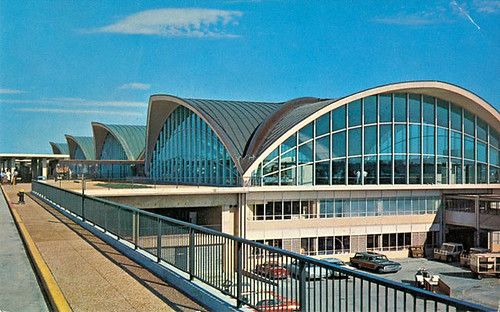 However, the actual shining moment for St. Louis was the prominent feature of the main terminal at Lambert International Airport (shown above unsullied in 1970). Lots of the film takes place inside of the airport -- again, the triumph of place-erasing architecture -- but there is a splendid moment in front. George Clooney's character Ryan Bingham has to get a snapshot of a cut-out of his sister and her fiancee in St. Louis for a display board of such photos at their rehearsal dinner. Bingham selects Lambert Airport, a choice questioned by his colleague Natalie Keener (Anna Kendrick).
The doubt pulls from Bingham a soliloquy about the role of the Lambert terminal in the development of modern airport architecture. Of course the soon-to-be newlyweds would want their cut-out photographed in front of the Lambert terminal. After all, this is the first modern terminal that set the standard before JFK or DeGaulle were designed. Despite the clutter we have tacked onto Hellmuth, Yamasaki & Leinweber's 1956 terminal, it looks great in this scene. The terminal's modernity shines through, and provokes one of several moment in which Bingham seems to break from his detachment to show love.
Bingham basically reiterates the words of critic Robert W. Duffy, who wrote a few years back that the Lambert terminal was "the first airport building to make a formal statement about aviation and aerodynamics." The thin-cast concrete shell demonstrated that architecture could respond to the curves and contours of industrial design in an original expression.
Coincidentally, St. Louis' other great modernist temple of travel also had a moment of film fame. Schwarz and Van Hoefen's Greyhound Terminal (1964) on Broadway (interior seen here), demolished for the domed stadium we seem posed to soon demolish, was used in Planes, Trains and Automobiles. John Hughes chose to shoot the interior scene elsewhere, but the exterior was projected onto thousands of screens around the nation.
To some, the idea that St. Louis and modern jet-set travel -- of which I make no claim that Greyhound is a part -- are intertwined would seem foolish. Yet how did a supposedly complacent region embrace and build one of the landmarks of postwar international travel, and a bus station finer than almost any other ever built? We had great designers whose wellspring of innovation was too great to be harnessed by innate local conservatism. That conservatism was as strong in 1956 as it is in 2009, too, so we don't get to cop out and rest on our cynicism. If a place-loathing cynic like Ryan Bingham can show some love for St. Louis' modern architecture, why can't we?
Thursday, December 31, 2009
Bethany Deaf Church in Kirkwood Demolished
Kirkwood's local historic district ordinance did not prevent the new owner of the Bethany Deaf Church (photograph via link) at 310 E. Argonne from demolishing the building around Christmas. A reader writes that the wreckers destroyed the front doors rather than salvage them, but that the rose window may have been saved.
Wednesday, December 23, 2009
Mid-Century Modern in the Hanley Industrial Court
I found myself in a situation that I normally avoid during the month of December (or any month, really): I had to go shopping at a store on Brentwood Boulevard. Coming from the southeast of my destination, I headed north on Hanley Road and decided to slip through the reliable Hanley Industrial Court short-cut.
Am I glad that I did! What I found brightened my day and made the otherwise excruciating experience worthwhile.
 Voila, at 318 Hanely Industrial Court stands the home of Arcliff Wholesale Distributors. The mod building dates to 1960, and is in pristine condition down to the swanky metal letters above the roof life. The center is cut away, opening to an employee parking area that separates the showroom from the storeroom. The building's roofline changes to underscore the separation, creating welcome variation and presenting an almost Potemkin-like front to what is actually two very small sections and a lot of parking.
 The storeroom section is accented with brown tile tapestry that underscores the tile sold wholesale by Arcliff. What a gem! Few of the other Hanley Industrial Court buildings demonstrate this much care in their design, so I was quite surprised to see this. I took a wrong turn to get there, so perhaps the serendipity was inevitable.
Am I glad that I did! What I found brightened my day and made the otherwise excruciating experience worthwhile.
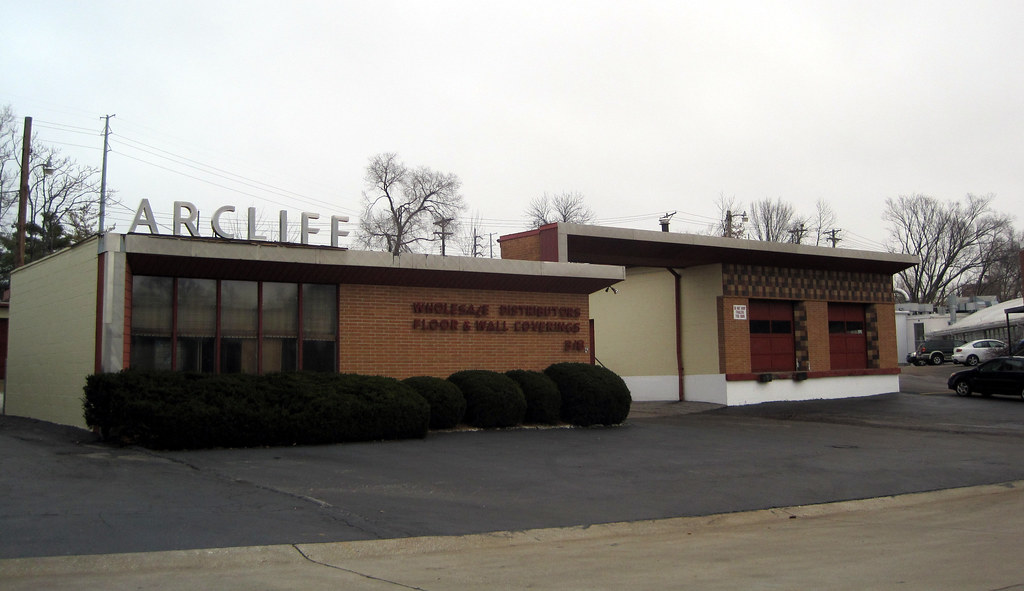 Voila, at 318 Hanely Industrial Court stands the home of Arcliff Wholesale Distributors. The mod building dates to 1960, and is in pristine condition down to the swanky metal letters above the roof life. The center is cut away, opening to an employee parking area that separates the showroom from the storeroom. The building's roofline changes to underscore the separation, creating welcome variation and presenting an almost Potemkin-like front to what is actually two very small sections and a lot of parking.
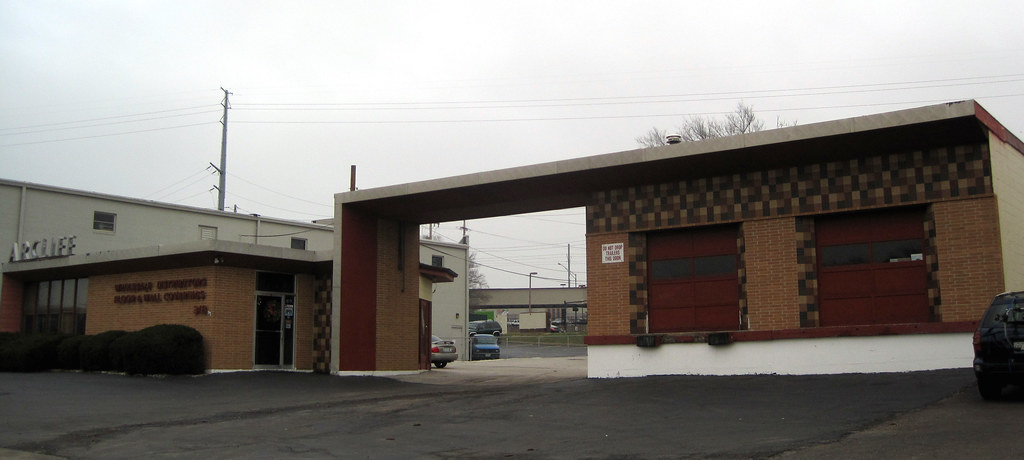 The storeroom section is accented with brown tile tapestry that underscores the tile sold wholesale by Arcliff. What a gem! Few of the other Hanley Industrial Court buildings demonstrate this much care in their design, so I was quite surprised to see this. I took a wrong turn to get there, so perhaps the serendipity was inevitable.
Monday, November 30, 2009
Some Thoughts on Our Gasometer(s)
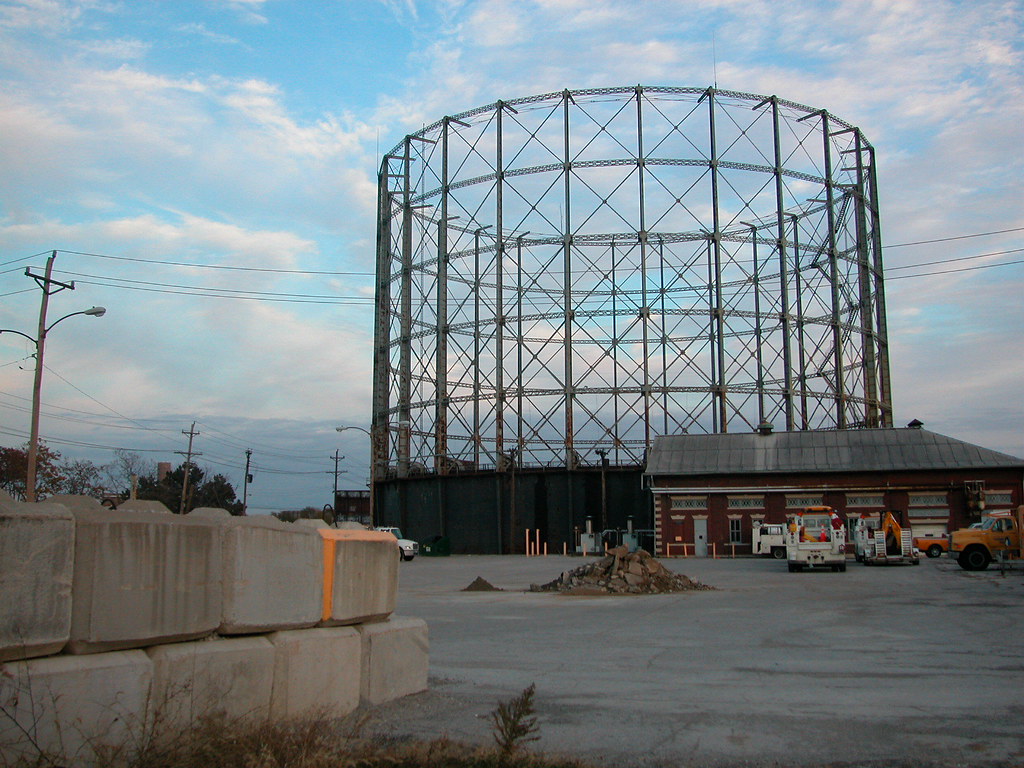 The impending demolition of the two gasometers in Shrewsbury draws me back to the demolition of the gasometer in Forest Park Southeast. Once one of two gasometers at Laclede Gas Company's Pumping Station G and built in 1901 (rebuilt in 1942), the Forest Park Southeast gasometer was a landmark for over a century. When Highway 40 was first built, the gasometer's prominence greatly increased, and it was one of several iconic structures -- the St. Louis Science Center's McDonnell Planetarium, the grain elevator at Sarah and Duncan, Barnes Hospital -- that gave a magically urban character to an otherwise dull trip down the highway. Within Forest Park Southeast, the gasometer's web of steel served as a backdrop to views from backyards, bedrooms and sidewalks. The gasometer was a strange remnant that had outlived its purpose -- regulating the supply of the city's gas system -- but not its industrial charm and connection to the past.
 In 2006, developers successfully listed Pumping Station G in the National Register of Historic Places (read the nomination by Susan Sheppard and Doug Johnson here). The State Historic Preservation Office insisted that the gasometer be included, and the gasometer was listed as a contributing structure. However, the official landmark status provided no protection. The developers had never intended to try to save the structure.
 An eloquent plea for preservation from historian and then-St. Louis University professor Joseph Heathcott, "Getting creative with the region's exceptional industrial heritage", appeared in the February 8, 2007 issue of the St Louis Post-Dispatch, but there was no strong effort to preserve the gasometer. There was plenty of discussion, however, among architects, Forest Park Southeast residents and preservationists. The alternative ends for the gasometer were obvious. Several European cities, including London and Vienna, have converted iconic gasometers into equally iconic apartment and office buildings. Others have maintained the structures as urban artifacts. Heathcott's article alluded to the imaginative possibilities.

Alas, imagination did not win out. Neither did National Register protection; the city's Cultural Resources Office approved demolition of the gasometer without bringing the matter to a public hearing at the Preservation Board. Demolition of the gasometer was completed in the middle of 2007.
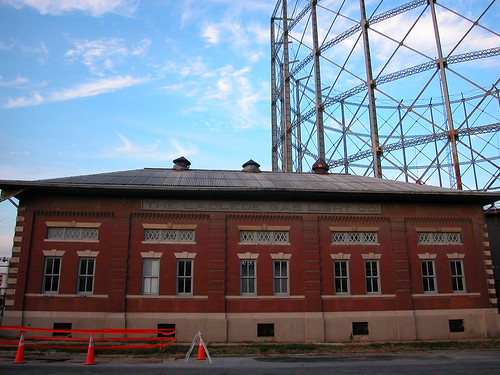
Today, the Pumping Station G site is largely vacant. The pumping house (1911) still stands, vacant but slated for rehabilitation. The developers who wrecked the gasometer sold the site to different developers, who have yet to devise plans for the site. In the end, the gasometer could have remained standing as a resource for its neighborhood and a icon for the city. Perhaps a new owner would have been interested in the challenge of finding a new use for the structure. Now, the gasometer is gone, and two of its three sisters soon also will be gone.
That leaves St. Louis only one chance to reclaim a gasometer: the gasometer at the vacant Pumping Station N, located just south of Natural Bridge Road on Chevrolet Avenue in north St. Louis. Can we rise to the challenge of retaining an endangered structural type, or will we let it fall too?

Wednesday, October 28, 2009
Ranch House Renewal in Ferguson
Today's St. Louis Beacon carries an article about the inner-ring St. Louis County suburb of Ferguson's attempt to revitalize neighborhoods composed largely of small postwar ranch houses. Rosalind Williams, director of planning and development for the city, has plans to save some of these homes by expanding them. From the article by Mary Delach Leonard:
Williams says the plan is to buy the homes and then "right-size" them by adding a bedroom or bathroom to make them more attractive to home buyers. The long-term goal: neighborhood stabilization.
Ferguson has continued its efforts to identify potential historic districts, including neighborhoods of smaller mid-century homes. In today's economy, those smaller houses might be looking as good as they did fifty years ago.
Williams says the plan is to buy the homes and then "right-size" them by adding a bedroom or bathroom to make them more attractive to home buyers. The long-term goal: neighborhood stabilization.
Ferguson has continued its efforts to identify potential historic districts, including neighborhoods of smaller mid-century homes. In today's economy, those smaller houses might be looking as good as they did fifty years ago.
Wednesday, October 14, 2009
RFT Throws Spotlight on Esley Hamilton, Preservationist
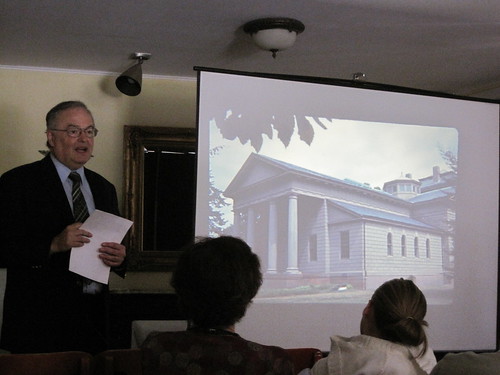 Esley Hamilton discussed Greek Revival architecture in America at the Chatillon-DeMenil House on September 27.
This week's issue of the Riverfront Times carries a feature article by Aimee Levitt on the inimitable Esley Hamilton, Historian for the St. Louis County Department of Parks and Recreation. The article, entitled "To Preserve and Protect: Esley Hamilton has a boundless passion for St. Louis' architectural past", provides a good overview of Esley's career and contributions to preservation efforts in St. Louis. Esley probably would rather see a feature article on an endangered building, but he's earned the attention.
Tuesday, October 6, 2009
Clayton Tear Down
A CraigsList ad offers for sale parts of a "large house in [C]layton to be demolished." It's a remove-yourself sale at 57 Broadview in Clayon's Clavarach Park neighborhood, recently listed in the National Register of Historic Places as a historic district. Clayton lacks a historic preservation ordinance. According to Esley Hamilton, Historian at the St. Louis County Department of Parks and Recreation, the house dtaes to 1958 and was designed by Ralph Fournier.
Wednesday, July 22, 2009
A Weekend of Twentieth Century Architecture Ahead
First, Landmarks Association of St. Louis brings an exciting Architecture Weekend:
Architecture Weekend Lecture: Modern Religious Architecture in St. Louis
Date: Friday, July 24 at Noon
Location: Architecture St. Louis, 911 Washington Avenue #170
Esley Hamilton, Preservation Historian for the St. Louis County Department of Parks and Recreation, will provide an overview of the influence of the modern movement on religious architecture across the St. Louis region. Hamilton's illustrated lecture will cover examples of modernist church design from the city and county in the 20th century. Places of worship designed by Hellmuth, Obata & Kassebaum, Nagel & Dunn, Joseph Murphy and other architects of St. Louis' modern era will be included.
Architecture Weekend Tour: Two Modern Churches in Kirkwood
Date: Saturday, July 25 from 10:00 a.m. - noon.
Location: Start at First Presbyterian Church, 100 East Adams in Kirkwood
Suburban Kirkwood is blessed with several notable examples of mid-century modern religious architecture. On Saturday, two of Kirkwood's most splendid modern churches will open their doors for us. We'll start with a guided tour at First Presbyterian Church (1956-7, Fisher & Campbell), 100 East Adams. After that, make the short walk or drive to the Kirkwood United Methodist Church (1964, Schmidt, Perlsee & Black), which will be open for self-guided tours. On your way out of town, you may wish to pass by Grace Episcopal Church, 514 E. Argonne (1964, Frederick Dunn) or St. Peter's Catholic Church, 237 W. Argonne (1955, Joseph Murphy), Kirkwood's other modern churches.
Then, a new group has its first meeting:
St. Louis Arts and Crafts Society Open House
Sunday, July 26 from 2:00 p.m. - 5:00 p.m.
700 Bellerive Boulevard in south St. Louis
Are you interested in St. Louis architecture from 1900 to 1940? Do you describe your home as Arts and Crafts, Craftsman, Mission, Bungalow or Prairie? Does your vocabulary include: exposed rafters, corbels, mortised & tenoned, pergola, Inglenook and thru-tenon-keyed? St. Louis has a rich stock of Arts and Crafts architecture that is often overlooked.
Please join us if you are interested in becoming a member of the St. Louis Arts and Crafts Society. Bring pictures of your home or furniture to discuss with other enthusiasts. FOR more information, call Patrice at 314-412-1382 OR e-mail at rjppwp@charter.net
Architecture Weekend Lecture: Modern Religious Architecture in St. Louis
Date: Friday, July 24 at Noon
Location: Architecture St. Louis, 911 Washington Avenue #170
Esley Hamilton, Preservation Historian for the St. Louis County Department of Parks and Recreation, will provide an overview of the influence of the modern movement on religious architecture across the St. Louis region. Hamilton's illustrated lecture will cover examples of modernist church design from the city and county in the 20th century. Places of worship designed by Hellmuth, Obata & Kassebaum, Nagel & Dunn, Joseph Murphy and other architects of St. Louis' modern era will be included.
Architecture Weekend Tour: Two Modern Churches in Kirkwood
Date: Saturday, July 25 from 10:00 a.m. - noon.
Location: Start at First Presbyterian Church, 100 East Adams in Kirkwood
Suburban Kirkwood is blessed with several notable examples of mid-century modern religious architecture. On Saturday, two of Kirkwood's most splendid modern churches will open their doors for us. We'll start with a guided tour at First Presbyterian Church (1956-7, Fisher & Campbell), 100 East Adams. After that, make the short walk or drive to the Kirkwood United Methodist Church (1964, Schmidt, Perlsee & Black), which will be open for self-guided tours. On your way out of town, you may wish to pass by Grace Episcopal Church, 514 E. Argonne (1964, Frederick Dunn) or St. Peter's Catholic Church, 237 W. Argonne (1955, Joseph Murphy), Kirkwood's other modern churches.
Then, a new group has its first meeting:
St. Louis Arts and Crafts Society Open House
Sunday, July 26 from 2:00 p.m. - 5:00 p.m.
700 Bellerive Boulevard in south St. Louis
Are you interested in St. Louis architecture from 1900 to 1940? Do you describe your home as Arts and Crafts, Craftsman, Mission, Bungalow or Prairie? Does your vocabulary include: exposed rafters, corbels, mortised & tenoned, pergola, Inglenook and thru-tenon-keyed? St. Louis has a rich stock of Arts and Crafts architecture that is often overlooked.
Please join us if you are interested in becoming a member of the St. Louis Arts and Crafts Society. Bring pictures of your home or furniture to discuss with other enthusiasts. FOR more information, call Patrice at 314-412-1382 OR e-mail at rjppwp@charter.net
Monday, April 6, 2009
University City Votes Should Vote NO on Proposition U
by Lindsey Derrington
Tomorrow University City residents will have the opportunity to vote either for or against Proposition U, a $53.6 million bond issue for the University City School District. If passed, this bond issue will fund the district's proposed facilities plan which entails the demolition of Pershing (1920) and Barbara C. Jordan (1951) Elementary schools -- the former designed by Ittner himself, and the latter designed by William B. Ittner, Inc. Both of these schools currently provide healthy, functioning educational environments and both have shown the most improvement within the district in recent years. If failed, property taxes will drop in University City and the district will have a community mandate to rework its plans to improve educational achievement amongst its students, one which would focus less on facilities and more on the teachers and students themselves.
A vote for or against Proposition U is not a vote for or against the students within the UCSD, but one for or against a facilities plan which fails to address the real needs of the district.
Tomorrow University City residents will have the opportunity to vote either for or against Proposition U, a $53.6 million bond issue for the University City School District. If passed, this bond issue will fund the district's proposed facilities plan which entails the demolition of Pershing (1920) and Barbara C. Jordan (1951) Elementary schools -- the former designed by Ittner himself, and the latter designed by William B. Ittner, Inc. Both of these schools currently provide healthy, functioning educational environments and both have shown the most improvement within the district in recent years. If failed, property taxes will drop in University City and the district will have a community mandate to rework its plans to improve educational achievement amongst its students, one which would focus less on facilities and more on the teachers and students themselves.
A vote for or against Proposition U is not a vote for or against the students within the UCSD, but one for or against a facilities plan which fails to address the real needs of the district.
Thursday, January 22, 2009
Former Christian Brothers High School Threatened
The Post-Dispatch reports that the former Christian Brothers High School on Clayton Road is threatened with demolition.
Wednesday, January 21, 2009
More Mid-Century Modern Rehabbing Ahead?
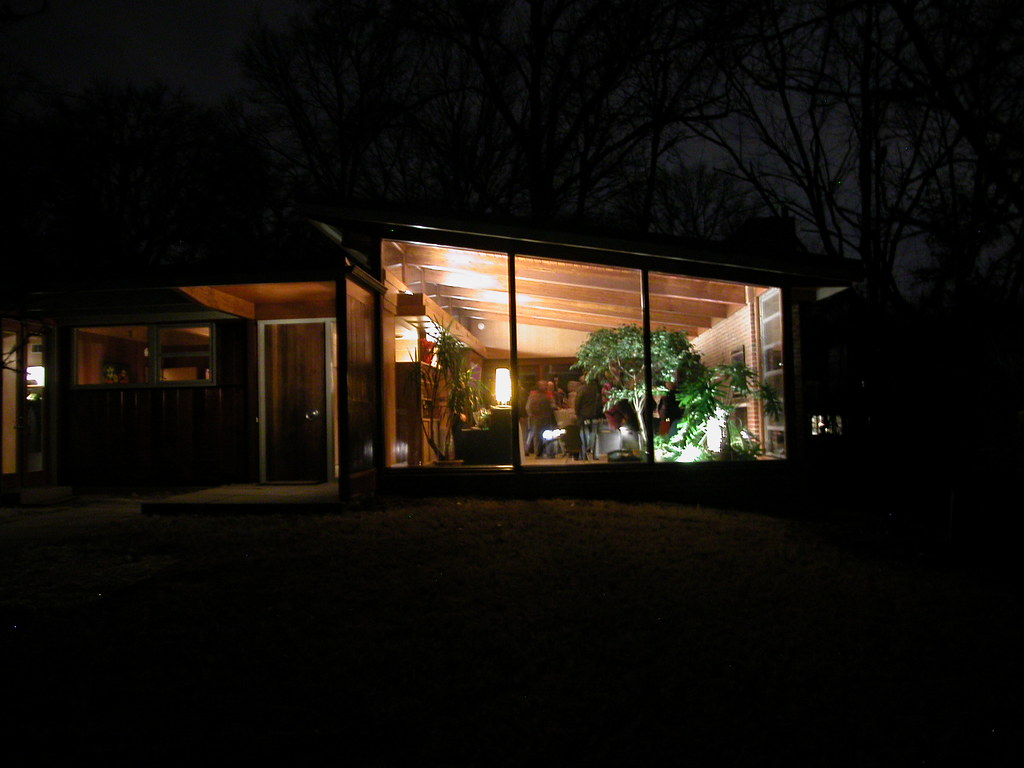 At a swinging party on Sunday, architect and rehab trend-setter Ray Simon celebrated completion of the rehabilitation of the Harry Hammerman House in Ladue. Guests enjoyed a look at the amazing realized potential that small mid-century homes offer. While the Hammerman House, a Usonian-inspired gem from 1952, is quite unique, its plight before Ray's purchase was not. Designer, builder and occupant Hammerman passed away in 2001, and the house sat vacant until Simon's purchase. Meanwhile, it was considered for a tear-down by an intervening owner. During this time, Ladue lost the Morton May House, the Louis Zorensky House and countless other mid-century modern houses large and small. On Graybridge Road, where the Hammerman House is located, one other modern home has fallen to the tear-down trend.
The rehab of the Harry Hammerman House breathes new life into a fine mid-century home, uses historic rehabilitation tax credits and allows a unique street to retain its character. What Ray Simon did can and should be done elsewhere across St. Louis County. The sobriety of the current housing market may help convince homeowners that conservation, retro-cool design, energy economy and modest scale are better for long-term investment than the super-sized, vinyl-clad villas that fed on the abundant east credit. St. Louis County is a treasure trove of opportunities for getting the most out of the new market!
Read more about the Harry Hammerman House here.
Tuesday, December 30, 2008
St. Louis Area Makes a List for Obama Administration
An article in the December 26 edition of the St. Louis Business Journal reported that the City of St. Louis has created a 400-page report on its federal infrastructure funding priorities, while St. Louis County has created a 200-page document of the same. The governments will deliver these reports to the incoming presidential administration of Barack Obama in response to his promise to channel federal dollars into public works programs across the nation.
The city's report outlines some big-ticket priorities: $900 million for the North/South MetroLink line, $219.5 million in streetscape improvements, $160 million in public school building improvements, $80 million in airport improvements and $59 million to implement the Gateway Mall Master Plan. According to Deputy Mayor Barbara Geisman, all of these projects are ready to start as soon as they are funded, but full funding is unlikely immediately. Still, the city's placement of MetroLink expansion at the top of its list is smart, since that is a crucial component of building a strong city economy and connecting citizens to jobs. The city's list carries some basic but crucial needs: street and transportation improvements and school renovation. (The Gateway Mall project is another story, but something does need to happen to the mall area.) These are important to stabilizing our neighborhoods, and Geisman should be commended for placing a high priority on these things.
Moving beyond the ready-to-go ideas, perhaps the city would consider a future request for an urban homesteading program. The program could find funding to stabilize and market the Land Reutiliation Authority's thousands of vacant homes across the city, generating hundreds of construction jobs and getting tax-free property back on city tax rolls where it can generate money to fund roads and schools.
St. Louis County's list starts with a $200 million, 3.3-mile expansion on Highway 141 at the top followed by the $105 million needed to retain existing Metro public transportation in the outer county. A significant and less costly item on the St. Louis County list is $24 million to fund a Midwest China Trade and Commercialization Center at NorthPark. While the China cargo hub prospect is not a done deal, it has the potential to bring more jobs to the St. Louis area in the next decade than any other prospect.
Other requests headed to the Obama administration are a predictable $510 million highway spending request from the Missouri Department of Transportation and a $66 million request to extend Page Avenue farther into St. Charles County, so that one may have a straight drive from downtown St. Louis to Mid Rivers Mall Drive. These requests are the usual pave-it-and-they-will-come junk.
Obviously, the disparate requests show the problem of regional political fragmentation. Inevitably, there will be partial funding of many requests rather than full funding of something big and transformational. Imagine what might happen if the regional governments pulled together with one request for the North/South MetroLink line this year, and further extensions in the future, rather than place the burden solely on the City of St. Louis. Imagine if the Missouri Department of Transportation put some of the needed Metro funding in its request.
Remember when we imagined that Obama could become president? Now that the dream is real, it's time to imagine other changes closer to home. Or, we can all fight over the pie for the next eight years, but it doesn't take much imagination to guess where that will get the St. Louis area.
The city's report outlines some big-ticket priorities: $900 million for the North/South MetroLink line, $219.5 million in streetscape improvements, $160 million in public school building improvements, $80 million in airport improvements and $59 million to implement the Gateway Mall Master Plan. According to Deputy Mayor Barbara Geisman, all of these projects are ready to start as soon as they are funded, but full funding is unlikely immediately. Still, the city's placement of MetroLink expansion at the top of its list is smart, since that is a crucial component of building a strong city economy and connecting citizens to jobs. The city's list carries some basic but crucial needs: street and transportation improvements and school renovation. (The Gateway Mall project is another story, but something does need to happen to the mall area.) These are important to stabilizing our neighborhoods, and Geisman should be commended for placing a high priority on these things.
Moving beyond the ready-to-go ideas, perhaps the city would consider a future request for an urban homesteading program. The program could find funding to stabilize and market the Land Reutiliation Authority's thousands of vacant homes across the city, generating hundreds of construction jobs and getting tax-free property back on city tax rolls where it can generate money to fund roads and schools.
St. Louis County's list starts with a $200 million, 3.3-mile expansion on Highway 141 at the top followed by the $105 million needed to retain existing Metro public transportation in the outer county. A significant and less costly item on the St. Louis County list is $24 million to fund a Midwest China Trade and Commercialization Center at NorthPark. While the China cargo hub prospect is not a done deal, it has the potential to bring more jobs to the St. Louis area in the next decade than any other prospect.
Other requests headed to the Obama administration are a predictable $510 million highway spending request from the Missouri Department of Transportation and a $66 million request to extend Page Avenue farther into St. Charles County, so that one may have a straight drive from downtown St. Louis to Mid Rivers Mall Drive. These requests are the usual pave-it-and-they-will-come junk.
Obviously, the disparate requests show the problem of regional political fragmentation. Inevitably, there will be partial funding of many requests rather than full funding of something big and transformational. Imagine what might happen if the regional governments pulled together with one request for the North/South MetroLink line this year, and further extensions in the future, rather than place the burden solely on the City of St. Louis. Imagine if the Missouri Department of Transportation put some of the needed Metro funding in its request.
Remember when we imagined that Obama could become president? Now that the dream is real, it's time to imagine other changes closer to home. Or, we can all fight over the pie for the next eight years, but it doesn't take much imagination to guess where that will get the St. Louis area.
Subscribe to:
Posts (Atom)


 Posts
Posts

