
At last night's meeting of the Special Administrative Board of the St. Louis Public Schools, Superintendent Kelvin Adams recommended closing the following six school buildings:
Gallaudet School for the Hearing Impaired, 1616 S. Grand; built in 1925; Rockwell Milligan, architect.
Alternative South at Lyon School; 7417 Vermont; built in 1909; William B. Ittner, architect.
Ford Branch School; 1383 Clara Avenue; built around 1960.
Fresh Start at Turner Middle School; 2615 Billups Avenue; built in 1939; George Sanger, architect.
Bunche at Madison School, 1118 S. Seventh; built in 1910; William B. Ittner, architect.
Pruitt Middle School (Cleveland Junior Naval Academy), 1212 N. 22nd; built in 1954.
Lyon School And Turner Middle School (formerly Stowe Teachers College) are already listed in the National Register of Historic Places. Gallaudet, Madison and Pruitt are eligible for such designation. Ford Branch might contribute to a historic district listing.
Six schools that Adams once suggested closing, including Mann Elementary School at 4047 Juniata Avenue in Tower Grove South (built in 1901-16 and designed by William B. Ittner; listed in the National Register), will be placed on a new "turnaround model" with new principals and at least 50% new teaching staff.
Four schools are going to be placed on "restart" -- closed as public schools and reopened as chartered schools. One of these is the venerable -- but academically failing -- Sumner High School at 4248 Cottage Avenue in the Ville (built in 1908-9 and designed by William B. Ittner; listed in the National Register).
Showing posts with label schools. Show all posts
Showing posts with label schools. Show all posts
Friday, April 16, 2010


Thursday, April 15, 2010
More St. Louis Public Schools to Close
On Tuesday, the St. Louis Beacon published an article by Dale Singer covering a presentation by Superintendent Kelvin Adams on the state of the troubled St. Louis Public Schools. Not surprising, perhaps, is the prediction by Adams that more school closings are ahead. Singer writes:
Of the district's buildings -- 74 currently in use, 39 decommissioned -- the average age is 75 years, he said, ranging from six years to 132. Last year more than a dozen schools were closed, down from the 29 closings that a consulting firm had recommended, but more are certain to be on the closing list this time around.
Mann School in Tower Grove South, previously considered for demolition and replacement or closure, likely will again be threatened with closure. Given the district's financial state, however, demolition and construction of new school buildings seems unlikely.
That the average age of a city school building is 75 years means that the average city school student attends class in a historic neighborhood school. While that fact alone does not produce desired educational outcome, it is reassuring. Our students are interacting with their city's heritage and most are attending class in humane buildings with ample natural light, ventilation and classroom space. Imagine if the troubled district was mostly housed in the bleak, low-ceiling, fluorescent-lit educational hot-houses being built today. Performance could be much worse.
Of the district's buildings -- 74 currently in use, 39 decommissioned -- the average age is 75 years, he said, ranging from six years to 132. Last year more than a dozen schools were closed, down from the 29 closings that a consulting firm had recommended, but more are certain to be on the closing list this time around.
Mann School in Tower Grove South, previously considered for demolition and replacement or closure, likely will again be threatened with closure. Given the district's financial state, however, demolition and construction of new school buildings seems unlikely.
That the average age of a city school building is 75 years means that the average city school student attends class in a historic neighborhood school. While that fact alone does not produce desired educational outcome, it is reassuring. Our students are interacting with their city's heritage and most are attending class in humane buildings with ample natural light, ventilation and classroom space. Imagine if the troubled district was mostly housed in the bleak, low-ceiling, fluorescent-lit educational hot-houses being built today. Performance could be much worse.
Friday, February 26, 2010
Senate Bill Introduced For Historic Schools
From Preservation Action:
On January 29th, Sen. Jim Webb (D-VA) introduced S. 2970, the Rehabilitation of Historic Schools Act of 2010. A companion bill (H.R. 4133) was introduced in the House by Eric Cantor (R-VA) in November.
The bill would change a provision in the Federal Rehabilitation Tax Credit that currently restricts renovation of older public school buildings, limiting the ability of local governments to partner with private developers to rehabilitate schools.
"With municipalities across the country unable to fund school repairs and construction, this bill will provide needed assistance, partner local government with the private sector, create jobs, and give our children the facilities they need to learn and grow,” said Webb in his press release. "Good local schools and well-maintained public facilities are key indicators of where businesses may locate. This legislation strengthens our communities across the board."
On January 29th, Sen. Jim Webb (D-VA) introduced S. 2970, the Rehabilitation of Historic Schools Act of 2010. A companion bill (H.R. 4133) was introduced in the House by Eric Cantor (R-VA) in November.
The bill would change a provision in the Federal Rehabilitation Tax Credit that currently restricts renovation of older public school buildings, limiting the ability of local governments to partner with private developers to rehabilitate schools.
"With municipalities across the country unable to fund school repairs and construction, this bill will provide needed assistance, partner local government with the private sector, create jobs, and give our children the facilities they need to learn and grow,” said Webb in his press release. "Good local schools and well-maintained public facilities are key indicators of where businesses may locate. This legislation strengthens our communities across the board."
Monday, December 21, 2009
Marshall School Awaits New Use
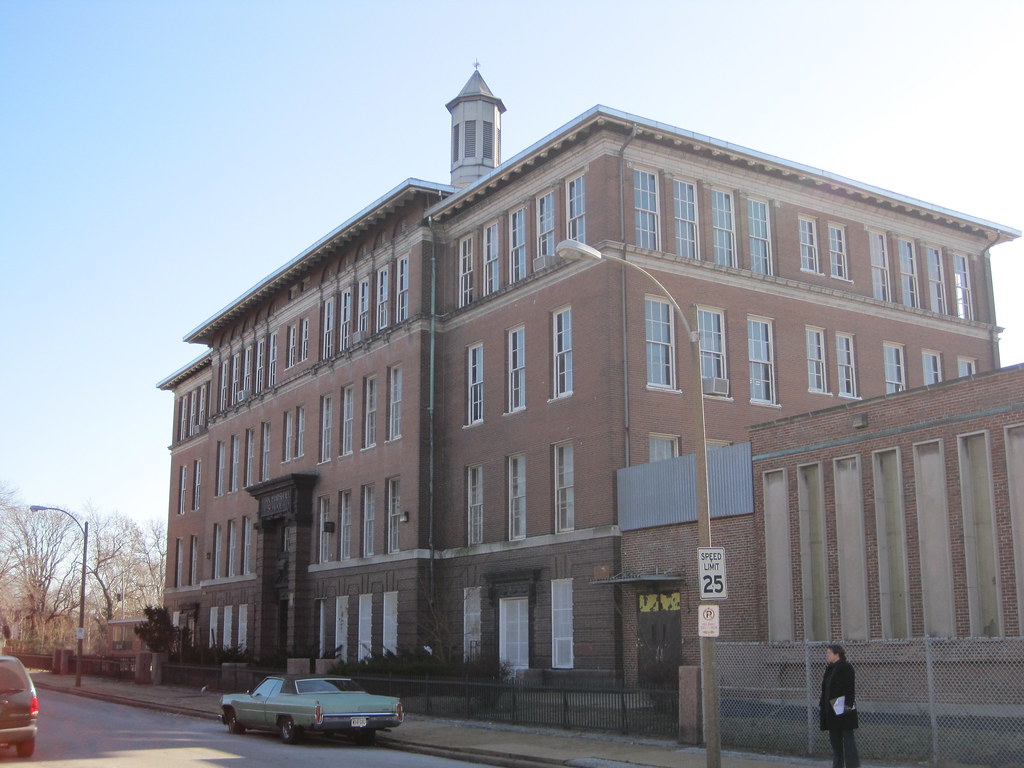 This week's news of a reprieve for Sumner High School brought relief to the Ville neighborhood, where another public school remains vacant after closing this summer. Stately John Marshall School stands at 4342 Aldine Avenue between Newstead and Pendleton avenues. The three-story building in the Classical Revival style dates to 1900 and is one of architect William B. Ittner's first uses of the E-Plan layout.
 The entrance is imposing and formed by brick piers supporting a massing terra cotta entablature. Brown terra cotta is used there and surrounding the doorway, over which a bust of John Marshall watches.
 Like Sumner, Marshall School is a crucial part of the cultural legacy of the Ville. During segregation, the school became an African-American intermediate school in 1918 and an elementary school in 1927. Many students who would pass through the doors of mighty Sumner High School, also designed by Ittner, would first pass through Marshall School.
What future may be in store for the shuttered Marshall School is uncertain. With deed restrictions against charter school purchase lifted by the St. Louis Public Schools, educational use is possible. For now, however, all that is certain is that the Ville does not need another vacant school building.
Thursday, December 17, 2009
Good News and Bad News on Page Boulevard
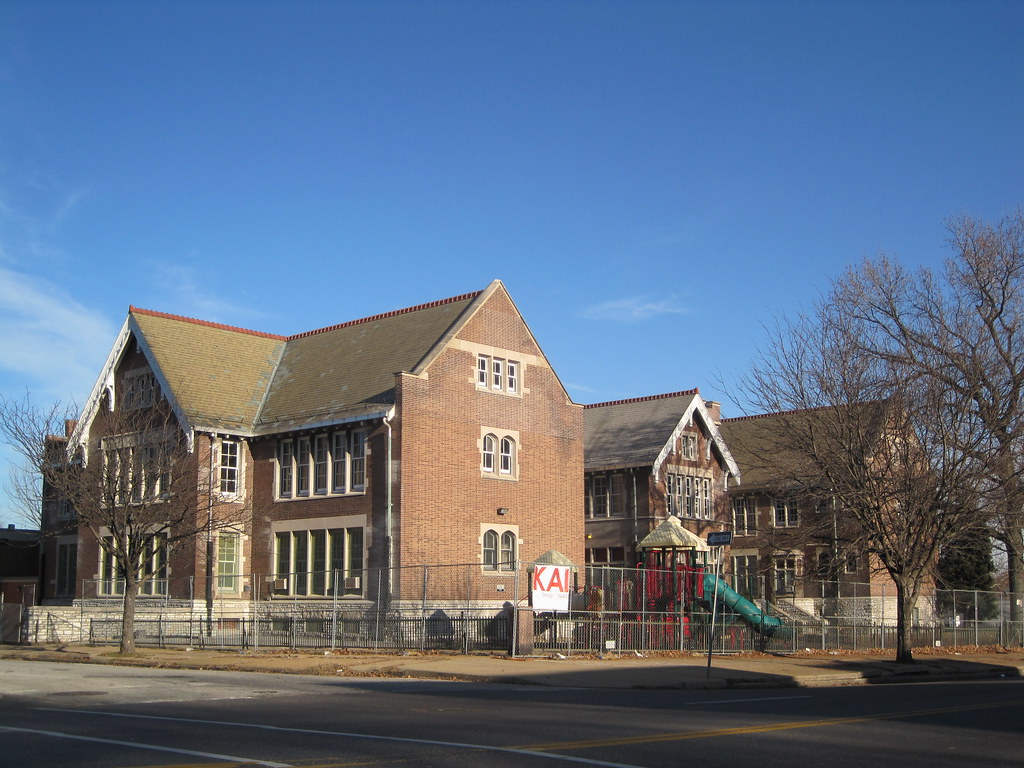 Preservationists should send their thanks to Better Family Life, a cultural and educational organization that is uplifting African-American St. Louis while rehabilitating one of our city's irreplaceable historic schools. In 2005, Better Family Life purchased the shuttered Ralph Waldo Emerson School at 5415 Page Boulevard. This year, the organization began a $4.5 million rehabilitation that will convert the school into an educational and cultural center.
Currently, a construction fence surrounds the school. Workers are on site most days, and a lift was in front today. The daily activity at Emerson School has not been this high since the school's last day of classes in June 2003. When the school closed, few predicted that any serious buyer would step forward so soon. The landmark could have become an abandoned wreck.
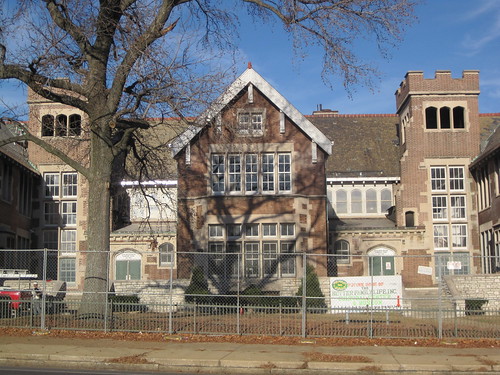 Designed by William B. Ittner and completed in 1901, the brick school is one of the earliest of Ittner's schools in the hybrid "Jacobethan" style that he helped popularize. Ittner began working for the St. Louis Board of Education in 1898, and did not turn to the Renaissance styles until a few years into his tenure. Emerson School is a handsome early work utilizing the architect's open floor plan. The grace of the landmark shall be with us for generations, thanks to Better Family Life.
 If only all good news from St. Louis' built environment did not have to be counterbalanced by bad news. Just two blocks east of Emerson on the south side of mighty Page Boulevard at Union Boulevards, another north side landmark is meeting a sad end. The corner commercial block at 5986-98 Page Boulevard, written about on this blog several times before, is finally falling to the wreckers. I offer here an image of the building in better days, and will spare readers yet another demolition photograph.
The corner building is a younger building than Emerson School, with a completion date at 1905. The two-story building is part of the Mount Cabanne-Raymond Place Historic District and could have been reused utilizing historic tax credit programs. Surely, commercial storefronts and apartments enjoy far more demand in the city than cultural centers. However, the building had the wrong owner, the Berean Seventh Day Adventist Church, which will be building a parking lot on the site.
In February 2008, the city's Preservation Board voted 5-2 to deny a demolition permit for this building. Then, in June 2009, the city's Planning Commission arbitrarily overturned the Preservation Board decision (see "Planning Commission Overturns Two Preservation Board Decisions", June 19).
The story got stranger after that when the church failed to meet the requirements of the Planning Commission decision but began demolition this summer without a permit. City officials called a halt to the wrecking, but the wreckers had already delivered fatal damage by removing most of the roof. Now the rest of the building will be removed legally. Page Boulevard will have a completely disjointed, unhinged intersection with Union Boulevard. Two prominent thoroughfares shall meet at an intersection as full of character as any generic suburban intersection anywhere in the United States. This city, it should be stated, deserves better. It deserves what it had before.
Wednesday, July 8, 2009
Records Left at Arlington School
A fascinating report on KTVI news covers the discovery of children psychiatric records found inside of a portable classroom at the abandoned Arlington School at 1617 Burd Avenue in Wells-Goodfellow. I have been all over inside of the historic building for documentation work, but never inside of the classrooms built in 1961. However, I have been inside enough abandoned buildings to know that the abandonment of private employee and medical records is far too common.
The story also hits on the upcoming renovation of Arlington, quoting Alderman Jeffrey Boyd (D-22nd) saying: "For some people, it is an eyesore. I see it as an opportunity."
Good attitude.
The story also hits on the upcoming renovation of Arlington, quoting Alderman Jeffrey Boyd (D-22nd) saying: "For some people, it is an eyesore. I see it as an opportunity."
Good attitude.
Tuesday, April 21, 2009
St. Louis Public School Closings on NPR's "All Things Considered"
KWMU reporter Adam Allington's story on St. Louis Public Schools closings was carried today on NPR's "All Things Considered." NPR's website features a gallery of photographs of schools closed in the current round. The story will air again tonight at 6:40 p.m. on 90.7 FM, and the audio file will be posted online after 7:00 p.m.
Friday, April 17, 2009
SLPS Deed Restrictions Out
From the St. Louis Public Schools:
ST. LOUIS, MO, April 17, 2009 – The Special Administrative Board of the St. Louis Public Schools voted unanimously (3-0) in closed session last evening to remove the deed restriction clause currently included in all property sales contracts. This policy goes into effect on June 30, 2009, to allow the district ample time to evaluate the facility needs for the upcoming school year in light of several new academic initiatives presented at the meeting by Superintendent Dr. Kelvin Adams.
Among those issues are:
· Assessing the required classrooms and schools needed for initiatives, such as pilot independent schools, before and after school programs, and alternative education programs which are included in Superintendent Dr. Kelvin Adams’ academic plan for the district.
· Providing alternate school sites for buildings undergoing lead paint abatement during the summer of 2009.
"We have worked with our elected leaders at the state capital in resolving this issue, and we appreciate their support in finding a resolution where we can enhance the education for all of our City students," said Rick Sullivan, President & CEO of the Special Administrative Board.
The deed restriction has been a long standing issue from past school boards, and it was determined by the Special Administrative Board to be in the best interest of student education in St. Louis to revisit and revise the policy.
State Representative Tim Jones (R-89) said, "I appreciate the willingness of the St. Louis Public Schools to revisit this policy. I believe that by working together, we have reached a solution satisfactory to all parties for the betterment of education for the children in the City of St. Louis."
State Representative Chris Carter (D-61) added, "I support the Special Administrative Board in this decision that will help make our neighborhoods stronger. This decision allows the St. Louis Public Schools to do what it believes is in the best interest of all the students in the City of St. Louis."
ST. LOUIS, MO, April 17, 2009 – The Special Administrative Board of the St. Louis Public Schools voted unanimously (3-0) in closed session last evening to remove the deed restriction clause currently included in all property sales contracts. This policy goes into effect on June 30, 2009, to allow the district ample time to evaluate the facility needs for the upcoming school year in light of several new academic initiatives presented at the meeting by Superintendent Dr. Kelvin Adams.
Among those issues are:
· Assessing the required classrooms and schools needed for initiatives, such as pilot independent schools, before and after school programs, and alternative education programs which are included in Superintendent Dr. Kelvin Adams’ academic plan for the district.
· Providing alternate school sites for buildings undergoing lead paint abatement during the summer of 2009.
"We have worked with our elected leaders at the state capital in resolving this issue, and we appreciate their support in finding a resolution where we can enhance the education for all of our City students," said Rick Sullivan, President & CEO of the Special Administrative Board.
The deed restriction has been a long standing issue from past school boards, and it was determined by the Special Administrative Board to be in the best interest of student education in St. Louis to revisit and revise the policy.
State Representative Tim Jones (R-89) said, "I appreciate the willingness of the St. Louis Public Schools to revisit this policy. I believe that by working together, we have reached a solution satisfactory to all parties for the betterment of education for the children in the City of St. Louis."
State Representative Chris Carter (D-61) added, "I support the Special Administrative Board in this decision that will help make our neighborhoods stronger. This decision allows the St. Louis Public Schools to do what it believes is in the best interest of all the students in the City of St. Louis."
Monday, April 6, 2009
University City Votes Should Vote NO on Proposition U
by Lindsey Derrington
Tomorrow University City residents will have the opportunity to vote either for or against Proposition U, a $53.6 million bond issue for the University City School District. If passed, this bond issue will fund the district's proposed facilities plan which entails the demolition of Pershing (1920) and Barbara C. Jordan (1951) Elementary schools -- the former designed by Ittner himself, and the latter designed by William B. Ittner, Inc. Both of these schools currently provide healthy, functioning educational environments and both have shown the most improvement within the district in recent years. If failed, property taxes will drop in University City and the district will have a community mandate to rework its plans to improve educational achievement amongst its students, one which would focus less on facilities and more on the teachers and students themselves.
A vote for or against Proposition U is not a vote for or against the students within the UCSD, but one for or against a facilities plan which fails to address the real needs of the district.
Tomorrow University City residents will have the opportunity to vote either for or against Proposition U, a $53.6 million bond issue for the University City School District. If passed, this bond issue will fund the district's proposed facilities plan which entails the demolition of Pershing (1920) and Barbara C. Jordan (1951) Elementary schools -- the former designed by Ittner himself, and the latter designed by William B. Ittner, Inc. Both of these schools currently provide healthy, functioning educational environments and both have shown the most improvement within the district in recent years. If failed, property taxes will drop in University City and the district will have a community mandate to rework its plans to improve educational achievement amongst its students, one which would focus less on facilities and more on the teachers and students themselves.
A vote for or against Proposition U is not a vote for or against the students within the UCSD, but one for or against a facilities plan which fails to address the real needs of the district.
Thursday, April 2, 2009
A St. Louis Public School Not Designed by Ittner or Milligan
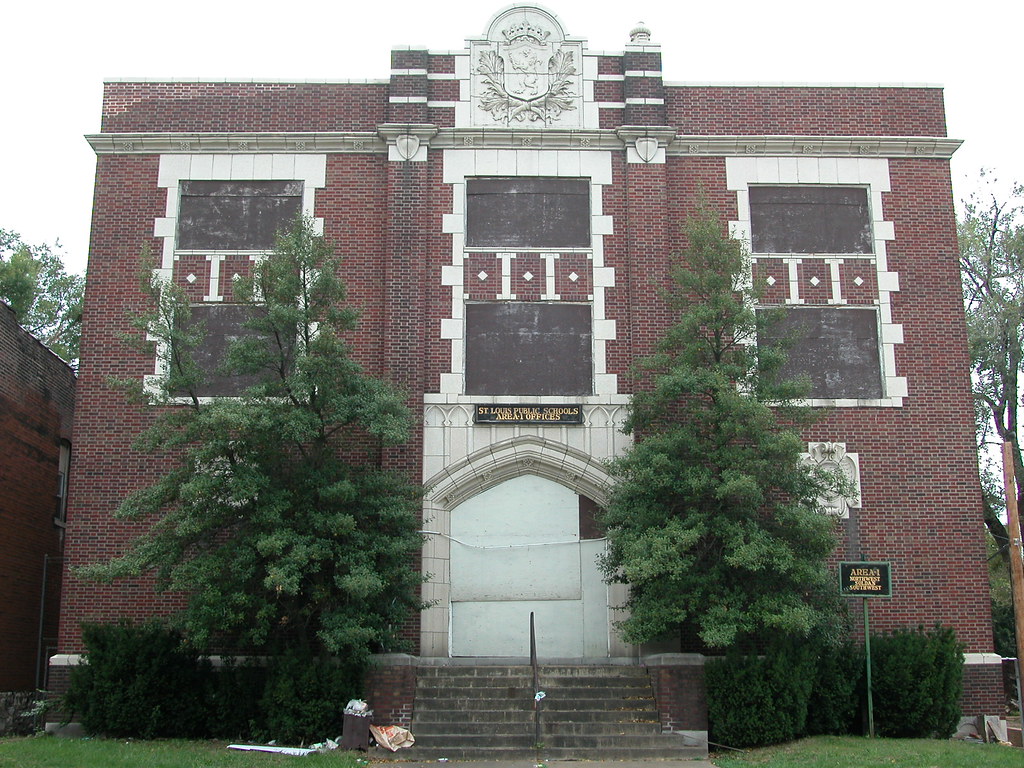 The large vacant brick building at 5234 Wells Avenue in the Academy Neighborhood bears a sign reading "St. Louis Public Schools / Area 1 Offices." The imposing Jacobethan building has the symmetry, grace and quality of construction that is consistent with the stock of the St. Louis Public Schools, but it really does not resemble the buildings designed by William B. Ittner or Rockwell Milligan. Stylistically, there is some connection, but the plan, siting, lack of ornamentation on the side elevation and detailing is different. The massive terra cotta heraldic shield that caps the central entrance bay as well as the cartouches under the flanking window bays are clearly the work of another architect.
There's a good reason for this: the building was not built for the St. Louis Public Schools. The Mt. Calvary Evangelical Lutheran Church built this building in 1928 as a private religious school (cost was $40,000). Architect Albert Meyer designed the building, likely trying to match the renowned architecture of the public school district. Eventually, however, the congregation moved west and the closed school met the needs of an expanding St. Louis Public School district. Yes, the district expanded to the point of buying other school buildings within the lifetimes of many living city residents.
The Mt. Calvary school became Wells School and then Emerson Branch School. The last use was as the Area 1 Offices, housing regional administration for the Northwest, Soldan and Southwest high schools. The district closed the building in 1995 and sold it in 2006 to Grizzly LLC, a St. Charles-based firm. Today the building sits empty with no plans for reuse.
MGT of America recommended that the St. Louis Public Schools consider selling the downtown headquarters building and reusing existing schools for offices. This building, already converted, would have fit the bill. Its small size would also have made it a suitable alternative school. Too bad the district sold it.
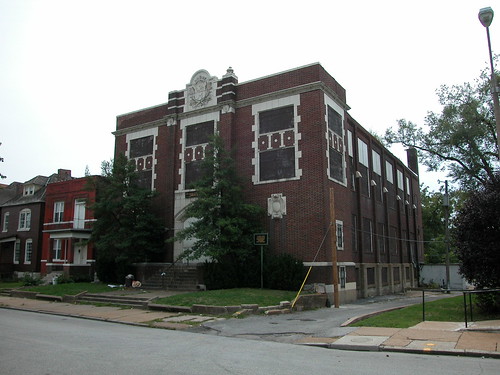
Area 1 Offices building in September 2006.

Area 1 Offices building in May 1988 (photograph by Landmarks Association of St. Louis).
Friday, March 13, 2009
SAB Approves Superintendent's Recommended Facilities Plan
Last night, the Special Administrative Board unanimously approved the Facilities Management Plan recommended by St. Louis Public Schools Superintendent Kelvin Adams. The recommendations call for 17 school closures and the possible demolition of Mann School in Tower Grove South. (The summary and list are available here.) Adams first presented his recommendations to the SAB on February 26.
At last night's meeting, three individuals spoke on behalf of Mann School during the public comment period, but the SAB ignored the pleas to keep the school open. However, the plan approved by the SAB would not close Mann until 2011 with a decision made next year, providing time for community input and reversal of the recommendations. Tower Grove South residents including the Block Captains association as well as Alderwoman Jennifer Florida (D-15th) oppose closing Mann and any plan that would call for its demolition.
At last night's meeting, three individuals spoke on behalf of Mann School during the public comment period, but the SAB ignored the pleas to keep the school open. However, the plan approved by the SAB would not close Mann until 2011 with a decision made next year, providing time for community input and reversal of the recommendations. Tower Grove South residents including the Block Captains association as well as Alderwoman Jennifer Florida (D-15th) oppose closing Mann and any plan that would call for its demolition.
Thursday, March 12, 2009
The Fate of Mann School
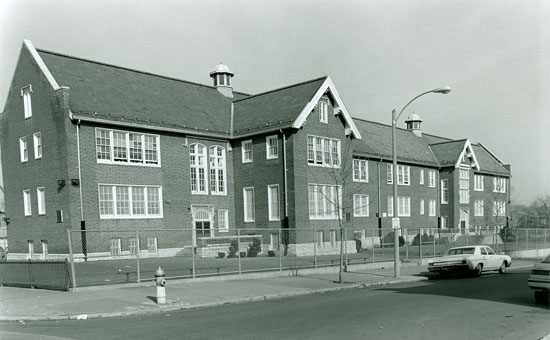
St. Louis Public Schools Superintendent Kelvin Adams relieved many city residents with his closure recommendations, which number 17 as opposed to the 29 schools proposed by a team of consultants hired by the district in January. However, Adams raised the threat to Mann School at 4047 Juniata in Tower Grove South, which Admas is proposing not only for closure but also for possible demolition and replacement with a new building.
This recommendation is actually the one point where Adams is actually pushing a more severe threat to the district's historic architecture than did the old-building-fearing consultants from MGT of America. MGT proposed closing Mann along with Shenandoah and Sherman schools, with all three south side elementaries combined at a new super-school in Tower Grove East. Adams wants Shenandoah to remain open, but is proposing a merger of Mann and Sherman in a new building he thinks could be built on the Mann site. A final decision would be made next year, but the crucial step is taken tonight when the facilities management plan is ratified.
The Mann site must be the most poorly-suited site in the district for construction of a new school building. When Mann was built in 1901 to designs by William Ittner, the ornate Jacobethen revival school was a compact two-story building on a compact site. Unlike those of other Ittner schools, the Mann site was not expansive and landscaped; it was small and paved, used for playground space. The school was in close proximity to buildings across the alley and across the street, in a siting beautifully urban. A 1916 addition that doubled Mann's size maintained the relationship of the school to the neighborhood. (Paul Hohmann has great photographs in a recent blog post at Vanishing STL.)
Now, the school is landlocked in one of the city's most stable and densely populated neighborhoods. Furthermore, the elementary school is doing well -- enrollment is around 80%, the student base is 52% ESOL so south city's immigrants are well-served, and 12 different organizations provide services at the school to students neighborhood children. This is a model neighborhood school. In fact, the state of Mann sounds a lot like the vision that members of the Special Administrative Board have for other elementary schools in the district.
Tonight (Thursday, March 12), the Special Administrative Board has a chance to save that model school. The Board will approve a facilities plan and closure list at its meeting, 6:00 p.m. at the Gateway Schools complex gymnasium, 1200 N. Jefferson. the public may address the Board at this meeting.
The largest step that the SAB could take would be removing Mann from the closure list altogether to safeguard its success and connection to the neighborhood. However, under any circumstances, demolition of Mann School should not be an option in the facilities plan. The SAB must amend Adams' recommendations to prohibit demolition of Mann or any other historic school building -- a condition now placed by the SAB in all sales contracts to private owners. Besides, rehabbing Mann or Sherman, or both, would be far more economical than building new.
This building, listed in the National Register of Historic Places in 1992 for architectural significance, is a unique gem in a strong urban setting. The site is too small for a new school. The school is doing well. Why force an awkward fit, lose a great building and tamper with a stable neighborhood?
Monday, March 9, 2009
100 Supporters March and Rally to Save Public Schools
ST. LOUIS, Mo. – One hundred public school supporters held a Save Our Schools Rally at Shepard Elementary School at 3405 Wisconsin this morning to show support for keeping the school open. They then marched to Monroe Elementary, Carnahan High School, Meramec Elementary, three schools that have been recommended to stay open, with a concluding rally at Cleveland High School on S. Grand (which was closed three years ago).
At Shepard Alderman Craig Schmid urged participants to sign a petition opposing the closure of St. Louis Public Schools such as Shepard (e-MINTS) Elementary, Meramec Elementary, Cleveland High and Scruggs Elementary. “There are plenty of children in the area, but we have not seen sufficient efforts to market or recruit students to participate in quality St. Louis Public School programming,” Schmid said. Shepard pre-schoolers led those gathered in saying the pledge of allegiance to the flag and singing “The Star Spangled Banner” before reciting a portion of a speech by Dr. Martin Luther King, Jr.
At Monroe Elementary, Schmid told the history of the school’s successful re-opening after almost 20 years of being closed. He questioned whether charter schools would be accountable to the community for quality education and noted that charter schools already operating in the area do not compare well with student achievement at Monroe.
At Carnahan High School and Meramec Elementary School, marchers stopped to celebrate successes, including recent awards given to Dr. Alice Roach, principal of Carnahan. Student ambassadors told about high tech classroom aids available at the school and announced that Carnahan had just received accreditation through the North Central Association.
John Chen of The Alliance to Save Cleveland High greeted marchers at the final stop of the Save Our Schools event and told them about work that citizens are doing to get the high school re-opened. Chen said they hope to see the building used as a much-needed community center and “as a collection of small learning communities in one large building.” Such a model has operated successfully, according to Cleveland supporters who have been researching “best practices” in other cities.
Alderwoman Dorothy Kirner (Ward 25) and State Representative Jeanette Mott Oxford (District 59) were also present to show support for keeping the schools open. Those interested in joining efforts to support any of these schools are invited to call Schmid at 314-589-6816 or Oxford at 314-771-8882.
At Shepard Alderman Craig Schmid urged participants to sign a petition opposing the closure of St. Louis Public Schools such as Shepard (e-MINTS) Elementary, Meramec Elementary, Cleveland High and Scruggs Elementary. “There are plenty of children in the area, but we have not seen sufficient efforts to market or recruit students to participate in quality St. Louis Public School programming,” Schmid said. Shepard pre-schoolers led those gathered in saying the pledge of allegiance to the flag and singing “The Star Spangled Banner” before reciting a portion of a speech by Dr. Martin Luther King, Jr.
At Monroe Elementary, Schmid told the history of the school’s successful re-opening after almost 20 years of being closed. He questioned whether charter schools would be accountable to the community for quality education and noted that charter schools already operating in the area do not compare well with student achievement at Monroe.
At Carnahan High School and Meramec Elementary School, marchers stopped to celebrate successes, including recent awards given to Dr. Alice Roach, principal of Carnahan. Student ambassadors told about high tech classroom aids available at the school and announced that Carnahan had just received accreditation through the North Central Association.
John Chen of The Alliance to Save Cleveland High greeted marchers at the final stop of the Save Our Schools event and told them about work that citizens are doing to get the high school re-opened. Chen said they hope to see the building used as a much-needed community center and “as a collection of small learning communities in one large building.” Such a model has operated successfully, according to Cleveland supporters who have been researching “best practices” in other cities.
Alderwoman Dorothy Kirner (Ward 25) and State Representative Jeanette Mott Oxford (District 59) were also present to show support for keeping the schools open. Those interested in joining efforts to support any of these schools are invited to call Schmid at 314-589-6816 or Oxford at 314-771-8882.
Sunday, March 1, 2009
Adams Recommends Keeping Ames School Open
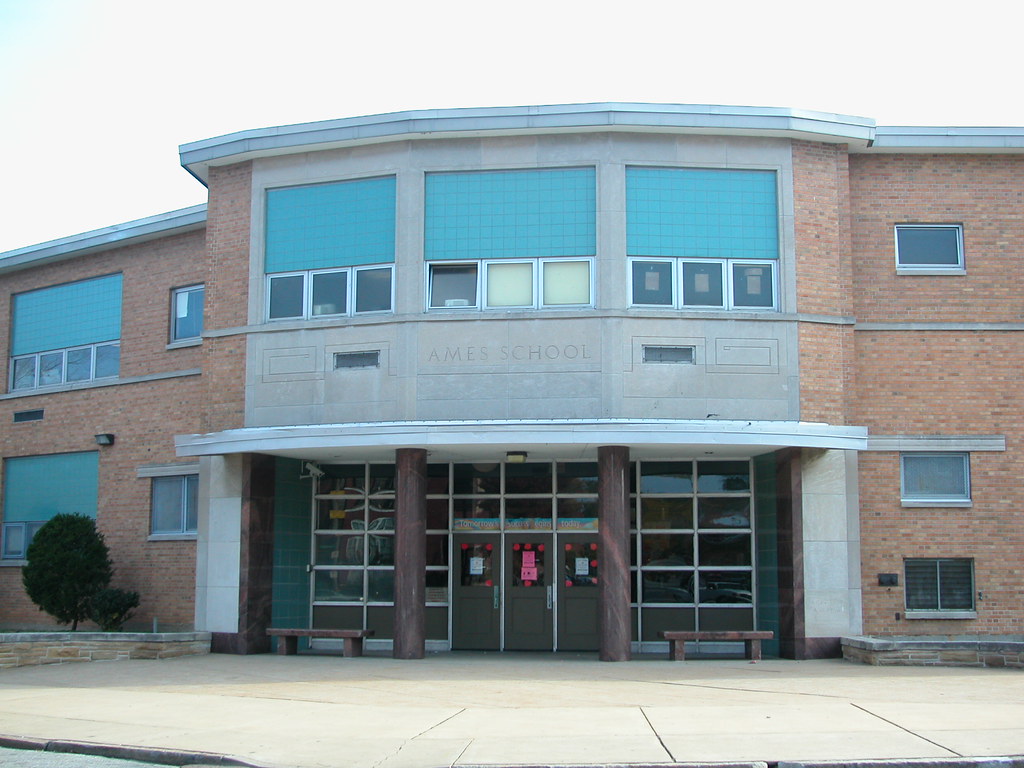 St. Louis Public Schools Superintendent Kelvin Adams is recommending that Ames Visual and Performing Arts (VPA) Elementary School at 2900 Hadley Street in Old North St. Louis remain open. On Thursday, February 26, Adams recommended to the Special Administrative Board (SAB) that the Board reject the proposal from consultants MGT of America that Ames combine with Shaw VPA Elementary School at the Blewett Middle School on Cass Avenue, and the two schools' buildings close.
While the SAB will not approve Adams' recommendations until March 12, the shift from the consultants' recommendations is welcome in Old North, a neighborhood that remains beset by an earlier school closure. In 2007, the Board of Education closed Webster Middle School at 2127 N. 11th Street. Webster is a large historic school whose site encompasses an entire city block. Since its closure, which came after the opening of charter school Confluence Academy in Old North, the district has not placed Webster for sale nor determined its future use. The building sits vacant in a neighborhood saddled with many large, vacant historic buildings, including the partly-stabilized Mullanphy Emigrant Home, the Meier and Pohlmann factory and the burned-out Fourth Baptist Church. The neighborhood did not need another building added to that list.
Opened in 1956, Ames is a fine mid-century building that provides a pleasant contrast with its 19th-century red-brick surroundings. Ames closes eastward views down both Wright and Sullivan streets. In 1992 under the Capital Improvement Program, Ames was expanded with a substantial addition. Later, in 2006, Ames closed for a period to be fully air-conditioned. Ames is a polling place, community meeting space and has been a source for student volunteers in neighborhood garden programs.
Thursday, February 26, 2009
Shenandoah School May Be Spared
 Shenandoah Elementary School at 3412 Shenandoah Avenue in Tower Grove East received a reprieve tonight when St. Louis Public Schools Superintendent recommended to the Special Administrative Board (SAB) that the school remain open in its current building. Although the final decision of Adams' recommendation won't be made by the SAB until March 12, the news is a relief to a neighborhood concerned that the future a community resource might become a huge question mark.
Under the proposal from consultants MGT of America unveiled in January, Shenandoah was set to be combined with Mann Elemantary School in Tower Grove Soth and Sherman Elementary School in Shaw in a new building to be build "near" Shenandoah. Neighborhood residents feared that "near" in a dense, landlocked neighborhood meant "on" and that an architectural gem would be lost. The MGT recommendations came only a year after the SLPS had proposed closing Shenandoah outright.
 The school is a remarkable building, known widely for the braided limestone columns of its striking entrance (pictured above). Designed by Rockwell Milligan and built in 1925, Shenandoah School is an excellent example of the eclectic strain in 1920s American architecture. Combining Spanish Revival and Renaissance Revival elements on an imposing buff-brick body with a red tile roof, Shenandoah is an unique school buidling and a treasure to its neighbors.
Unfortunately, Adams' recommendations still include the closure and merger of Mann and Sherman in a new school. This time, Mann is suggested for demolition.
Adams Proposes 17, Not 29, School Closings
Tonight, St. Louis Public Schools (SLPS) Superintendent Kelvin Adams presented to the Special Administrative Board (SAB) his recommendations for school closures and consolidations. While consultants MGT of America had recommended 29 closures, Adams recommends 17. Adams' plan makes one wonder why MGT was hired at all, given how far off their plan was from the needs of the district identified by its superintendent.
Adams recommends closing the following schools in June 2009:
Ashland Branch
Baden Elementary School
Henry eMINTS Elemntary School
Clark eMINTS Elementary School
Big Picture at Des Peres School
Mark Twain Elementary School
Meda P. Washington Early Childhood Center
Scruggs Elementary School
Shepard Elementary School
Simmons-Marshall School
Blewett Middle School
Stowe Middle School
Big Picture at Turner School
Roosevelet Ninth Grade Center at Humboldt School
Big Picture at Kottmeyer School
Adams recommends closing the following schools in June 2011:
Cote Brilliante Elementary School
Mann Elementary eMINTS School
Sherman Elementary School
The following schools that MGT had proposed closing will remain open:
Gallaudet School
Patrick Henry Elementary School
Mallinckrodt Elementary School
Ames Elementary VPA School
Shaw Elementary VPS School
Shenandoah Elementary School
Hickey Elementary School
Bunche Middle School
L'Overture Middle School
Langston Middle School
McKinley Middle School
Stevens Middle School
Gateway High School (possibly in new building on site)
Nottingham CJAT School
Cleveland High @ Pruitt (no return to Cleveland)
Northwest Academy of Law
Adams retains the idea from MGT of constructing two new elementary schools -- one south and one north. The south side school will combine Mann and Sherman and astonishingly is proposed for the Mann School site.
Among other recommendations from Adams is a proposal to turn the 13 SLPS-run community education centers into full service schools along the line proposed by the Board of Education; and two new alternative schools that could occupy existing buildings that have scored an overall 70 or higher in MGT's survey.
Overall, the closures will save the district slightly less than $14 million.
The Special Administrative Board will make its final decision at a public meeting held on March 12, 2009.
Adams recommends closing the following schools in June 2009:
Ashland Branch
Baden Elementary School
Henry eMINTS Elemntary School
Clark eMINTS Elementary School
Big Picture at Des Peres School
Mark Twain Elementary School
Meda P. Washington Early Childhood Center
Scruggs Elementary School
Shepard Elementary School
Simmons-Marshall School
Blewett Middle School
Stowe Middle School
Big Picture at Turner School
Roosevelet Ninth Grade Center at Humboldt School
Big Picture at Kottmeyer School
Adams recommends closing the following schools in June 2011:
Cote Brilliante Elementary School
Mann Elementary eMINTS School
Sherman Elementary School
The following schools that MGT had proposed closing will remain open:
Gallaudet School
Patrick Henry Elementary School
Mallinckrodt Elementary School
Ames Elementary VPA School
Shaw Elementary VPS School
Shenandoah Elementary School
Hickey Elementary School
Bunche Middle School
L'Overture Middle School
Langston Middle School
McKinley Middle School
Stevens Middle School
Gateway High School (possibly in new building on site)
Nottingham CJAT School
Cleveland High @ Pruitt (no return to Cleveland)
Northwest Academy of Law
Adams retains the idea from MGT of constructing two new elementary schools -- one south and one north. The south side school will combine Mann and Sherman and astonishingly is proposed for the Mann School site.
Among other recommendations from Adams is a proposal to turn the 13 SLPS-run community education centers into full service schools along the line proposed by the Board of Education; and two new alternative schools that could occupy existing buildings that have scored an overall 70 or higher in MGT's survey.
Overall, the closures will save the district slightly less than $14 million.
The Special Administrative Board will make its final decision at a public meeting held on March 12, 2009.
Wednesday, February 25, 2009
Superintendent to Present Facilities Recommendations on Thursday at Public Meeting
A very important meeting in the St. Louis Public Schools facilities management process occurs tomorrow night. The Special Administrative Board (SAB) will meet to hear a presentation from Superintendent Kelvin Adams on his recommendations for the facilities management plan, including a closure list. Adams' recommendations could very well become the plan adopted by the SAB.
Neighborhood activists across the city would do well to attend and find out what the superintendent recommends.
The public meeting takes place at 6:00 p.m. on Thursday, February 26 at the Gateway Schools complex gymansium, 1200 N. Jefferson.
A demonstration against the MGT of America facilities recommendations will commence at 5:25 p.m. outside of the Gateway Schools complex.
Neighborhood activists across the city would do well to attend and find out what the superintendent recommends.
The public meeting takes place at 6:00 p.m. on Thursday, February 26 at the Gateway Schools complex gymansium, 1200 N. Jefferson.
A demonstration against the MGT of America facilities recommendations will commence at 5:25 p.m. outside of the Gateway Schools complex.
Aldermen Support Re-Opening Cleveland High School
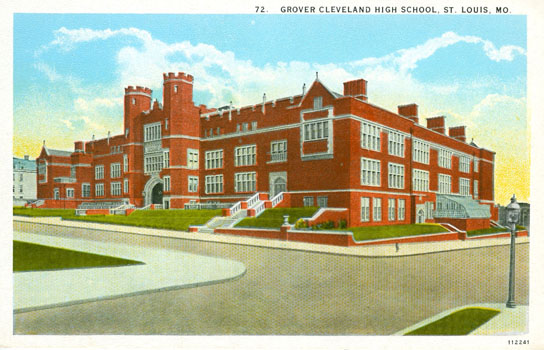
At the Monday meeting of the Intergovernmental Affairs Committee of the St. Louis Board of Aldermen, three aldermen spoke strongly in favor of reopening the shuttered Cleveland High School at 4352 Louisiana Avenue in Dutchtown. The Special Administrative Board (SAB) appeared at the committee to present the proposed facilities management plan and take comments and questions from committee members.
Alderwoman Dorothy Kirner (D-25th), whose ward includes the magnificent school, was direct. During her inquiry, Kirner reminded the Board of the earlier plan to reopen Cleveland, and stated that "I want to know that still holds."
In response, SAB Member Richard Gaines stated only that the cost of reopening Cleveland would be at least $40 million. Gaines made no further comment.
The Board of Education authorized closure of Cleveland High School in 2006 with the stipulation that it be renovated and reopened. In 2007, the Missouri Department of Elementary and Secondary Education placed the St. Louis Public Schools under the control of a three-person appointed Special Administrative Board. That Board has made no move to find funding for making good on the District's earlier pledge to Dutchtown that the school would open again.
Cleveland housed a successful Naval JROTC program that is now temporarily housed at Pruitt School. The in the proposed District facilities plan drafted by consultants MGT of America, the Naval JROTC program would move to Vashon High School. Teachers and students in the JROTC program oppose the move.
Cleveland alum Alderman Craig Schmid (D-20th) also spoke in favor of reopening the school. According to Schmid, the school's last principal disliked the building and sought its closure despite support for the building from students and faculty. Schmid reminded the SAB that the District has worked closely with Dutchtown organizations, including the Alliance to Save Cleveland High School, to create plans for rehabilitation.
Schmid wondered why the SAB was not taking action against the state of Missouri, which owes the St. Louis Public School millions of dollars as part of the desegregation settlement.
"We are not united together marching on our state capital" to get the money, said Schmid. Schmid wondered if those funds would allow the District to reduce the number of schools that it plans to close, or fund projects like rehabilitation of Cleveland High School.
Alderwoman Marlene Davis (D-19th), whose ward includes Vashon High School, joined with Kirner and Schmid to voice support for reopening Cleveland as the home of the JROTC program. Davis stated that federal funds might help the District get Cleveland reopened.
Tuesday, February 24, 2009
Hilliker Sale Listings for Historic City Schools
On the website of the Hilliker Corporation brokerage is a page listing all for-sale buildings owned by the St. Louis Public Schools. Also on the website are documents related to the sale process, including a sample sales contract with the current deed addendum that prohibits a buyer from demolishing a building and requires rehabilitation be conducted following the Secretary of the Interior's Standards for Rehabilitation (see page 14 of the contract).
The schools that are included in Landmarks Association's survey of school buildings built before 1938 currently for sale are Central High School at 3616 N. Garrison Avenue (1902, William B. Ittner), Hempstead Elementary School at 5872 Minerva Avenue (1907, William B. Ittner), Gardenville School at 6651 Gravois (1907, William B. Ittner), Jackson School at 1632 Hogan Street (1898, William B. Ittner), Hodgen School at 2730 Eads Avenue (1884, Otto Wilhelmi), Garfield School at 3200 Texas Avenue (1937, George Sanger), Eliot School at 4242 Grove Avenue (under contract; 1898, William B. Ittner) and Scullin School at 4610 N. Kingshighway (1927, Rockwell Milligan). Besides those eight buildings, there are other post-1938 buildings for sale.
Hilliker's website includes historic information about each school, including the name of the architect, date of construction and even architectural style. The presentation clearly is designed to call attention to the beauty and unique history of the buildings to lure responsible buyers.
The schools that are included in Landmarks Association's survey of school buildings built before 1938 currently for sale are Central High School at 3616 N. Garrison Avenue (1902, William B. Ittner), Hempstead Elementary School at 5872 Minerva Avenue (1907, William B. Ittner), Gardenville School at 6651 Gravois (1907, William B. Ittner), Jackson School at 1632 Hogan Street (1898, William B. Ittner), Hodgen School at 2730 Eads Avenue (1884, Otto Wilhelmi), Garfield School at 3200 Texas Avenue (1937, George Sanger), Eliot School at 4242 Grove Avenue (under contract; 1898, William B. Ittner) and Scullin School at 4610 N. Kingshighway (1927, Rockwell Milligan). Besides those eight buildings, there are other post-1938 buildings for sale.
Hilliker's website includes historic information about each school, including the name of the architect, date of construction and even architectural style. The presentation clearly is designed to call attention to the beauty and unique history of the buildings to lure responsible buyers.
Friday, February 13, 2009
AIA Chapter Issues Response to SLPS Facilities Plan
The American Institute of Architects - St. Louis Chapter has issued the following response to the St. Louis Public Schools' draft Facilities Management Plan, one that is consistent with the statement earlier published by Landmarks Association of St. Louis:
AIA St. Louis Response to the Comprehensive Facilities Review:
The members of the American Institute of Architects St. Louis Chapter, of whom approximately forty percent reside or work in the City of St. Louis, commend the St. Louis Public Schools for undertaking the Comprehensive Facilities Review. We are pleased that a local architectural firm, David Mason & Associates participated in the study.
We believe, however, that the study focuses on creating a more effective 20th century school system, rather than a visionary 21st century school system to graduate students ready to lead our community into the future. We need to think differently, envision bolder and ponder a different kind of future.
We believe that the MGT plan falls far short of its goal as a "visionary plan" that considers "all options" and strives to find "ways to revitalize St. Louis neighborhoods." Those statements are noble and deserve to be brought front and center in the SLPS plan. We challenge the St. Louis Public Schools and the Special Administrative Board to envision an urban school system that can be a model of efficiency and the keystone to the redevelopment of languishing St. Louis neighborhoods.
- We encourage community-based schools
Neighborhood schools are the anchors to Livable Communities: The local school, with its athletic and cultural resources, stabilizes the community and provides a place of pride that unites generations of residents. A livable community is one where residents can live, learn, work, and play without using an interstate highway, one where children can walk to their school and learn alongside their neighbors.
- We encourage the pursuit of mixed-use partnerships
Mixed-use occupancy is another hallmark of livable communities. Private-public partnerships could bring significant investment resources to the district while serving community needs. We encourage the pursuit of creative mixed-use partnerships to renovate portions of the buildings with venues for social services, senior housing, government offices, or other functions perhaps through innovative lease or land-lease agreements. Creative partnerships can assist in the funding and maintenance of schools. We believe that cross generational uses of school buildings benefits both generations and provides a synergy otherwise left untapped.
- We encourage sustainability through renovation vs. new construction
The best way to limit our environmental footprint is to continue to use and maintain the resources we have already accumulated. Sustainability begins with re-use and the old recycling adage "re-use, reduce, and recycle" starts with re-use with good reason. High-performance energy efficient buildings do not have to be new. Many of today's emerging green building technologies can be easily adapted to the existing, historic, architecturally-significant buildings in the St. Louis Public Schools portfolio.
Exposure to sustainable design solutions within schools offers an incredible teaching opportunity and aids in the development of young stewards for the environment and transforms the buildings themselves into learning opportunities. Schools across the country are developing ways for schools to manufacture energy that is then used by the schools and even sold on the market. We see no innovative thinking along these lines.
- We support protection of the historic legacy of the schools
In cases of resale, we support the current contract terms which require renovation of historic school properties in accordance with the standards set forth by the Department of the Interior, and encourage the use of design and construction professionals trained in these standards. We do not support the deed restrictions placed on the property.
We suggest re-visiting the current restrictions to allow new approaches which help St. Louis Public Schools continue their legacy of innovation and show bolder leadership.
The St. Louis Public Schools are challenged to play a key role in revitalizing and rebuilding St. Louis neighborhoods, and its stewardship responsibility must go well beyond its students. We believe that the students' needs are best met when their schools meet that long range responsibility.
The American Institute of Architects St. Louis chapter does not just wish to comment and leave. In years gone by, a close collaborative relationship with AIA St. Louis and the St. Louis School Board was forged and we suggest that once again, we work closely with you to view the plan with sustainable vision.
AIA St. Louis Response to the Comprehensive Facilities Review:
The members of the American Institute of Architects St. Louis Chapter, of whom approximately forty percent reside or work in the City of St. Louis, commend the St. Louis Public Schools for undertaking the Comprehensive Facilities Review. We are pleased that a local architectural firm, David Mason & Associates participated in the study.
We believe, however, that the study focuses on creating a more effective 20th century school system, rather than a visionary 21st century school system to graduate students ready to lead our community into the future. We need to think differently, envision bolder and ponder a different kind of future.
We believe that the MGT plan falls far short of its goal as a "visionary plan" that considers "all options" and strives to find "ways to revitalize St. Louis neighborhoods." Those statements are noble and deserve to be brought front and center in the SLPS plan. We challenge the St. Louis Public Schools and the Special Administrative Board to envision an urban school system that can be a model of efficiency and the keystone to the redevelopment of languishing St. Louis neighborhoods.
- We encourage community-based schools
Neighborhood schools are the anchors to Livable Communities: The local school, with its athletic and cultural resources, stabilizes the community and provides a place of pride that unites generations of residents. A livable community is one where residents can live, learn, work, and play without using an interstate highway, one where children can walk to their school and learn alongside their neighbors.
- We encourage the pursuit of mixed-use partnerships
Mixed-use occupancy is another hallmark of livable communities. Private-public partnerships could bring significant investment resources to the district while serving community needs. We encourage the pursuit of creative mixed-use partnerships to renovate portions of the buildings with venues for social services, senior housing, government offices, or other functions perhaps through innovative lease or land-lease agreements. Creative partnerships can assist in the funding and maintenance of schools. We believe that cross generational uses of school buildings benefits both generations and provides a synergy otherwise left untapped.
- We encourage sustainability through renovation vs. new construction
The best way to limit our environmental footprint is to continue to use and maintain the resources we have already accumulated. Sustainability begins with re-use and the old recycling adage "re-use, reduce, and recycle" starts with re-use with good reason. High-performance energy efficient buildings do not have to be new. Many of today's emerging green building technologies can be easily adapted to the existing, historic, architecturally-significant buildings in the St. Louis Public Schools portfolio.
Exposure to sustainable design solutions within schools offers an incredible teaching opportunity and aids in the development of young stewards for the environment and transforms the buildings themselves into learning opportunities. Schools across the country are developing ways for schools to manufacture energy that is then used by the schools and even sold on the market. We see no innovative thinking along these lines.
- We support protection of the historic legacy of the schools
In cases of resale, we support the current contract terms which require renovation of historic school properties in accordance with the standards set forth by the Department of the Interior, and encourage the use of design and construction professionals trained in these standards. We do not support the deed restrictions placed on the property.
We suggest re-visiting the current restrictions to allow new approaches which help St. Louis Public Schools continue their legacy of innovation and show bolder leadership.
The St. Louis Public Schools are challenged to play a key role in revitalizing and rebuilding St. Louis neighborhoods, and its stewardship responsibility must go well beyond its students. We believe that the students' needs are best met when their schools meet that long range responsibility.
The American Institute of Architects St. Louis chapter does not just wish to comment and leave. In years gone by, a close collaborative relationship with AIA St. Louis and the St. Louis School Board was forged and we suggest that once again, we work closely with you to view the plan with sustainable vision.
Subscribe to:
Posts (Atom)


 Posts
Posts

