We've Moved

Ecology of Absence now resides at www.preservationresearch.com. Please change your links and feeds.

Showing posts with label mass transit. Show all posts

Thursday, May 13, 2010

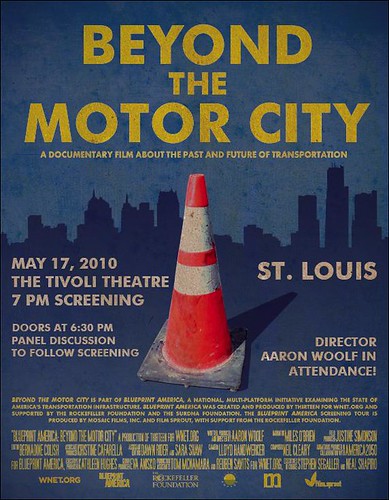
Free Screening of "Beyond the Motor City" on Monday

"The old system hasn't died, and the new system hasn't been born yet," says one of the subjects in Beyond the Motor City. He's talking about urban transportation.

Beyond the Motor City is a critical look at the intersection between mass transit and the renewal of post-industrial Detroit. Director Aaron Wolf is best known for his documentary King Corn, which examined the terrible impact of federal agricultural policy on the American diet and on the small farm.

Thanks to the sponsorship of Citizens for Modern Transit, St. Louis is fortunate to be one of eight cities where Beyond the Motor City is being screened free -- Monday, May 17th at 7:00 p.m. at the Tivoli. Appropriately, this event falls in Historic Preservation Month. The role of public transportation in cities is often left out of the historic preservation discussion.


From the film's website:

Beyond the Motor City examines how Detroit, a grim symbol of America’s diminishing status in the world, may come to represent the future of transportation and progress in this country. The film explores Detroit’s historic investments in infrastructure—from early 19th-century canals to the urban freeways that gave The Motor City its name and made America’s transportation system the envy of the world. But it also reveals that over the last 30 years, much of the world has left Detroit—and America—behind, choosing faster, cleaner, more modern transportation.

In a journey that takes us into the neighborhoods of Detroit and then beyond to Spain, California, and our nation’s capital, Beyond the Motor City urges us to ask how a symbol of America’s urban decay might transform itself into a model of urban revitalization. Can we finally push America’s transit system into the 21st century?

Immediately following the film, there will be a panel discussion moderated by KETC’s Patrick Murphy with Congressman Russ Carnahan, director Woolf, and Citizen for Modern Transit’s Tom Shrout.

Monday, April 5, 2010

Proposition A

This United Railways streetcar line map from 1903 reminds us of what is possible with mass transit. The red lines mark streetcar lines, which augment the street grid with a separate network of traffic. In 1903, that separate network was primary to many people. The streets where the street car lines ran gave rise to commerce and pedestrian traffic. The streets around them saw secondary benefits.

Now, 107 years later, county residents are faced with a choice on whether to approve Proposition A to fund the region's public transit system, now doing business as Metro. That the funding comes through a sales tax increase that triggers an already-approved sales-tax increase in the city has generated concern. A sales tax increase is not desirable, but neither is the funneling of tax revenues to a state infrastructure agency, the Missouri Department of Transportation, that exclusively fund roadway construction. The money raised for state highways ought to stay in the region to begin with, to fund the transportation that best serves an urban area -- just as Chillicothe's transportation dollars are probably best spent on roads. If the money must go to the state, then it should return in the form of funding for mass transit operations in addition to highway funding. There is a board political goal from which our leaders cannot shirk after tomorrow, no matter what outcome.

Back to the 1903 map: density of transit lines created and sustained commercial districts at the turn of the last century. The map here shows midtown St. Louis, which soon afterward would be dubbed the "second downtown." This is entirely due to the placement and density of mass transit street car lines. Today, we don't have such stark benefit but we have a regional core where bus and MetroLink service is sufficient to support the location of major employment.

In 1903, mass transit made Midtown more desirable than other parts of the city of St. Louis. Today, mass transit makes the core more desirable for major employers than exurban locations. County voters are not voting to build up the city, but to sustain their own place in the regional economy -- a place staked by relative density of population and transit lines. Without the sustaining the Metro system, what gives a county municipality like Brentwood a distinct business advantage over St. Peters? Or, for that matter, Chesterfield over Wentzville?

When we lost the street car lines, we found out what would happen when Midtown had to compete with the county in the absence of a strong mass transit system. Midtown faded away. So it could go with St. Louis County. Whether the city or St. Charles County ultimately benefits from the decline of Metro is a gamble of unknown odds. Somehow I doubt that defeat of funding for mass transit will benefit the urbanization of an already too-dispersed region. Yes, if Proposition A fails, the system is not dead -- but it will shrink immediately and the prospect of service restoration will diminish. Passage of Proposition A allows time to build a better funding system without regional havoc or further economic dispersal.

Wednesday, February 24, 2010

Friday, January 29, 2010

Metro Funding Serves County's Interest

This week, the St. Louis Post-Dispatch carried a commentary by NiNi Harris entitled "County residents should vote own interests". Harris makes the case for St. Louis County voters' approving the sales tax measure for Metro that will appear on the April 6 ballot.

Instead of the usual -- and correct -- arguments in favor of mass transit as something the region needs to have to be competitive and maintain an urban quality of life, Harris demonstrates that the sales tax measure will help St. Louis County maintain its quality of life. The services that county voters take for granted are dependent on workers' being able to easily get to jobs in the county. For many workers, that means catching the bus.

Voters might not consider the fact that even health care costs are associated with the availability of public transportation:

The quality of hospital care is not only determined by the physicians and registered nurses, but also by the LPNs, the people who do the laundry and cleaning and food service staffs. The quality of overall care can be maintained without mass transit only by increasing wages or providing other transportation.

After all, according to Harris:

It's not just a few workers about whom we are talking. Last year, Metro buses, MetroLink and the Metro service for the disabled provided rides for almost 53 million boarders.


Can the county maintain its quality of life with diminished Metro service? Absolutely not.

Saturday, January 2, 2010

Jobs for Main Street or Sprawl Road?

Former Milwaukee Mayor John Norquist published an op-ed in the Charlotte Observer that lays out the problems in the "Jobs for Main Street" bill that Congressional Democrats pushed through the House of Representatives. The bill is yet another instance where the Democratic Party has missed the boat on urban policy under the guise of helping cities and small towns. While the bill includes $8.4 billion for transit and $800 million for Amtrack, its biggest component is a $27.5 billion appropriation for highway construction!

According to Norquist:

The $27.5 billion isn't targeted to rebuild streets at the heart of older cities and towns. No, it will mostly go to the expansion of wide, motor-vehicle-only highways that go hand-in-hand with energy-wasting sprawl. This follows the earlier stimulus bill that favored massive highway projects, including a batch of expensive "highways to nowhere," which an examination by the Infrastructurist Web site concluded "make no sense."

Saturday, December 26, 2009

Vintage Streetcar Photographs Show Mid-Century St. Louis

This week St. Louisan extraordinaire Jeff Vines discovered an online cache of 120 photographs of St. Louis Public Service Company trolley cars taken between 1954 and 1961. A few photographs from the 1980s are included.

The images of the cars in their vintage red, white and tan color scheme are fabulous. Yet the photographs also capture views of the city long lost, change or, in a few cases, preserved. The old Grand Avenue viaduct, its replacement soon to be replaced, features in many of the photographs in use adn under demolition. Other locations include the South Broadway car barn (now site of Carnahan Middle School), the Midtown skyline (remarkably unchanged), Maplewood, University City and Flynn Park, Washington Avenue from the Eads Bridge street car turn-around to 15th Street, rural Creve Couer, downtown St. Charles, and McKnight Road.

The photographs of the vicinity of the Eads Bridge and Washington Avenue include shots of the piers for the modern elevated lanes of I-70, now seen as likely to be removed in most of our life times.

Friday, May 8, 2009

Legislature Gives Metro $12 Million

The St. Louis Beacon reports that the legislature passed a stimulus bill that contains $12 million for Metro (actually still named the Bi-State Development Agency but doing business as Metro). This is a one-time payment, of course, and short of the $20 million that Metro estimates it needs to restore all service cuts made in March.

Governor Jay Nixon, often silent on state-funded programs that support St. Louis, actually has expressed support for Metro. However, the $12 million request came from Lt. Governor Peter Kinder, not Nixon. If the governor signs the bill, Metro will be able to restore Call-a-Ride and some bus routes -- for one year.

Realistically, the stimulus money is a small stop-gap. What is needed is a regional taxing district. Senator Robin Wright-Jones introduced a bill in this legislative session to allow such a district to be created, but the bill remains on the Senate's informal calender.

No matter what the fate of the stimulus funding or Wright-Jones' bill, Metro has a lot of work to do right now to build a strong case for its support. The longer the agency waits to start building public support, the longer people are stuck without transportation -- and the longer cities that have regional investment in transportation will surpass our ability to attract new residents and jobs. We can't have a hand-to-mouth transit system if St. Louis is going to be a competitive American city.

Friday, September 28, 2007

danish public transportation haiku

These little poems were written by Zoe Trope, who is blogging her experience studying abroad in Denmark.

As a transit rider half a world away here in the urban Midwest, I gotta say, I often feel just the same when I'm bussin' it (or attempting to bus it) across town. Enjoy:

everyone thinks
trains are so quiet, fast, clean.
try the regional.

waiting for the bus
it is twenty minutes late
you can suck my dick.

when i tell people
about my commute, they gasp
"i'm sorry for you."

Friday, April 13, 2007

Even a cat can do it

I am reminded on a daily basis that StL's bus system needs to be more user-friendly. Even bare bones schedules and maps at every stop would go a long way, as would running buses more than every 500 years (erm, 30 minutes).

But still, I have heard some funny excuses over the years for why folks don't climb aboard.

Next time I get an earful about how trying [just once!] even the straightforward, straight line, eponymous, every-10-minutes Grand bus is mysteriously "too hard," I believe I will have to let the person know that even a cat can figure out a bus system.

Behold!: Mystery cat takes regular bus to the shops


....thanks to Jesse Swoboda for the tip!

Wednesday, August 30, 2006

Taking the (revised) bus

I'm happy about the new Metrolink branch, but I've yet to find time to ride it. I have, however, spent the past three days immersed in the bus side of Metro Redefined, and it is definitely not as cool as the new Metrolink.

Bus schedules and times and drivers have changed, with little announcement. I've had to tell coworkers and strangers on the street about the changes--a number of them have not heard. On the bus on Monday, the bus driver was shouting the new connections as he drove, and lots of people were surprised and confused. One angry man got off the bus, cursing the fact that he had no idea how he'd get to work that day without the #52 Clayton South County, and that he'd not heard anything about it.

I am particularly thankful that I was able to tell my coworker S about the fact that our bus route changed before she tried to take the bus. She had not heard a word about the change. She is a senior who takes the bus around 4something in the morning and lives in a rougher part of the North Side. She did not need to end up standing out there alone at that bus stop at that hour, in the dark, wondering what happened to the bus.

If Metro had done something as simple as making all bus drivers announce the changes two weeks in advance, a lot of frustration, problems, and anger could have been avoided. I also think that giant "THIS ROUTE IS CHANGING. HERE ARE THE CHANGES!" posters on each bus would have been useful. I'm sure Metro would counter that they updated their website (even though it doesn't reach a lot of transit users, and even though the pdf system map of Missouri was still outdated when I tried to consult it this afternoon) and that they printed 20 copies of a brochure about it one time, but with something this important and basic, you have to spell it out as simply and loudly as you can to make sure that everyone hears.

As for my experiences trying to get around:

I have stood at the bus stop for half an hour for the past three mornings in a row, trying to catch my bus. The first day I was way too early for the readjusted time and stood there for almost half an hour until the bus finally showed up at 7:25.

Okay, I thought. The bus gets here at 7:25 now. The next morning I was out there at 7:20, but saw neither hide nor hair of a bus for 28 minutes.

So, this morning, after extensive perusal of the schedule, I got there even earlier, but again found myself standing there for over thirty minutes waiting for a bus that is allegedly spaced half an hour apart.

So when does the bus get there?

This is not particularly different from my experiences with the pre-Redefined Metro. One day my bus would be at my corner at 7:28, the next day 7:28, and then BAM! 7:46! And then 7:35 the day after that! Then 7:27! I started finding myself late to work pretty often, which was exasperating. My boss is very understanding, but it's still sloppy, and I am still paranoid from previous jobs I've had where employers were, ahem, not transit-friendly.

And no matter how forgiving my boss can be about transit-caused lateness, it still doesn't change how stupid I'd feel when I rushed out the door at 7:25 and skipped packing a lunch, only to stand there for 20 minutes because the bus was slow that day. Or, on the flip side, there was the other feeling of stupidity that came when I'd tell myself "The bus has been really late for the past six weekdays! I will give myself two more minutes to get my lunch together since it's only 7:25!" ...and I'd walk out the door to see that the bus had decided to come early at 7:26 that day, and I was gonna be half an hour late to work.

(And we'll gloss over my lousy attempts to complete errands and social outings that used to be no problem before the bus schedule changes--suffice it to say, after the amount of time I've wasted waiting for transit over the past three days, I ended up walking home from Downtown this evening because I didn't want to wait at a bus stop for one more minute.)

But this ain't all bad. After I finish typing this entry, I'm going to take constructive action and wipe all the plaster dust off my bike and get it ready for riding tomorrow morning. With the shape I'm in, I'm going to have to start by biking to my bus transfer point and taking the bus the rest of the way to work. But with practice, I'll be able to ride all the way to work.

Actually, one of my neighbors just got a job at another Midtown megainstitution, and we've agreed to start biking to work together once I'm in suitable shape. I'm looking forward to it. I need the physical activity, and it will be a nice chit-chat/bonding/kvetching/plotting-n-planning opportunity.

You might even say that my daily commute will be redefined.

Sunday, April 30, 2006

bus + bike + me = eep!

Does anyone have any advice for a gal who's going to take her bike on the bus for the first time?

I am a frequent public transit rider (I buy the month pass!) and moreover a frequent bus rider, but never in my years of riding Metro and the CTA have I ever taken my bike on a bus. Like many of my colleagues who've never ridden a bus before are intimidated by the prospect of doing so, I've never taken my bike on the bus before, and the idea kind of intimidates me. I've taken it on Metrolink and the El, but that's pretty foolproof--you just wheel right on to the train car, and there's plenty of room. The hardest thing in that situation is not falling down or letting your bike fall. But when it comes to taking my bike on the bus, I picture myself standing there fumbling with the bike rack and trying to hoist my sloppily-painted hot pink bike up into it, while a busfull of impatient, late-to-work people watches silently, cursing me in their minds (at which point I drop the bike, probably onto myself).

What an optimistic image, no?

I'm starting a new job, and after extensive perusal of the various relevant bus schedules, it looks like it would really be to my advantage to bike to the bus, and then take the bus to work. And as a non-driver, taking my bike on the bus is a skill that would greatly improve my ability to get around anyway.

So, some time this week I'm gonna do a practice run or two, so I know what to expect before I've got a whole busload of people waiting on me at rush hour.

Any advice for me?

Monday, December 26, 2005

Bus Schedule Changes, Today and Monday, January 2

Several of my coworkers and I were late to work today. Why? Because Christmas was on a Sunday, Metro changed today to a Sunday schedule so that its workers could "observe" Christmas. While I'm glad they get the break, it would have been nice if the change had been well advertised or posted. I didn't hear about the change on any bus that I rode, and when I consulted my bus schedules this morning, they simply said, "NOTE: Sunday schedules operate on New Year's Day, Memorial Day, 4th of July, Labor Day, Thanksgiving, and Christmas." December 26 was nowhere to be seen on that list. Thus, we were late. Cmon, Metro, work with us here--we need to get to work!

Also of note: A coworker informed me that on next Monday, January 2, busses will again run on Sunday schedules. Share the news with all the public transit riders in your life!

(Thanks for the tip, Adria!)

Thursday, December 16, 2004

No such thing as a free ride?

First Day Of Fare Strike Descends On Chicago

That's right. Yesterday was the first day of the citizen fare strike against the Chicago Transit Authority, which is calling for massive cuts in regular train and bus service -- including the elimination of 24/7 hours for the entire Blue Line -- beginning in January 2005 despite its planned expenditures for the multi-million dollar "Gold Line" that would link tourist attractions.

May chaos ensue until CTA backs down, drops the Gold Line plan and demands that Mayor Daley share some of the city's $271 million tax increment financing surplus with CTA.

Of course, that probably won't happen since CTA Board President Frank Kreusi and most of the board are beholden to Little Daley.

Stay tuned.