
We've Moved

Ecology of Absence now resides at www.preservationresearch.com. Please change your links and feeds.

Showing posts with label clearance. Show all posts

Wednesday, December 31, 2008

Talking About McRee Town

Jackie Jones introduces her presentation.


Yesterday afternoon St. Louis University doctoral student Jackie Jones presented her dissertation thesis, "Picturing a Neighborhood: McRee Town in Saint Louis, Missouri," to a crowd at the Royale, 3132 S. Kingshighway. The interesting venue for Jones' presentation and resulting discussion offered a relaxed setting for what remains a controversial topic: the wholesale clearance of six blocks of an urban neighborhood by the Garden District Commision and resulting replacement by new housing. Jones disavowed any stance on the clearance, instead focusing on how images were used to justify the clearance in the press -- and how other images contradict the story told by the Commission's carefully-selected images.

Here's Jones' own description of her presentation:

In 2003, the Garden District Commission demolished more than two hundred buildings on the eastern half of the McRee Town neighborhood in Saint Louis. The Commission, a private coalition headed by officials from the nearby Missouri Botanical Garden, demolished six blocks of historic brick homes and apartment buildings that housed primarily low-income renters and homeowners, relocated hundreds of residents, erected twenty-five acres of market-rate, single-family, suburban-style housing on the cleared land, and ceremoniously renamed the area Botanical Heights. This presentation explores how visual representations of McRee Town between 1998-2003 helped legitimize this urban renewal project and the dislocations it caused in the lives of McRee Town residents. It engages viewers with the photographs of burned-out, boarded-up, weed-infested buildings that populated newspaper reports and public relations documents during these five years, and juxtaposes them with photographs taken by Genevelyn Peters, a McRee Town resident prior to the neighborhood’s destruction. These images – of family, homelife, play, and community – complicate and challenge the dominant understanding of this neighborhood and its residents as criminal and atomized by presenting images that depict a vibrant neighborhood community.

People listen to Jones' making a point.


The people present included someone involved in the decision to clear the six blocks, residents of Botanical Heights (the new housing development), the area's Neighborhood Stabilization Officer Luke Reven and others. While I had to leave before discussion was over, discussion touched on the damaging impact of I-44 construction in the early 1970s, the way in which similar images as those taken in McRee Town galvanized Lafayette Square and Soulard residents to pursue preservation instead of clearance, the deceptive nature of photographs and whether or not the term "suburban" applies to Botanical Heights.
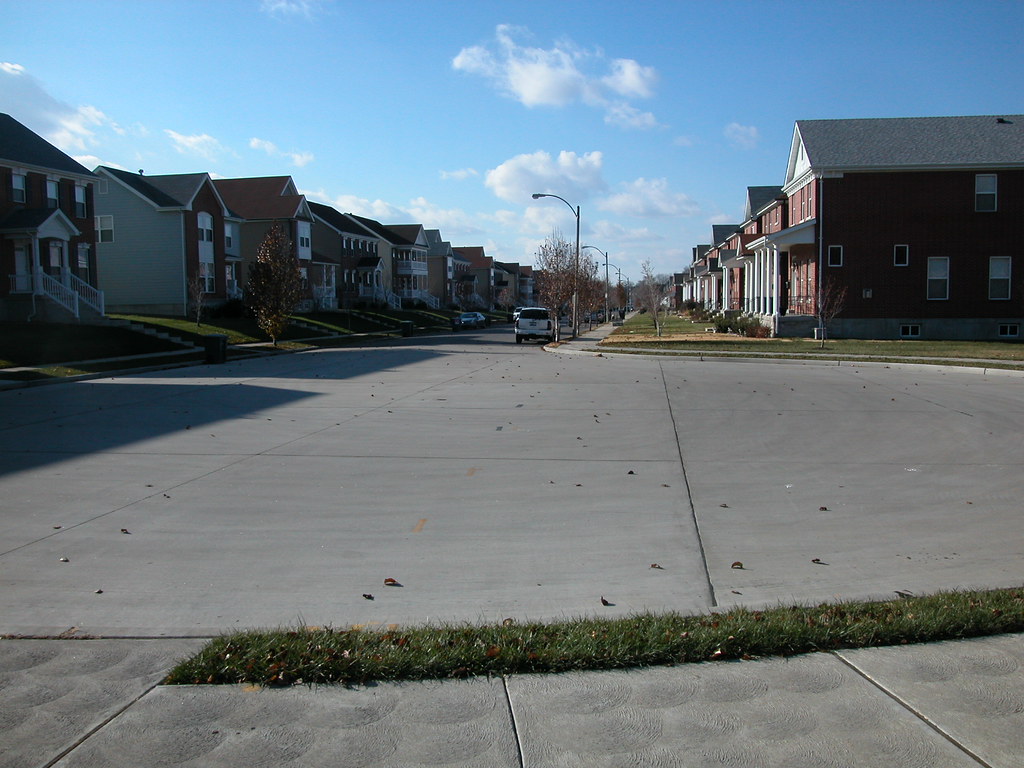
Looking west down McRee Avenue from 39th Street.


On another note, if Royale proprietor Steven Fitzpatrick Smith is attempting to revive the tradition of the discussion salon, count me in!

Monday, July 16, 2007

Pruitt-Igoe Demolition as Seen in "Koyaanisqatsi"

Someone has posted a long segment from Godfrey Reggio's 1983 film Koyaanisqatsi that includes the famous aerial footage of the vacant housing project and the explosion-based demolition that took down the entire complex between 1972 and 1974.

The Pruitt-Igoe sequence begins at 2:49.

Thirty-three acres of the originally 57-acre Pruitt-Igoe site at the southeast corner of Cass and Jefferson avenues remain vacant to this day.

Tuesday, June 26, 2007

In 1966, City Demolished 150 Buildings on Near North Side

According to an article that appeared in the November 26, 1966 issue of the St. Louis Globe-Democrat with the prosaic title "$151,000 Demolition Job," the city of St. Louis was embarking upon a large-scale scattered-site clearance project on the near north side. In an area bounded by Jefferson on the east, Delmar of the south, Grand on the west and St. Louis on the north, the city was planning to demolish 150 buildings identified as substandard. This area at the time was known as Grand Prairie or Mid-City, but today is better known as the eastern half of JeffVanderLou. $101,000 of the $151,000 cost of the project came from federal funds.

This project started six years ahead of the introduction of the Team Four Plan for the wholesale deprivation of the near north side. This came ahead of widespread organized architectural surveys conducted by Landmarks Association of St. Louis and city government. This came thirty years before Paul J. McKee, Jr. set his sights on this area.

This part of the city has been long betrayed by many people. McKee's plans are simply the endgame of decades of deprivation, demolition and neglect. However, knowing what we know now about the lack of sustainability of large-scale urban renewal projects, we should be in a better position to avoid further destroying the near north side. We don't have the density of physical and social resources that should remain on the near north side, but we now know the value of what's left, if only due to its scarcity.

Wednesday, October 25, 2006

Demolition Updates

MORSE SHOE FACTORY UNDER DEMOLITION

Workers have begun removing the terra cotta ornament from the O. Morse Shoe Company Building at Duncan and Boyle. Apparently, some of the ornament will be "reused" in construction of the building that will replace the venerable shoe factory building: the sleekly boring, sub-urban headquarters building for Solae. Whether or not such reuse is appropriate remains to be seen.

FOREST PARK SOUTHEAST DEMOLITION SPREE NEARLY DONE

Meanwhile, the clearance of 22 buildings in Forest Park Southeast is nearly complete. The demolitions at the north end of the neighborhood on Chouteau and Donovan avenues has created a large open space that is extremely jarring. Hopefully redevelopment will be swift. To the west, the Laclede Gas Pumping Station G will lose its landmark gasometer but retain its delightful Classical Revival pump house (built in 1910). West of there, the Freund Bread Company site has been cleared since last year, awaiting new buildings that are part of the Pumping Station project.

Overall, though, the neighborhood is looking better than ever. The transformation of Manchester Avenue within the last year has reversed the decay of many historic buildings and led to the openings of several new businesses.

BRECHT BUTCHER SUPPLY COMPANY BUILDINGS HOLDING ON

On October 10, the Building Division issued an emergency condemnation for the Brecht Butcher Supply Company Buildings. However, demolition is up to the Blairmont Associates LC of O'Fallon, Missouri, owners of the complex. So far, there is no demolition application at City Hall.

Thursday, May 25, 2006

Aldermen and the Preservation Board

Richard Nickel, the Chicago architectural photographer, salvager and preservation activist, once said that two things threaten old buildings: water and stupid men.

In what language does the prefix "alder" translate as "stupid"?

This question comes to the minds of anyone who attended Monday's Preservation Board meeting. Actions on two items from the agenda stand out as examples of the short-sightedness of the Gang of 28:

3524 Victor: David Guller, owner of this magnificent home in the Compton Hill local historic district, replaced windows, cornice and soffit without a permit. He was caught by a neighbor and had to apply for a permit. Unfortunately, his vinyl replacements don't meet the local district code and when Guller made an application for a permit on the already-done remuddling the city's Cultural Resources Office (CRO) denied his application. He appealed to the Preservation Board, which denied the appeal. Guller agreed to rework his soffit and cornice to the liking of the CRO. But he didn't want to replace the six windows on his front elevation, and somehow appealed the denial of his appeal.

How was this even possible? Legally, it's not. The city's Preservation Review Ordinance holds the Preservation Board's denial of appeal as the final deliberation, after which a matter would go to court through lawsuit. Apparently there is an unwritten exception that Alderman Stephen Conway, Guller's representative, used to secure a second hearing at last month's meeting. Guller did not appear, and the Board voted again to uphold the CRO denial. The item re-appeared this month, and Guller as well as Alderman Conway testified in support of his supposedly appropriate vinyl windows. The windows have embedded muntins and a terrible flat appearance; at the least, he could have sought simulated exterior muntins. best of all, Guller could re-install the wooden windows that he removed on the front elevation and keep his vinyl windows on the side and rear elevations (private elevations under city law). But he has thrown them out.

The Preservation Board smartly voted again to uphold CRO denial. If the matter comes up again, perhaps someone who supports CRO should file suit against Guller and Conway for abusing the process!

Forest Park Southeast Demolitions: The tides turned against 32 houses owned by Forest West Properties, a real estate corporation created by the Washington University Medical Center Redevelopment Corporation. Forest West sought demolition permits for all 32 and ended up receiving 22 permits, the staff recommendation of CRO. While last month's consideration by the Board of the same matter met with widespread resentment of Forest West's lack of a plan for and lack of communication with CRO.

This month, things had changed. Namely, Alderman Joseph Roddy's name, absent from earlier deliberations, surfaced. CRO Director Kate Shea told the Preservation Board that Roddy had asked Forest West to buy the homes and tear them down for new construction. This fact is irrelevant to any discussion of the consequences of the demolition permit, the adequacy of their excuses for seeking one and approaches to preservation planning for these properties -- but it seemed to carry weight. Never mind that only Forest West's Brian Phillips testified in favor of demolition and that four people -- Claire Nowak-Boyd, Anthony Coffin, Steve Patterson and myself -- testified at length on the problems with the application.

The Preservation Board itself was diminished by the total absence of members John Burse and Alderman Terry Kennedy (continuing his string of absences and becoming the third alderman in this story) and the departure of Melanie Fathman in the middle of testimony on this matter. Richard Callow recused himself after asking to split the vote on permits so that he would not vote on permits for buildings that a client was seeking to buy. For some reason, his suggestion did not go anywhere. So members Mary "One" Johnson, Luis Porello, Anthony Robinson and Chairman Tim Mulligan were left to vote. Johnson is the most uncritical cheerleader of the status quo on the Board, with Porello often siding with her. On this matter, they were true to form with Johnson "complimenting" Phillips from the start. Robinson was oddly quiet; he would have been a voice of reason. Mulligan opposed the permits strongly last month but endorsed the staff recommendation this time.

In the end, the vote was 3-1 in favor of the staff recommendation to approve demolition of 22 buildings, with Robinson dissenting. Testimony from opponents was mostly ignored, unlike last month when it was led to enthusiastic discussion with Shea and board members.

What a difference an alderman can make!

Thursday, May 11, 2006

USA Today Touts St. Louis

More say, 'Meet me in St. Louis' as city shows signs of renewal - Charisse Jones (USA Today, May 10)

USA Today came to town, and didn't quite get everything right -- although it's good to get good press from a paper read at airports, motels and chain restaurants everywhere.

Here are a few problematic sentences:

"The old post office, for years a relic surrounded by other vacant buildings, has been refurbished, its space fully rented."

This project is the worst representative of downtown renovation. The OPO is fully rented by government agencies and institutions invited (or cajoled) into taking space. The only entrepreneurial tenants are the Pasta House Pronto and the St. Louis Business Journal, and those both have ties to the developers of the project. Yawn!

"Lambert-St. Louis International Airport unveiled a $1 billion expansion April 13."

This is evidence of renaissance? All I have read about the expansion so far has been bad news: cost overruns, limited efficiency, lack of use of new runways and so forth. Plus, the airport is far away fom the city and has little to do with the quality of life for St. Louisans -- although I guess it's a bellwether for USA Today readers.

"McCree Town, a violent southside neighborhood that was filled with dilapidated housing, has been rechristened Botanical Heights, and people are lining up to buy new homes."

Not only did the paper get the McRee Town name wrong, it readily accepted force-fed facts to paint a rosy picture.

"After losing some corporate headquarters in recent years, the city hopes the presence of local institutions such as Washington University will help nurture new industries."

Huh? Perhaps the reporter skim-read a packet from CORTEX.

Thursday, October 28, 2004

More fires in St. Louis's McRee Town neighborhood

From the October 26 St. Louis Post-Dispatch:

"3 suspicious fires hit McRee Town

"Suspicious fires were set in two vacant buildings in McRee Town early Monday and in a third building nearby, authorities reported. The fires were in the 4000 block of McRee and Folsom Avenues in McRee Town and a three-story multifamily building at 39th Street and Shaw Boulevard.

"All the fires were discovered between 3 and 4 a.m., and police bombing and arson squad detectives presume all three were set by the same person. McRee Town was beset by a rash of fires in December, but until Monday the area had had just one fire over the past six months."

Seems that wholesale land clearance and gentrification have done nothing to make this area safer.
