
To some people, the current discussion about McEagle's "NorthSide" project has roots in a project proposed for the same area 13 years ago: Gateway Village. Like "NorthSide," Gateway Village involved a close relationship between a mayor and a private developer from outside of the city, proposed massive demolition, proposed eminent domain and large public subsidy. Unlike "NorthSide," however, Gateway Village never moved close enough to reality to disrupt the section of St. Louis Place it would have wiped out.
In 1996, Mayor Freeman Bosley, Jr. unveiled his grand plan for revitalizing north St. Louis: a 180-acre golf course and subdivision called Gateway Village that would use the Pruitt-Igoe site as well as the western part of St. Louis Place. The boundaries were Martin Luther King Drive on the south, 20th Street on the east, St. Louis Avenue on the north and Jefferson Avenue on the west. The plan called for building 781 new homes (priced out of range of most St. Louis Place residents) and a 9-hole golf course (designed by renowned designers Don Childs Associates) platted for very low density at odds with surrounding historic city fabric. Going against neighborhood sentiment in an area where he had tremendous political support, Bosley supported the acquisition of 209 residences and six businesses to clear the project site.
The developer behind the project, whose identity was unveiled after the first announcement, was Waycor Corporation of Detroit. Waycor's president was Don Barden, a wealthy Detroit businessman who has since gone on to become a major casino owner. At the time, Barden was the owner of television stations who had never developed a project on the scale of Gateway Village. Also in 1996, the Federal Election Commission determined that Barden has co-signed an illegal loan to a Detroit Congresswoman.
Whatever his inexperience and lack of ties to St. Louis, Barden gained the confidence of Bosley, Jr. and Maureen McAvey, the director of the St. Louis Development Corporation. Unlike today, where McEagle is unveiling its own plans, in 1996 Bosley and McAvoy did the public relations work for the developer. In August 1996, McAvoy released a study by Don Childs Associates that predicted that Gateway Village would be feasible and successful. The city paid the architects $38,000 for a study that championed a project in which they had a financial interest.
The study predicted that Gateway Village would precipitate "a return to living in major metropolitan cities" and that it would "act as a catalyst to revitalize the area." The Greater Pruitt Igoe Neighborhood Association, which is now defunct, rose up against the plan to safeguard the 209 homes sought for condemnation and demolition.
In October 1996, the city government requested a $8 million grant from the United States Department of Housing and Urban Development toward the project. The total project budget was $127.5 million, an amount fairly low for such a large area. The low cost was indicative of low density construction and low construction standards. Of course, $8 million was not the only handout sought by Waycor. Waycor wanted an additional $35 million in public financing. Waycor would not commit any of its own capital unless it could secure public money first -- also different than the current situation.
The feasibility study commissioned by the city outlined the path toward development, with step one beings "complete agreement with Waycor." That step was removed after the St. Louis Post-Dispatch discovered that the city had commissioned a development feasibility study that not only recommended a certain developer but indicated that an agreement was already being created.
The Greater Pruitt Igoe Neighborhood Association sent a letter to HUD Secretary Henry Cisneros asking that he deny the $8 million grant request. Shirley Booker was one of the authors of the letter and very active in organizing St. Louis Place residents. Vernon Betts was one of a few St. Louis Place residents who gave favorable comments about Gateway Village to the press, but the majority of residents were opposed.
Bosley's response to the Greater Pruitt Igoe Neighborhood Association's letter is classic and timely: "It's unfortunate that a small group now want to try and thwart the one thing that can work."
In development, there always seems to be "the one thing that can work" -- what the person using that phrase wants to do.
An aldermanic election for the Fifth Ward, where the project was located, came in spring 1997. Veteran Alderwoman Mary Ross was retiring. In the race to succeed Ross, Democratic candidates April Ford-Griffin and Loretta Hall supported Gateway Village, and John Bratkowski was adamantly opposed. Ford-Griffin, whose support was for the project was not staunch, won the seat. At the mayoral level, Bosley lost the Democratic primary to Clarence Harmon.
Even before he took office, Harmon announced his plans to pull city government out of the Gateway Village project. On April 4, 1997, the Post-Dispatch published an article entitled "Harmon: 'Dead Stop' for Golf Course Plan," that covered the mayor-elect's opposition to a project that would lead to the dislocation of city residents. McAvey retorted that the project would bring the middle class back as well as retail for low-income residents.
Harmon's move coincided with HUD's denial of the city's request for funding. Shirley Booker explained neighborhood opposition well. Residents wanted development, she said, "just not a golf course. We can't keep existing with all this vacant land. The Lord didn't mean for it to be like that. It's a waste."
McAvey clung to Gateway Village, though, telling the press that no one would be able to develop St. Louis Place without large public subsidy and amenities provided. Her tenure would end shortly thereafter. Ford-Griffin learned a few lessons from Gateway Village and spearheaded an often rocky but productive community-based planning process leading to the Fifth Ward Master Plan, published in 2000 although not fully adopted by the Board of Aldermen.
Harmon, of course, showed little leadership on development issues, but his decision to pull the plug on Gateway Village allowed for the kindling of small-scale development on the near north side. Many leaders learned very little from the Gateway Village experience and continued to bemoan the lack of a large scale plan for the area around Pruitt Igoe. Bosley, Jr. himself is now a backer of the McEagle project, seen occasionally accompanying Paul J. McKee, Jr. at meetings.
One of the problems with the Gateway Village debacle and the resulting Fifth Ward Master Plan is that there was no strong legislative result. The threat of a large-scale plan in the Fifth Ward remained because there were no basic protections against that mode of development. Zoning and land use recommendations were never implemented as law, historic districts and sites were not identified and listed in the National Register of Historic Places, and redevelopment zones that would have broken the ward into smaller pieces were not created. The Fifth Ward's biggest problem in recent years is the large amount of vacant city-owned land -- quite a big prize to lure developers. Without safeguards against large scale projects, the ward has been left vulnerable to the supersized visions that Gateway Village illustrated.
Showing posts with label pruitt igoe. Show all posts
Showing posts with label pruitt igoe. Show all posts
Monday, May 25, 2009


Wednesday, May 20, 2009
The Urban Character of Eastern JeffVanderLou
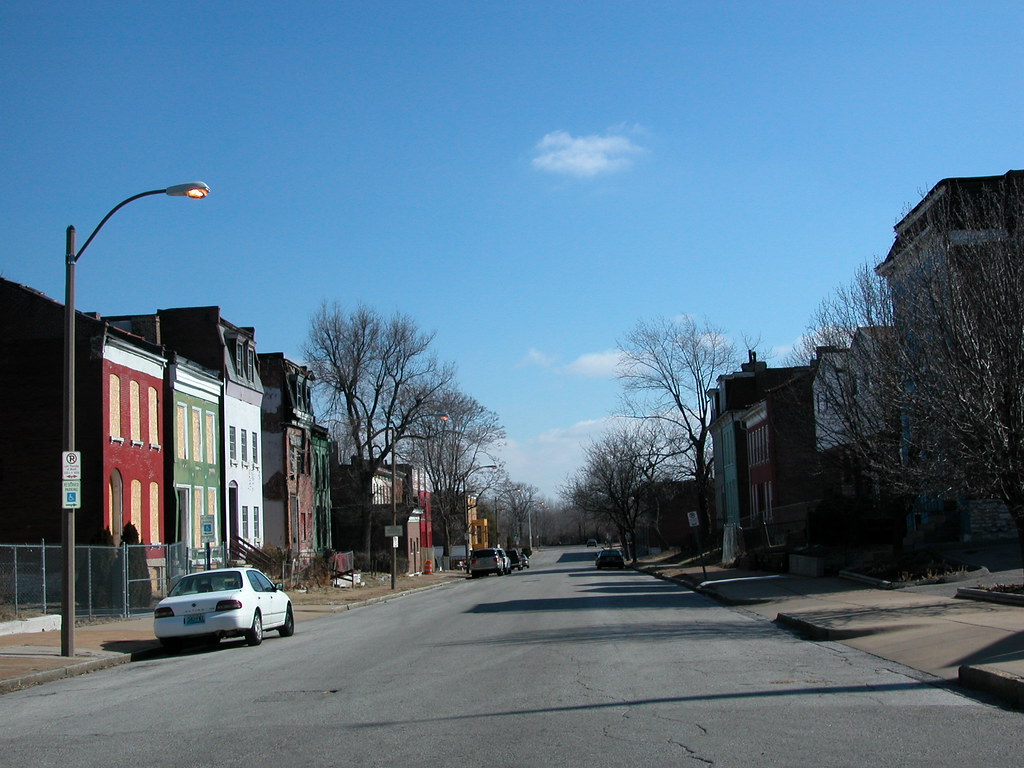
One of the characterizations often raised about the area of north St. Louis included in the McEagle project is that it is "urban prairie" where few houses remain. The area is marked by only a handful of historic buildings, vacant land, and people who are unseemly and whose eviction will only benefit the area. There are many vacant lots and houses (too many) and a few bad apples, but by and large the persistence of these neighborhoods is contrary to the word on the street. The worst parts happen to be very photogenic examples of disinvestment, but the best parts show resilience and an urban character impossible to recreate.
St. Louis Place and JeffVanderLou are amazingly rich with fine architecture, caring residents and many efforts at neighborhood improvement. These neighborhoods could use a boost -- the bigger the better. However, that boost must complement what is already there.
Here are photographs of the rich architectural character of the part of JeffVanderLou just west of an admitted urban forest, the site of the Pruitt-Igoe housing project. These photographs show that historic preservation and sensitivity to existing residents must be part of the McEagle plan -- there is critical mass here.

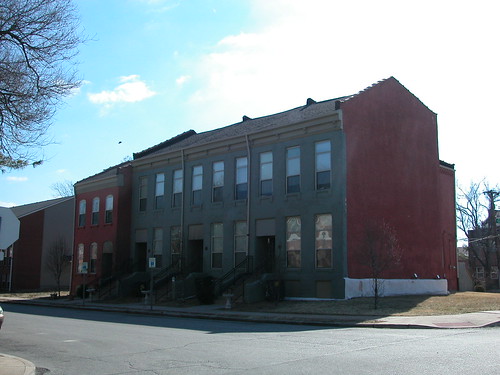

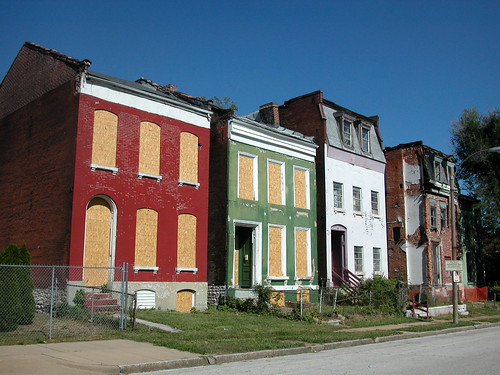

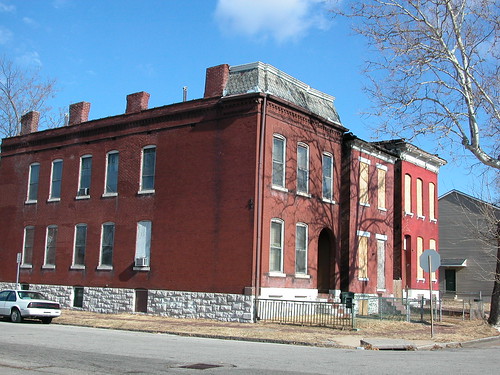
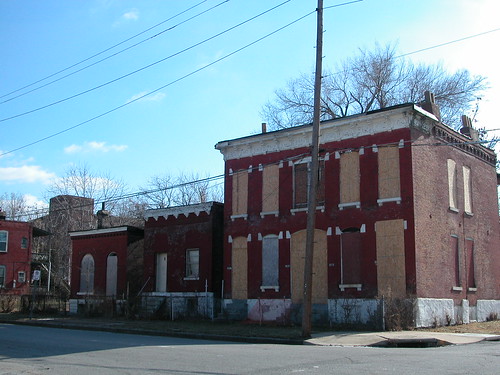
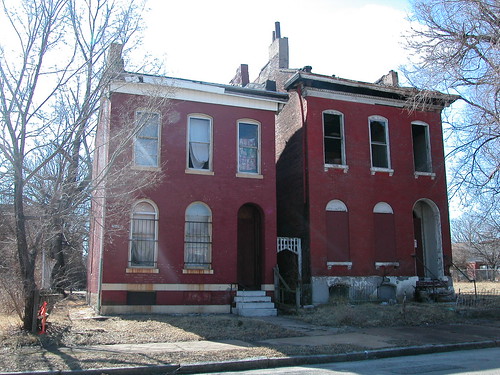
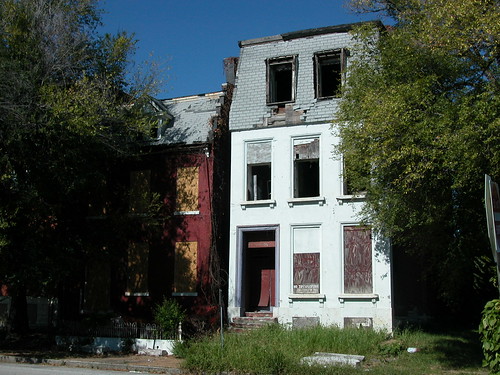
These houses date from 1870 through 1910, and span a wide stylistic range. There has not yet been a comprehensive architectural survey of the area, but a cursory examination shows much remaining building stock with strong significance. The building density in JeffVanderLou is higher than that of Old North St. Louis -- there is tremendous opportunity for preservation-oriented development. Many individuals and the St. Louis Equity Fund have invested in historic buildings, but a lot of work remains. Listing as much of the neighborhood as possible on the National Register of Historic Places would help bring economic development incentives and recognition of the unique architecture that remains.
Of course, photographs only tell part of the story. In JeffVanderLou, one also can find the photographs that would prove an "urban prairie" theory. The truth is complex, and best experienced in person away from the manipulations of photographs and aerial plans. One will find a neighborhood -- flawed, deprived, lively and urban. New investment must face this reality and work with it.
Monday, May 18, 2009
Corner Storefronts Are Important to Building Community
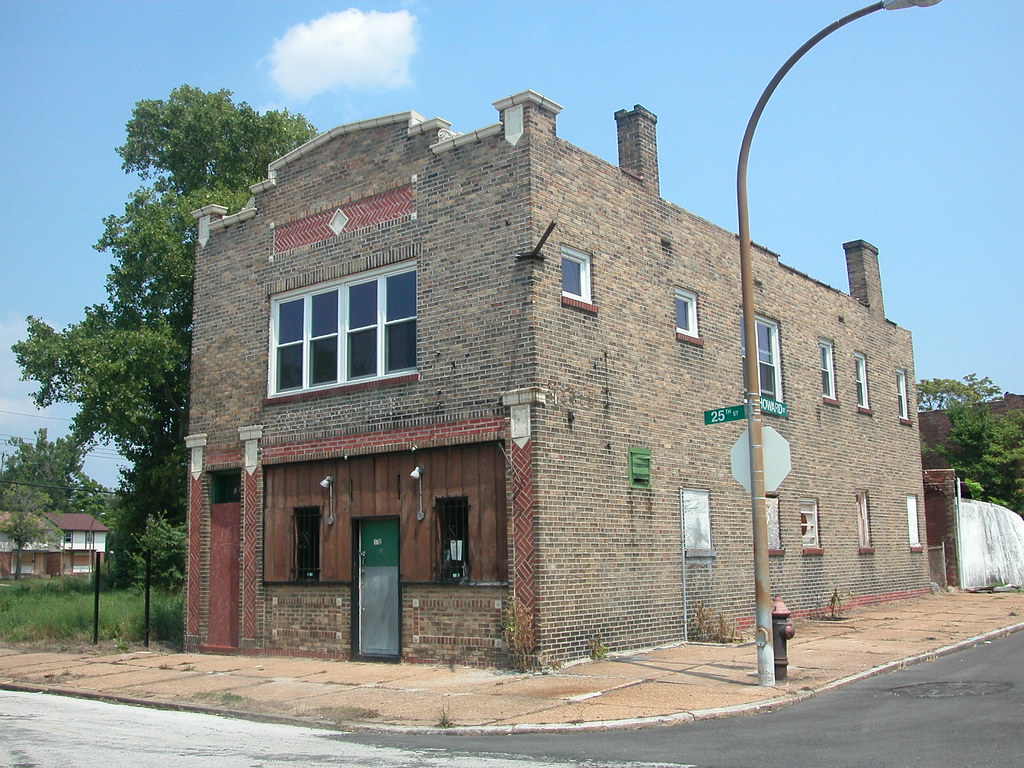
What's a neighborhood without a corner commercial storefront?
What's a corner commercial storefront without a neighborhood?
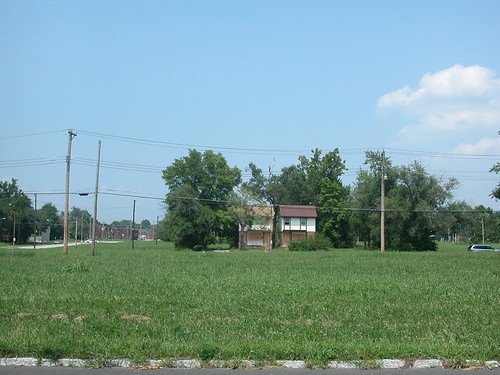
These questions are pertinent to the fate of the building pictured above, located at the northeast corner of 25th and Howard streets in the southwest end of St. Louis Place. This lonely building is one of three remaining on its block, which is surrounded by blocks of similar low density.
Many do not realize that the forlorn appearance of this "urban prairie" is the result of city policy. In 1973, under Mayor John Poelker, the city identified this six-block area north of the Pruitt Igoe site bounded by Cass on the south, 22nd on the east, Madison on the north and 25th on the west as ripe for industrial expansion. In fact, the Planned Industrial Expansion Authority began buying up land there, while the Planning Commission urged clearance of these blocks. Speculators moved in, arsons were common, and people were pushed out. With Pruitt-Igoe gone, city planners figured that large vacant site and these emptying blocks were a perfect area for a large-scale industrial park.
Yet, thankfully the industrial park project never happened. The city wasn't able to push out all of the residents -- nor were city government or the area's alderman willing to invest in rebuilding the area. In 1996, Mayor Freeman Bosley, Jr. revived the idea of using this area for something big. Bosley's administration created the ridiculous Gateway Village golf course subdivision plan, which was shelved by Mayor Clarence Harmon during his first week on the job.
The urban prairie was left behind, with residents, businesses and churches spread out across a quiet pocket of the neighborhood. Many people love living in that area and hope to stay for the rest of their lives. When developer Paul McKee Jr. began purchasing land, many speculated that his intention was to combine this area with Pruitt-Igoe for a massive commercial development. However, the plan that his representatives showed residents last week showed commercial development confined to the Pruitt-Igoe site and the six blocks platted with high-density residential development much like what was once there.
What that means for remaining buildings and residents is unclear. The plans unveiled last week are not detailed enough for further assumption. How the corner commercial building at 25th and Howard, built in 1920, managed to survive is pure luck -- and solid construction. This building is in great condition, and was occupied by a tavern only a few years ago before McKee's holding company Sheridan Place LC purchased it in 2006.
Sure, there might be retail at Pruitt Igoe, but great urban neighborhoods do not cluster retail into centers. Neighborhoods like St. Louis Place have always had their main streets and their corner bars and stores. The less concentrated commercial activity is located in a neighborhood, the more people will be able to walk to buy a carton of milk or meet friends for dinner.
Preservation is not simply a matter of saving pretty buildings (which this one is) or keeping buildings from the landfill (which is important if we want "green" to be more than a catch phrase). Preservation fundamentally is about maintenance of the relationships between people and place that foster a high quality of life. Having a corner storefront increases a neighborhood quality of life, provides a place for social interaction and gathering and encourages people to experience their neighborhood on foot -- where they will meet more people doing the same.
Architecture is fundamental to building and sustaining community, although other factors are also fundamental -- some more so. If McEagle is serious about building community in north St. Louis, its principals will do more than just calculate the future of a building like the corner storefront in dollars and sense. The project must build up from what is already in place -- buildings and people. The intrinsic connection between architecture and community comes from daily human action. After all, the corner bar stayed open even after the loss of most of the rest of the block and the industrial park never got built!
If this storefront is lost in the development to come, that will be a shame. However, if the neighborhood mode of life is lost, that will be a tragedy. Architecture should never come at the expense of community.
Tuesday, October 28, 2008
The Churches of Pruitt-Igoe
In the center of the Pruitt-Igoe Nature Preserve, also known as the undeveloped section of the site of the Pruitt and Igoe housing projects, there is is a central east-west access road running from Jefferson Avenue east, then bending north to Cass Avenue. Another northern spur also leads to Cass. The odd thing is that each view outward down the main path and the view outward down the northern spur are closed by churches, marked on this aerial photograph from the Geo St. Louis website.
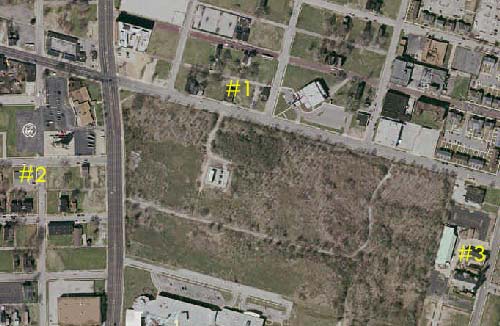
Church #1 is True Grace Baptist Church, a storefront-style worship space at 2319 Cass Avenue.
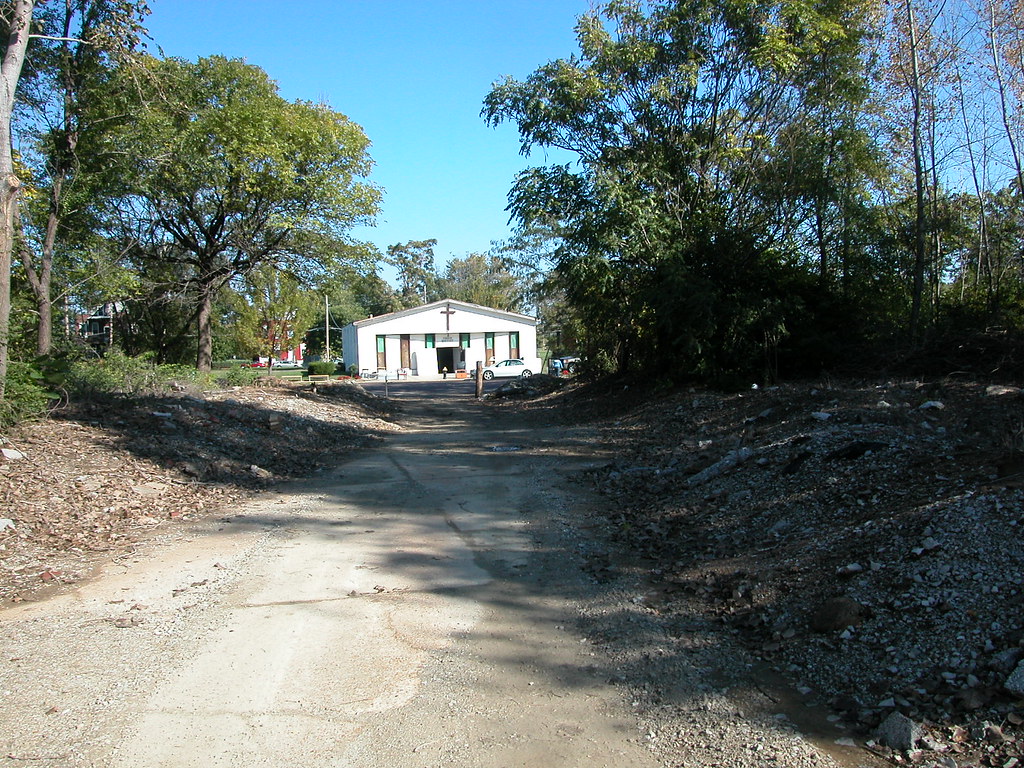
Church #2 is actually one block west from the Pruitt-Igoe site, but there are no intervening buildings to block the view. This is Zion Temple Missionary Baptist Church at 2700 Thomas Avenue.

Church #3 is the famous St. Stanislaus Kostka Church at 1413 N. 20th Street, which pre-dates the construction of Pruitt-Igoe by over a half-century.
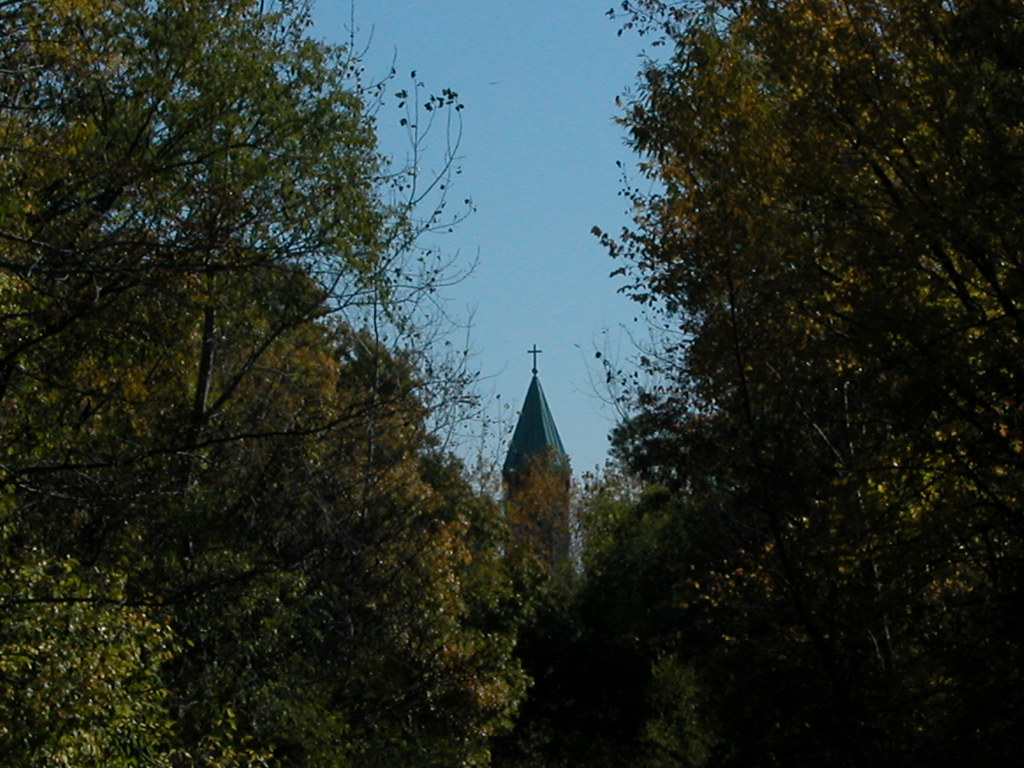
The other northern-leading path's view terminates at the rear of the Mullanphy Tenement, visible across the parking lot of the Absorene Company.
The Pruitt-Igoe grounds hold both the history of the failed but once proud housing projects as well as years of dumped debris. The layers of fill and remains have not stopped healthy vegetation, and much of the site resembles a nature preserve. the access roads, which are largely clear, gives the site's wild state a sense of intention. The presence of the three churches closing the long views down these paths adds serenity to the scene. The churches' presence on the margins of the Pruitt-Igoe site call to mind the notion of redemption. In its current state, the Pruitt Igoe site seems to have cleansed its historical wounds and reconciled with nature. The site's current ecological state is wholly new and supportive of new life. Has this tortured land met its redemption?
UPDATE: Reader Bill Michalski sent me a still frame from the film Koyaanisqatsi, where True Grace Baptist Church is evident in footage taken in 1972.

Church #1 is True Grace Baptist Church, a storefront-style worship space at 2319 Cass Avenue.
Church #2 is actually one block west from the Pruitt-Igoe site, but there are no intervening buildings to block the view. This is Zion Temple Missionary Baptist Church at 2700 Thomas Avenue.
Church #3 is the famous St. Stanislaus Kostka Church at 1413 N. 20th Street, which pre-dates the construction of Pruitt-Igoe by over a half-century.
The other northern-leading path's view terminates at the rear of the Mullanphy Tenement, visible across the parking lot of the Absorene Company.
The Pruitt-Igoe grounds hold both the history of the failed but once proud housing projects as well as years of dumped debris. The layers of fill and remains have not stopped healthy vegetation, and much of the site resembles a nature preserve. the access roads, which are largely clear, gives the site's wild state a sense of intention. The presence of the three churches closing the long views down these paths adds serenity to the scene. The churches' presence on the margins of the Pruitt-Igoe site call to mind the notion of redemption. In its current state, the Pruitt Igoe site seems to have cleansed its historical wounds and reconciled with nature. The site's current ecological state is wholly new and supportive of new life. Has this tortured land met its redemption?
UPDATE: Reader Bill Michalski sent me a still frame from the film Koyaanisqatsi, where True Grace Baptist Church is evident in footage taken in 1972.
Sunday, April 6, 2008
St. Stanislaus Kostka: A Preface
Stewardship has been a watchword of the struggle between St. Stanislaus Kostka Church, located at 1413 N. 20th on the near north side, and the Archdiocese of St. Louis, led by Archbishop Raymond Burke. The lay board of St. Stan's has asserted their ownership of the parish and its property against the Archdiocese' claim of ownership. At the heart of the dispute is a conflict over the best way to practice stewardship of the physical and pastoral fabric of the parish. The Archdiocese's point is that the parish is but a unit of the larger church, and that centralized stewardship balances the interests of the region's many parishes. The board of St. Stan's makes the counterargument that localized stewardship of the parish puts both control and responsibility for the future of the parish on the shoulders of those who know it best -- its board, pastor and members.
The backdrop is the tumultuous recent history of the DeSoto-Carr neighborhood where St. Stanislaus Kostka has been located since the church was built in 1891. After World War II, most of this neighborhood was cleared for the massive Pruitt-Igoe housing project, which entailed clearance of nearly every building between Jefferson, Cass, 20th and Carr streets save the Roman Catholic churches of St. Bridget on Jefferson and St. Stanislaus Kostka on 20th Street.
St. Stan's shared an uneasy property line with the housing project. Then came the clearance of the neighborhood across 20th street and the construction of the Vaugh Homes. The old Polish church was surrounded by dull monolithic housing towers. The gentle, humanist architecture of the church and parish buildings was in sharp contrast to the modernist developments around it. Socially, the environment was changed forever. The parish was no longer a group of people who walked to mass, sharing an ethnic identity as well as a neighborhood. Members fled the city, but not the parish. The church survived even as its neighborhood disintegrated, first with the new housing projects and later with the downfall of the same.
By the early 21st century, St. Stan's had endured so much uncertainty its members could hardly be blamed for a defensive posture. Since 1972, the cleared Pruitt-Igoe site was a desert of scrub trees and dumped debris. At one point in the early 199s, Mayor Freeman Bosley floated a ridiculous scheme to build an 18-hole gold course and large subdivision centered on the Pruitt-Igoe site. The plan could have wiped out St. Stan's, and at least would have again put its context at risk.
The golf course plan died amid political opposition, though, and a change for the better came to the area around St. Stan's. Starting in 2002, the Vaughn Homes site had been remade into Murphy Park, a successful and attractive mixed-income development. However, developer Paul J. McKee, Jr. also began buying large amounts of property around the Pruitt-Igoe site, with rumors yet another clearance scheme circulating. In 2004 and 2005, the Archdiocese closed dozens of city parishes.
No wonder many members of St. Stanislaus Kostka vigorously defend their right to hold ownership to the parish. If the entire neighborhood that once composed the parish could be cleared wholesale multiple times, clearance of the church was an easy possibility. If even strong parishes in densely-populated parts of south city could be closed, why not a parish in ravaged north city whose members mostly lived outside of the neighborhood?
No one at St. Stan's has ever accused the Archdiocese of specifically wanting to sell out the property or close the parish; the issue is more a matter of principle than fear. History set the odds against the parish surviving, and any step toward beating those odds was one worth taking -- even defiance of the Archbishop.
The backdrop is the tumultuous recent history of the DeSoto-Carr neighborhood where St. Stanislaus Kostka has been located since the church was built in 1891. After World War II, most of this neighborhood was cleared for the massive Pruitt-Igoe housing project, which entailed clearance of nearly every building between Jefferson, Cass, 20th and Carr streets save the Roman Catholic churches of St. Bridget on Jefferson and St. Stanislaus Kostka on 20th Street.
St. Stan's shared an uneasy property line with the housing project. Then came the clearance of the neighborhood across 20th street and the construction of the Vaugh Homes. The old Polish church was surrounded by dull monolithic housing towers. The gentle, humanist architecture of the church and parish buildings was in sharp contrast to the modernist developments around it. Socially, the environment was changed forever. The parish was no longer a group of people who walked to mass, sharing an ethnic identity as well as a neighborhood. Members fled the city, but not the parish. The church survived even as its neighborhood disintegrated, first with the new housing projects and later with the downfall of the same.
By the early 21st century, St. Stan's had endured so much uncertainty its members could hardly be blamed for a defensive posture. Since 1972, the cleared Pruitt-Igoe site was a desert of scrub trees and dumped debris. At one point in the early 199s, Mayor Freeman Bosley floated a ridiculous scheme to build an 18-hole gold course and large subdivision centered on the Pruitt-Igoe site. The plan could have wiped out St. Stan's, and at least would have again put its context at risk.
The golf course plan died amid political opposition, though, and a change for the better came to the area around St. Stan's. Starting in 2002, the Vaughn Homes site had been remade into Murphy Park, a successful and attractive mixed-income development. However, developer Paul J. McKee, Jr. also began buying large amounts of property around the Pruitt-Igoe site, with rumors yet another clearance scheme circulating. In 2004 and 2005, the Archdiocese closed dozens of city parishes.
No wonder many members of St. Stanislaus Kostka vigorously defend their right to hold ownership to the parish. If the entire neighborhood that once composed the parish could be cleared wholesale multiple times, clearance of the church was an easy possibility. If even strong parishes in densely-populated parts of south city could be closed, why not a parish in ravaged north city whose members mostly lived outside of the neighborhood?
No one at St. Stan's has ever accused the Archdiocese of specifically wanting to sell out the property or close the parish; the issue is more a matter of principle than fear. History set the odds against the parish surviving, and any step toward beating those odds was one worth taking -- even defiance of the Archbishop.
Tuesday, March 25, 2008
Cochran Gardens Demolition Nearing Completion
Demolition work at the Cochran Gardens housing complex north of downtown is nearing completion. After demolition of three low-rise buildings, wreckers are working to finish demolition of one of the two tall buildings at the former public housing complex.
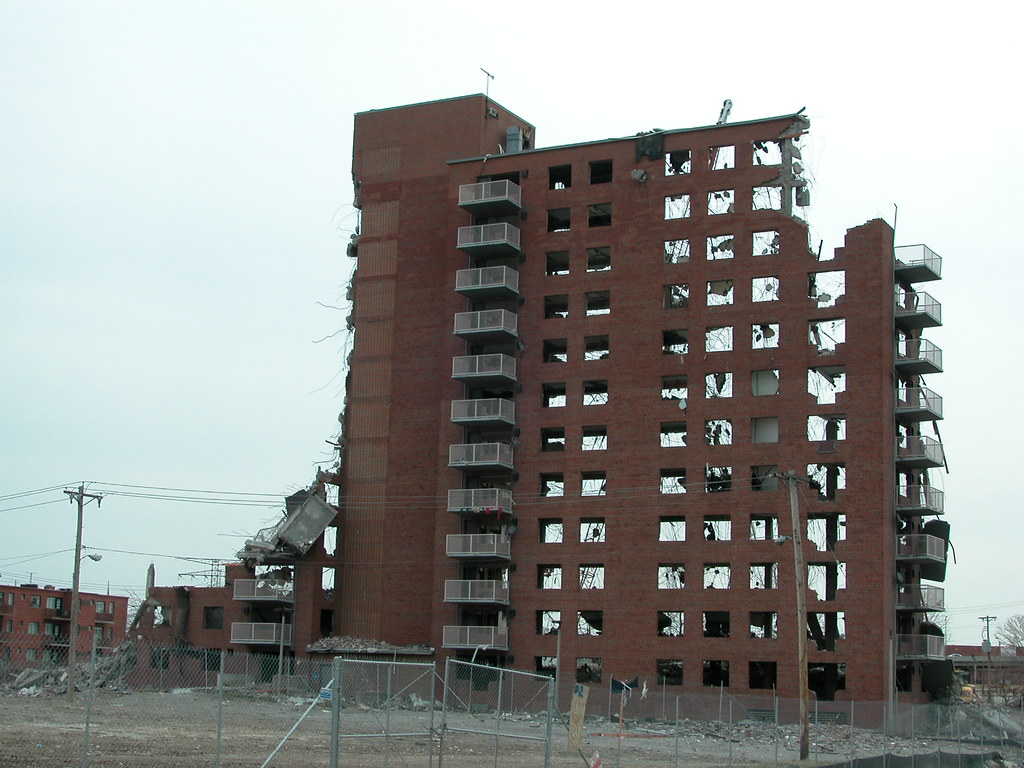
Completed in 1953 and designed by architect George Hellmuth, Cochran Gardens was the first project built by the St. Louis Housing Authority that made use of "high-rise" buildings. However, the complex balanced two 12-story buildings with four wide six-story buildings. Nevertheless, Cochran Gardens set the stage for the Pruitt-Igoe, Darst-Webbe, Vaughn and Blumeyer housing complexes that were composed exclusively of tall buildings. In time, all of these projects have been cleared and redeveloped, most using the federal HOPE VI program.

Cochran Gardens will retain its second tower, transformed in the 1980s into elderly housing. That tower will remain as the first and last tall public housing building in St. Louis.
Completed in 1953 and designed by architect George Hellmuth, Cochran Gardens was the first project built by the St. Louis Housing Authority that made use of "high-rise" buildings. However, the complex balanced two 12-story buildings with four wide six-story buildings. Nevertheless, Cochran Gardens set the stage for the Pruitt-Igoe, Darst-Webbe, Vaughn and Blumeyer housing complexes that were composed exclusively of tall buildings. In time, all of these projects have been cleared and redeveloped, most using the federal HOPE VI program.
Cochran Gardens will retain its second tower, transformed in the 1980s into elderly housing. That tower will remain as the first and last tall public housing building in St. Louis.
Wednesday, August 8, 2007
"Historic" Cochran Gardens
One local television station's report on today's fire at one of the Cochran Gardens buildings on Seventh Street north of downtown called the building "historic."
The use of that adjective was bittersweet. The six red brick apartment buildings -- including two buildings reputed to be the first high-rise public housing buildings in the city -- are a handsome example of relatively sensitive mid-century design. Designed by George Hellmuth and completed in 1953, Cochran Gardens was the city's third federally-funded housing project built by the St. Louis Housing Authority. It also was the scene for one of the nation's earliest and most successful tenant management programs. For better or for worse, Cochran Gardens survived its contemporaries, form Pruitt-Igoe to Darst-Webbe. Tenant management helped, as did a modern design much more humanely scaled than the successor projects with uniform heights and building types.
Demolition of Cochran Gardens is currently underway, with five of the six buildings slated for eventual demolition. One of the taller buildings will remain. The replacement HOPE VI project is under construction, and seems better-designed than many recent examples. One wonders what sort of viability the Cochran Gardens buildings could have had in today's downtown housing market. Next door, the stunning rehabilitation of the Neighborhood Gardens Apartments demonstrates that much can be done to creatively transform mass housing, and that there is demand for the end products. Whereas the intended tenants of high-rise public housing may have desired housing more along the lines of what HOPE VI projects provide, some people do choose to live in basic, sturdy spaces off of the ground. After all, the transformation of the wholesale buildings of Washington Avenue into desired housing suggests that just about any kind of building can be someone's house. Why not a building design for housing in the first place? No matter -- we lost the chance with Cochran Gardens. Next time?
The use of that adjective was bittersweet. The six red brick apartment buildings -- including two buildings reputed to be the first high-rise public housing buildings in the city -- are a handsome example of relatively sensitive mid-century design. Designed by George Hellmuth and completed in 1953, Cochran Gardens was the city's third federally-funded housing project built by the St. Louis Housing Authority. It also was the scene for one of the nation's earliest and most successful tenant management programs. For better or for worse, Cochran Gardens survived its contemporaries, form Pruitt-Igoe to Darst-Webbe. Tenant management helped, as did a modern design much more humanely scaled than the successor projects with uniform heights and building types.
Demolition of Cochran Gardens is currently underway, with five of the six buildings slated for eventual demolition. One of the taller buildings will remain. The replacement HOPE VI project is under construction, and seems better-designed than many recent examples. One wonders what sort of viability the Cochran Gardens buildings could have had in today's downtown housing market. Next door, the stunning rehabilitation of the Neighborhood Gardens Apartments demonstrates that much can be done to creatively transform mass housing, and that there is demand for the end products. Whereas the intended tenants of high-rise public housing may have desired housing more along the lines of what HOPE VI projects provide, some people do choose to live in basic, sturdy spaces off of the ground. After all, the transformation of the wholesale buildings of Washington Avenue into desired housing suggests that just about any kind of building can be someone's house. Why not a building design for housing in the first place? No matter -- we lost the chance with Cochran Gardens. Next time?
Monday, July 16, 2007
Pruitt-Igoe Demolition as Seen in "Koyaanisqatsi"
Someone has posted a long segment from Godfrey Reggio's 1983 film Koyaanisqatsi that includes the famous aerial footage of the vacant housing project and the explosion-based demolition that took down the entire complex between 1972 and 1974.
The Pruitt-Igoe sequence begins at 2:49.
Thirty-three acres of the originally 57-acre Pruitt-Igoe site at the southeast corner of Cass and Jefferson avenues remain vacant to this day.
Thursday, July 12, 2007
Latest Brick Rustling Casualty in St. Louis Place

In the last two weeks, brick rustlers have reduced this Romanesque Revival two-flat at 2318 Howard Street to the tell-tale mess of sagging floors supported by internal walls. The four brick walls are completely gone, with the bricks taken to one of the yards that gladly fence bricks stolen from the north side. Some veneered McMansion in the Phoenix suburbs could end up with a thin face of brick taken from this house to raise money for rent, crack cocaine or any number of other needs and desires. I took the photograph above last summer; the building was remarkably intact
The building stands (barely) on city block 2318, bounded by Howard on the north, 25th on the west, Mullanphy on the south and 23rd on the east. This is two blocks north of the former Pruitt-Igoe housing project site in an area of St. Louis Place that resembles
The ownership pattern on the block is rather strange:
2346 HOWARD ST BLAIRMONT ASSOCIATES LTD CO
2344 HOWARD ST PIE
2342 HOWARD ST PIE
2336 HOWARD ST PIE
2334 HOWARD ST LRA
2326 HOWARD ST PIE
2324 HOWARD ST N & G VENTURES LC
2322 HOWARD ST PIE
2320 HOWARD ST PIE
2318 HOWARD ST PIE
2316 HOWARD ST L C R A
2314 HOWARD ST PIE
2312 HOWARD ST BLAIRMONT ASSOCIATES LTD CO
2308 HOWARD ST BLAIRMONT ASSOCIATES LTD CO
2306 HOWARD ST BLAIRMONT ASSOCIATES LTD CO
2304 HOWARD ST LRA
2300 HOWARD ST PIE
1617 N 23RD ST LRA
2305 MULLANPHY ST PIE
2321 MULLANPHY ST SIMS, OTHIA L & LUCILLE D
2323 MULLANPHY ST BELK, OLIVER L & KATHALEEN
2325 MULLANPHY ST MOBLEY, IDA N & JOYCE MCCALL
2327 MULLANPHY ST MOBLEY, IDA N
2329 MULLANPHY ST 1615 N 25TH ST LLC
In addition to one LCRA holding here we have the Planned Industrial Expansion Authority (PIE), Land Reutilization Authority (LRA), N & G Ventures LC and Blairmont Associates LC, two of Paul McKee's companies, and a smattering of private owners.
Monday, June 11, 2007
The Right Moment?
Sometimes I wish that I had been around in the 1950s to found a historic rehabilitation business. Or better yet, doing the same in the 1930s. Still better would to have been a United States Senator in 1934 when Congress passed the bill that established the Federal Housing Administration. (According to an article by Sam Smith, "91% of the homes insured by the agency in metropolitan St. Louis between 1935 and 1939 were in the suburbs.") Perhaps being a St. Louis alderman at the start of the clearance of the DeSoto-Carr neighborhood for Pruitt-Igoe would have made a big difference. There definitely were better times to intervene on behalf of preserving north St. Louis. But what demographic narratives were playing out? Those of decline. These were narratives built on the struggle of every great American city to stay alive, to survive the onslaught of the automobile so forcefully enshrined in the Interstate Highway Program (oh, to have been in Congress to vote against that!) and countless deadly urban renewal projects. What truly could have made a difference was national resistance to the destruction of cities.
Sadly, that came later when countless intellectuals, designers, politicians and others arose to find the overwhelming evidence of the realized destruction to be the most persuasive argument to mend their ways. In some ways, now is a better time to make the argument for categorical preservation. I'm not one of those people who argue that the thousands of St. Louis buildings that came down had to, because there was no other way for St. Louis to renew itself save through some blight, population loss and decrease of density. That's not true. I think that a variety of forces that conspired to destroy urban areas could have been stopped, but the warning signs were too weak and the faith in technological progress too strong for the people who were on the front lines. Today we simply know more, can do more, and see the lines of defense so much more clearly.
Sadly, that came later when countless intellectuals, designers, politicians and others arose to find the overwhelming evidence of the realized destruction to be the most persuasive argument to mend their ways. In some ways, now is a better time to make the argument for categorical preservation. I'm not one of those people who argue that the thousands of St. Louis buildings that came down had to, because there was no other way for St. Louis to renew itself save through some blight, population loss and decrease of density. That's not true. I think that a variety of forces that conspired to destroy urban areas could have been stopped, but the warning signs were too weak and the faith in technological progress too strong for the people who were on the front lines. Today we simply know more, can do more, and see the lines of defense so much more clearly.
Wednesday, December 20, 2006
Pruitt-Igoe Site the Key to Blairmont's Scheme?
If one studies the map of Blairmont holdings that we posted last month, an interersting picture emerges. Besides other concentrations that I have noted, all of the holdings seem to center on one site: the vacant site of the Pruitt-Igoe housing project.
All of the holdings fan out from that location, a city-owned megaparcel frequently discussed as the nexus of new development on the near northside. Recall that nearly ten years ago the administration of Mayor Freeman Bosley, Jr. embraced a plan to build an 18-hole golf course surrounded by suburban-style housing, using the Pruitt-Igoe site and much of the St. Louis Place neighborhood.
Jump forward to 1999-2000, and one may remember the Fifth Ward Land Use Plan created by Schweyte Architects and vigorously opposed by architects and preservationists, including the Old North St. Louis Restoration Group, Landmarks Association and former St. Louis Place resident Robert Myers. That plan called for the demolition of hundreds of buildings located in the footprint in which Blairmont has been purchasing its holdings. The Pruitt-Igoe site was key to the recommendations of that plan, which seems to be one guide to Blairmont's scope of activities.
Is the Pruitt-Igoe site key to whatever project Blairmont might be concocting? It's hard to say without word from the company's representatives. But it seems that acquisition of that site is essential to any development Blairmont may be planning.
All of the holdings fan out from that location, a city-owned megaparcel frequently discussed as the nexus of new development on the near northside. Recall that nearly ten years ago the administration of Mayor Freeman Bosley, Jr. embraced a plan to build an 18-hole golf course surrounded by suburban-style housing, using the Pruitt-Igoe site and much of the St. Louis Place neighborhood.
Jump forward to 1999-2000, and one may remember the Fifth Ward Land Use Plan created by Schweyte Architects and vigorously opposed by architects and preservationists, including the Old North St. Louis Restoration Group, Landmarks Association and former St. Louis Place resident Robert Myers. That plan called for the demolition of hundreds of buildings located in the footprint in which Blairmont has been purchasing its holdings. The Pruitt-Igoe site was key to the recommendations of that plan, which seems to be one guide to Blairmont's scope of activities.
Is the Pruitt-Igoe site key to whatever project Blairmont might be concocting? It's hard to say without word from the company's representatives. But it seems that acquisition of that site is essential to any development Blairmont may be planning.
Tuesday, February 14, 2006
Redeveloping the Pruitt-Igoe site
The Mayor's office is talking with a pharmaceutical company about building a plant on the site of the Pruitt-Igoe housing projects.
First question: How many full-time jobs with benefits would the plant create? The article states that the plant might create up to 850 jobs, but we all know how big companies use part-time waged labor positions to keep profits high and workers from having a decent life. If these would be 850 honest-to-goodness real jobs, that would be great for the north side.
Second question: Can we please build the plant in a way that allows the street grid to be re-established and allows for other uses along Jefferson and Cass? I would prefer mixed use of the site, but I don't necessarily think that it has to include residential components -- there is ample space for that all over the near north side. Using the Pruitt-Igoe site for retail, office tenants and manufacturing would be a great for the near north side. But the site should not remain an inaccessible superblock -- that's kind of the historical problem with the site. It should be dense, urban and connected no matter what use is found. A factory may need a larger space, but it could still be build up rather than out and leave space for other new construction on the site.
First question: How many full-time jobs with benefits would the plant create? The article states that the plant might create up to 850 jobs, but we all know how big companies use part-time waged labor positions to keep profits high and workers from having a decent life. If these would be 850 honest-to-goodness real jobs, that would be great for the north side.
Second question: Can we please build the plant in a way that allows the street grid to be re-established and allows for other uses along Jefferson and Cass? I would prefer mixed use of the site, but I don't necessarily think that it has to include residential components -- there is ample space for that all over the near north side. Using the Pruitt-Igoe site for retail, office tenants and manufacturing would be a great for the near north side. But the site should not remain an inaccessible superblock -- that's kind of the historical problem with the site. It should be dense, urban and connected no matter what use is found. A factory may need a larger space, but it could still be build up rather than out and leave space for other new construction on the site.
Subscribe to:
Posts (Atom)


 Posts
Posts

