We've Moved

Ecology of Absence now resides at www.preservationresearch.com. Please change your links and feeds.

Showing posts with label fpse. Show all posts

Monday, December 7, 2009

Thoughts on the Proposed Adams Grove Infill Project

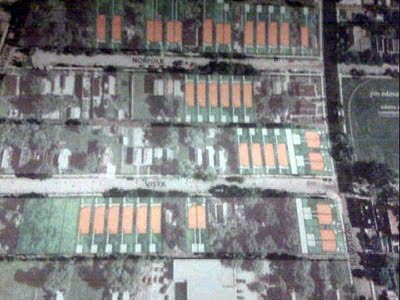
Alex Ihnen has reported the his St. Louis Urban Workshop blog that a substantial new scattered-site infill housing project is in the works for part of Forest Park Southeast. Specifically, the Regional Housing and Community Development Alliance hopes to build 40 new houses on and around Norfolk and Vista avenues west of Newstead. These are some the neighborhood's roughest blocks in its most neglected portion, the area south of Manchester Avenue known as Adams Grove. Adams Grove was platted in 1875 and is the oldest part of Forest Park Southeast, but long has lagged behind the northern section of the neighborhood in development efforts.

Readers may recall that in 2006, these blocks were targeted by the Forest Park Southeast Development Corporation during a wide round of demolition that took down over 30 buildings across the neighborhood. The Preservation Board approved demolition permits for one building on Norfolk and eight buildings on Vista.

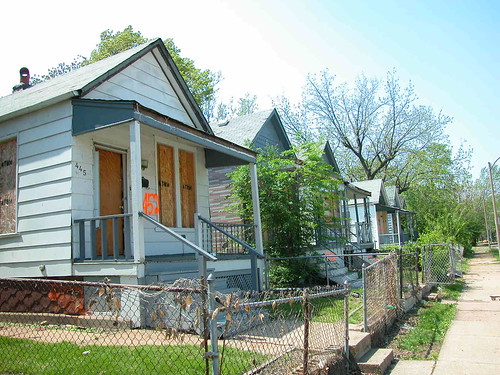
One of the worst aspects of this round of demolition was the wholesale removal of vacant frame houses like the row shown here. These six houses stood from 4452-4462 Vista Avenue. Proponents of demolition argued that the houses were too small for people's demands, and that wide clearance would allow for a large-scale new housing effort.

While the large-scale infill project is welcome fulfillment of the promises that the Development Corporation made in support of demolition, there remains some bittersweet irony that the houses now proposed for construction are small, one-story homes like those rejected as unfit for housing needs. Make no mistake, though -- the size of the proposed infill is perfect for the area and the housing needs. That's why some of us opposed demolishing the frame shotgun houses that also could have served those needs.

The wide demolition in 2006 could lead to two other losses, one of which is the prominent two-story brick corner building at Newstead and Vista that recent was being rehabilitated. Getting remaining buildings listed in the National Register of Historic Places to attain historic rehab tax credits might be difficult, although certainly not impossible. The demolitions are tentative, though, and could be avoidable.

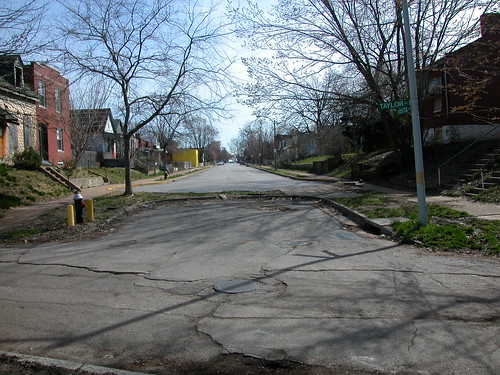
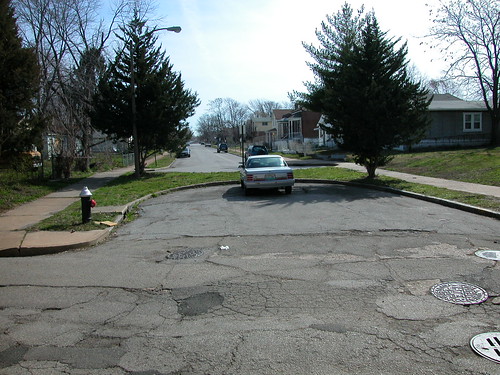
One problem for these specific block of Adams Grove are the cul-de-sac street closures on the western end. These closures are partly responsible for the decline of the building stock in this area. Placement of the closures at an unsightly and moribund stretch of Taylor Avenue has compounded the ill effects. The "dead ends" on Swan, Norfolk and Vista avenues attract enough criminal activity to deserve the term.

Here's the closure on Norfolk:


And this is Vista:


The Vista closure even has large evergreen trees that close off the sight lines of the street. To make these blocks safe and desirable places to live, the closures must be removed and Taylor must be improved. I want very much for the infill project to succeed, because Adams Grove needs major development. That development must address the circulation problem to succeed.

Monday, November 30, 2009

Some Thoughts on Our Gasometer(s)

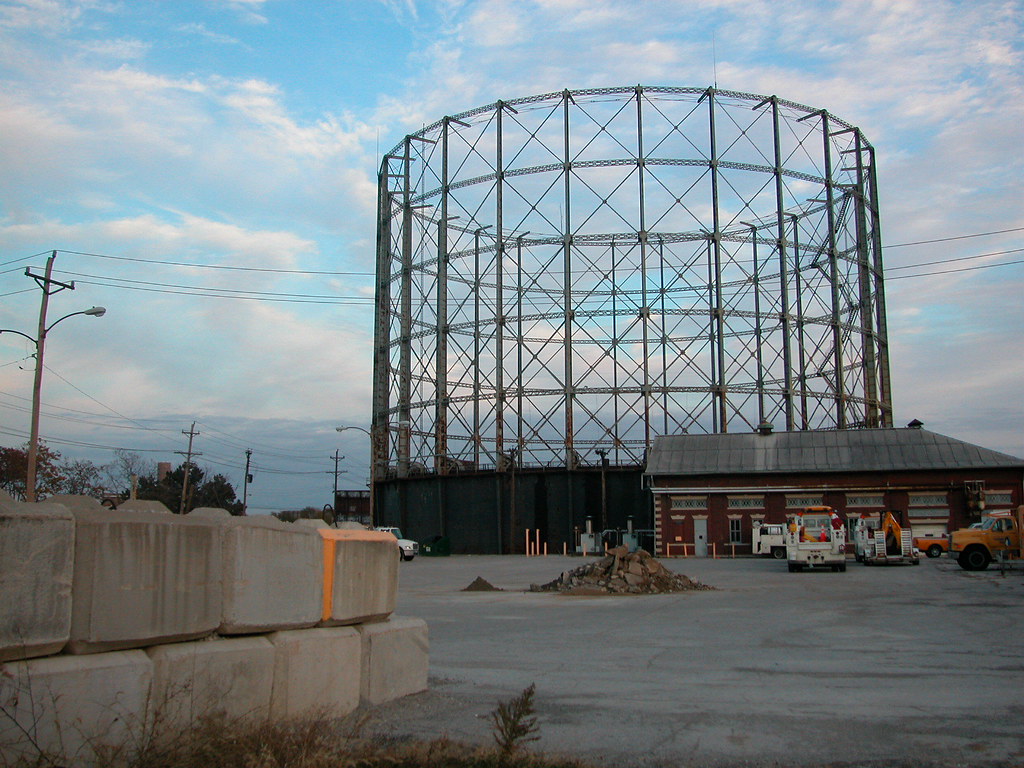
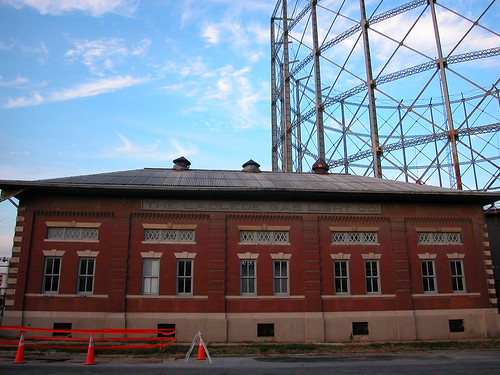
The impending demolition of the two gasometers in Shrewsbury draws me back to the demolition of the gasometer in Forest Park Southeast. Once one of two gasometers at Laclede Gas Company's Pumping Station G and built in 1901 (rebuilt in 1942), the Forest Park Southeast gasometer was a landmark for over a century. When Highway 40 was first built, the gasometer's prominence greatly increased, and it was one of several iconic structures -- the St. Louis Science Center's McDonnell Planetarium, the grain elevator at Sarah and Duncan, Barnes Hospital -- that gave a magically urban character to an otherwise dull trip down the highway. Within Forest Park Southeast, the gasometer's web of steel served as a backdrop to views from backyards, bedrooms and sidewalks. The gasometer was a strange remnant that had outlived its purpose -- regulating the supply of the city's gas system -- but not its industrial charm and connection to the past.

In 2006, developers successfully listed Pumping Station G in the National Register of Historic Places (read the nomination by Susan Sheppard and Doug Johnson here). The State Historic Preservation Office insisted that the gasometer be included, and the gasometer was listed as a contributing structure. However, the official landmark status provided no protection. The developers had never intended to try to save the structure.

An eloquent plea for preservation from historian and then-St. Louis University professor Joseph Heathcott, "Getting creative with the region's exceptional industrial heritage", appeared in the February 8, 2007 issue of the St Louis Post-Dispatch, but there was no strong effort to preserve the gasometer. There was plenty of discussion, however, among architects, Forest Park Southeast residents and preservationists. The alternative ends for the gasometer were obvious. Several European cities, including London and Vienna, have converted iconic gasometers into equally iconic apartment and office buildings. Others have maintained the structures as urban artifacts. Heathcott's article alluded to the imaginative possibilities.

Photograph of Viennese gasometer reuse project from Wikipedia.

Alas, imagination did not win out. Neither did National Register protection; the city's Cultural Resources Office approved demolition of the gasometer without bringing the matter to a public hearing at the Preservation Board. Demolition of the gasometer was completed in the middle of 2007.


Today, the Pumping Station G site is largely vacant. The pumping house (1911) still stands, vacant but slated for rehabilitation. The developers who wrecked the gasometer sold the site to different developers, who have yet to devise plans for the site. In the end, the gasometer could have remained standing as a resource for its neighborhood and a icon for the city. Perhaps a new owner would have been interested in the challenge of finding a new use for the structure. Now, the gasometer is gone, and two of its three sisters soon also will be gone.

That leaves St. Louis only one chance to reclaim a gasometer: the gasometer at the vacant Pumping Station N, located just south of Natural Bridge Road on Chevrolet Avenue in north St. Louis. Can we rise to the challenge of retaining an endangered structural type, or will we let it fall too?

Thursday, September 4, 2008

Industrial Inspiration?

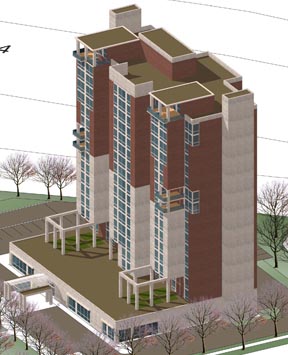
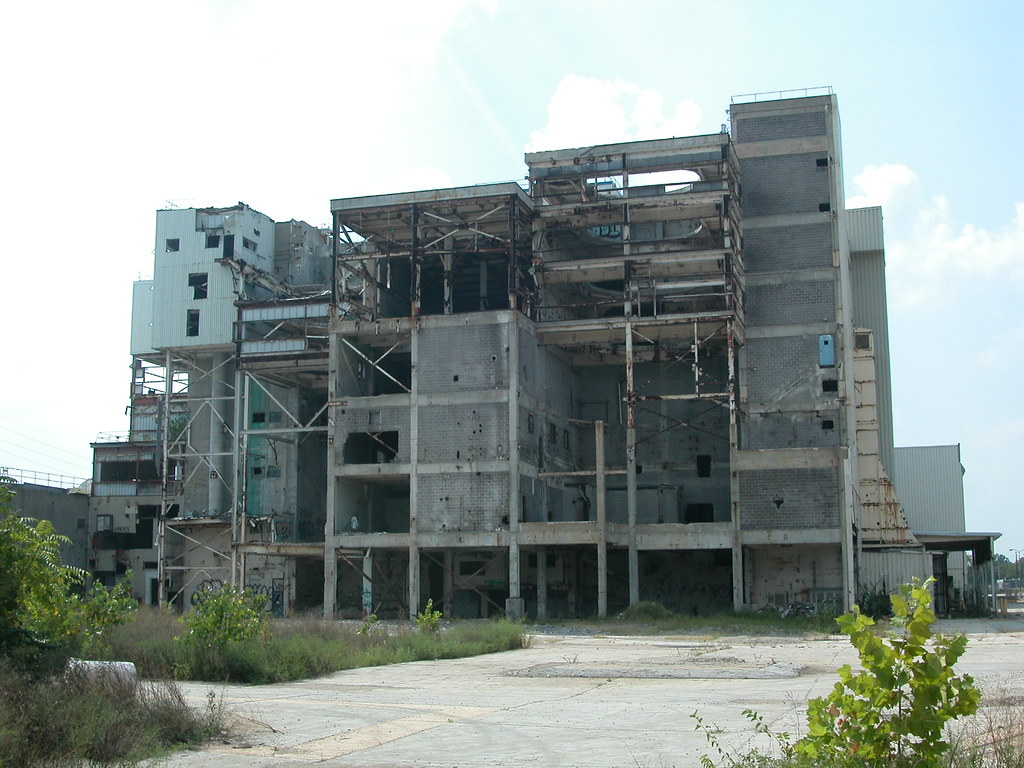
There seems to be more than a passing resemblance between the Forest Park Southeast hotel designs that Drury Inn presented at a recent neighborhood meeting and the abandoned Lever Soap Plant in Pagedale. The three-dimensional renderings of two hotel buildings planned for a site at the southeast corner of the Kingshighway and I-64/40 interchange are in a conceptual phase, but their apparent industrial inspiration is somewhat encouraging.

Here is a close-up of one of the hotels:


Here is the Lever Plant, a lovely composition of industrial economy:
Just sayin'.

Tuesday, August 19, 2008

Odds and Ends

MCPHEETERS WAREHOUSES NEARLY GONE: The McPheeters Warehouses on Leonor K. Sullivan Boulevard, subject of a Vital Voice column of mine published in June, are nearly gone. Demolition started two weeks ago, and now the one-story cold storage warehouse and most of the center building are gone.

SHANK SONS HONOR ISADORE: Peter and Stephen Shank have published Firbeams, a lovely website featuring the residential architecture of father Isadore Shank.

KIEL PROGRESS: In the St. Louis Beacon, Charlene Prost reports on progress in the plan by SCP Worldwide and McEagle Properties to re-open the Kiel Opera House.

VACANT BUILDING INITIATIVE: As featured in a story on KSDK TV this week, Alderman Kacie Starr Triplett (D-6th) has introduced Board Bill 174, which would require owners of vacant buildings to pay an annual registration fee, carry liability insurance and secure all openings, among other requirements. Church and nonprofit property is exempt, but Land Reutilization Authority property is not. More later.

STATEWIDE PRESERVATION CONFERENCE SEPTEMBER 10-13 IN ST. CHARLES: The 2008 Annual Statewide Preservation Conference begins on Wednesday, September 10 in St. Charles. I am co-presenting a workshop with Jan Cameron of the St. Louis Cultural Resources Office entitled "Vernacular Architecture from the Stone Age to the Space Age." Details here.

DRURY WANTS TO DO WHAT?: At Vanishing STL, Paul Hohmann reports on a bizarre plan by Drury Hotels to demolish the northwest corner of the Forest Park Southeast neighborhood for a new hotel. The plan threatens the Lambskin Temple and many historic homes. Drury will present the plans tonight at the Gibson Heights Neighborhood Association meeting, 7:00 p.m. at 1034 S. Kingshighway.

Friday, May 25, 2007

Gasometer Gone, Switzer Columns (Mostly) Survive

Two demolition updates from guys named Paul H.:

At Vanishing St. Louis, Paul Hohmann reports that the gasometer at Laclede Gas Light Company Pumping Station G has fallen.

In today's St. Louis Post-Dispatch, Paul Hampel reports on the confusion surrounding the salvage of the cast iron storefront of the Switzer Building.

When work on our house is further along, I will share more of my thoughts on these losses on the main Ecology of Absence site.

Saturday, February 3, 2007

The BJC Park Lease and the Public Sphere

To all those people who bemoan the fact that some citizens are hesitant to grant BJC Healthcare a 99-year lease of a supposed forgotten corner of Forest Park: please examine the public sphere in the age of neoliberalism. Under policies at all levels of government, the ideal of the public good has become politically gauche. To talk openly about holding the stewardship of park land by our city government over the economic benefit of BJC's expansion seems a political third rail, when even twenty-five years ago widespread opposition would have been a given, and few city officials would dare have favored a 99-year lease of public land to a private hospital group headed by a real estate developer.

In the past few years, we have watched the public school system sell off or discard assets of the public trust; not so long ago, the public hospital system was dismantled; city government has gone from a collective trust among citizens to provide for their needs to a near-sighted machine for favors, cobbled-together compromises and defensive gestures. Things that should belong to the citizens have been sold off or promised to private interest, and there seems to be widespread acceptance among leaders that government is now a tool for endorsement and acceleration of market forces. Once, government was the check against those forces that ensured that no matter what the city's commercial fortunes the citizens had good parks, clean water, schools and the infrastructure needed for living.

While the opposition to the Forest Park lease may be more symbolic than anything given that BJC already has a lease on the land it is posed to get, the opposition recognizes the precedent the lease sets for future "needs" by big corporations like BJC. The lease makes law the trend of using city government to aid the powerful at the expense of safeguarding the public trust.

In that light, the lonely votes of opposition cast by Alderman Jeffrey Boyd (D-22nd) and Aldermanic President James Shrewsbury on the perfection of the lease deal are not foolish or ignorant acts. After all, BJC could seriously have chosen many other lands for the expansion project; the site is a red herring of epic proportion. They are the bare minimum we should expect of our elected officials in an age in which the very purpose of democratic government is under attack by hyper-capitalists who have managed to influence our government, nonprofit and intellectual spheres. This attack should be resisted everywhere, but it is especially pernicious on an urban city with relatively scarce resources like St. Louis.

Thankfully, we have two representatives in city government who are wary of the attack on the public sphere. We may every well have a third, if Comptroller Darlene Green votes against the lease when the final and binding vote by the Board of Estimate and Apportionment takes place.

Wednesday, January 31, 2007

What Other People Are Writing

In "Late and Unlamented" (Built St. Louis blog, January 29), Rob Powers examines his changing appreciation of the now-demolished Kohler Building at St. Louis State Hospital, a mid-century building that blocked the front elevation of the landmark "Old Main" building.

Meanwhile, Paul Hohmann laments the demolition of the iconic gasometer in Forest Park Southeast ("Laclede Gasometer - Newstead & Chouteau," Vanishing STL, January 23).

Wednesday, December 6, 2006

Update on 4202 Chouteau

Last week, I posted information from Marti Frumhoff about a condemned house at 4202 Chouteau in Forest Park Southeast. Here's an update.

The Forest Park Southeast Development Corporation and Alderman Joe Roddy (D-17th) decided last year to pursue a nuisance case against the owner of the home, Andrew Yee, who had purchased it in 2003 for rehab only to leave it in a terrible state for over two years. Neighbors have been upset by the condition, so the alderman and the development corporation rightly got involved.

However, apparently somehow the nuisance case led to a condemnation suit seeking demolition, and on November 20 a circuit court judge ordered the building condemned and demolished. Also, the owner claims the alderman is using eminent domain to acquire the building; I have no knowledge of whether or not that's the case but am not necessarily opposed given the property condition.

Residents of FPSE are concerned that the house, which is a contributing resource to the Forest Park Southeast Historic District and eligible for tax credits, may be demolished per the judge's order.

Anyone who wants to step forward to rescue the house should immediately contact Irving Blue, Executiev Director of the Forest Park Southeast Development Corporation, at 314-533-6704 and Alderman Roddy at 314-622-3287. While demolition may seem like a viable solution, I am sure they would not oppose a quality historic rehab. However, if a new owner can't be found soon demolition is inevitable.

Monday, November 27, 2006

4485 Vista Decision Deferred

Today, without discussion, the Preservation Board voted unanimously to defer for six months consideration of the demolition application for 4485 Vista.

We have six months to find a better future than destruction. Ideas?

Opportunity in Forest Park Southeast

From Marti Frumhoff:

4202 Chouteau is for sale. They are asking $54,900. It is a 2 family getting ready to be demolished by the city and it seems worth saving.

I suspect an offer of $5,000, that's right, $5,000, might get the winning bid. Find a realtor and make an offer. Or, just call the listing agent and make an offer. Here is the link to the MLS listing.

Wednesday, November 22, 2006

Preservation Board to Consider Demolition of Unique House in "The Grove"

On the agenda for Monday's meeting of the St. Louis Preservation Board is the demolition of a unique house at 4485 Vista Avenue in "the Grove." The city's Land Reutilization Authority owns the house and is applying for demolition along with Alderman Joseph Roddy (D-17th).

Check out the last photograph on this page of a report that I wrote on the condition of Taylor Avenue, which runs to the west of the house. You'll see that 4485 Vista is a wide, symmetrical side-gabled frame home with a center-hall plan. The centered doorway is flanked by pairs of windows, with one dormer centered above each pair. This symplicity is almost rustic -- no surprise given that the center-hall house was a common choice for Midwestern farms in the nineteenth century. Very few homes of this type exist in the city of St. Louis, and no other can be found in the Grove. The date of construction is not definitive, but it's possible this house dates to the period when the Adams Grove area was subdivided as the Laclede Race Course Addition to the city in 1875.

This house is a unique home and clearly eligible for listing on the National Register of Historic Places. Hopefully, the Preservation Board will block demolition so that a respectful owner will purchase the building from the city.

Earlier, the LRA applied for a demolition permit for the house in 2004 and was denied by the Cultural Resources Office and the Preservation Board.

If you'd like to comment on the demolition, there are several ways. You can attend Monday's meeting of the Preservation Board at 4:00 p.m. in the 12th floor conference room of the Locust Building, 1015 Locust. You can call the staff of the Cultural Resources Office at 314-622-3400. Also, you can send written testimony to Kate Shea, Director of Cultural Resources, at SheaK(at)stlouiscity.com.

Monday, October 30, 2006

Gasometer Love

Someone (with the wry Flickr username of "flickr_screen_name") has posted a photographic ode to the gasometer at Laclede Gas Company Pumping Station G on Chouteau Avenue in Forest Park Southeast. Here are the photos.

The gasometer, built in 1901 and rebuilt in the 1940's, stands next to a delightful Renaissance Revival pumping station that will be renovated for condo use. The gasometer is not as fortunate, and is slated for demolition.

Wednesday, October 25, 2006

Demolition Updates

MORSE SHOE FACTORY UNDER DEMOLITION

Workers have begun removing the terra cotta ornament from the O. Morse Shoe Company Building at Duncan and Boyle. Apparently, some of the ornament will be "reused" in construction of the building that will replace the venerable shoe factory building: the sleekly boring, sub-urban headquarters building for Solae. Whether or not such reuse is appropriate remains to be seen.

FOREST PARK SOUTHEAST DEMOLITION SPREE NEARLY DONE

Meanwhile, the clearance of 22 buildings in Forest Park Southeast is nearly complete. The demolitions at the north end of the neighborhood on Chouteau and Donovan avenues has created a large open space that is extremely jarring. Hopefully redevelopment will be swift. To the west, the Laclede Gas Pumping Station G will lose its landmark gasometer but retain its delightful Classical Revival pump house (built in 1910). West of there, the Freund Bread Company site has been cleared since last year, awaiting new buildings that are part of the Pumping Station project.

Overall, though, the neighborhood is looking better than ever. The transformation of Manchester Avenue within the last year has reversed the decay of many historic buildings and led to the openings of several new businesses.

BRECHT BUTCHER SUPPLY COMPANY BUILDINGS HOLDING ON

On October 10, the Building Division issued an emergency condemnation for the Brecht Butcher Supply Company Buildings. However, demolition is up to the Blairmont Associates LC of O'Fallon, Missouri, owners of the complex. So far, there is no demolition application at City Hall.

Thursday, May 25, 2006

Aldermen and the Preservation Board

Richard Nickel, the Chicago architectural photographer, salvager and preservation activist, once said that two things threaten old buildings: water and stupid men.

In what language does the prefix "alder" translate as "stupid"?

This question comes to the minds of anyone who attended Monday's Preservation Board meeting. Actions on two items from the agenda stand out as examples of the short-sightedness of the Gang of 28:

3524 Victor: David Guller, owner of this magnificent home in the Compton Hill local historic district, replaced windows, cornice and soffit without a permit. He was caught by a neighbor and had to apply for a permit. Unfortunately, his vinyl replacements don't meet the local district code and when Guller made an application for a permit on the already-done remuddling the city's Cultural Resources Office (CRO) denied his application. He appealed to the Preservation Board, which denied the appeal. Guller agreed to rework his soffit and cornice to the liking of the CRO. But he didn't want to replace the six windows on his front elevation, and somehow appealed the denial of his appeal.

How was this even possible? Legally, it's not. The city's Preservation Review Ordinance holds the Preservation Board's denial of appeal as the final deliberation, after which a matter would go to court through lawsuit. Apparently there is an unwritten exception that Alderman Stephen Conway, Guller's representative, used to secure a second hearing at last month's meeting. Guller did not appear, and the Board voted again to uphold the CRO denial. The item re-appeared this month, and Guller as well as Alderman Conway testified in support of his supposedly appropriate vinyl windows. The windows have embedded muntins and a terrible flat appearance; at the least, he could have sought simulated exterior muntins. best of all, Guller could re-install the wooden windows that he removed on the front elevation and keep his vinyl windows on the side and rear elevations (private elevations under city law). But he has thrown them out.

The Preservation Board smartly voted again to uphold CRO denial. If the matter comes up again, perhaps someone who supports CRO should file suit against Guller and Conway for abusing the process!

Forest Park Southeast Demolitions: The tides turned against 32 houses owned by Forest West Properties, a real estate corporation created by the Washington University Medical Center Redevelopment Corporation. Forest West sought demolition permits for all 32 and ended up receiving 22 permits, the staff recommendation of CRO. While last month's consideration by the Board of the same matter met with widespread resentment of Forest West's lack of a plan for and lack of communication with CRO.

This month, things had changed. Namely, Alderman Joseph Roddy's name, absent from earlier deliberations, surfaced. CRO Director Kate Shea told the Preservation Board that Roddy had asked Forest West to buy the homes and tear them down for new construction. This fact is irrelevant to any discussion of the consequences of the demolition permit, the adequacy of their excuses for seeking one and approaches to preservation planning for these properties -- but it seemed to carry weight. Never mind that only Forest West's Brian Phillips testified in favor of demolition and that four people -- Claire Nowak-Boyd, Anthony Coffin, Steve Patterson and myself -- testified at length on the problems with the application.

The Preservation Board itself was diminished by the total absence of members John Burse and Alderman Terry Kennedy (continuing his string of absences and becoming the third alderman in this story) and the departure of Melanie Fathman in the middle of testimony on this matter. Richard Callow recused himself after asking to split the vote on permits so that he would not vote on permits for buildings that a client was seeking to buy. For some reason, his suggestion did not go anywhere. So members Mary "One" Johnson, Luis Porello, Anthony Robinson and Chairman Tim Mulligan were left to vote. Johnson is the most uncritical cheerleader of the status quo on the Board, with Porello often siding with her. On this matter, they were true to form with Johnson "complimenting" Phillips from the start. Robinson was oddly quiet; he would have been a voice of reason. Mulligan opposed the permits strongly last month but endorsed the staff recommendation this time.

In the end, the vote was 3-1 in favor of the staff recommendation to approve demolition of 22 buildings, with Robinson dissenting. Testimony from opponents was mostly ignored, unlike last month when it was led to enthusiastic discussion with Shea and board members.

What a difference an alderman can make!

Sunday, May 21, 2006

Forest Park Southeast Clear-Cut On Monday's Preservation Board Agenda

On the agenda for tomorrow's Preservation Board meeting once again is the matter of the demolition of buildings owned by Forest West Properties in Forest Park Southeast. (Read all about last month's attempt to get Preservation Board approval to demolish 30 buildings.) This time, the number of buildings is 32. This time, the Cultural Resources Office is recommending denying permits for ten buildings. However, the reasoning behind the ten buildings recommended is difficult to discern. It seems to have more to do with basic architectural features that with a comprehensive plan for the neighborhood. From a preservation standpoint, such reasoning may be logical but from a more holistic view it could end up producing dispersed vacant lots that diminish historic contexts appropriate for renovation and historic district designation without demolition.

In my testimony at last month's meeting, I suggested a plan for ranking the buildings architecturally as a worst-case preservation strategy. In the absence of compelling plans for the buildings' sites, the best case for planning still exists, despite what Forest West Properties says.

Since last month, a credible developer has made an offer to acquire over half of these buildings south of Manchester, in a pattern that would retain the remaining context there and may allow for a historic district to be created that would enable the use of tax credits.

As far as I know, Forest West has not responded to the offer except to immediately re-apply for preliminary review of the demolition. (The Board did not vote at last month's meeting because, due to absences and recused members, only two members were able to vote so no quorum existed.)

Forest West needs to explore sensible redevelopment of these buildings and not continue in a mad rush to tear them down. There is still time to build a true redevelopment plan. Forest West knows a lot about waiting, because they have owned these buildings for over a year without coming up with any plans for redevelopment. All they can do now is take the easy way out with clearance.

Their best bet may be a sale to a developer with expertise at complicated urban development that is architecturally sensitive and at working in rebounding marginal areas. Demolition only will make things worse for the southern part of "the Grove."

See the agenda for the meeting here.

Meeting details:
Monday, May 22 at 4:00 p.m.
1015 Locust Street, 12th Floor

Tuesday, April 25, 2006

Preservation Board Meeting Leads to Good Decisions

Yesterday's Preservation Board meeting yielded some good outcomes for the city. The Board was short a few members: perpetually-absent Alderman Terry Kennedy, Mary "One" Johnson and Melanie Fathman. (Of course, the seat that gets filled by a member of the Planning Commission remains vacant.) That left board members John Burse, Richard Callow, Chairman Timothy Mulligan Luis Porrello and Anthony Robinson to deliberate on the full agenda for the evening.

The noteworthy votes included a vote on a sign, a vote on a storefront banking facility and the two demolition applications mentioned in this blog. The sign-related item was the application from Hammerstone's bar in Soulard to restore the vintage neon Budweiser blade sign on the corner of its building (the restoration will involve major replacement). Staff at the Cultural Resources Office denied the permit because local Historic District standards for Soulard prohibit such a sign type without a variance, despite the fact that the sign pre-dates the historic district ordinance and the lifetimes of many of the people attending last night's meeting. The sign has been in place on the building at least since the 1950s, and signs of its type date back to the late 1920s. St. Louis was a major manufacturing city for neon signs, and they are an important and lively part of the city's architectural heritage. Steve Patterson spoke on the subject and passed around a book that included photos of local streetscapes in the 1950s with many similar signs. Currently, the Hammerstone's sign is covered in Dryvit -- somehow that is acceptable under Historic District standards. Thankfully, the Preservation Board unanimously voted to approve the application.

This vote was a great demonstration of what constitutes an appropriate variance. The Historic District standards no doubt intended to prohibit bad new signs, but in doing so removed the protection for existing historic signs that may not date to the "old days" of Soulard but have attained great historic significance in themselves. The standards also prohibit new signs that would be thoughtful. I appreciate the standards and the precautionary principle embodied within, but they are short-sighted on signage (as most local district standards are). Accumulation is the urban condition!

A unanimous vote to allow a walk-up ATM in the Central West End for a new National City Bank branch location was also a good thing that will hopefully encourage banks to use walk-up ATMs instead of drive-through lanes in the city.

I was very surprised that the Board ended up unanimously denying the demolition application for the Lutheran Altenheim Home in Baden. Few architectural historians had paid much attention to this wonderful institutional building, and in light of in-progress interior demolition, Cultural Resources head Kate Shea was resigned to only trying to guarantee salvage of architectural elements. Thankfully, Board member Callow asked one simple but important question: Had the owners, multi-state residential care facility operators Hillside Manor Property LLC, determined the presumably prohibitive cost of reuse? The answer, after staff of the company denounced the building for being too old and for having been built around, was "no." The Preservation Review ordinance stipulates that there must be demonstration that the cost of reuse is prohibitive before the Preservation Board can approve a demolition permit -- no matter how much far the demolition-happy Building Division has let the owners go. Callow moved to deny the application and the other members vote in favor of it.

The best part of the evening was the result of the consideration of Forest West Properties' application to demolish 30 houses in Forest Park Southeast. I've written much about the application before, so I won't go into great detail. Suffice to say that the climate of hostility toward preservation dissolved at the meeting. Before the meeting, I heard that a reputable developer has a strong interest in acquiring almost all of the 30 buildings, saving those on Chouteau and Swan if my source is correct. While I lack details about the developer and their plans, the potential interest is something that myself and Kate Shea mentioned at the meeting. Kate's presentation was good, and included more reasons for preservation than for demolition -- and, in fact, she reversed her recommendation by the end of the meeting and recommended denial of the permits. Apparently, her only contact with Forest West prior to the meeting were two short phone calls! Forest West sent a representative since director Brian Phillips was out of town. The representative discussed reasons for demolition, mostly involving the abuse of the buildings by people rather than building conditions. I spoke against the demolition, as did Claire Nowak-Boyd and Steve Patterson. We made great points, touching on how wrong the demolition was from the standpoints of urban planning, architectural and social history, neighborhood stabilization and economic development. Everyone worked well with each other, including Kate Shea, and by the end of the testimony a clear and multi-faceted case for preservation was made. (This is the sort of meeting that Jane Jacobs would have loved.) Oddly, due to Forest West's affiliation with Washington University, Board members Burse and Porello recused themselves; Callow also recused himself due to a potential conflict of interest with a client. Mulligan and Robinson seemed very swayed by the testimony -- Mulligan brought up Botanical Heights and called it a failure -- but ended up deferring the matter due to concern over the lack of a voting quorum. Shea promised to deny the permit the next morning; hopefully, Forest West will take heed and look into selling the buildings rather than try some end-run through the Board of Alderman or Planning Commission (possibly difficult without a development plan, and Forest West's representative said that the company has no plans to develop the sites itself).

What a great outcome! Hopefully, it opens the door for reconsideration of the demolition plans and our mystery developer will emerge with a solid plan.

The final agenda item was an appeal of a Preservation Board decision against very inappropriate modifications to a house at 3524 Victor. Apparently, upon being told that the law -- and that is what the preservation ordinances are -- prohibited his "choices," the owner complained to his alderman, Stephen Conway, who made a fuss. Both should know better.

Thursday, April 20, 2006

Most of Thirty Buildings Proposed for Demolition in Forest Park Southeast Have Architectural Merit

I have posted my review of the 30 buildings in Forest Park Southeast that Forest West Properties seeks to demolish. The review includes photographs and brief assessments of each building.

Tuesday, April 18, 2006

Massive demolition coming to Forest Park Southeast

The agenda for the Preservation Board meeting on Monday, April 24 shows an application for demolition permits for 30 buildings in Forest Park Southeast. These buildings are owned by Forest West Properties, which is tied to Washington University. Apparently the demolition is related to an infill housing project.

A quick memory scan and drive-by shows that at least ten of the buildings are of high local architectural merit and are structurally sound. I was surprised at how many of these buildings are masonry and how many are two-story buildings. I'm sure that the infill housing developer and their friends in city government will be talking "density" even though they will be replacing four unit buildings with single-family homes. Some of the wood-frame buildings on the list are of questionable architectural merit and are quite dilapidated, but probably 10-15 of these buildings are clearly worth preserving.

We will be developing a site section with photos and short evaluations; in the meantime, we managed to find photos of three of the buildings in our collection:
4371 Hunt Avenue; 4484 and 4486-90 Vista Avenue.

Wednesday, December 7, 2005

4101 Manchester Avenue

Word from Forest Park Southeast business folks is that Alderman Joseph Roddy and other businesses is pushing for a parking lot on the LRA-owned lot at 4101 Manchester, just west of Manchester's intersection with Vandeventer. This is a prominent location that is one of the first things visitors see when coming from the east into the business district along Manchester. Nothing could be uglier and less exciting than a surface parking lot at the entrance to a growing business strip. The clubs, bars and restaurants here rely on the density slowly growing as new businesses open in proximity to each other. Why not put a new business at this hot location?

Manchester is not exactly a safe street, yet it attracts hundreds of people every weekend night. These people are coming to the nightlife without surface parking. If the lot gets developed for a building, the crowd at Atomic Cowboy or Novak's is not going to fall off -- the crowd will only grow. Surface parking in a major location would only reinforce people's reservations about the business district; people are encouraged by vitality, architectural density and storefront activity. This site is perfect for a new building.

Thursday, October 20, 2005

The Red Car Drives Away

The little red car behind the cinder block house at 4467 Norfolk in the Adams Grove section of Forest Park Southeast left yesterday, according to neighbors. It first appeared behind the house in August, and would still be there had someone not contacted Neighborhood Stabilization Office head Joe Thele, who actually worked diligently to get the car removed.

Officials of the Forest Park Southeast Development Corporation are on a listserv on which the red car was discussed. Not one of them posted a comment on the car or made an offer to use their clout to resolve the matter.

I guess removing the red car wouldn't further the agenda for Adams Grove: suspension of city services, landbanking and wholesale clearance for new homes built by a suburban-minded developer. Now it's gone, though, which is a small victory for the good people who are still trying to make Adams Grove a liveable part of the neighborhood.