
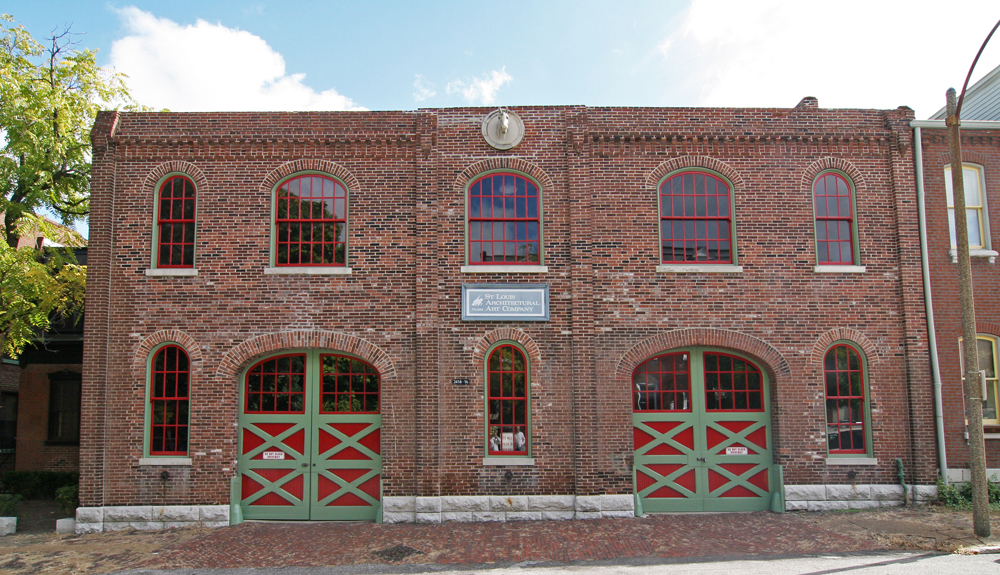
 Now there is a rare opportunity: the chance to purchase the historic Stahl stables at 2414-16 Menard Street in Soulard and an adjacent house at 2412 Menard Street. Rehabilitated in the 1970s to house the St. Louis Architectural Art Company, the spacious stables consist of a rear building dating to 1866 and the front section, which dates to 1891. There are few comparable buildings in Soulard. The sale will benefit the current owner of the property, the non-profit St. Louis Building Arts Foundation. Read more about the buildings in the sale brochure.
Showing posts with label soulard. Show all posts
Showing posts with label soulard. Show all posts
Sunday, November 22, 2009
Historic Stahl Stables in Soulard For Sale
Now there is a rare opportunity: the chance to purchase the historic Stahl stables at 2414-16 Menard Street in Soulard and an adjacent house at 2412 Menard Street. Rehabilitated in the 1970s to house the St. Louis Architectural Art Company, the spacious stables consist of a rear building dating to 1866 and the front section, which dates to 1891. There are few comparable buildings in Soulard. The sale will benefit the current owner of the property, the non-profit St. Louis Building Arts Foundation. Read more about the buildings in the sale brochure.


Friday, October 23, 2009
Cultural Resources Office Stands Up for House in Soulard
The city's Cultural Resource Office (CRO) has published the final agenda for Monday's Preservation Board meeting. CRO recommends that the Board uphold denial of the house at 1925-27 S. 10th Street in Soulard. The report clears up any doubt that Rehab Girls LLC is tied to developer Pete Rothschild. This action is inconsistent with Rothschild's lauded track record on preservation.
Sunday, October 18, 2009
"Rehab Girls" Seek Soulard Demolition
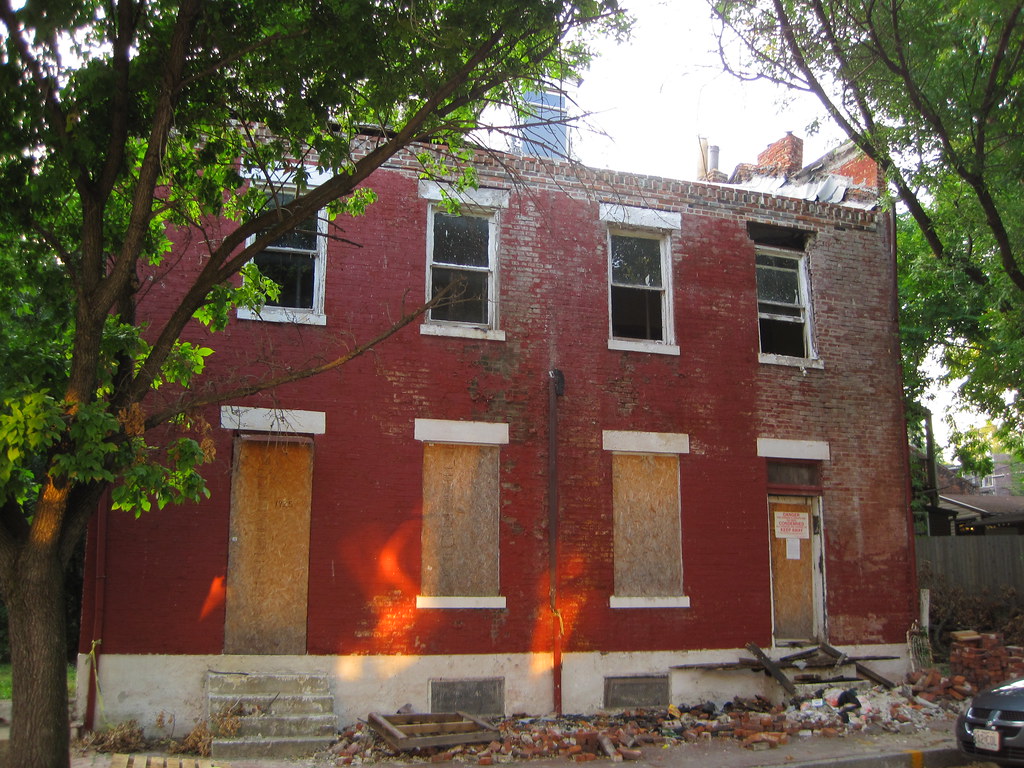 The most troubling item on the October 26 agenda for the St. Louis Preservation Board is the only actual demolition permit on the agenda, for a house at 1927-9 S. 10th Street in Soulard. While any demolition permit for a perfectly sound historic building is troubling, this one is egregious. For one thing, the two-and-a-half brick house is located in a dense and stable part of one of the city's most dense and stable historic districts. For another, the house at 1927-9 S. 10th Street is one of the number of remaining St. Louis buildings that appear in the pages of Pictorial St. Louis, the 1875 atlas by Richard Compton and Camille Dry. The simple brick dentils on the cornice indicate an age even earlier than the atlas -- perhaps in the 1850s or 1860s, before wooden cornices began appearing on modest housing like this. Such buildings are rare enough that the Preservation Board should never permit their demolition.
What this writer knows about the back story here provides little clue as to why the owner, Rehab Girls LLC, is pushing demolition. In its fictitious registration of the name Rehab Girls, Rehab Girls LLC -- registered through a third-party registrar -- reported that Peggy Sheffold is Vice President and that the company office is the same as Rothschild Development Ltd., Sheffold's employer. Rothschild owns a lot of Soulard property, including a corner mixed-use building directly north of this house.
Rehab Girls LLC purchased the house on South 10th for $50,000 on December 19, 2006. Recently, the house was listed for sale by Red Brick Management, a Rothschild company, with a $136,000 asking price. Since the purchase, there are no recorded building permits despite a full recent reconstruction of the cornice.
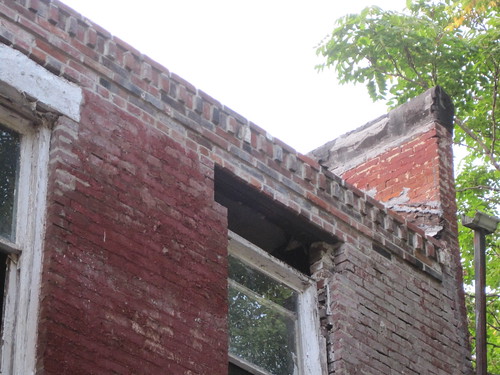 The work performed on the cornice indicates that the building's brick work is fully repairable. Why Rehab Girls aborted the work and decided to pursue demolition is unfathomable. Soulard is a neighborhood that long has moved past dark days of demolition and on to significant infill construction. The "Rehab Girls" should stick to their name or sell this fine building. Meanwhile, the Preservation Board should deny the demolition request.
The Preservation Board meets at 4:00 p.m. on Monday, October 26 in the offices of the St. Louis Development Corporation, 1015 Locust Street, 12th floor.
However, citizens need not be present to submit written testimony. Testimony can be sent to the board via its secretary, Adona Buford, at BufordA@stlouiscity.com or care of the Cultural Resources Office, 1015 Locust Street, Suite 1200, St. Louis MO 63101.
Tuesday, April 25, 2006
Preservation Board Meeting Leads to Good Decisions
Yesterday's Preservation Board meeting yielded some good outcomes for the city. The Board was short a few members: perpetually-absent Alderman Terry Kennedy, Mary "One" Johnson and Melanie Fathman. (Of course, the seat that gets filled by a member of the Planning Commission remains vacant.) That left board members John Burse, Richard Callow, Chairman Timothy Mulligan Luis Porrello and Anthony Robinson to deliberate on the full agenda for the evening.
The noteworthy votes included a vote on a sign, a vote on a storefront banking facility and the two demolition applications mentioned in this blog. The sign-related item was the application from Hammerstone's bar in Soulard to restore the vintage neon Budweiser blade sign on the corner of its building (the restoration will involve major replacement). Staff at the Cultural Resources Office denied the permit because local Historic District standards for Soulard prohibit such a sign type without a variance, despite the fact that the sign pre-dates the historic district ordinance and the lifetimes of many of the people attending last night's meeting. The sign has been in place on the building at least since the 1950s, and signs of its type date back to the late 1920s. St. Louis was a major manufacturing city for neon signs, and they are an important and lively part of the city's architectural heritage. Steve Patterson spoke on the subject and passed around a book that included photos of local streetscapes in the 1950s with many similar signs. Currently, the Hammerstone's sign is covered in Dryvit -- somehow that is acceptable under Historic District standards. Thankfully, the Preservation Board unanimously voted to approve the application.
This vote was a great demonstration of what constitutes an appropriate variance. The Historic District standards no doubt intended to prohibit bad new signs, but in doing so removed the protection for existing historic signs that may not date to the "old days" of Soulard but have attained great historic significance in themselves. The standards also prohibit new signs that would be thoughtful. I appreciate the standards and the precautionary principle embodied within, but they are short-sighted on signage (as most local district standards are). Accumulation is the urban condition!
A unanimous vote to allow a walk-up ATM in the Central West End for a new National City Bank branch location was also a good thing that will hopefully encourage banks to use walk-up ATMs instead of drive-through lanes in the city.
I was very surprised that the Board ended up unanimously denying the demolition application for the Lutheran Altenheim Home in Baden. Few architectural historians had paid much attention to this wonderful institutional building, and in light of in-progress interior demolition, Cultural Resources head Kate Shea was resigned to only trying to guarantee salvage of architectural elements. Thankfully, Board member Callow asked one simple but important question: Had the owners, multi-state residential care facility operators Hillside Manor Property LLC, determined the presumably prohibitive cost of reuse? The answer, after staff of the company denounced the building for being too old and for having been built around, was "no." The Preservation Review ordinance stipulates that there must be demonstration that the cost of reuse is prohibitive before the Preservation Board can approve a demolition permit -- no matter how much far the demolition-happy Building Division has let the owners go. Callow moved to deny the application and the other members vote in favor of it.
The best part of the evening was the result of the consideration of Forest West Properties' application to demolish 30 houses in Forest Park Southeast. I've written much about the application before, so I won't go into great detail. Suffice to say that the climate of hostility toward preservation dissolved at the meeting. Before the meeting, I heard that a reputable developer has a strong interest in acquiring almost all of the 30 buildings, saving those on Chouteau and Swan if my source is correct. While I lack details about the developer and their plans, the potential interest is something that myself and Kate Shea mentioned at the meeting. Kate's presentation was good, and included more reasons for preservation than for demolition -- and, in fact, she reversed her recommendation by the end of the meeting and recommended denial of the permits. Apparently, her only contact with Forest West prior to the meeting were two short phone calls! Forest West sent a representative since director Brian Phillips was out of town. The representative discussed reasons for demolition, mostly involving the abuse of the buildings by people rather than building conditions. I spoke against the demolition, as did Claire Nowak-Boyd and Steve Patterson. We made great points, touching on how wrong the demolition was from the standpoints of urban planning, architectural and social history, neighborhood stabilization and economic development. Everyone worked well with each other, including Kate Shea, and by the end of the testimony a clear and multi-faceted case for preservation was made. (This is the sort of meeting that Jane Jacobs would have loved.) Oddly, due to Forest West's affiliation with Washington University, Board members Burse and Porello recused themselves; Callow also recused himself due to a potential conflict of interest with a client. Mulligan and Robinson seemed very swayed by the testimony -- Mulligan brought up Botanical Heights and called it a failure -- but ended up deferring the matter due to concern over the lack of a voting quorum. Shea promised to deny the permit the next morning; hopefully, Forest West will take heed and look into selling the buildings rather than try some end-run through the Board of Alderman or Planning Commission (possibly difficult without a development plan, and Forest West's representative said that the company has no plans to develop the sites itself).
What a great outcome! Hopefully, it opens the door for reconsideration of the demolition plans and our mystery developer will emerge with a solid plan.
The final agenda item was an appeal of a Preservation Board decision against very inappropriate modifications to a house at 3524 Victor. Apparently, upon being told that the law -- and that is what the preservation ordinances are -- prohibited his "choices," the owner complained to his alderman, Stephen Conway, who made a fuss. Both should know better.
The noteworthy votes included a vote on a sign, a vote on a storefront banking facility and the two demolition applications mentioned in this blog. The sign-related item was the application from Hammerstone's bar in Soulard to restore the vintage neon Budweiser blade sign on the corner of its building (the restoration will involve major replacement). Staff at the Cultural Resources Office denied the permit because local Historic District standards for Soulard prohibit such a sign type without a variance, despite the fact that the sign pre-dates the historic district ordinance and the lifetimes of many of the people attending last night's meeting. The sign has been in place on the building at least since the 1950s, and signs of its type date back to the late 1920s. St. Louis was a major manufacturing city for neon signs, and they are an important and lively part of the city's architectural heritage. Steve Patterson spoke on the subject and passed around a book that included photos of local streetscapes in the 1950s with many similar signs. Currently, the Hammerstone's sign is covered in Dryvit -- somehow that is acceptable under Historic District standards. Thankfully, the Preservation Board unanimously voted to approve the application.
This vote was a great demonstration of what constitutes an appropriate variance. The Historic District standards no doubt intended to prohibit bad new signs, but in doing so removed the protection for existing historic signs that may not date to the "old days" of Soulard but have attained great historic significance in themselves. The standards also prohibit new signs that would be thoughtful. I appreciate the standards and the precautionary principle embodied within, but they are short-sighted on signage (as most local district standards are). Accumulation is the urban condition!
A unanimous vote to allow a walk-up ATM in the Central West End for a new National City Bank branch location was also a good thing that will hopefully encourage banks to use walk-up ATMs instead of drive-through lanes in the city.
I was very surprised that the Board ended up unanimously denying the demolition application for the Lutheran Altenheim Home in Baden. Few architectural historians had paid much attention to this wonderful institutional building, and in light of in-progress interior demolition, Cultural Resources head Kate Shea was resigned to only trying to guarantee salvage of architectural elements. Thankfully, Board member Callow asked one simple but important question: Had the owners, multi-state residential care facility operators Hillside Manor Property LLC, determined the presumably prohibitive cost of reuse? The answer, after staff of the company denounced the building for being too old and for having been built around, was "no." The Preservation Review ordinance stipulates that there must be demonstration that the cost of reuse is prohibitive before the Preservation Board can approve a demolition permit -- no matter how much far the demolition-happy Building Division has let the owners go. Callow moved to deny the application and the other members vote in favor of it.
The best part of the evening was the result of the consideration of Forest West Properties' application to demolish 30 houses in Forest Park Southeast. I've written much about the application before, so I won't go into great detail. Suffice to say that the climate of hostility toward preservation dissolved at the meeting. Before the meeting, I heard that a reputable developer has a strong interest in acquiring almost all of the 30 buildings, saving those on Chouteau and Swan if my source is correct. While I lack details about the developer and their plans, the potential interest is something that myself and Kate Shea mentioned at the meeting. Kate's presentation was good, and included more reasons for preservation than for demolition -- and, in fact, she reversed her recommendation by the end of the meeting and recommended denial of the permits. Apparently, her only contact with Forest West prior to the meeting were two short phone calls! Forest West sent a representative since director Brian Phillips was out of town. The representative discussed reasons for demolition, mostly involving the abuse of the buildings by people rather than building conditions. I spoke against the demolition, as did Claire Nowak-Boyd and Steve Patterson. We made great points, touching on how wrong the demolition was from the standpoints of urban planning, architectural and social history, neighborhood stabilization and economic development. Everyone worked well with each other, including Kate Shea, and by the end of the testimony a clear and multi-faceted case for preservation was made. (This is the sort of meeting that Jane Jacobs would have loved.) Oddly, due to Forest West's affiliation with Washington University, Board members Burse and Porello recused themselves; Callow also recused himself due to a potential conflict of interest with a client. Mulligan and Robinson seemed very swayed by the testimony -- Mulligan brought up Botanical Heights and called it a failure -- but ended up deferring the matter due to concern over the lack of a voting quorum. Shea promised to deny the permit the next morning; hopefully, Forest West will take heed and look into selling the buildings rather than try some end-run through the Board of Alderman or Planning Commission (possibly difficult without a development plan, and Forest West's representative said that the company has no plans to develop the sites itself).
What a great outcome! Hopefully, it opens the door for reconsideration of the demolition plans and our mystery developer will emerge with a solid plan.
The final agenda item was an appeal of a Preservation Board decision against very inappropriate modifications to a house at 3524 Victor. Apparently, upon being told that the law -- and that is what the preservation ordinances are -- prohibited his "choices," the owner complained to his alderman, Stephen Conway, who made a fuss. Both should know better.
Friday, February 24, 2006
Like a terribly, terribly overgrown Cubs game, but with very old, French roots
The Mardi Gras parade is tomorrow.
For those brave souls who venture out to watch and/or participate, you oughta know that the Old North St. Louis Restoration Group will be selling beer at a booth at the corner of 7th and Victor in order to raise funds for our wonderful, historic neighborhood. We will be there from 8AM until 4PM. Stop by and buy a beer, or a soda, or water, or a hurricane, and drop some money in the tip jar to support the neighborhood even more. At least you will be able to tell your friends you did one honorable thing at Mardi Gras!
For those brave souls who venture out to watch and/or participate, you oughta know that the Old North St. Louis Restoration Group will be selling beer at a booth at the corner of 7th and Victor in order to raise funds for our wonderful, historic neighborhood. We will be there from 8AM until 4PM. Stop by and buy a beer, or a soda, or water, or a hurricane, and drop some money in the tip jar to support the neighborhood even more. At least you will be able to tell your friends you did one honorable thing at Mardi Gras!
Thursday, December 2, 2004
Mexican Hat Factory Redux
A good thing that I've been seeing around Saint Louis lately is the updating of historic buildings that underwent earlier renovations that weren't very respectful of architectural features. People are taking out dropped ceilings and carpeting and re-opening large, hemmed-in windows and doors. This is far from the norm, regretfully, but it seems that a significant number of people are amending past mistakes. Certainly, Missouri's 1997 historic rehab tax credit provides an incentive to remodel previously-updated buildings in a manner more sympathetic to their unique architectural features.
One of the biggest of these projects is happening right now at the "Allen Market Lane Apartments," better known as the Mexican-American Hat Factory, in Soulard. This 100-year-old block-sized factory sits at Russell and Tucker. McCormick-Baron spent $4.8 million to renovate it in 1980, for elderly apartments. Under their new moniker, McCormick Baron Salazar, the firm is renovating it again, this time for $11.8 million. They are removing dropped ceilings that obscure the 470 10-foot-high windows, replacing all of the windows and fixtures and... keeping all of the residents! The work progresses around the residents, who will stay in the building. The building will remain in use for moderate-priced elderly apartments.
This is a great example of how developers nowadays can restore apartment buildings without having to sell out units as condos and force out residents to finance renovation and make a huge profit. Of course, this project benefits from $7.7 million in state and federal historic and low-income housing tax credits. Andy Trivers, designer of the new MetroLofts, Hi-Pointe Lofts and other housing projects in the city, is the architect.
The project coincides with the current renovation of nearby building also designed by the firm of Weber and Groves, the former City Hospital at 1515 Lafayette. That project, however, will not create any affordable rental housing.
One of the biggest of these projects is happening right now at the "Allen Market Lane Apartments," better known as the Mexican-American Hat Factory, in Soulard. This 100-year-old block-sized factory sits at Russell and Tucker. McCormick-Baron spent $4.8 million to renovate it in 1980, for elderly apartments. Under their new moniker, McCormick Baron Salazar, the firm is renovating it again, this time for $11.8 million. They are removing dropped ceilings that obscure the 470 10-foot-high windows, replacing all of the windows and fixtures and... keeping all of the residents! The work progresses around the residents, who will stay in the building. The building will remain in use for moderate-priced elderly apartments.
This is a great example of how developers nowadays can restore apartment buildings without having to sell out units as condos and force out residents to finance renovation and make a huge profit. Of course, this project benefits from $7.7 million in state and federal historic and low-income housing tax credits. Andy Trivers, designer of the new MetroLofts, Hi-Pointe Lofts and other housing projects in the city, is the architect.
The project coincides with the current renovation of nearby building also designed by the firm of Weber and Groves, the former City Hospital at 1515 Lafayette. That project, however, will not create any affordable rental housing.
Subscribe to:
Posts (Atom)


 Posts
Posts

