
While the thunder of a showy trial on McEagle's NorthSide project has marched along, the next round of redevelopment ordinances specific to the four phases of the project apparently have not. The Board of Aldermen was supposed to consider those ordinances before April 1, but they may not come for some time longer. At least, that's what Jerry Berger tells us:
Most City Hall observers expect McKee and his partners will let the date slip by while the McEagle team continues to acquire properties and wait for answers to his requests for federal and state assistance.
Dale Singer has a sold analysis of the trial in the Beacon. Read it here.
On the matter of federal and state assistance, the city lost its bid for a federal TIGER grant to reconfigure the Jefferson/22nd Street exits downtown. McEagle needs that reconfiguration and a land swap with the Missouri Department of Transportation to start one of the first-phase components of the project.
Showing posts with label board of aldermen. Show all posts
Showing posts with label board of aldermen. Show all posts
Sunday, March 7, 2010


Saturday, March 6, 2010
Brick Thieves and Brick Dealers
After this week's spate of fires in JeffVanderLou, Alderman Sam Moore (D-4th) proposes changing city ordinances to force brick thieves to pay back the amount of damage that they cause, instead of the current maximum of $500. Moore's proposal makes sense.
 The commercial building at 2538 St. Louis Avenue in St. Louis Place, destroyed by brick thieves in August 2007.
Yet a new ordinance should go further. The thieves are only the first -- and least compensated -- beneficiaries of the money generated by the stolen brick. Penalties for dealers who buy stolen brick are the same as for the thieves. Those should be increased too.
 The commercial building at 2538 St. Louis Avenue in St. Louis Place, destroyed by brick thieves in August 2007.
What if dealers caught buying stolen brick permanently lost their business licenses?
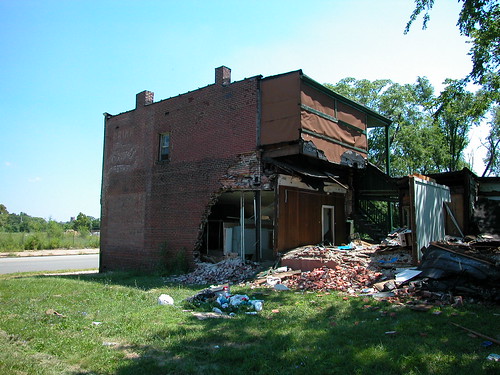 The commercial building at 2538 St. Louis Avenue in St. Louis Place, destroyed by brick thieves in August 2007.
Yet a new ordinance should go further. The thieves are only the first -- and least compensated -- beneficiaries of the money generated by the stolen brick. Penalties for dealers who buy stolen brick are the same as for the thieves. Those should be increased too.
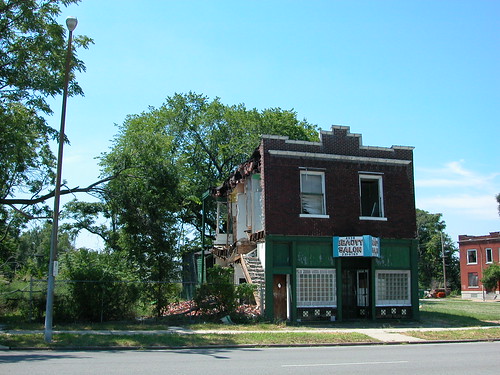 The commercial building at 2538 St. Louis Avenue in St. Louis Place, destroyed by brick thieves in August 2007.
Thursday, January 28, 2010
Mayor's Budget Suggestions Include Planning Cut
On January 18, Mayor Francis Slay released a list of budget changes he is suggesting to the St. Louis Board of Aldermen to address this year's shortfall. Neither any alderman or Comptroller Darlene Green released any ideas ahead of the mayor, and none has released any since. Hopefully, we won't just see a round of orders from the mayor's menu -- take this, leave that. After all, we are not discussing mere numbers but actual functions of government. The budget debate is as much about public service priorities as it is about money.
Readers of this blog will be most interested in the suggestion that the city eliminate the $130,000 annual payment from general revenue to the city's Planning and Urban Design Agency. According to the mayor's proposal, eliminating that subsidy will remove two full-time positions from the agency. One of those might be the Preservation Planner position in the Cultural Resources Office created by the Board of Aldermen in 2007. The Planning and Urban Design Agency has not even had a permanent director since Rollin Stanley's departure in December 2007.
If we actually wanted a strong, pro-active planning agency, we would need more than the current staff level. Cutting two positions to save money is a step in the wrong direction, and the savings realized minuscule. Scratch that one off the list.
Wednesday, January 6, 2010
Now That McKee Has His Money, City Should Slow Process
At the end of 2009, developer Paul J. McKee, Jr. received $19.62 million in Distressed Areas Land Assemblage Tax Credits. According to the developer's application, McKee's Northside Regeneration LLC claims a little over $25 million in assemblage, interest and maintenance costs to date, and projects an additional $66 million in acquisition costs. Only part of the application has been released publicly, so a breakdown of those figures is not yet available.
The $25 million figure corresponds to the amount of a $25 million Second Mortgage and Deed of Trust filed with the St. Louis Recorder of Deeds by Northside Regeneration LLC on December 10. That second deed of trust is guaranteed by Paric Corporation, the construction company founded by McKee and now headed by his son Joe McKee.
Now that McKee has the tax credits he claimed all last year he needed to proceed, what will the developer do with the proceeds of selling them? Pay down his debt.
That use of the credits may surprise those who put stock in the words of supporters of the tax credit, including Lt. Gov. Peter Kinder, who claimed those credits would enable development of north St. Louis. Those who read the tax credit bill realized that it was in effect remuneration for questionable acquisition activity already underway.
Now that McKee has received his first payment and announced his intended use of the proceeds, we know that he will have paid down most of his claimed debt. Since McKee's company continues to fail to secure and adequately maintain holdings, his holding costs must be minimal. This payment enables him to sit for another length of time.
More importantly, however, this payment enables city government to look more carefully at the Northside Regeneration project. McKee can no longer claim that the Board of Alderman's lack of action is keeping him from money he needs to survive. The developer has redevelopment rights and TIF financing secured through the ordinances passed in October 2009. Both sides are even. There are going to be additional bills needed to enable redevelopment of the four areas McKee has divided the project into, and to activate the tax increment financing. This time, the Board of Aldermen and Mayor Francis Slay should not rush the process.
There needs to be a full and open debate of whether or not the project's boundaries are appropriate, whether eminent domain restrictions need to be stronger, whether historic preservation planning ought to be included in additional ordinances, and what happens to McKee's holdings outside of his project boundaries in the Old North St. Louis neighborhood.
Let's lay this all on the table before passing more enabling ordinances.
Wednesday, November 4, 2009
Alderman French Looking Toward the Future of North City
This video footage from Friday's meeting of the St. Louis Board of Alderman shows Alderman Antonio French (D-21st) stating why he would vote against both board bills 218 and 219 which enable the McEagle NorthSide project. French's words on the problem posed to the rest of north city by the Distressed Areas Land Assemblage Tax Credit are right on.
Friday, October 23, 2009
On Public Record McKee Denies Connection to Urban Assets
Douglas Duckworth posted this video that he took at yesterday's aldermanic Housing, Urban Development and Zoning committee meeting. Toward the end of questioning by Alderman Antonio French (D-21st), Paul J. McKee Jr. -- on public record -- denies any intention to purchase land outside of the NorthSide project area and any involvement in land-grabbing shell company Urban Assets LLC.
Wednesday, October 21, 2009
Aldermanic Hearing on NorthSide Project Tomorrow
The St. Louis Board of Aldermen's Housing, Urban Development and Zoning Committee will hold a hearing tomorrow on the two board bills -- 218 and 219 -- that would enact a redevelopment agreement for the McEagle NorthSide project and allocate Tax increment financing to the project's first two phases.
The meeting will take place at 10:00 a.m. in the Kennedy Room, formerly the City Council chamber when the city had a bicameral legislature (Room 208).
Word is buzzing about lawsuits against the project and a recall effort against Alderwoman April Ford-Griffin (D-5th), but the legislation that will give McEagle development power marches along. Does the haste to pass the bill and the fervor to kill it create a situation where smart changes will have little political support? No doubt that McEagle has the votes it needs to pass these ordinances as they have been introduced. The only part of the deal that would probably fail at the Board is public guarantee of the TIF, and that proposal has not been introduced as a bill. Many aldermen have stated total opposition to public guarantee but support for the project itself with the TIF currently proposed.
Thus, there is only a small amount of time in which real changes to these bills can be crafted and proposed. Let's get those changes on the table quickly. What should they be? Post them here and bring them tomorrow morning.
Monday, August 31, 2009
An Update of Sorts on NorthSide
Dale Singer's article "Questions still being raised about McKee's north side development" (St. Louis Beacon, August 31) provides an update on the politics of this redevelopment project.
A few items jump out at me.
No Eminent Domain on Churches
Paul J. McKee, Jr. lays to rest one of the rumors circulating: that his companies plan to use eminent domain on churches. McKee says:
"We've bought some churches from people who want to sell them. If they want to sell them, we'll buy them. But can you imagine asking for eminent domain for churches? That would be short of insanity. We spend a lot of time putting to sleep those kind of rumors."
Indeed, many churches have voluntarily sold parcels and church buildings to the developers, and others are actively supporting the project. Those that remain could enjoy great benefits to their surroundings should the plan come to fruition. The origin of the church rumor was nothing more than the poorly-prepared list of parcels needed for the project that was released by the St. Louis Development Corporation. Seriously, that list looked less like a sinister plot than a cut-and-paste job with owner-occupied parcels removed and everything else retained without a final proofreading.
What Happened to the Forum?
McKee's comments about McEagle's removal of the public forum on his website is lacking. Here's what the article reports:
McKee also defended the fact that a website for the project shut down an area where people could go on and make anonymous comments. He said the forum had degenerated and was not serving any constructive purpose.
In reality, McEagle moderated every aspect of the site. Julie Guignon at McEagle had to approve requests to set up an account on the board, and either Guignon or someone else deleted inappropriate posts. The only posts that were ever published were all thoughtful, intelligent requests for information or maintenance, and were made in response to leading questions like "What Information Do You Want to See?" posted by a site moderator. None of the suggestions or questions ever got a real response.
McEagle's formerly open media strategy had received kudos from the St. Louis Social Media Report. As an often skeptical observer of the project and its public relations blunders, I was quick to praise the unconventional move.
Let me retract that praise and call the media strategy a bizarre failure. McEagle tapped into social media like no developer before, received praise even from long-time critics, posted some content and then...killed its own momentum (and new found good will) by closing up shop prematurely.
CBA Group Opposed to Any TIF?
The Northside Community Benefits Alliance seems opposed to any form of tax increment financing for the NorthSide project. Keith Marquand, the group's treasurer, is quoted:
"Ronald Reagan had the saying, 'Trust but verify,' " he said. "I don't understand why we should have any basis for trust whatsoever. Look at the city's record with TIF projects. ... The city doesn't have a very good record of enforcing agreements with developers."
I think that McEagle has the votes to pass even a $410 million TIF through the Board of Aldermen. The TIF alone doesn't upset me because I think that TIFs were designed exactly for the purpose proposed by McEagle: renewal of truly distressed areas. The real problem, of course, remains the scale of development, resident displacement and lack of solid urban design and historic preservation guidelines.
What is questionable, and what does not likely have a majority of aldermanic votes, is city backing of half of the TIF. After St. Louis Centre's failure and the city's wise refusal to grant backing to Ballpark Village, McEagle faces an uphill battle on that point.
Of note in the initial TIF application is that without city backing, the developer projects a 3.21% profit on the project, and with such backing projects an 8.21% profit. Hence, the project is still profitable without the city backing the bonds.
On the other hand, if the City of St. Louis had to pay $205 million should the developer default -- and remember, no one assumed that Pyramid would ever fail -- the city government would go bankrupt.
Sunday, August 9, 2009
Can St. Louis Lure Small Businesses?
This week New Geography published an interesting article by Steve Null entitled "New York City Closes Shop". The article reports that under the anti-small business policies of New York City Mayor Michael Bloomberg, over 83,000 small businesses have been forced to close since 2001. That astounding figure represents just the recent effort to "crack down" on commerce that predecessors Rudy Giuliani, David Dinkins and Ed Koch all enforced as well.
Has this trend pushed small business out of the Big Apple? If so, what can smaller cities do to lure some of the entrepreneurs that might end up looking for a more encouraging urban business environment?
While Chicago has been a beneficiary of New York's terrible policies, St. Louis could lure some of the business. St. Louis has an abundance of historic commercial districts, where old buildings offer cheap rents and low purchase prices. Small business owners can afford to rent a small space in New York and maybe an entire building in Chicago. In St. Louis, they can buy a building -- or two. The low cost of living is a base incentive.

The 8200 block of North Broadway in the Baden neighborhood, 2006.
However, St. Louis needs more than a low cost of living and old buildings to draw businesses from larger cities. We need better urban planning policies to promote commercial districts by retaining storefront buildings and keeping out fast food, drug stores and other uses that break up urban streetscapes needed to draw shoppers. We need public sector investment in infrastructure like sidewalks, alleys and lighting. The business license fees and sales tax rates in the city are too high, especially on food and drink. Most of all, we need to break down the ward-by-ward differences in business and license policy with strict citywide standards that make sense to people from the outside world.
I'm not suggesting that a wave of would-be New Yorkers are coming. In fact, many of the small business owners we need to attract are those who chose Clayton, St. Charles or Belleville -- or Memphis, Cleveland or Kansas City -- over the city proper. The bottom line is that we have to create a city that not only has sensible small business policy but actively encourages small business to keep our neighborhood commercial districts thriving.
I would be very interested in comments from city small business owners.
Has this trend pushed small business out of the Big Apple? If so, what can smaller cities do to lure some of the entrepreneurs that might end up looking for a more encouraging urban business environment?
While Chicago has been a beneficiary of New York's terrible policies, St. Louis could lure some of the business. St. Louis has an abundance of historic commercial districts, where old buildings offer cheap rents and low purchase prices. Small business owners can afford to rent a small space in New York and maybe an entire building in Chicago. In St. Louis, they can buy a building -- or two. The low cost of living is a base incentive.
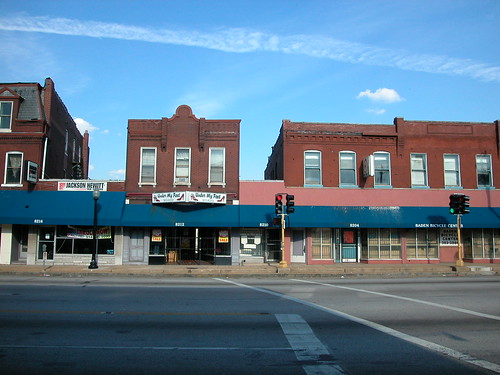
However, St. Louis needs more than a low cost of living and old buildings to draw businesses from larger cities. We need better urban planning policies to promote commercial districts by retaining storefront buildings and keeping out fast food, drug stores and other uses that break up urban streetscapes needed to draw shoppers. We need public sector investment in infrastructure like sidewalks, alleys and lighting. The business license fees and sales tax rates in the city are too high, especially on food and drink. Most of all, we need to break down the ward-by-ward differences in business and license policy with strict citywide standards that make sense to people from the outside world.
I'm not suggesting that a wave of would-be New Yorkers are coming. In fact, many of the small business owners we need to attract are those who chose Clayton, St. Charles or Belleville -- or Memphis, Cleveland or Kansas City -- over the city proper. The bottom line is that we have to create a city that not only has sensible small business policy but actively encourages small business to keep our neighborhood commercial districts thriving.
I would be very interested in comments from city small business owners.
Thursday, July 23, 2009
San Luis Plight Gets National Attention
The national publication The Architect's Newspaper covers the San Luis Apartments demolition in its blog today. The coverage shows how the issue resonates on a national level, with its questions of preservation law, mid-century modern preservation and politics.
Amid reasonable quotes in the blog post, Alderwoman Lyda Krewson (D-28th) makes one error. (While I clearly have a major disagreement with the alderwoman here, I understand her perception of the political quandry of the matter and am not intending to attack her.) Krewson states that "it's not a contributing building [in the Central West End Historic District]. Until recently, there was no outcry about the architectural wonders of this building."
Actually, the building is indeed a contributing building in the Central West End Historic District. That local district was created by ordinance in 1974 and the ordinance does not exempt a single building from its standards. The standards laud modern buildings, expressly state that imitation-historic architecture should not be built in the district and require that parking be shielded by being placed behind or to the side of buildings and not visible from the street.
Krewson would be correct to point out that the San Luis is not noted as a contributing building in the 1979 certification of the district by the National Park Service. That certification, however, serves a different purpose than the local historic district: it defines which buildings are eligible for the use of state and federal tax credits tied to federal historic status. That's it. Just because the San Luis, only 16 years old in 1979, was not considered contributing then does not exempt it from the provisions of a local law.
Also, the certification is out-dated and based on a 1979 rule of thumb. Why would the federal government permit the owner of a 16-year-old building to reap the benefit historic tax credits? The equation changes greatly when the same building becomes 46 years old and its architectural significance more clear across time. However, the local district ordinance (fundamentally a design ordinance) still applies.
I concur with Alderwoman Krewson that local preservationists should have been less reactionary on this issue, but why fault today's crop for the inaction of a past generation? Additionally, the San Luis was hailed at the times of its construction, but that shall be the subject of another essay.
Friday, May 29, 2009
French Introduces Bill to Place 21st Ward in Preservation Review
Today Alderman Antonio French (D-21st) introduced Board Bill 78 to make his ward one of the preservation review districts governed by the city's preservation ordinance. Preservation review allows the city's Cultural Resources Office to review demolition permits in the ward and deny them based on the architectural merit and reuse potential criteria established by the ordinance.
The 21st ward is one of nine city wards that are not preservation review areas. Here is a map showing the distribution of wards that do not participate (in white):

This map shows that the area covered by the McEagle NorthSide project (mostly the 5th and 19th wards) is not included in preservation review. Neither is most of the north city swath in which Urban Assets and other holding companies are buying buildings and land.
A ward's lack of preservation review enables demolition on a wide scale -- not necessarily all at once, either. The conditions of many wards without preservation review have deteriorated through the loss of one building at a time for decades. Loss of buildings means loss of residents, loss of job and loss of a sense of community -- adding up to conditions that make wards vulnerable for land-banking. Preservation review is not designed to keep every old building standing forever, but to create a mechanism for careful decision-making about the physical resources of our neighborhoods.
Alderman French has a great ward with a largely intact building stock. Placing the 21st ward under preservation review will help keep the 21st ward in good shape for generations to come. By making the move to place the ward under such review early in his tenure, French shows that he will be working to protect and strengthen the neighborhoods he already governs, rather than jockeying for the big development that can shatter communities.
Friday, May 22, 2009
Video from Last Night's Meeting on the McEagle Project
Seth Teel captured video at last night's public meeting on McEagle's "NorthSide" project and posted it to YouTube.
Here are some of Alderwoman April Ford-Griffin (D-5th)'s opening remarks:
Here is the talk by Paul J. McKee, Jr. in several short segments:
Here is the closing address by Alderwoman Marlene Davis (D-19th):
Here is the closing statement by Alderwoman Ford-Griffin:
Here are some of Alderwoman April Ford-Griffin (D-5th)'s opening remarks:
Here is the talk by Paul J. McKee, Jr. in several short segments:
Here is the closing address by Alderwoman Marlene Davis (D-19th):
Here is the closing statement by Alderwoman Ford-Griffin:
Tuesday, April 21, 2009
Board of Aldermen Back in Session With New Faces
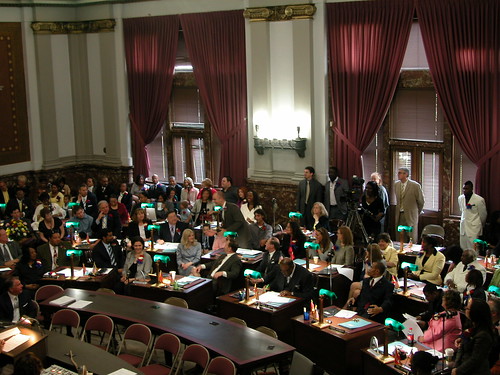 Today, the St. Louis Board of Aldermen convened for the first time since the general election. New members Antonio French (D-21st), Joe Vaccaro (D-23rd) and Shane Cohn (D-25th) joined 11 re-elected incumbents and 14 members whose terms do not expire until 2011. The board approved several consent resolutions and had first reading of 25 bills, including several to vacate streets and alleys.
Shane Cohn and Antonio French are young, neighborhood-oriented aldermen whose reputations as activists precedes their efforts at electoral politics. In Dutchtown, Shane has been part of an emerging renaissance of the business district around Meramec and Virginia. Shane is also the first openly gay member of the Board of Aldermen. Coming from the heart of south St. Louis, that is a great accomplishment.
Through Pub Def (reborn today), Antonio has kept the flame of intelligent political advocacy journalism alive in St. Louis. His prior campaign for the Board of Education showed that he is willing to act on his principles. In the six years since that run, Antonio's work has only gotten better. One of his strongest traits is his penchant to build coalitions around issues he cares about -- sometimes drawing together people who otherwise would not talk. He's also been an ambassador to other cities, attending the Great Lakes Urban Exchange conferences to represent the great things happening in St. Louis to young people from the broader region.
Readers of this blog will take heart that both Shane and Antonio are preservation-minded. In fact, Antonio ran on a platform centered on re-directing block grant money from new construction to existing housing where constituents need home repairs. Both represent areas densely populated with abundant, aging stocks of historic buildings -- pivotal wards for the future of preservation in the city.
I don't know what Vaccaro will do in terms of preservation and development, but I have no reason to be alarmed.
Some may still mourn the lack of competition for Room 200, but I'm overjoyed that we elected two young, progressive aldermen this year. Change starts at home, not the executive office. Few call the mayor when they want the vacant house next door torn down -- they call the alderman.
Saturday, April 18, 2009
Kennedy Out as Public Safety Chair, Preservation Board Member?
Word from the Board of Aldermen this week is that Alderman Terry Kennedy (D-18th) is out as Chairperson of the Public Safety Committee, to be replaced by Alderman Phyllis Young (D-7th). Kennedy is supposed to chair the Transportation Committee instead.
This move is significant to historic preservation because the chair of the Public Safety Committee by ordinance has a seat on the city's Preservation Board. The chairperson can take that spot himself, as Kennedy did, or appoint a proxy member of the Public Safety Committee. No news yet on Young's intentions.
Terry has been a thoughtful member of the Preservation Board, often raising issues of class, race and public policy that no one else would. While more often than not we have been on opposing sides of granting demolition permits, I have always appreciated Terry's principled voice and willingness to discuss -- and find solutions to -- deep divides between preservationists and communities.
Wednesday, April 8, 2009
Detroit City Council Members Play Structural Engineers
If you think that the preservation system in St. Louis city government is screwed up, count your blessings. In Detroit, the City Council just passed a resolution calling for the emergency demolition of the landmark Michigan Central Station. The resolution comes after the council has done the following: not conduct a structural assessment of the building; not consult the building's owner about plans for redevelopment; not implore the building owner to redevelop or sell to someone who will; and, most important, only get interested in the building's plight after the mayor made a move.
Strange priority for a City Council that is having a hard time dealing with a $300 million municipal budget deficit.
Although the building is owned by billionaire developer Manuel Moroun, Mayor Ken Cockrel, Jr. had requested federal stimulus funds for demolition work that could cost around $3.6 million. Since Michicagn Central is listed on the National Register of Historic Places, federal funds for demolition will entail a Section 106 demolition review that could complicate the mayor's plans. (Michigan Central Station dates to 1913 and was designed by Warren and Wetmore with Reed and Stem.)
The Council's resolution directs the owner to pay for an emergency demolition, attempting to use a 1984 ordinance that gives the council discretionary power to take down "dangerous" structures. Council President Monica Conyers, perhaps America's most self-serving urban politician, opines that the building should have come down years ago. Despite years of decay, Michigan Central Station is not unsound and clearly not dangerous in any legal sense. Check out Forgotten Detroit and see for yourself. The old station has great reuse potential!
The St. Louis Board of Aldermen has never passed a similar resolution, despite its many redevelopment ordinances that override preservation review. Then again, the St. Louis of today is a city where many aldermen are often the first in line defending the economic value of our landmarks. Thank goodness for the Missouri historic rehabilitation tax credit and the paradigm shift it allowed!
Tuesday, August 19, 2008
Odds and Ends
MCPHEETERS WAREHOUSES NEARLY GONE: The McPheeters Warehouses on Leonor K. Sullivan Boulevard, subject of a Vital Voice column of mine published in June, are nearly gone. Demolition started two weeks ago, and now the one-story cold storage warehouse and most of the center building are gone.
SHANK SONS HONOR ISADORE: Peter and Stephen Shank have published Firbeams, a lovely website featuring the residential architecture of father Isadore Shank.
KIEL PROGRESS: In the St. Louis Beacon, Charlene Prost reports on progress in the plan by SCP Worldwide and McEagle Properties to re-open the Kiel Opera House.
VACANT BUILDING INITIATIVE: As featured in a story on KSDK TV this week, Alderman Kacie Starr Triplett (D-6th) has introduced Board Bill 174, which would require owners of vacant buildings to pay an annual registration fee, carry liability insurance and secure all openings, among other requirements. Church and nonprofit property is exempt, but Land Reutilization Authority property is not. More later.
STATEWIDE PRESERVATION CONFERENCE SEPTEMBER 10-13 IN ST. CHARLES: The 2008 Annual Statewide Preservation Conference begins on Wednesday, September 10 in St. Charles. I am co-presenting a workshop with Jan Cameron of the St. Louis Cultural Resources Office entitled "Vernacular Architecture from the Stone Age to the Space Age." Details here.
DRURY WANTS TO DO WHAT?: At Vanishing STL, Paul Hohmann reports on a bizarre plan by Drury Hotels to demolish the northwest corner of the Forest Park Southeast neighborhood for a new hotel. The plan threatens the Lambskin Temple and many historic homes. Drury will present the plans tonight at the Gibson Heights Neighborhood Association meeting, 7:00 p.m. at 1034 S. Kingshighway.
Sunday, May 11, 2008
Will Aldermen Consider McKee Plan This Year?
My latest "Inside the Metropolis" column for the Vital Voice is more timely than I imagined when I submitted it:
Will Aldermen Consider McKee Plan This Year?
Will Aldermen Consider McKee Plan This Year?
Wednesday, September 26, 2007
3500 North Grand: One of LRA's Many Available Buildings

Photo from Land Reutilization Authority.
This three-story commercial building with a distinctive chamfered corner stands at 3500 N. Grand Boulevard (northeast corner of Grand and Hebert) in the Lindell Park neighborhood. Formerly home to a bank, this building in the Classical Revival style was built in 1909.
This is just one of the thousands of properties owned by the city's holding agency, the Land Reutilization Authority (LRA). LRA seeks $15,000 for this building -- a price below market value. A recent sales contract fell through and the building is again on the featured properties section of LRA's website.
Last September, I published a blog entry entitled "LRA's Problem With Marketing: It Needs to Start." I chastised LRA for leaving properties that had sold in the featured properties list without adding new ones. One year later, I am pleased to report that LRA's website features only available properties on this list. I am not pleased to report that the online list still represents the bulk of LRA's marketing efforts.
While many blame LRA itself, that's a cop out. As a municipal authority, LRA is hidebound to funding and operational binds placed on it by those with budgetary and legislative authority. Ultimately, each of us city residents is a stakeholder in LRA. LRA's staff cannot effect major and necessary policy changes related to the disposition of city-owned buildings and land -- but our elected representatives can.
Wednesday, August 29, 2007
Who Has the Power?
Tomorrow, residents of the near north side neighborhoods affected by the acquisitions of developer Paul J. McKee, Jr. have a chance to share their concerns in a public setting hosted by elected officials. In addition to appearances by state representatives, there will be presentations from alderwomen April Ford-Griffin (D-5th) and Marlene Davis (D-19th) as well as mayoral aide Charles Bryson. While the issue of the Distressed Areas Land Assemblage Tax Credit Act is important, we should not lose sight of the big picture of development -- and that the fact that most of the political power to shape McKee's development lies at the local level.
Long before anyone amended the Distressed Areas Land Assemblage Tax Credit Act, there was local control over the near north side. Under our municipal government system, the aldermen have a lot of power to either facilitate smooth sailing by developers or hold them accountable. Lately we have watched the two aldermen representing the wards most affected by McKee's project act to hold the developer accountable. We have watched the mayor's office use its power to set the big picture of what is permissible by lending support to the embattled developer.
Tomorrow is a chance for citizens to ask questions, learn facts and discuss solutions. The meeting's attendees should not lose sight of the fact that they have a lot of power -- both through the officials who will be speaking and on their own.
Hopefully, the spirit of the forum will be one that acknowledges the power. Hopefully the officials will identify ways in which they can use their power to shape outcomes to the problems they will be detailing. Too often, we see public process get mired on problems. Citizens watch their leaders identify problems without offering real involvement for citizens who want to solve the problems. The resulting feelings of powerlessness and cynicism further stagnates our anemic civic culture.
With the McKee development, the aldermen are gatekeepers of redevelopment. They don't need to see McKee's plans to articulate a vision for their wards, and ask that the developer act accordingly. They can expedite nuisance complaints. They will be on the front lines of the fight in the Board of Aldermen on McKee's plans. No matter what version of Distressed Areas Land Assemblage Tax Credit Act passes the General Assembly this week, it will require a tax credit applicant to get a redevelopment agreement with a municipal government -- and that has to come from the Board of Aldermen in St. Louis.
Nothing can happen for McKee without the support of these alderwomen. That's mighty power. Furthermore, nothing can happen for these alderwomen without the support of their constituents. That may be the biggest power in play here, if people use it well. Any power imbalance here can be overcome, and tomorrow offers a great chance to start.
Tuesday, July 17, 2007
Bosley Wants to Get Strict With Brick Dealers
Alderman Freeman Bosley, Sr. (D-3rd) has introduced Board Bill 232 to increase the regulation of brick recyclers in the city of St. Louis. The bill has two aims:
- To require that brick dealers videotape all transactions on their yards, keep the tapes for thirty days afterwards and make tapes available to the police department.
- To limit the hours of operation of brick yards so that they close at 6:00 p.m. on Fridays and do not reopen until 5:00 a.m. on Monday.
Bosley's bill imposes the punishment of fines not to exceed $500.00 and imprisonment not to exceed ninety days for each violation of the bill by a dealer.
These measures are practical and seem to be effective steps to combat the rising tide of brick theft that is decimating vacant buildings in St. Louis Place, JeffVanderLou and Hyde Park. While the theft occurs at all hours, theft is increased during late night and weekend hours, and most thieves lack storage space and money, and thus quickly sell the stolen goods to yards. Late-night sales are not uncommon at some yards.
While the bill does not harm dealers in the suburbs who are also buying stolen brick, perhaps it will inspire ordinances in St. Louis County and other areas where dealers operate. The punishment called for in Bosley's bill may also not be severe enough to serve as a major deterrent. However, the provision for use of cameras will no doubt have a major impact on the incomes of those who profit from dealing stolen bricks.
Hopefully, the Board of Aldermen will swiftly pass Bosley's bill.
Subscribe to:
Posts (Atom)


 Posts

