
Today's press release from the Friends of the San Luis (for which I serve as president):
While the Friends of the San Luis had hoped for a ruling by the Court of Appeals that would have affirmed the public interest rights of the community, we accept the ruling issued last week. We will not appeal the cause further, but instead will rededicate ourselves to the outreach and education needed to prevent future losses.
At the start, we sought remedy to a loophole in the St. Louis preservation ordinance (Ordinance 64689) that requires a stay of demolition to appeal meaningfully an action by the Preservation Board. We have always maintained that stakeholders should not have to undertake extraordinary legal measures to assert a right of standing implicit in the ordinance.
However, we appealed the circuit court ruling expressly to clarify that right for future preservation battles – even after we lost the building that united us. Our hope has been that no other citizens would have to go to the troubles that we have. Unfortunately, they probably will. While the aldermen who passed the ordinance apparently intended for there to be a legitimate right to appeal – a necessary check and balance system -- the Court has found that the wording is insufficient to explicitly endorse that right.
The Court of Appeals ruling suggests that the ultimate remedy is not judicial but legislative. The city preservation law is a wonderful example of government recognition of the public interest in historic preservation and urban planning, but it has a major weakness in leaving the public right to appeal as clear as red brick. That should change.
While we are disappointed, we are at least encouraged that the ruling has unequivocally identified an aspect of the city's preservation ordinance that needs to be clarified by our representatives in order to ensure due process in the fair and transparent mediation of disputes.
###
Showing posts with label deville. Show all posts
Showing posts with label deville. Show all posts
Monday, June 14, 2010


Sunday, May 23, 2010
Soulard Stable Hootenanny Boosts Preservation Efforts
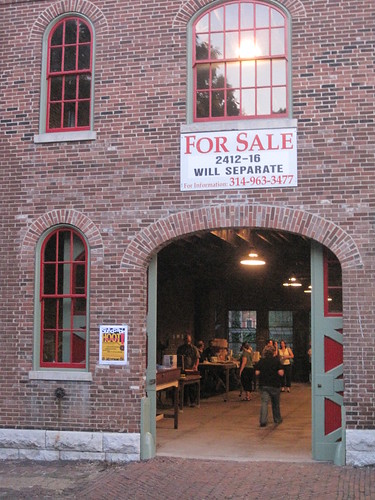 Last night's historic preservation benefit, the Anti-Wrecking Ball's Soulard Stable Hootenanny, was a success -- at least judging from the money raised and the good time had by all. There's something about rock 'n' roll, red brick and the early summer heat that makes a warehouse party just plain logical.
The show's proceeds were split evenly between the Friends of the San Luis' remaining legal costs and the St. Louis Building Arts Foundation's capital campaign for its conservatory in Sauget, Illinois.
The event was held at the Foundation's former warehouse in Soulard. Most people had never been inside of the historic former livery stable and its amazing space. The space, it turns out, was the perfect setting for a show.
One of the highlights of the evening was Bill Streeter's unveiling of the trailer for Brick by Chance and Fortune -- I can't wait to see more!
 The Union Electric, pictured above, Leadville and Pretty Little Empire rocked the house. These bands gave the gig their all. The brick and wood of the stable made the sound echo loud and clear throughout the building.
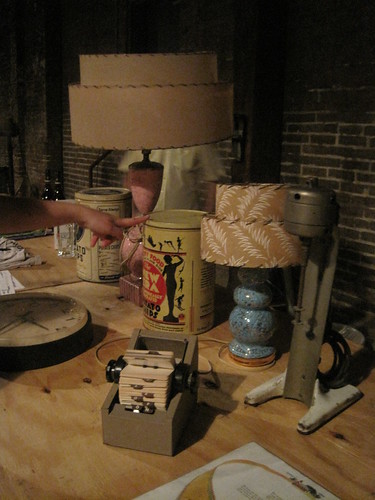 Galen Gondolfi and Dabney Frake donated a wide array of mid-century items for the raffle, which also included prizes from STL Style, St. Louis Cinemas and Schlafly. (And, yes, the pink lamp went first with winner's choice!)
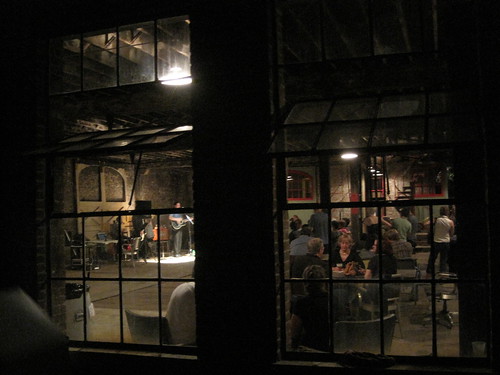
Who says preservation isn't fun?
Bill Streeter has more photographs here.
Tuesday, May 4, 2010
Missouri Court of Appeals to Hear San Luis Appeal Tomorrow
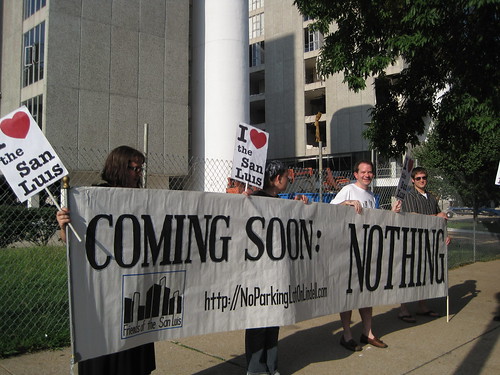
Tomorrow at 11:00 a.m., the Eastern District of the Missouri Court of Appeals hears oral arguments in Friends of the San Luis v. the Archdiocese of St. Louis. The court meets on the third floor of the Old Post Office downtown, and supporters of the Friends of the San Luis are invited to attend. The Court of Appeals will issue its ruling later.
What is happening? After the Preservation Board approved by a thin 3-2 margin a preliminary application for demolition in June 2009, the Friends of the San Luis (disclaimer: I serve as the organization's president) filed a petition for injunction to halt the demolition of the mid-century modern San Luis Apartments (originally the DeVille Motor Hotel) 1t 4483 Lindell Boulevard in the Central West End. Under city preservation law, a preliminary grant of demolition cannot be appealed until a demolition permit is issued. That stipulation makes appeals moot, at least beyond procedural review.
Circuit Court Judge Robert Dierker, Jr. dismissed the Friends' petition with prejudice. Dierker opined that preservation laws were an encumbrance on private property rights, and that only persons with direct financial interest -- essentially, adjacent property owners -- have standing under the city's preservation ordinance. (Dierker's forthcoming ruling in the Northside Regeneration suit should be interesting given that he must choose between the divergent interests of private property owners.) The ruling cut against city government's own interpretation of the ordinance by granting only narrow right to redress.
Given Dierker's conservative judicial activism, the Friends could have let the matter go. Yet we appealed to ensure that Dierker's ruling does not stand as precedent in the future. Who knows when and why citizens will need rights to appeal the Preservation Board's decisions? All we know is that the right to appeal should apply to any citizen of the city of St. Louis. After all, the ordinance states that "[t]he intent of this ordinance is to promote the prosperity and general welfare of the public, including particularly the educational and cultural welfare."
Friday, September 4, 2009
All of the San Luis is Not Lost
This week, the St. Louis Building Arts Foundation accepted the donation of two of the light posts from the San Luis Apartments (originally the DeVille Motor Hotel) at 4483 Lindell Boulevard. Here's a case where cooperation transcends conflict: Friends of the San Luis board member Jeff Vines saw the posts removed and contacted Tom Richter at the St. Louis Archdiocese. Richter promptly agreed to the donation and made arrangements with Building Arts Foundation President Larry Giles for pick-up.
 The light posts are headed to the Foundation's Conservatory in Sauget, Illinois, where they will live on alongside parts of the Century Building, the Ambassador Theater and countless other lost St. Louis buildings. As a board member of both the Building Arts Foundation and the Friends of the San Luis, I thank the Archdiocese for their assistance in preserving a small part of the modern motel!
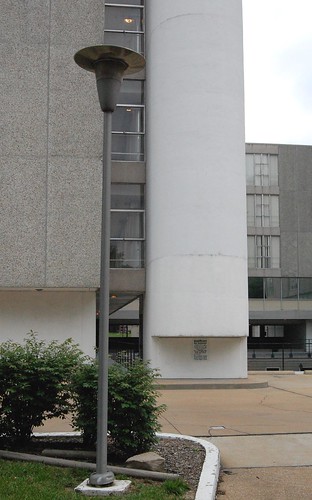 The light posts are headed to the Foundation's Conservatory in Sauget, Illinois, where they will live on alongside parts of the Century Building, the Ambassador Theater and countless other lost St. Louis buildings. As a board member of both the Building Arts Foundation and the Friends of the San Luis, I thank the Archdiocese for their assistance in preserving a small part of the modern motel!
Thursday, August 13, 2009
San Luis Column Spacing, Partitions Were Not Limiting
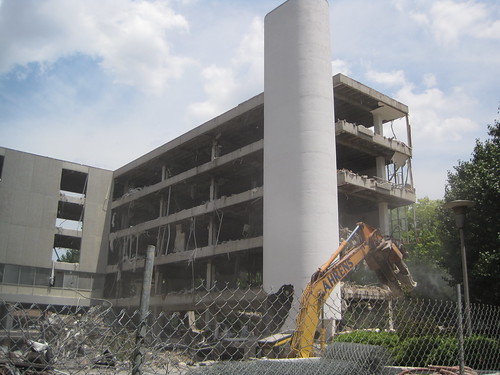 Even before the Building Division issued the demolition permit for the San Luis Apartments (originally the DeVille Motor Hotel), interior demolition began. That work showed anyone who passed by that the assertion by the St. Louis Archdiocese that the building's tiny, "prison-like" (as one staff member put it) rooms impeded rehabilitation was false. The room partitions crumpled at the strike of the Bobcat, and their removal had no structural bearing.
Moreover, demolition showed us that the the DeVille's column spacing was far more generous than represented by the Archdiocese. The photograph above shows that the columns on the wings were located only on the sides of the concrete floor plates. Once the partitions were removed, we all saw wide open floors that could be configured any way a developer wished.
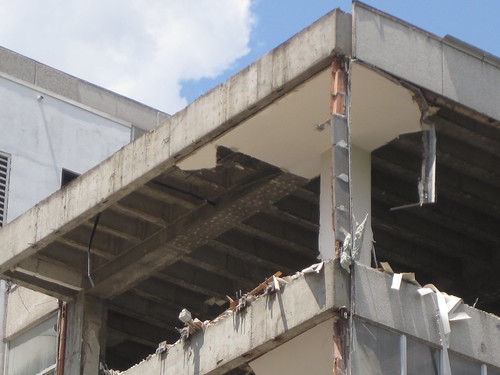 Look at that generous open space between the columns, and the ample ceiling height. There were many possibilities for reuse. At the Preservation Board, the Archdiocese and its architect Dan Jay gave the impression that the column spacing and motel-sized rooms were fixed limits to the future use of the building. Not so.
Wednesday, July 29, 2009
"Certainly This Will Be an Impressive Monument"
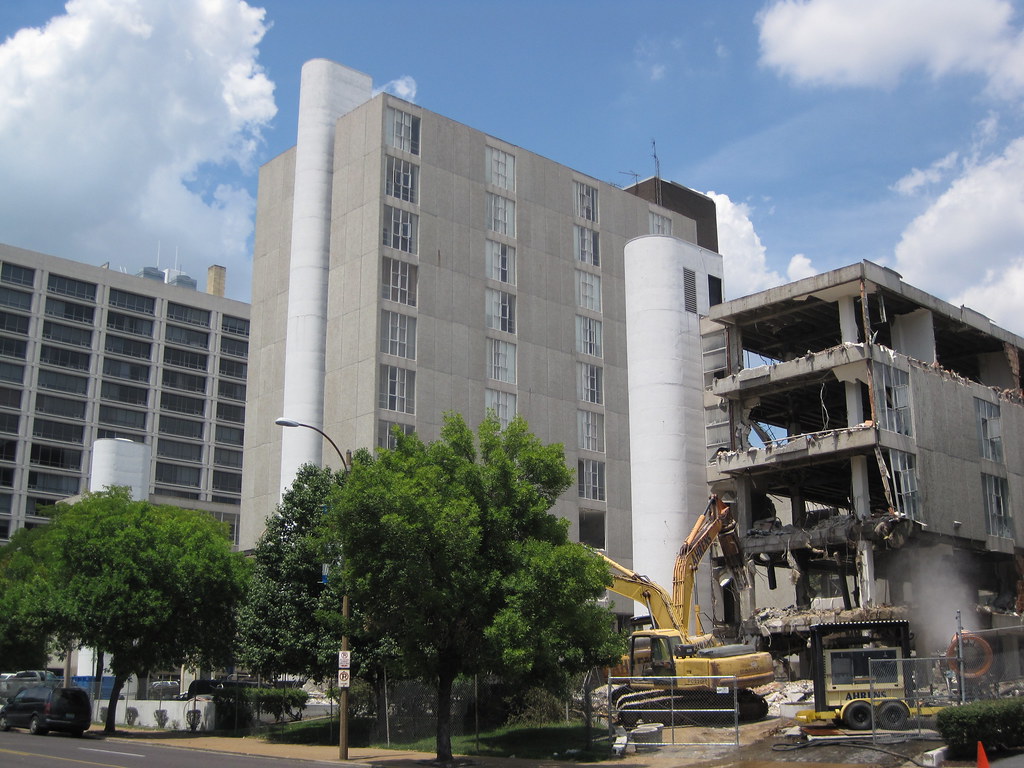 On the afternoon of Monday, July 20, Building Commissioner Frank Oswald officially issued the demolition permit for the DeVille Motor Hotel (formerly the San Luis Apartments) at 4483 Lindell Boulevard in the Central West End. Ahrens Demolition had already been working on interior demolition and abatement, and wasted no time removing windows and concrete panels. By mid-week, the east wing of the old modern motel was reduced to a shell after Ahrens obliterated the exterior envelope and started in on the concrete structure.
The previous Friday, July 17, the Friends of the San Luis filed a petition for injunctive relief in circuit court. We contended that our right to appeal issuance of the demolition permit, which could only be exercised after the permit was issued, was moot if the wrecking ball was swinging. Judge Rober J. Dierker, Jr. denied our initial motion for a temporary restraining order and then, on Monday July 27, dismissed our petition. The legal wrangling had no impact on demolition activity, of course, but the loss is now a fact of life.
 This is a sad end to a building whose idiosyncratic modern form was once hailed as innovative. Architect Charles Colbert designed the motel to rise far above the ranks of the Holiday Inns and Downtowners springing up in urban settings across the country. While definitely automobile-oriented, the DeVille had a sense of urban setting many of its contemporaries lacked. The motel made deft use of its site, reserving only the existing setback on Lindell for a lawn and building out the rest of the site.
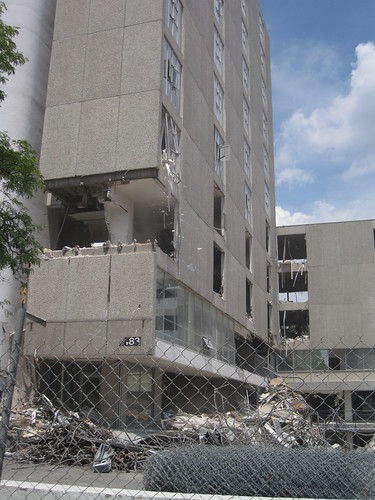 Yet the mass, site and style were not the only features noted in the press. When the builders broke ground in October 1961, they were making local building history. The new DeVille Motor Hotel would be the first major building built after the city's adoption of a new building code earlier that year.
Prior to the 1961 building code, large buildings were restrained by requirements that the majority of wall surface area meet a defined thickness. Materials like concrete panels and glass had to be employed within larger wall systems, and could not be used to clad an entire building. Before 1961, construction of a glass high-rise in St. Louis was not permitted by code. The removal of the old restrictions allowed St. Louis to embrace the building technologies that allowed for fully modern architectural expression.
Mayor Raymond Tucker was an enthusiast for the DeVille project. In a St. Louis Post-Dispatch article from 1961 ("$4,500,000 Hotel to Be Built at Corner of Lindell, Taylor," September 30, 1961), the mayor raved: "Certainly, this will be an impressive monument to the perseverance of those far-sighted citizens who worked on our code for more than five years."
Greater modern expressions would rise in St. Louis, of course, but the DeVille was the first to fully embrace the code. For 46 years, the DeVille remained an impressive monument to the potential of modern design.
Wednesday, July 1, 2009
Prominent Corner, Vacant Lot
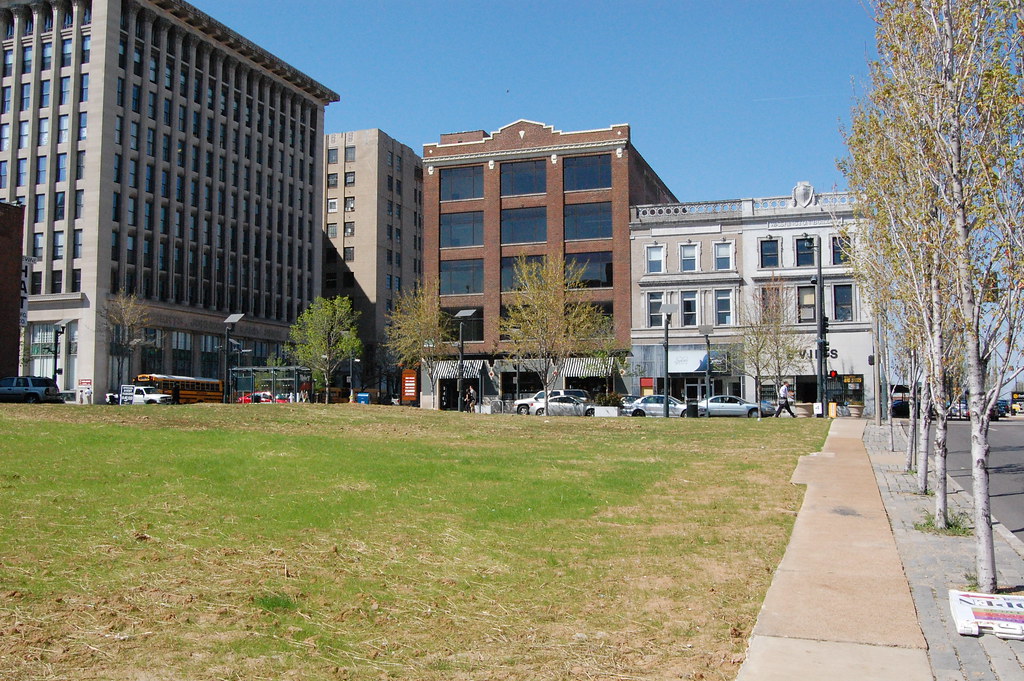 Vacant lot, major street, prominent corner...are there shades of the DeVille Motor Hotel issue at the southwest corner of 14th and Washington downtown? Yes, there are. This would have been the site of the SkyHouse, if the developers had closed on financing and built anything after they demolished the two buildings on this site.
In 2007, I wrote somewhat favorably of the SkyHouse project. Yet in retrospect I should have applied the precautionary principle. Two years later, Washington Avenue has a vacant corner where it previously had a corner-hugging building. While that building's preservation value was debatable, its urban form was superior to a vacant lot.
The DeVille situation is different because the best case (a cleared lot) is the same as the SkyHouse worst case. St. Louis is worthy of a better case.
Friday, June 26, 2009
Testimony on the DeVille Motor Hotel
Here is my testimony from Monday's Preservation Board consideration of the preliminary review of the Archdiocese's application to demolish the DeVille Motor Hotel (San Luis Apartments) at 4483 Lindell Boulevard and build a surface parking lot in its place.
The Board approved the application by a vote of 3-2, with Board members Richard Callow, David Richardson (who is Missouri adviser to the National trust for Historic Preservation) and Alderwoman Phyllis Young voting yes and members Melanie Fathman and Anthony Robinson voting no.
RELEVANT ORDINANCES
The Board approved the application by a vote of 3-2, with Board members Richard Callow, David Richardson (who is Missouri adviser to the National trust for Historic Preservation) and Alderwoman Phyllis Young voting yes and members Melanie Fathman and Anthony Robinson voting no.
RELEVANT ORDINANCES
In regard to the legal standards that bind the Preservation Board's decision today, I think that members will find the ordinances quite clear: the Archdiocese's plan meets neither the standards established by the Central West End Historic District ordinance nor the demolition review criteria in the city's preservation review ordinance. The Board should deny both parts of the proposal and uphold our city's preservation laws. The Preservation Board has no legal authority to make decisions based on the institutional parking requirements of the Archdiocese or Rosati-Kain, but only on the explicit criteria of the two applicable ordinances.
While the Central West End Local Historic District standards do not expressly forbid the construction of surface parking lots in the district, they are only allowed in areas with commercial zoning (zoned F or H). The DeVille parcel is zoned E (Multiple Family Residential), which is governed by the residential standards of the local district.
Even with a zoning change for this parcel, the parking lot proposal does not meet the commercial standards of the district, which I quote:
All off-street parking shall be located behind or to the side of commercial structures. Where visible from the street, screening with visually opaque landscaping or 5' minimum high masonry or concrete wall shall be necessary.
The current proposal fails to meet this provision because the parking lot will occupy the entire parcel, not adjacent to a building, but rather in the plain view of two streets, an alley and even from the sidewalk a great distance to the east. While the proposed screening may meet the standards, the standards disallow construction of a parking lot that is not adjacent to a building. The proposed parking lot requires a variance from the standards that I think is unwarranted.
Furthermore, the district standards explicitly safeguard the architectural characteristics of block faces. Again I quote the standards:
Developers, therefore, shall demonstrate compliance with exiting scale, size and proportion… Visual compliance shall be judged on massing and detail in addition to size and scale.
The parking lot does not meet the "visual compliance" standard established here. The current face of this block is a symmetrical arrangement, with the large Cathedral and DeVille buildings serving as book ends on either side of the Chancery. While the architectural character is varied, the urban forms that give the block face harmony are dependent on the balance of large, taller buildings on each corner. The parking lot removes one of those buildings, creating an imbalance that clearly does not maintain existing scale, size or proportion. Plus, the stark exposure of the alley and utilities from Lindell will create a visual problem for pedestrians.
Note that Central West End residents have successfully blocked development projects in the past by filing lawsuits to uphold enforcement of these standards. These standards enjoy widespread and passionate support in the neighborhood, not simply because they enshrine common values but because they are an effective and clear legal tool for protecting the urban character of the neighborhood.
Beyond the local district standards, the current proposal also fails to meet the standard criteria of the preservation ordinance. (I will not address financial hardship, which is clearly not at issue in this matter.)
A. Redevelopment Plans
There is no approved or proposed formal redevelopment plan for the DeVille site.
B. Architectural Quality
The DeVille Motor Hotel is eligible for the National Register of Historic Places for its local architectural significance. (More on that in a moment.) Under the Preservation ordinance's definition, the DeVille is thus a High Merit structure. (“High Merit”partly is defined as "deserving of consideration for single site historic or Landmark Site designation.")
This criteria is one of the primary reasons why the Board has authority to deny the demolition of the DeVille. Under the preservation review ordinance, the Board must act to protect all Merit and High Merit structures . The State Historic Preservation Office's statement of eligibility for single-site listing is cause for treating the DeVille as a High merit structure at the present moment.
C. Condition
The DeVille building obviously requires repairs common to buildings of its age, but it is sound under the ordinance and apparently safe enough that the Archdiocese maintained it as a residential building until 2007.
D. Neighborhood Effect and Reuse Potential
The Central West End Association and many neighborhood residents have offered the opinion that the surface parking lot has an adverse neighborhood impact.
As for reuse potential, we have only a report prepared by the architectural firm hired to design the parking lot. There has been no independent analysis of reuse potential. However, given the successful rehabilitation of the Hotel Indigo to the west and the former Days Inn downtown, reuse potential of mid-century motels for original or adapted uses now has been demonstrated in the city.
E. Urban Design.
The preservation ordinance reiterates the principles of the Central West End local historic district ordinance regarding integrity of block face as well as the impact on "significant character important to a district, street, block or intersection." Clearly, the proposal is detrimental to its block face, but also it is detrimental in a larger architectural context along Lindell Boulevard. This brings me to the issue of National Register of Historic Places eligibility.
ELIGIBILITY FOR NATIONAL REGISTER
Because of the DeVille's unique architectural quality as well as its contributing role to a significant group of Modern buildings on Lindell Boulevard, the State Historic Preservation office has determined that the DeVille is eligible for inclusion in the National Register of Historic Places. Not only do we have that hopeful determination, but also on May 1 the Keeper of the National Register listed Lindell's other mid-century motel: the Bel Air Motel at 4630 Lindell, built between 1958-1961 and beautifully rehabilitated as the Hotel Indigo. (The Preservation Board approved the Bel Air nomination last year.)
Also, in the past two years, I have written or co-written two other successful National Register nominations of mid-century buildings in the city built within the past 50 years -- the Plaza Square Apartments downtown and the Nooter Corporation Building at 1400 S. Third Street. In these cases, the opinions of the State Historic Preservation Office and the Keeper of the National Register were aligned: if the buildings were eligible for the National Register at all, waiting until the "50 year mark" to pursue listing was unnecessary and arbitrary. In fact, at a 2007 workshop hosted by the Missouri State Historic Preservation Office, National Park Service historian Dan Vivian relayed to Missouri preparers of nominations that the practice of waiting for a property to reach 50 years of age before listing was based on myth and not actual Park service policy. Vivian urged us to nominate eligible buildings in accordance with National Register Criterion Consideration G -- a consideration that ensures that buildings less than 50 years old have attained exceptional significance worthy of inclusion in the Register.
Our knowledge of the eligibility of modern buildings has grown over the past three years, and the Bel Air Motel nomination allowed greater exploration of a context in which the DeVille plays a major role. As part of the Bel Air nomination, Karen Baxter and I conducted a survey of the mid-century modern resources of Lindell between Grand Avenue and Kingshighway. Lindell long was the main connection between downtown St. Louis and Clayton, and attracted commercial development as the city resumed developing itself after the slowdown of the Great Depression and World War II era. The aging mansions offered large lots well-suited for new commercial buildings.
In the Lindell survey area, 36 buildings were constructed and two others were re-clad in a building boom between 1945 and 1977. Of these, 34 were built in the styles of the Modern movement. Only one of these buildings has been demolished. The range of design quality, height, material use and stylistic influences is wide among these buildings, yet they have an indelible impact on Lindell. In my opinion, one can say that modern commercial architecture is as much a part of the definitive character of Lindell as is the earlier revival-style residential architecture.
Historically, the unique Mid-Century Modern grouping on Lindell is by far the city's most significant Modern commercial development. The development of Mid-Century Modern architecture on Lindell Boulevard precedes major downtown urban renewal projects that also used the style (including the iconic Gateway Arch and Busch Stadium). Lindell's modern buildings demonstrate that St. Louis after World War II was a city deftly remaking itself through bold modern buildings. The concentration includes very significant buildings to the development of Modern Movement architecture in St. Louis. Three of these buildings even achieved early recognition through inclusion in the 1967 edition of George McCue's The Building Art in St. Louis.
Not surprising, however, is the finding that most of the modern buildings on Lindell were designed by local architects or draftsman, many of little renown. There are strong supporting buildings and a few obvious architectural stars, like the Archdiocesan Chancery, the Lindell Terrace, the Engineers Club and the DeVille, designed by Charles Colbert of New Orleans (1963). Four of the modern buildings have out-of-town architects, but of those four, only Colbert has what can plainly be called a national reputation among architectural historians. While the Bel Air Motel is a fine building that merits National Register listing, the DeVille has greater significance through its more original design, form and massing as well as its association with Charles Colbert.
Demolition of the DeVille would result in the removal of one of Lindell's finest modern buildings, a clear negative urban design impact on one of the city's most prominent thoroughfares. So far, the only lost mid-century building on Lindell has been the Cinerama at 4218 Lindell. On Lindell, we have an unparalled nearly-intact document of our city's triumphant attempt to reclaim its future amid declining fortunes and suburban growth. Ironically, these buildings took the place of others that we all now recognize as worthy of preservation. Proposed demolition of the DeVille raises the issue of whether we are about to embark upon renewing the unsustainable cycle of demolition and replacement that this city infamously embraced in the late 20th century.
The Preservation Board can break the cycle by upholding the laws we developed in response to the demolition cycle that once plagued our city. Members should deny the proposed parking lot and demolition of the DeVille Motor Hotel since each action certainly fails to meet the criteria of the ordinances under which today's action will be taken.
Tuesday, June 23, 2009
Preservation Board Grants Preliminary Approval DeVille, North Grand Demolitions
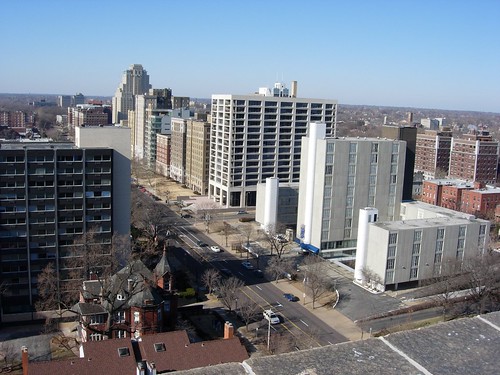 Last night, the Preservation Board voted 3-2 to grant preliminary approval of a surface parking lot and demolition of the San Luis Apartments (formerly the DeVille Motor Hotel). I'm on my way out of town today so I will offer thoughts when I return. For now, I should point out that five out of nine Preservation Board members were present, while 20 citizens testified against demolition. While this ration is unusual, it shows the discrepancy between citizen interest and Preservation Board member interest in one of biggest urban design matters this year.
Alderwoman Lyda Krewson (D-28th) tipped the balance by coming out in favor of approval at the end of the meeting. Her remarks were a roller coaster ride of what side she would take, but when she came back to the issue of Archdiocese parking needs (politically germane, but beyond the legal scope of the ordinances governing Preservation Board action) hearts sank. Frankly, she might have done better for herself had she not spoken at all instead of aligning herself with the surface lot plan that even she admits is not appropriate for that corner.
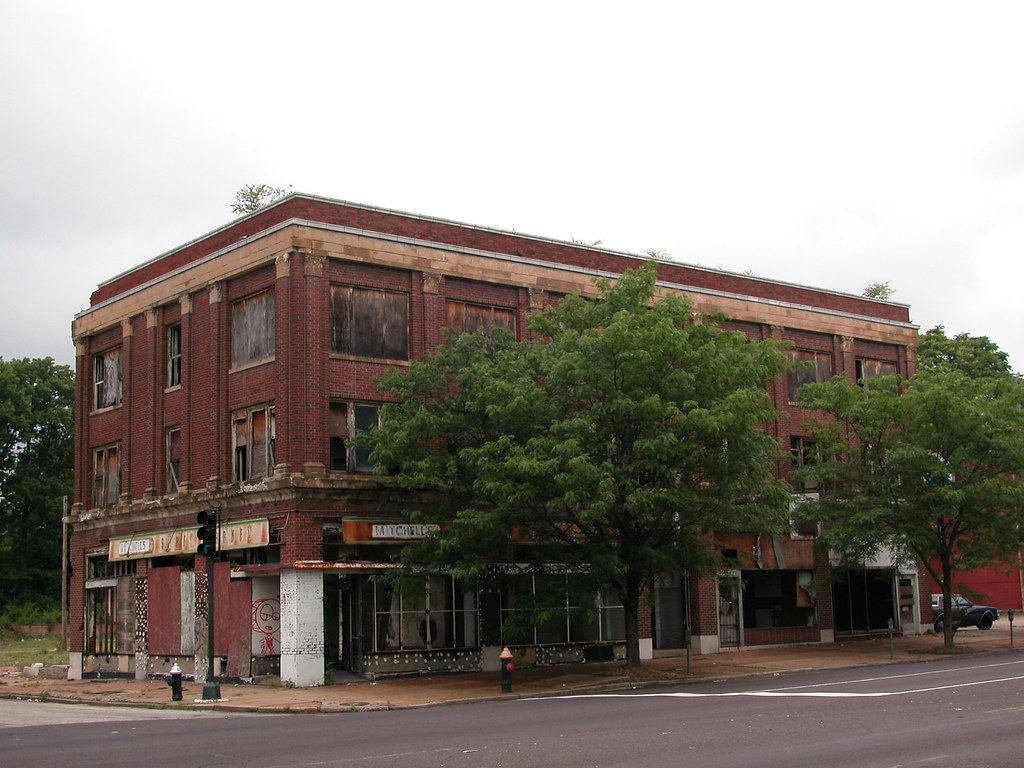 While my colleagues will be writing about the DeVille over the next few days, I want to point out that another demolition was approved by the Preservation Board yesterday in a questionable manner. When I arrived at the Board meeting, I found preliminary review of the demolition of the commercial building at 3501-9 North Grand Avenue was on the agenda. This matter did not appear on the agenda posted online a week before the meeting, nor did it appear in any special notice sent within 24 hours of the start of the meeting.
The public, including residents of the area around the building (intersection of Grand and Hebert), would never have known this matter was on the Board agenda. Most people probably still don't.
Alderman Freeman Bosley, Sr. (D-3rd), often a preservation-minded alderman, had the item placed on the agenda and was the official applicant. However, building owner Darryl Mitchell appeared to announce that he had already applied for a demolition permit and that he was the applicant. The Preservation Board changed the record to reflect this testimony, which may or may not be allowed under Preservation Board procedures.
Perhaps this matter is irrelevant given that the Board granted preliminary approval 4-0 and only two people from an audience of more than 40 testified, but I think the procedure followed was wrong. If an actual demolition permit was on the table, then it cannot be considered as a preliminary review. The Cultural Resources Office staff had not reviewed the permit yet, so the matter certainly was not an appeal.
Since this was a preliminary review, the Board can bring the matter back and give the demolition permit its appropriately-announced legal hearing. I hope that the Board does so.
Saturday, June 20, 2009
Daily DeVille #5
 Architect Charles Colbert imparted to the DeVille Motor Hotel the geometric exuberance of the most interesting American modernism. There are many fine modern buildings on Lindell Boulevard that are derivative of the International Style, but there are a few truly original compositions. The DeVille is one of them.
Friday, June 19, 2009
Daily DeVille #4
 Cultural Resources Office Director Kathleen Shea has now posted her recommendation to the Preservation Board for the demolition of the former DeVille Motor Hotel and its replacement by a parking lot. Shea seems ambivalent about the Archdiocese's proposal. Meanwhile, opposition to the demolition grows.
Since the DeVille's architect was Charles Colbert of New Orleans, the New Orleans architectural community is stirred up. The Board of Directors of the New Orleans chapter of the American Institute of Architects sent a plea to the St. Louis Preservation Board. The National Trust for Historic Preservation is also opposed. Long engaged in the struggle, Landmarks Association of St. Louis sent a note to members this week urging them to send letters to the Preservation Board and Alderwoman Lyda Krewson (D-28th).
Fliers are circulating around the Central West End with information about the demolition. Many Central West End residents oppose the demolition, while many also simply object to the proposal that a prominent corner in the city's poster neighborhood for urban living be occupied by a parking lot.
Thursday, June 18, 2009
Daily DeVille #3
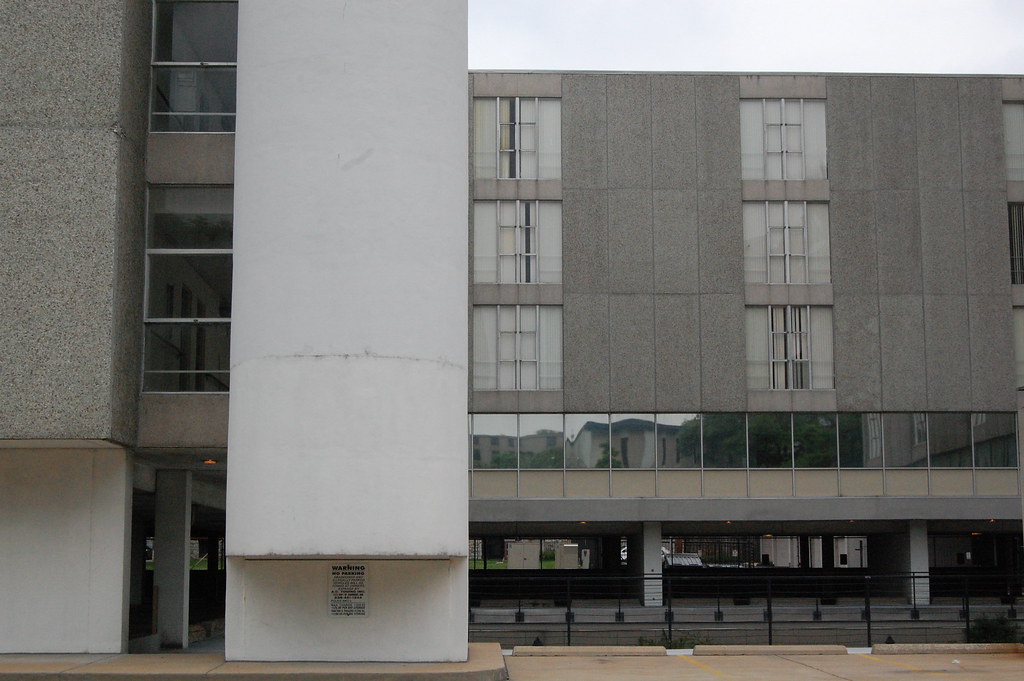 Demolition of the former DeVille Motor Hotel, 4483 Lindell Boulevard, will be on Monday's Preservation Board agenda. Read more here.
Wednesday, June 17, 2009
Springfield's State House Inn: Another Successful Mid-Century Motel Renovation

The first motel in Springfield, Illinois was the State House Inn at 101 E. Adams Street in the heart of downtown. Built in 1961 and designed by Henry Newhouse, the State House Inn is a contemporary of St. Louis' threatened DeVille Motor Hotel.
However, the State House Inn is celebrated by its city and has received the benefit of a historically-sensitive renovation. In 2003, the motel reopened after a three-year, $8 million renovation. Today, the motel's guests enjoy lovely modern lodgings just a short walk from Springfield's major attractions as well as the Amtrak station.
Could the DeVille be the beneficiary of a similar renovation? While not downtown, the DeVille is a short walk from some of the city's attractions -- the Cathedral, Forest Park -- and near light rail that connects to our Greyhound/Amtrak station. The Central West End stays open later than downtown Springfield, too, with many restaurants and bars within a short walk of the motel. With the same applied imagination that the State House Inn received, the DeVille could be one of St. Louis' coolest places to stay.
Daily DeVille #2
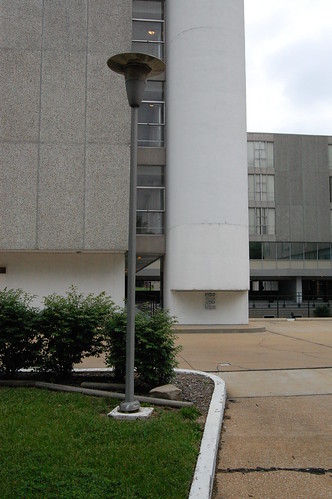 Demolition of the former DeVille Motor Hotel, 4483 Lindell Boulevard, will be on Monday's Preservation Board agenda. Read more here.
Tuesday, June 16, 2009
Daily DeVille #1
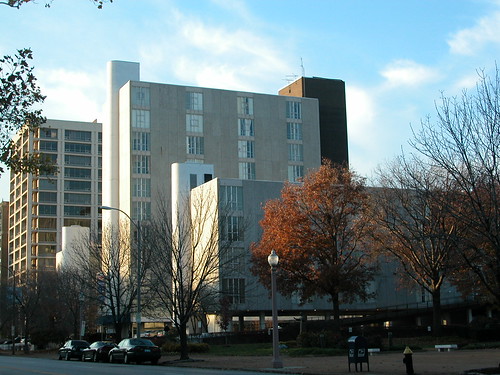
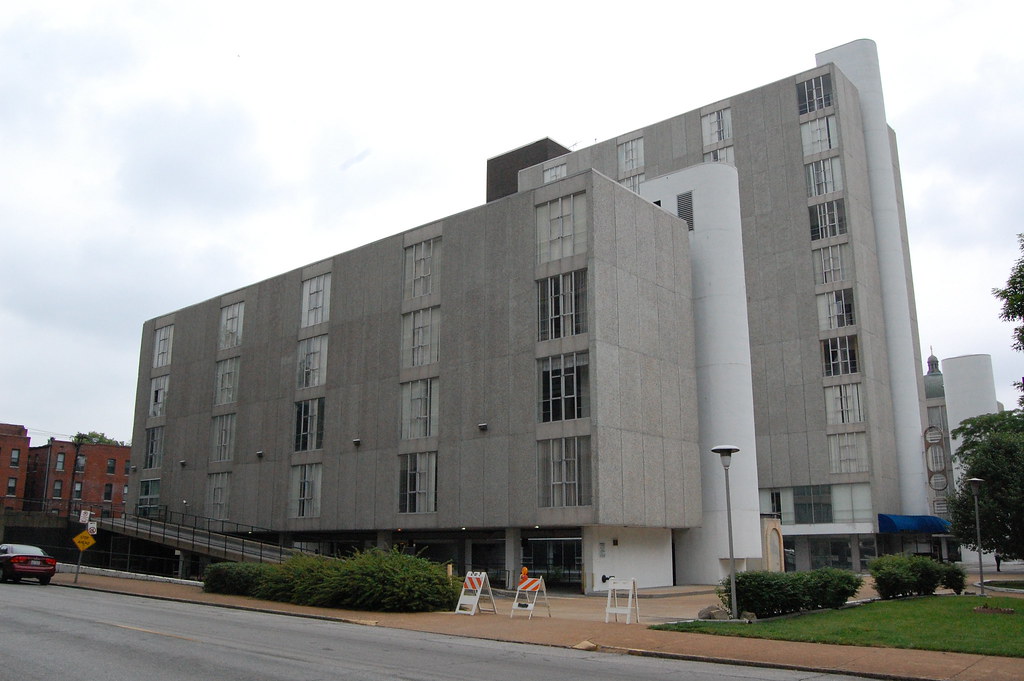 The DeVille Motor Hotel viewed from the corner of Taylor and Lindell. Oh mighty modern motel, how you soar!
Monday, June 15, 2009
Help Stop a New Parking Lot on Lindell
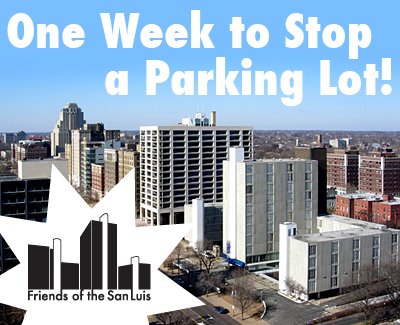
The day has arrived: On next Monday, June 22, the St. Louis Preservation Board will consider the demolition of the DeVille Motor Hotel (recently the San Luis Apartments) at 4483 Lindell Boulevard. The Archdiocese of St. Louis has asked the Board to conduct a preliminary review of its plan to demolish the mid-century motel and build a surface parking lot. As a preliminary review, the issue is not tied to an actual demolition permit. However, if the Board grants preliminary review, the city's Cultural Resources Office must approve the demolition permit (after any stipulations placed on issuance have been met). If the preliminary review ends up with a denial, the Archdiocese will have to return to the Preservation Board with a new plan.
While some have said that this is a "done deal," that is not true. The Preservation Board can block the demolition next Monday. However, your help is needed -- the Board seeks direction not only from the applicant and preservation professionals, but from the wider public. Central West End residents especially should chime in.
I should also note that those who don't particularly like the DeVille but loathe the urban design travesty of a surface lot on Lindell Boulevard will be best served by board denial of the current proposal. Once the parking lot is approved, the idea of a new building on the site is at the Archdiocese's discretion. Don't hold your breath.
Please send your written comments, no matter how brief, to the Preservation Board by submitting an e-mail to Board Secretary Adonna Buford at BufordA@stlouiscity.com. You might consider copying your letter to Alderwoman Lyda Krewson (D-28th), who represents the DeVille site and whose leadership on this matter would be helpful.
You can also send a letter via postal mail to:
Preservation Board
c/o Cultural Resources Office
1015 Locust Street, Suite 1200
St. Louis, MO 63101
If you would like to present your comments in person, the Preservation Board meeting is at 4:00 P.M. on the 22nd at 1015 Locust, Suite 1200. There are several items on the agenda before the San Luis, so the meeting may be long.
Everything you need to know about the issue is online at No Parking Lot on Lindell!.
Tuesday, June 9, 2009
Realizing the Potential of a Mid-Century Motel
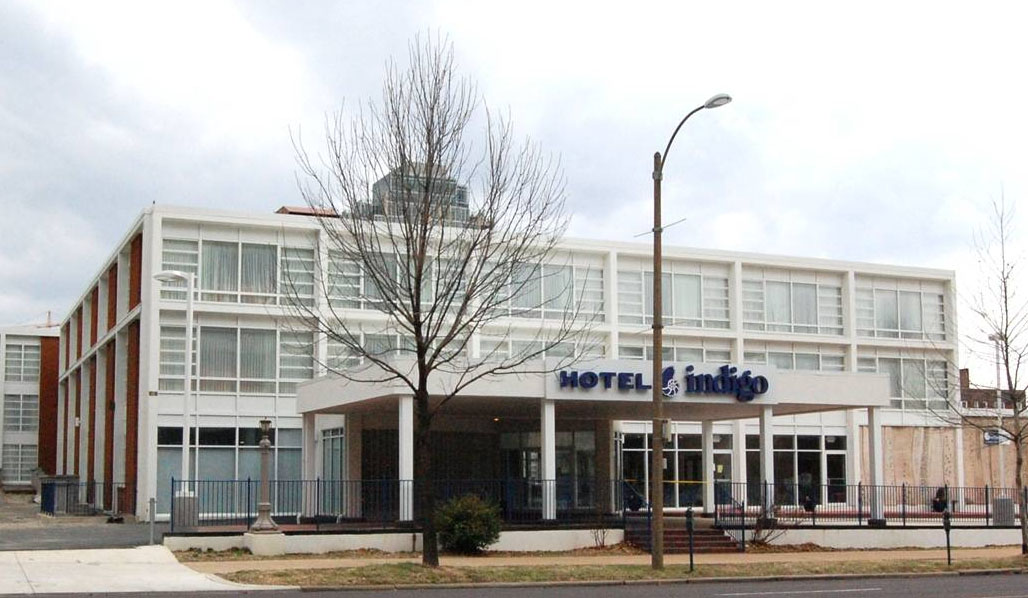 On May 1, the National Park Service listed a mid-century motel on Lindell Boulevard in the National Register of Historic Places. This recognition went not to the much-celebrated, threatened DeVille Motor Hotel, but to its predecessor one block west, the former Bel Air Motel at 4630 Lindell Boulevard.
Along with the National Register listing, the Bel Air has received a $9 million renovation by the Roberts Companies and rebranding as the Hotel Indigo. Although not yet open, the spiffed-up modern motel has attracted a lot of positive attention. Central West End residents can't believe their eyes when they look at what was recently a run-down Best Western. Others have taken notice, too: last month, Landmarks Association of St. Louis bestowed upon the Roberts brothers one of the Most Enhanced Sites awards, further recognizing the mid-century renovation.
The motel's streamline frame has been cleaned and repainted a crisp white (the previous colors were black and pink), the obnoxious canopy rebuilt in a manner sympathetic with the motel's design and the interior updated. All in all, the Hotel Indigo is a shining, clean, cool testament to the power of imagination and rehabilitation. The place hasn't looked this great since opening day in 1958!
That opening day was a big event itself, since the Bel Air was the city's first motel. The motel (short for "motor hotel") style of lodging dated back to California in 1925. Motels before World War II tended to be "motor courts" like the celebrated Coral Court where rooms had separate exterior entrances and often private garages facing out on a court or central driveway. In St. Louis, a few of these courts were built in St. Louis County and in Illinois on Route 66. The city had its large, fine hotels with lodging, dinner and dancing all under one roof.
Developer Norman K. Probstein thought that the modern motel and the city hotel could be melded into a form new to St. Louis, the urban motel or motor lodge. In 1957, Probstein hired Wilburn McCormack to design a two-story motel for a site on Lindell. construction was underway that year. McCormack's design was spare and used the principles of the International style. Rooms were accessed both by interior hallway. Some rooms have balconies facing a courtyard. Parking was underneath the motel. There was an outside swimming pool and an inside restaurant, expanded later in 1961. After opening, the Bel Air had so much business that Probstein added a third floor (designed by Russell, Schwarz, Mullgardt & Van Hoefen) in 1959 to bring the motel to a grand total of 198 rooms. Later, Probstein opened a downtown Bel Air East at Fourth and Washington (now the Hampton Inn), and dubbed the original Bel Air the "Bel Air West."
Here is what the Bel Air looked like in 1979, with the Doctors Building visible in the background:
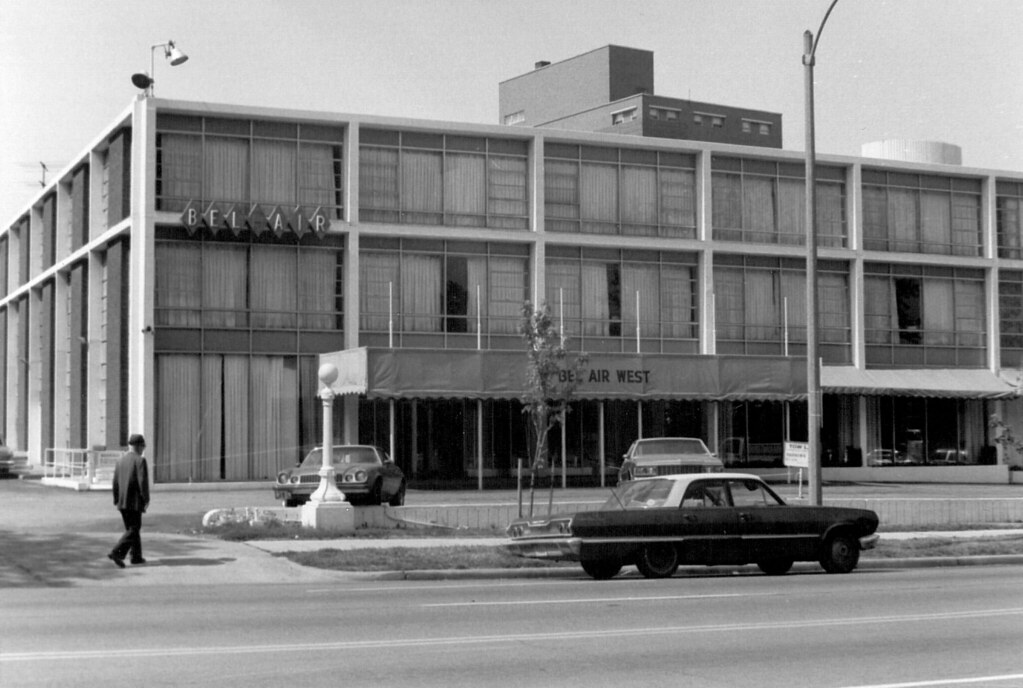
Over the years, the motel's luster was lost through changes in ownership, interior decoration and exterior painting and signage. The Bel Air lost more of its historic character than the DeVille Motor Hotel has, yet it retained more than enough beauty to attract the interest of a developer and get listed in the National Register of Historic Places. The Roberts Companies purchased the motel in 2007 and worked with Killeen Studio Architects to develop a thoughtful, respectful rehabilitation plan. Karen Bode Baxter, Tim Maloney and I wrote the National Register of Historic Places nomination.
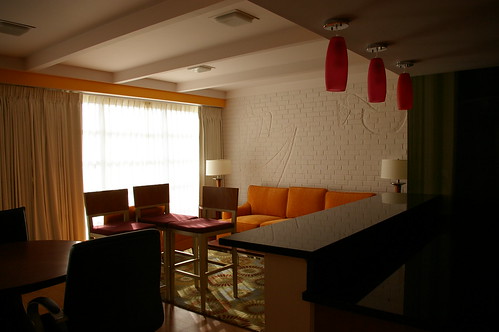
The exterior is back to near-original condition, with a few changes like the glass block entrance. Inside, where fewer details remained, the style is more contemporary than retro but a few historic elements can be found. One of the coolest features is the etched brick wall in a third floor suite:
One of the fundamental elements of the design of the Bel Air is the contrast between the white-painted concrete piers and caps and the red brick. The rehabilitation revives this stark and magnetic element on all sides. Here's a look at the rear courtyard:
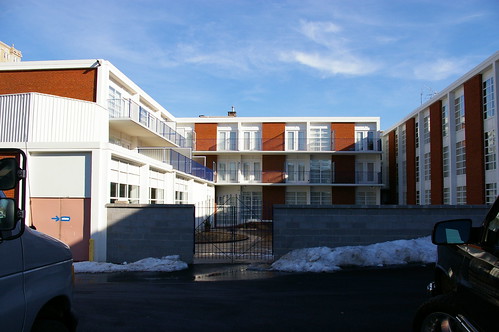 The renewed Bel Air Motel shows us that mid-century motels can be rehabilitated beautifully and that developers are interested in tackling these buildings. While many of the city's modern motels are lost or reclad, those that are left could very well follow the path that the Roberts Companies has wonderfully shown us is possible.
(Contemporary photographs courtesy of the Roberts Companies.)
Saturday, April 18, 2009
San Luis: This Was the Future
In early March, I received a call from Jeff Vines. He was part of a team that entered a documentary film competition, and they had been fortunate enough to draw "history" for their topic. You know what that meant -- a chance to celebrate the DeVille Motor Hotel! Jeff's team included familiar faces -- his brother Randy, filmmaker Carson Minow, editor Jon Swegle and musician Brian Wiegert. Toby Weiss and I were interview subjects for what turned out to be a smart, cool little film. Check it out!
Wednesday, March 11, 2009
Dead Zone
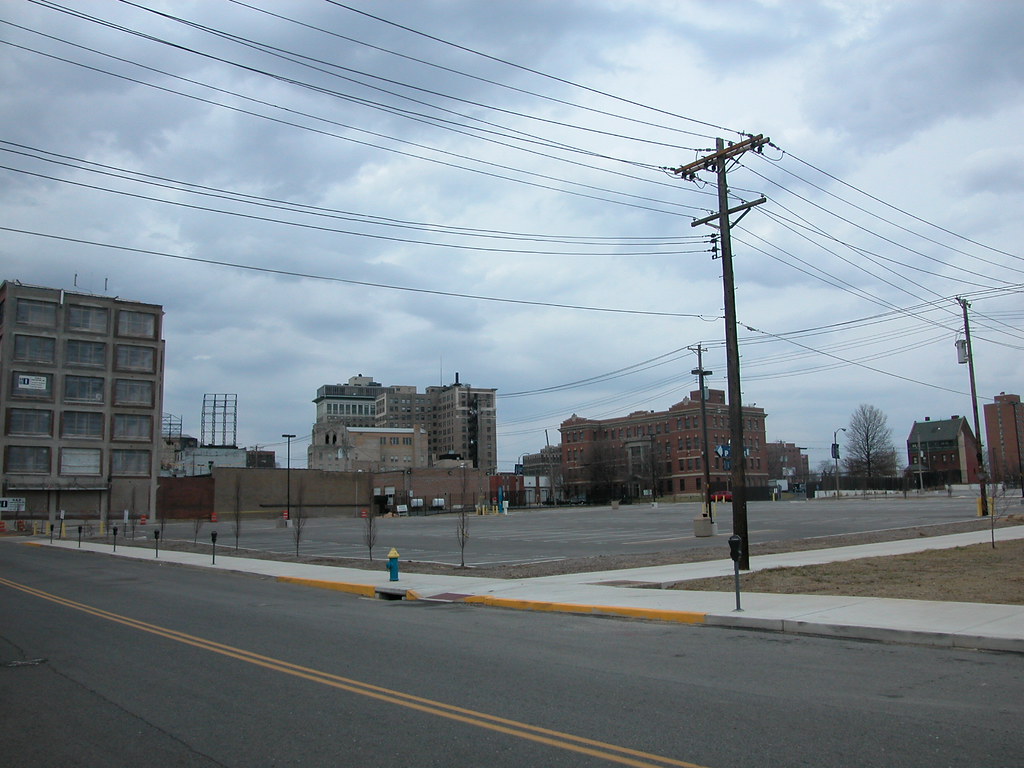 Over the weekend, I had the opportunity to spend some time at the site on Locust Street where the livery stable demolished by St. Louis University in 2007 once stood. The site would be located at the northwest corner of Locust and Josephine Baker Avenue, except that the university requested that Josephine Baker be removed.
The occasion was the filming of This Was the Future, a short documentary on the efforts to save the DeVille Motor Hotel (more on that film later). For the film, interview subjects were invited to select a site where a historic building once stood that is now an empty hole in a vibrant area. While it is hard to choose from some of the harsh empty lots we have in this city, I settled on what has to be one of the worst urban planning disasters in recent years.
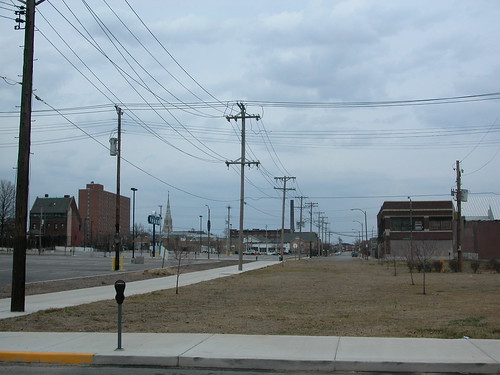 The two-story livery stable building was a bridge between the emergent renewal in the Locust Street Business District and the more established revitalization of Grand Center. Grand Center's motto is "the intersection of art and life," an acknowledgment of the power of crossroads. Here stood a building that was a crossroads, and now we have an asphalt chasm, and not even a literal crossroads since one of the two streets here is now gone.
Even as a warehouse, the livery stable exuded more life than the parking lot on a busy night. On a Saturday afternoon, not a single car was parked on the lot, and few were parked at nearby meters. Clearly, the lot is there for special events. However, trading the potential of daily urban activity in a rehabilitated building for the occasional overuse of a parking lot makes no sense in a central city location. Not at all.
The side effect of the livery stable debacle is the spatial segregation (through building density) of Grand Center from the emergent area on Locust and of Renaissance Place (through removal of Josephine Baker) from St. Louis University and Locust Street. Human-scale urban renewal has finally come to Midtown on Locust Street and at Renaissance Place, and a potential connection between those successes is lost, and replaced with a land use that not only divides but is totally alien to the surrounding urban fabric. We could have done so much better.
Thursday, February 12, 2009
Stories from the DeVille Motor Hotel

There's nothing quite like a posh urban hotel. A fine hotel has long been the ultimate urban meeting place. From big convergences of finely-dressed party-goers to small groups of martini-lunch businessmen to encounters even more discreet -- the hotel is the place. The hotel is a fashionable but not ostentatious place for all manner of meetings, dining and drinks.
Hotels like the Chase, Park Plaza, the Mayfair and the Coronado are the legendary settings. How do we know this? The stories people tell. People talk about the restaurants, the dances, the political meetings, the bars, the music, the celebrities and all the things that made these more than just pretty buildings. we know that these buildings connected a lot of lives, and became part of thousands of memories.
The mid-century DeVille Motor Hotel at 4483 Lindell Boulevard, later the Holiday Inn Midtown, is not as old as the stalwarts of St. Louis' golden age of hotels, but it was the cream of the crop for the modern era. The DeVille definitely was a social hub in the 1960s and early 1970s. Perhaps we don't think of stories from that recent past as part of our history, but we should. The DeVille was the meeting spot for a different generation -- one that shaped contemporary St. Louis and breathed life into a city struggling with depopulation and sprawl. At the DeVille, the Central West End extended its glory days long enough to survive, and thousands of St. Louisans passed through its doors in the process.
What are their stories?
At B.E.L.T, Toby Weiss is collecting those tales from our recent past. Submit one of of your own here. This is a great project! Too often, we don't know how much a role a place has played in our lives until its lost. That's a shame, because we have the power to keep history alive in our own time simply by saving our own stories for future generations.
Subscribe to:
Posts (Atom)


 Posts

