
Illinois may yet pass a state historic rehabilitation tax credit this year. On March 18, the Illinois Senate passed SB 2559, which is now heading through the House committee process in the final days of this year's legislative session.
Apparently Governor Pat Quinn (D) is favorable to the bill. Supporters wisely have crafted a substitute that lowers the per-county cap from $25 million to $5 million, requires each project pass a "but for" test and subjects projects to a per-project issuance cap. These are provisions that make the bill -- and the dream that downstate communities like East St. Louis and Alton gain a powerful tool for neighborhood development -- alive. There may be one particular county that generated the per-county cap, and the per-project cap as well, but those are excellent ideas to ensure that the credit gets used where it is most needed -- where development actually needs a stimulus.
Showing posts with label illinois. Show all posts
Showing posts with label illinois. Show all posts
Thursday, April 29, 2010


Tuesday, April 20, 2010
2010 Illinois Ten Most Endangered Places
Today Landmarks Illinois announced its 2010 Ten Most Endangered Historic Places. More information is online here.
The list includes:
1. Bass-Mollett House -- Greenville
2. Chanute Headquarters and Mess Hall - Rantoul
3. Illinois Main Street Program
4. Manske-Niemann Farm - Litchfield
5. Massac Theater - Metropolis
6. North Pullman - Chicago
7. Prentice Women's Hospital - Chicago
8. Red Cliff - Moline
9. St. Laurence Complex - Chicago
10. Uptown Theatre - Chicago
This is an assortment indicative of the state's current preservation problems: there's a mid-century modern building (Prentice Women's Hospital), a farm, two theaters and a large church (always hard to adapt) and a popular state preservation program.
I previously wrote about the plight of the Massac Theater: "Massac Theater Crumbles in Metropolis, Illinois" (November 13, 2007).
The list includes:
1. Bass-Mollett House -- Greenville
2. Chanute Headquarters and Mess Hall - Rantoul
3. Illinois Main Street Program
4. Manske-Niemann Farm - Litchfield
5. Massac Theater - Metropolis
6. North Pullman - Chicago
7. Prentice Women's Hospital - Chicago
8. Red Cliff - Moline
9. St. Laurence Complex - Chicago
10. Uptown Theatre - Chicago
This is an assortment indicative of the state's current preservation problems: there's a mid-century modern building (Prentice Women's Hospital), a farm, two theaters and a large church (always hard to adapt) and a popular state preservation program.
I previously wrote about the plight of the Massac Theater: "Massac Theater Crumbles in Metropolis, Illinois" (November 13, 2007).
Monday, March 1, 2010
Illinois Legislators Trying to Create a Historic Rehabilitation Tax Credit
On February 11, Illinois State Senator Dave Koehler (D-Peoria) introduced SB 2559, a bill that would create a state historic rehabilitation tax credit modeled on Missouri's.
Since then, the bill has gained two co-sponsors, Senators Dale Risinger (D-Springfield) and Michael Noland (D-Springfield). However, the Senate Commerce Committee has postponed a hearing of the bill.
Meanwhile, a similar bill introduced last year by Representative Greg Harris (D-Chicago) in the Illinois House of Representatives (HB 586), has attained five co-sponsors but has yet to receive a committee hearing.
Since then, the bill has gained two co-sponsors, Senators Dale Risinger (D-Springfield) and Michael Noland (D-Springfield). However, the Senate Commerce Committee has postponed a hearing of the bill.
Meanwhile, a similar bill introduced last year by Representative Greg Harris (D-Chicago) in the Illinois House of Representatives (HB 586), has attained five co-sponsors but has yet to receive a committee hearing.
Sunday, December 27, 2009
Old KFCs Are Buildings Too
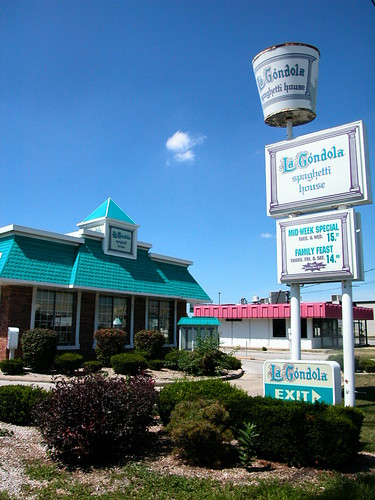 My wish for the New Year is simple: Let no vital structure go vacant or get demolished.
Shown above is one of the countless road side examples of the infinite adaptability of even the ugliest American buildings. The La Gondola Restaurant at 2855 North Water Street in Decatur, Illinois is located in a former Kentucky Fried Chicken restaurant. La Gondola's rehab of the iconic fast food building consisted of new signage and repainting. Removal of the bucket of chicken was not on the agenda, and thus La Gondola has what may be the nation's only bucket of spaghetti sign.
I write "may" because the excellent website Not Fooling Anybody shows us that La Gondola's rehab of an old KFC is in the middle of fast food conversions, which range from inconspicuous total cover-up to oddities like the chiropractic office that retains a KFC bucket sign.
La Gondola is no stranger to converting fast food buildings: the La Gondola Restaurant in Galesburg is located in a converted Mr. Quick Hamburgers restaurant. La Gondola is a central Illinois chain that makes use of the cast-offs of another chain. That practice makes perfect sense, since smaller chains don't have the capital that a mega-chain like KFC does. La Gondola saves money, an old KFC doesn't sit vacant or get torn down and hungry Illinoisans still have a place to get a quick bite right where they used to.
The simple model of reuse practiced by La Gondola is not glamorous, but it works economically as well as ecologically. While an old KFC is not architecturally or urbanistically high-style, it's still a building made of shaped and processed natural resources. When reused, those resources are saved.
Monday, September 14, 2009
Fantasyland
 The Fantasyland on Illinois Route 3 in Brooklyn once held two strip club stages, many video viewing rooms and a "health spa." In a small city whose center seems to have a church on every corner not occupied by a strip club, Fantasyland was the biggest of the non-religious operations. Then it closed at some point in the first few years of the 21st century. In 2007, there was a fire that started the damage shown above (See "Driving to Granite City", September 30, 2007).
 Two years later, surprisingly, the burned out, collapsing hulk still stands. The sign out front advertising a "health spa and rubs" is even still standing. Meanwhile, a convenience store across the street, opened in 2005, already is out of business. Once, the gigantic adult facility proclaimed the luster of roadside fantasy, but now the building and its remaining sign have a different message. The crumbling hulk is not far from the decaying remains of the National City stockyards, and the landscape in that stretch is a bit of unwanted fantasy -- the dwindling traces of long-gone industrial employment, the failure of even the marginal "adult entertainment" industry and the glimmering St. Louis skyline at night showcasing the glowing Lumiere Place casino. Life out of balance, or just the reality of the tenuous state of the inner ring of metro east cities?
Thursday, August 6, 2009
Madison County Still Could Save Part of Poor Farm Complex
 On Monday, wreckers from Premier Demolition of St. Louis began demolishing the two remaining buildings of the Madison County Poor Farm at 333 S. Main Street in Edwardsville, Illinois. The buildings, owned by Madison County, had recently been used as the Madison County Sheltered Care Home for developmentally disabled and mentally ill persons. There was considerable controversy when the County Board voted to close the home and move the residents to other facilities. While there seems to be reasonable doubt over the closure, there was no question that the buildings themselves are historically significant. The question was whether or not the Madison County Board had the foresight to avoid rushing to demolish a Civil War-era building and its cohort.
The demolition is hasty and regrettable for two reasons:
First, there is no plan to do anything with the large site save seeding the building footprints after the foundations are filled. The buildings were sound and in decent repair, and posed no public safety risk to residents of Edwardsville. The cost of demolition is around $70,000. The same amount could have mothballed the buildings for future use, or been spent on a more pressing county issue.
Second, the Edwardsville Historic Preservation Commission (HPC) designated the complex a city landmark in 2000 and voted to block demolition. City landmark status is a rare designation anywhere, and it denotes wide community recognition of a site being one of the most important to the identity of a city. That the HPC and its chairwoman Kathryn Hopkins fought so hard against demolition should have at least delayed the County Board's rush to tear down an irreplaceable landmark.

The complex began its life as the Madison County Poor Farm in the 1860s. Originally, the site was 180 acres with additional residential buildings on site. This facility was like those found in counties and cities across America: a refuge for the indigent who could not work due to age, infirmity or other malady. (St. Louis County's Poor Farm was located on present-day Arsenal Street west of Sublette. Two buildings remain at 59th and Arsenal, while the rest of the complex was wrecked in 1982.)
The system was sad but practical. People who could not afford to live elsewhere came to the farm. Some had small jobs working on the grounds or in the food plots that fed the residents. Others were idle, living out their days in the institution. When residents died, they were buried in a cemetery behind the Poor Farm, where to this day 600 unmarked graves and one general monument remain.
The historic view above shows the two extant buildings. The two-story Italianate-style building at left was the Superintendent's Building, built in 1865. Architecturally, the building was designed in the rustic strain of the Italianate style, which made use of asymmetry, a central design feature like a tower, projecting bay or cupola and tall, arched windows. This style was prevalant in American residential, institutional and commercial design from 1855 through around 1885.
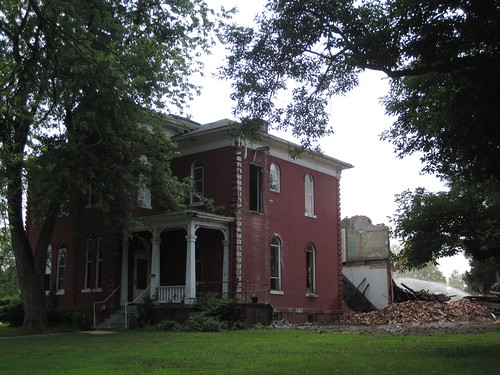 The Superintendent's Building is a refined work in the style. The building has quoins running up each corner, masonry arches over each window rather than the common cast iron hood-molds and fine decorative brackets under the roof overhang placed at the corners.
 The projecting central bay has a defining fornt gable and some rather striking tall, narrow windows.
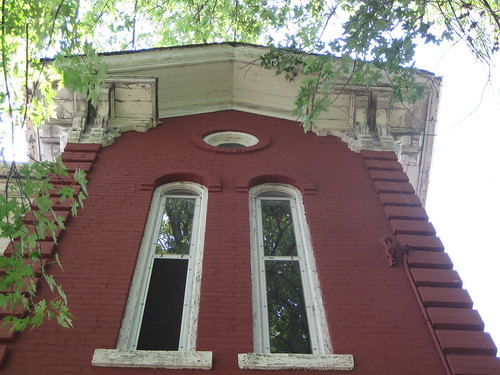 As these photographs show, the Superindent's Building is not currently under demolition. In fact, the interior has barely been touched. However, workers have removed historic window sash from behind the storm windows. Has the sash been destroyed?
 The residential hall, built in 1900, has not escaped death. While the front elevation of the building looks intact, displaying a simple Italianate-inspired design that harmonizes with the earlier neighbor, the back reveals that demolition has removed nearly half of the building mass.
 Alas, the residential hall is lost. However, the Superindent's Building is largely intact, structurally sound and not affected by demolition of the surrounding building fabric. The Madison County Board could still intervene to stop its destruction. While removal of the residential hall diminishes the context of the Superintendent's Building, it does not impact the architectural integrity of the remaining building. There is still a chance to preserve part of the landmark Poor Farm.
One possibility would be to complete demolition of the surrounding buildings, mothball the Superintendent's Building and issue a Request for Proposals for the site from developers who might wish to renovate the building. The County could end up breaking even on the old Poor Farm.
Perhaps a word to Madison County Board Chairman Alan Dunstan could stop total destruction:
Honorable Alan J. Dunstan
Madison County Administration Building
157 N. Main Street
Suite 165
Edwardsville, IL 62025-1963
(618) 296-4341
Monday, July 20, 2009
Trenton City Hall
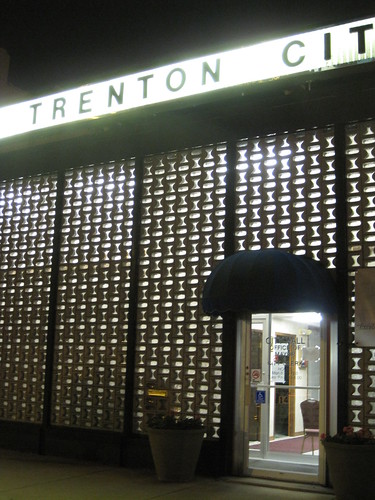 A night ride back from the Clinton County Fair in Carlyle, Illinois took us through Trenton, Illinois over the weekend. Trenton is a small town with a small City Hall, but their City Hall is no cookie-cutter box or faux colonial meeting hall. No, Trenton has a cool modernist building that was probably inexpensive to build -- again, small town with small city hall probably has small budget -- but is a delight to behold.
 The entire front wall consists of patterned glass blocks laid in between black-painted steel piers. these glass blocks are laid in a neat pattern. At center is a simple, common metal door with a delightfully curved handle. Across the top is the name of the building on a backlit plastic board (paging Robert Venturi). While the plastic board is a little out of synch with the simple, smart design below, the composition works. Trenton's leaders settled on distilling the importance of municipal government into as direct an architectural statement as possible.
While many towns across Illinois opt for allusions to classical architecture, or headquarter their government in plain-ugly, workable buildings, Trenton chose modern. Oh, I hope that their future leaders recognize and cherish the small wonder of City Hall!
Sunday, July 12, 2009
More Demolition in Downtown Granite City
 Last year, the building at 1310 Niedringhaus Avenue in downtown Granite City burned. The neighbor at 1308 Niedringhaus (at right above) suffered some damage, but nothing that compromised its structural integrity.
Here's a look at those two buildings three years ago, seen at right below:
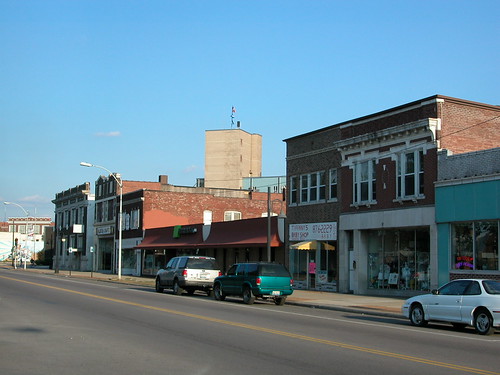 One can see that these buildings were part of an uninterrupted row of downtown buildings with storefront retail activity. Such blocks are few and far between in Granite City these days. Now there is one less, because the government of Granite City successfully pushed to have both the buildings at 1308 and 1310 Niedringhaus Avenue demolished. Today, the site is a gaping hole in the street wall.
 Like many municipalities in the St. Louis area, Granite City lacks a local preservation ordinance that would establish a citizen review commission for demolitions -- and the ability to seek federal grants for preservation planning. Such an ordinance would enable Granite City to become a Certified Local Government under federal rules, a status enjoyed by Belleville, Collinsville, Alton and Edwardsville. (Read more about Illinois' Certified Local Government program here.) If Granite City had a preservation ordinance, the city might have a shot at stopping the steady spate of demolitions that have been eroding the downtown area in the past decade.
Wednesday, June 17, 2009
Springfield's State House Inn: Another Successful Mid-Century Motel Renovation

The first motel in Springfield, Illinois was the State House Inn at 101 E. Adams Street in the heart of downtown. Built in 1961 and designed by Henry Newhouse, the State House Inn is a contemporary of St. Louis' threatened DeVille Motor Hotel.
However, the State House Inn is celebrated by its city and has received the benefit of a historically-sensitive renovation. In 2003, the motel reopened after a three-year, $8 million renovation. Today, the motel's guests enjoy lovely modern lodgings just a short walk from Springfield's major attractions as well as the Amtrak station.
Could the DeVille be the beneficiary of a similar renovation? While not downtown, the DeVille is a short walk from some of the city's attractions -- the Cathedral, Forest Park -- and near light rail that connects to our Greyhound/Amtrak station. The Central West End stays open later than downtown Springfield, too, with many restaurants and bars within a short walk of the motel. With the same applied imagination that the State House Inn received, the DeVille could be one of St. Louis' coolest places to stay.
Monday, June 15, 2009
One Cool Garage
 Walking around Grafton recently, I noticed this garage on First Street. Our Lady of the Waters, what a fine building! The walls are built entirely out of structural clay tile, with a lovely tapestry of mixed colors. The corners and edges around the doors and windows are even bull-nosed. I have little else to add save that one does not find clay tile buildings like this often in the St. Louis region. Yay!
Wednesday, June 3, 2009
Goldenrod Showboat Celebrates its Centennial
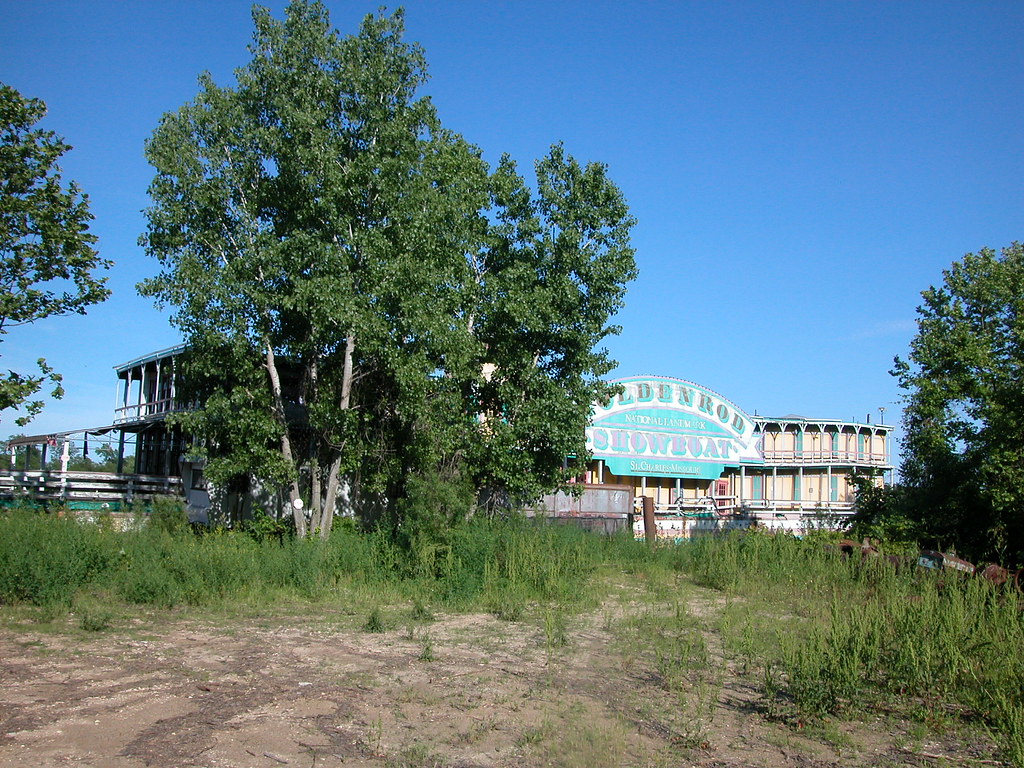 The day was beautiful, and our need for a trip away from the city strong. Looking for a destination, we settled on tracking down the Goldenrod Showboat on the Illinois River. After all, we are in the venerable entertainment vessel's 100th year. Using directions from a friend sent last year after he stumbled upon it and Google Earth (which showed it a few miles from where it actually lies), we got a general idea of the location in Kampsville, Illinois and set out.
Of course, the Goldenrod now sits outside of its first Kampsville location. After not finding the boat on the town's riverfront, we asked a couple walking down the road how to find it. The man knew where it was, gave directions and proceeded to offer the information that his aunt was a waitress and actress on the Goldenrod between 1945 and 1950. Even in this unlikely new home, the Goldenrod is part of a local's family heritage -- how 'bout that?
A few miles later, we spotted the Goldenrod moored to a barge on a section of overgrown riverfront. The boat was unmistakable, and the deterioration has not claimed much of its integrity. Everything is still there, down to the boat's recent (and somewhat unattractive) paint scheme. The paint is peeling, the wood drying and in some places rotting. Yet the Goldenrod survives unharmed in its sleepy Illinois berth.
A few years ago, this outcome was far from likely. After its itinerant early years (more on those later), the show boat became a permanently-moored restaurant on the St. Louis riverfront. In 1990, the City of St. Charles, which had purchased the boat in 1988, moved it to the St. Charles riverfront. The restaurant closed in 2001, and in 2003 the city decided to sell the boat. The St. Charles City Council accpeted bids, and sold it to a company headed by John Schwarz. (The Council rejected Bob Cassilly's bid to move it back to the St. Louis riverfront.) Schwarz moved the boat to Kampsville, after announcing plans to restore the vintage vessel.
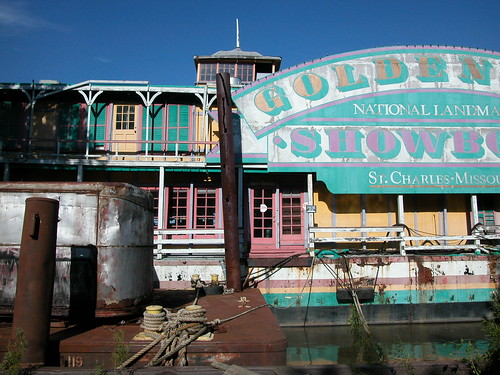
However, in 2007, Randy Newingham and Shelia Prokuski, owners of the site where the boat was moored, sued Schwarz for unpaid mooring fees. In September 2007, Newingham threatened to sell all or part of the boat for scrap to cover his costs. One month later, a Calhoun County judge ordered an auction of the boat, and the court accepted Newingham and Prokuski's lone $50,000 bid. However, by the end of the year the couple had reached and agreement to sell the Goldenrod back to John Schwarz. Schwarz moved the boat north. In 2008, however, Judge Richard Greenleaf declared that the proper court papers for the auction had not been filed, throwing the ownership in doubt. To date, the ownership has not been cleared.
Hence, the Goldenrod Showboat sits lonely on the side of Illinois Highway 100, and as summer sets in, disappears behind stands of grasses and the leaves of riverbank trees. The sturdy boat is crumbling, but not very rapidly. Asphalt roof paper provides cover for much of the deck area, and the boat is locked up tight. Hopefully, this is not how the Goldenrod will end its days, even if this sad state is how the boat will spend its centennial year.

The path from birth has been convoluted, but most of the Goldenrod's days have been good ones. Pope Dock Company of Parkersburg, West Virginia built the boat in 1909 for businessman W.R. Markle. Originally, the boat was named Markle's New Showboat. Built for entertainment, the boat would travel the Mississippi and Ohio rivers and stop at town where it would dock. Patrons would come aboard for a night of music, comedy and other live entertainment. According to most accounts, the boat was the last showboat built for the Mississippi and Ohio river circuits. At 200 feet long and 43 feet wide, the boat was one of the largest showboats ever built. The seating capacity was 1,400.
Markle lost the boat through foreclosure in 1913, and the next owner renamed the vessel the Goldenrod Showboat. In 1922, Captain Bill Menke purchased the boat and implemented a 12-month touring schedule. His tenure would be long and fruitful. Menke moored the boat at Aspinwall, Pennsylvania for two consecutive summers, 1930 and 1931. In summer 1937, Menke brought his show palace to St. Louis for repairs but ended up permanently mooring it here. According to "That Landmark on the River," an article by Mary Duffe that appeared in the St. Louis Post-Dispatch on December 10, 1968, the boat hosted stars like Red Skelton, Monte Blue, Kathy Nolan, Major Bowes and others during Menke's tenure. Menke reported that he had to ask patrons in southern towns to leave their firearms at the riverbank.
In 1963, Pierson and Franz purchased the Goldenrod Showboat. A few small fires led to major renovation, including a new steel hull. On Christmas Eve 1967, the National Park Service listed the Goldenrod Showboat as a National Historic Landmark, the highest federal distinction for a historic property. The National Historic Landmark nomination includes a short history of the boat, as well as the fact that the original hull is intact inside of the steel barge that now serves as the hull.
The National Historic Landmark nomination may be skimpy by today's standards of historic documentation, but the nomination's assertion of the great cultural significance of the Goldenrod remains true. This was one of the last and most lavish of the great river show boats, and it may be the only survivor of that type. Its future is important not only to St. Louis, its later home, but to the history of the 15 states the Goldenrod is known to have regularly visited between 1909 and 1937. The centennial of the boat should be a spur toward preservation. If the current owners (whoever they may be legally) cannot figure out how to bring the boat back to life, let's find the person who can.
Wednesday, May 6, 2009
Illinois' Ten Most Endangered -- And the Chicago Landmark Ordinance
Landmarks Illinois has released its ten most endangered places list for 2009; the list and information about each site is online here. There are no sites in southwestern Illinois near St. Louis, although a few southern Illinois sites are included.
Here's the full list:
1. Arcade Building (Riverside)
2. Archer House (Marshall)
3. Aurora Masonic Temple (Aurora)
4. Chautauqua Auditorium (Shelbyville)
5. Davenport, Rock Island and Northwestern Depot (Moline)
6. Lewis Pharmacy Interior (Canton)
7. Michael Reese Hospital Campus (Chicago)
8. Porthole Barns of Greene County
9. Prentice Women's Hospital (Chicago)
10. Shawneetown Bank (Old Shawneetown)
A special eleventh spot is included for the Chicago Landmark Ordinance. On January 31, an appellate court ruled that the criteria for landmark designation under the ordinance was vague and sent the ordinance to trial court for review. The outcome of that review could nullify the ordinance, removing legal protection for 277 landmark sites and 51 historic districts designated under the powers of that ordinance.
Here's the full list:
1. Arcade Building (Riverside)
2. Archer House (Marshall)
3. Aurora Masonic Temple (Aurora)
4. Chautauqua Auditorium (Shelbyville)
5. Davenport, Rock Island and Northwestern Depot (Moline)
6. Lewis Pharmacy Interior (Canton)
7. Michael Reese Hospital Campus (Chicago)
8. Porthole Barns of Greene County
9. Prentice Women's Hospital (Chicago)
10. Shawneetown Bank (Old Shawneetown)
A special eleventh spot is included for the Chicago Landmark Ordinance. On January 31, an appellate court ruled that the criteria for landmark designation under the ordinance was vague and sent the ordinance to trial court for review. The outcome of that review could nullify the ordinance, removing legal protection for 277 landmark sites and 51 historic districts designated under the powers of that ordinance.
Thursday, April 23, 2009
Illinois Historic Sites Reopened Today
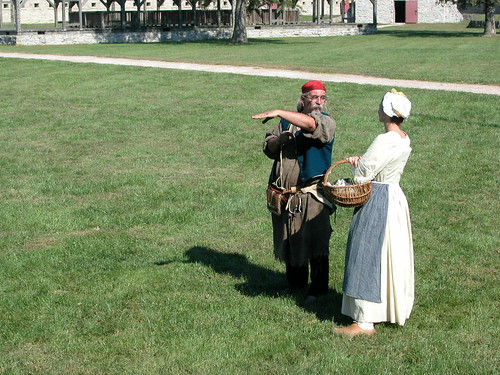
 Scenes like these captured at Fort de Chartres this fall will return to Illinois' closed historic sites. Today the sites, closed by former Illinois Governor Rod Blagojevich (Delusional-Chicago), opened once again.
This is good news for the entire state of Illinois as well as St. Louis. Fort de Chartres, the Pierre Menard Home and the Vandalia Statehouse are within 100 miles of St. Louis. They bring tourism dollars into the wider regional economy.
Planning a celebration with a friend whose husband is returning to work at one of the sites, I was happy to hear that Saturday might be a tight fit because he'll be back at work -- on the weekend, with beautiful weather and plenty of visitors!
Thursday, April 16, 2009
Celebrate: Illinois Historic Sites Reopening!
If you ever doubted the power of one person in elected office to mangle sensible public policy, the saga of former Democratic Illinois Governor Rod Blagojevich was a sobering lesson. A more hopeful lesson comes from current Democratic Illinois Governor Pat Quinn, who has gracefully built consensus to quickly reverse Blagojevich's cuts to state government agencies.
Great news came yesterday when Quinn announced that Illinois' 11 shuttered historic sites are reopening. Thirty-three laid-off workers have been recalled to duty on April 22.
According to the Associated Press:
The closures cost the state tourism revenue and Quinn said he's not going to "squeeze a nickel and lose half dollars."
Right on! Illinois' return to sanity in state government is welcome.
Great news came yesterday when Quinn announced that Illinois' 11 shuttered historic sites are reopening. Thirty-three laid-off workers have been recalled to duty on April 22.
According to the Associated Press:
The closures cost the state tourism revenue and Quinn said he's not going to "squeeze a nickel and lose half dollars."
Right on! Illinois' return to sanity in state government is welcome.
Friday, April 3, 2009
Illinois Legislation Would Enact Historic Tax Credit Modeled on Missouri's
Rick Bonasch at STL Rising wrote a post today asking for more information on a proposed state historic rehabilitation tax credit in Illinois.
Representative Jay Hoffman (D-Collinsville) filed HB 469 on February 4, Representative Greg Harris (D-Chicago) filed HB 586 on February 6 and Senator Dan Kotoski (D-Park Ridge) filed SB 1366 on February 10. The similar bills would enact a state historic rehabilitation tax credit modeled on Missouri's tax credit. All bills have had a first reading and remain in committee.
While Missouri inexplicably debates the future of its model tax credit, other states are looking at copying ours. What a strange reversal of regional dynamics if Illinois had an uncapped historic rehab tax credit and Missouri did not. The tax credit would be a boon to Alton, Belleville, Granite City and other east side communities that are interested in downtown revitalization.
Representative Jay Hoffman (D-Collinsville) filed HB 469 on February 4, Representative Greg Harris (D-Chicago) filed HB 586 on February 6 and Senator Dan Kotoski (D-Park Ridge) filed SB 1366 on February 10. The similar bills would enact a state historic rehabilitation tax credit modeled on Missouri's tax credit. All bills have had a first reading and remain in committee.
While Missouri inexplicably debates the future of its model tax credit, other states are looking at copying ours. What a strange reversal of regional dynamics if Illinois had an uncapped historic rehab tax credit and Missouri did not. The tax credit would be a boon to Alton, Belleville, Granite City and other east side communities that are interested in downtown revitalization.
Friday, January 30, 2009
Quinn Wants to Reopen Closed Illinois Historic Sites
In an article in today's Peoria Journal-Star, Illinois' new Governor Pat Quinn (D) pledges to reopen the closed Illinois state parks and historic sites. Furthermore, he indicates that he understands why the closures ordered by ousted Governor Rod Blagojevich (D) were foolish:
Nature-based and historic-based tourism are the fast-growing growing types of U.S. tourism, Quinn said. The dollars generated by tourism outweigh the cost of running the parks and historic sites, he said, adding that his administration somehow would find the money to reopen them.
"You squeeze a nickel and lose a half-dollar. That's not smart government," he said.
Quinn will reopen the closed sites "with dispatch."
Monday, December 8, 2008
Illinois Hires 89 Prison Guards One Week After Closing Historic Sites
UPDATE: The governor himself is now in jail!
If the administration of Illinois' Democratic Governor Rod Blagojevich is aiming to be the most confusing one in state history, it is doing well. Just one week after closing 12 historic sites and laying off 100 employees of those sites, the state has hired 89 prison guards for a prison transfer that may not take place. While the prison guard hiring had long been planned, the operation of the 12 state historic sites had been in the state budget as far back as 1913, when Illinois acquired Fort de Chartres. If Blagojevich seriously wanted to tighten the state's fiscal belt, he could have deferred the guard hiring to save money until the Pontiac Prison transfer lawsuit is resolved.
In January, expect the state legislature to again find funding for the shuttered historic sites. Also expect the governor to continue to cling to the ludicrous assertion that the closures have helped balance the state budget. Meanwhile, 100 workers whose work skills are hard to place in Illinois face uncertain futures. The twelve sites face doubtful prospects of reopening. Many communities will lose tourism dollars, and many tourism-boosted businesses will face failure. Meanwhile, other states that fully invest in their historic sites will capture a healthy number of visitors and their spending dollars.
If Blagojevich thinks the future he's setting into motion makes sense for Illinois, he has a lot of explaining to do.
The sites that closed on November 30 are the following:
Apple River Fort, Elizabeth
Black Hawk Site, Rock Island (Hauberg Indian Museum to be half-closed)
Bishop Hill Museum, Bishop Hill (Colony Church and Bjorklund Hotel)
Cahokia Courthouse, Cahokia
Dana Thomas House, Springfield
Fort de Chartres, Prairie du Rocher
Fort Kaskaskia, Ellis Grove
Jubilee College, near Brimfield
Lincoln Log Cabin, near Charleston
Pierre Menard Home, Ellis Grove
Old Statehouse, Vandalia
Carl Sandburg Home, Galesburg
If the administration of Illinois' Democratic Governor Rod Blagojevich is aiming to be the most confusing one in state history, it is doing well. Just one week after closing 12 historic sites and laying off 100 employees of those sites, the state has hired 89 prison guards for a prison transfer that may not take place. While the prison guard hiring had long been planned, the operation of the 12 state historic sites had been in the state budget as far back as 1913, when Illinois acquired Fort de Chartres. If Blagojevich seriously wanted to tighten the state's fiscal belt, he could have deferred the guard hiring to save money until the Pontiac Prison transfer lawsuit is resolved.
In January, expect the state legislature to again find funding for the shuttered historic sites. Also expect the governor to continue to cling to the ludicrous assertion that the closures have helped balance the state budget. Meanwhile, 100 workers whose work skills are hard to place in Illinois face uncertain futures. The twelve sites face doubtful prospects of reopening. Many communities will lose tourism dollars, and many tourism-boosted businesses will face failure. Meanwhile, other states that fully invest in their historic sites will capture a healthy number of visitors and their spending dollars.
If Blagojevich thinks the future he's setting into motion makes sense for Illinois, he has a lot of explaining to do.
The sites that closed on November 30 are the following:
Relic of Early Anheuser-Busch Empire in Granite City
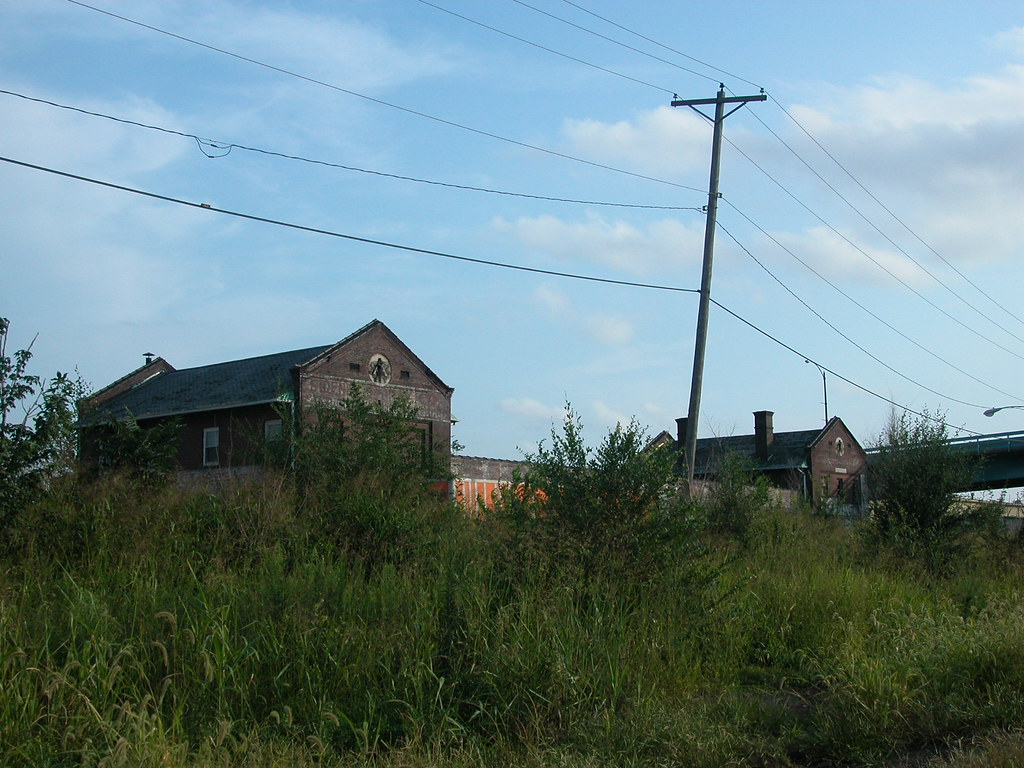 Under the 20th Street viaduct bridge in Granite City, Illinois stands a reminder of previous changes within the Anheuser-Busch empire. On Adams Street is a transfer terminal for the brewer built in the 1911 before the onset of prohibition. The brewer sent train loads of beer to Granite City by rail across the Merchant's Bridge, and the trains delivered the beer to this building. From here, teams of Clydesdales and later trucks carried smaller deliveries to local restaurants, taverns and lodge halls.
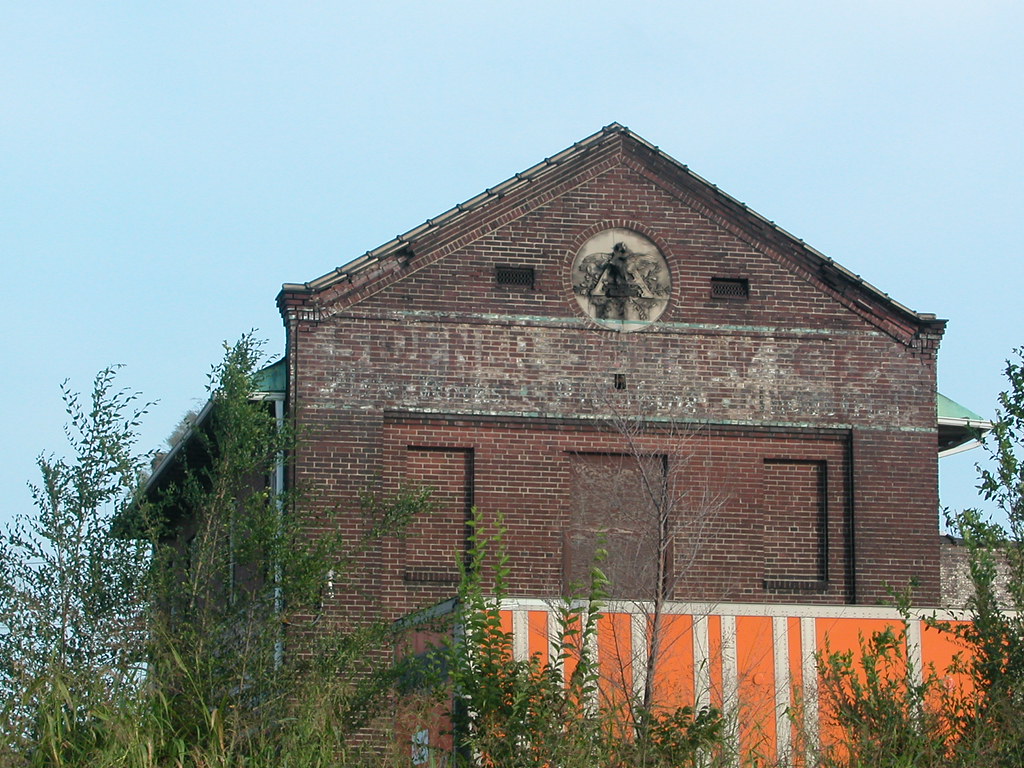 Anheuser-Busch closed the transfer terminal after World War II, when it became more feasible to simply truck the beer from St. Louis over roads. The transfer terminal remains, and is still in use as a transfer facility. Nowadays, truckloads are switched out here. At each of the four gable ends is a terra cotta medallion bearing a relief of the Anheuser-Busch eagle. The adjacent rail line does not have a spur to the old Anheuser-Busch transfer terminal. The terminal's use passed with time, then the railroad spur and finally the brewer itself.
Friday, November 21, 2008
Blagojevich Cuts Historic Sites Out of Restored Funding
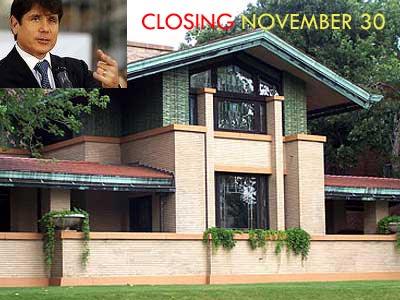
Rod Blagojevich, America's least popular governor with approval ratings consistently lower than President George W. Bush, has again taken aim at Illinois' state historic sites. Yesterday, Blagojevich signed part of a $230 million state budget passed by the legislature that restored funding cuts made to state parks and historic sites. The part that Blagojevich vetoed, however, included all of the funding needed to prevent closure of 13 state historic sites. The governor claimed that the funds that the legislature allocated for historic sites is federally prohibited from being used that way -- and he may be right. Still, there are other sources of funding, including revenues the governor approved being used to spare the 11 state parks that had been slated for closure.
Blagojevich's move seems extraordinarily petty and intended to marginalize the struggle to keep the state historic sites open. By removing that struggle from the struggle to reopen the state parks, the governor is trying to divide the army of advocates fighting both sites of closures.
Once again, though, Blagojevich has made a huge mistake. Citizens across the state -- and, really, the nation -- will not back down in efforts to keep the sites open. From the Dana Thomas House in Springfield (pictured above), an internationally-revered work of Frank Lloyd Wright, to Fort de Chartres in Prairie du Rocher, the oldest building in the state, the historic sites are the lifeblood of historians and towns whose economies benefit from the tourist economy. Expect an outcry that will grow as strong as the importance of the 13 sites -- one that will not be silenced by reactionary politicking in Springfield.
A Randolph County where the Fort and the Pierre Menard Home are closed is a frightening prospect to area residents. The Vandalia Statehouse, Carl Sandburg birthplace and Dana Thomas House are as ingrained in the hearts of Illinoisans as the Sears Tower and the capitol, and people are not going to let them meet uncertain fates. This matter will be brought back to the budget or to the ballot box. The legislature is now on board. The governor may be the only person in the state on the other side.
Blagojevich's move seems extraordinarily petty and intended to marginalize the struggle to keep the state historic sites open. By removing that struggle from the struggle to reopen the state parks, the governor is trying to divide the army of advocates fighting both sites of closures.
Once again, though, Blagojevich has made a huge mistake. Citizens across the state -- and, really, the nation -- will not back down in efforts to keep the sites open. From the Dana Thomas House in Springfield (pictured above), an internationally-revered work of Frank Lloyd Wright, to Fort de Chartres in Prairie du Rocher, the oldest building in the state, the historic sites are the lifeblood of historians and towns whose economies benefit from the tourist economy. Expect an outcry that will grow as strong as the importance of the 13 sites -- one that will not be silenced by reactionary politicking in Springfield.
A Randolph County where the Fort and the Pierre Menard Home are closed is a frightening prospect to area residents. The Vandalia Statehouse, Carl Sandburg birthplace and Dana Thomas House are as ingrained in the hearts of Illinoisans as the Sears Tower and the capitol, and people are not going to let them meet uncertain fates. This matter will be brought back to the budget or to the ballot box. The legislature is now on board. The governor may be the only person in the state on the other side.
Thursday, November 20, 2008
Re-Enactors Rally in Springfield Against Historic Site Closings
KSDK reports on yesterday's spirited demonstration at the Illinois state capital against closures of 13 historic sites. Over 50 re-enactors and their supporters came to the Illinois capital, many in historical costume, to urge Illinois Governor Rod Blagojevich to sign the bill on his desk to reinstate funding for the sites that otherwise close on November 30.
While the intractable governor is sticking to his penny unwise, pound very foolish stance, the most encouraging part of the rally is that those assembled have formed a new coalition called Save Illinois History to concentrate lobbying efforts. That's a smart move, as the struggle seems to be a long one. In January, when the legislature reconvenes, there will be much work to do to try to ensure that the state budget provides full funding again, and that the governor's stance changes.
While the intractable governor is sticking to his penny unwise, pound very foolish stance, the most encouraging part of the rally is that those assembled have formed a new coalition called Save Illinois History to concentrate lobbying efforts. That's a smart move, as the struggle seems to be a long one. In January, when the legislature reconvenes, there will be much work to do to try to ensure that the state budget provides full funding again, and that the governor's stance changes.
Subscribe to:
Posts (Atom)


 Posts
Posts

