We've Moved

Ecology of Absence now resides at www.preservationresearch.com. Please change your links and feeds.

Showing posts with label north side. Show all posts

Wednesday, August 12, 2009

The Precarious Condition of Two Beautiful Houses on St. Louis Avenue

Brick rustlers have returned to the lovely stone-faced house at 1930-6 St. Louis Avenue (see ""Who Would Destroy This Building?", January 7, 2007). Most recently a funeral home, the house was first built in 1873 by wholesale grocery merchant Bernhard Winkelmann. Winkelmann was one of the numerous new-money German-Americans whose lavish homes gave St. Louis Avenue the nickname "Millionaire's Row." Today, a different millionaire owns the property: developer Paul J. McKee, Jr. through holding company N & G Ventures.

The damage from 2007 concerned only a one-story flat-roofed addition behind the home, but this week's damage concerns the side wall of part of the house. Since joists run laterally and rest in the brick side walls of most 19th century buildings, this damage will eventually cause collapse of the roof and floors. However, the thieves have only struck an addition to the Winkelmann house's ell, so the original section is not yet damaged.

On May 21 and other occasions, McKee mentioned having a list of 60 "legacy properties" in his possession worthy of preservation. Is this house one of them? It should be. However, the list is a mystery to myself and many people in city government and the development world with whom I have discussed preservation issues related to the NorthSide project. We do know that the house at 1930 St. Louis Avenue made an official list that gives it undisputed historic status: the house is a contributing resource to the Clemens House-Columbia Brewery Historic District. It ought to be preserved, and McKee should secure it against further attack.
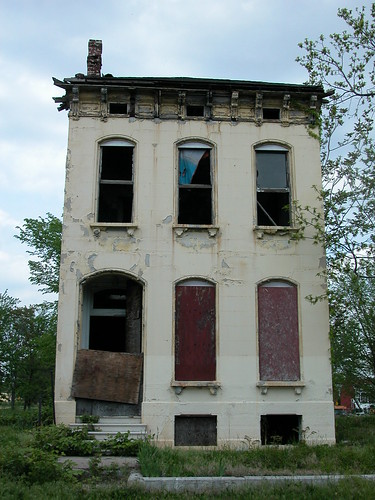
Across the street is another fine stone-faced house with a lovely wooden Italianate cornice. The house at 1925 St. Louis Avenue dates to 1879 and is owned by the city's Land Reutilization Authority (LRA). The house is outside of the present historic district boundary. The front looks ragged but sturdy, but a walk around the side reveals the sad truth.
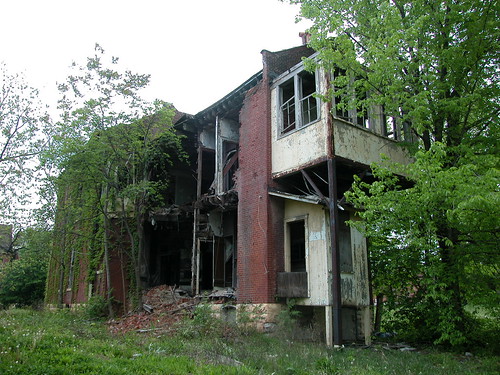
The east side wall of the ell is in shambles, although the second floor and roof are holding on for now. The condition of this house raises a preservation question related to NorthSide that has not been widely discussed: what happens to the numerous vacant historic buildings within the NorthSide footprint not owned by McEagle Properties and its subsidiaries? Most of those buildings are on the list of needed properties that McEagle submitted to the city's Tax Increment Financing Commission in May. Is the building at 1927 St. Louis Avenue one of the 60 "legacy properties"? There ar emore than 60 historic buildings owned by McEagle worthy of preservation, and at least as many in the project area owned by LRA and other entities.

City officials should not wait for the list of legacy properties to set into motion a sensible preservation plan for the NorthSide project. If public financing is on the table, that can be leveraged to ensure that buildings like the two above can be mothballed for eventual redevelopment in future phases of the NorthSide project.

Thursday, May 7, 2009

Lecture: The James Clemens House: Past, Present, Future

Volunteers for the Landmarks Association of St. Louis standing on the porch of the James Clemens, Jr. House in 1960.


"The James Clemens House, Past, Present and Future"
When: Sunday, May 10, 2009 at 2:00 p.m.
Where: Architecture St. Louis, 911 Washington Avenue #170

Join Michael Allen, Assistant Director of Landmarks Association, as he offers a look at one of the most significant endangered houses in St. Louis. Built in 1858 for James Clemens, Jr., the house at 1849 Cass Avenue is one of the few remaining antebellum mansions in the city. Later life included expansion of the house and use as a convent and several ministries. For the last decade, the fate of the vacant complex has been uncertain. Collapse of a chapel wall last year sent shock waves throughout the preservation community. Explore the fascinating history of this St. Louis landmark and discover what hope remains.

Lecture is free and open to the public, but reservations are requested, please call 421-6474.

The lecture is part of Preservation Week, a week-long series of events centered on historic preservation. The full schedule is online here.

Thursday, October 23, 2008

Romanesque Revival Flats From the Gilded Age


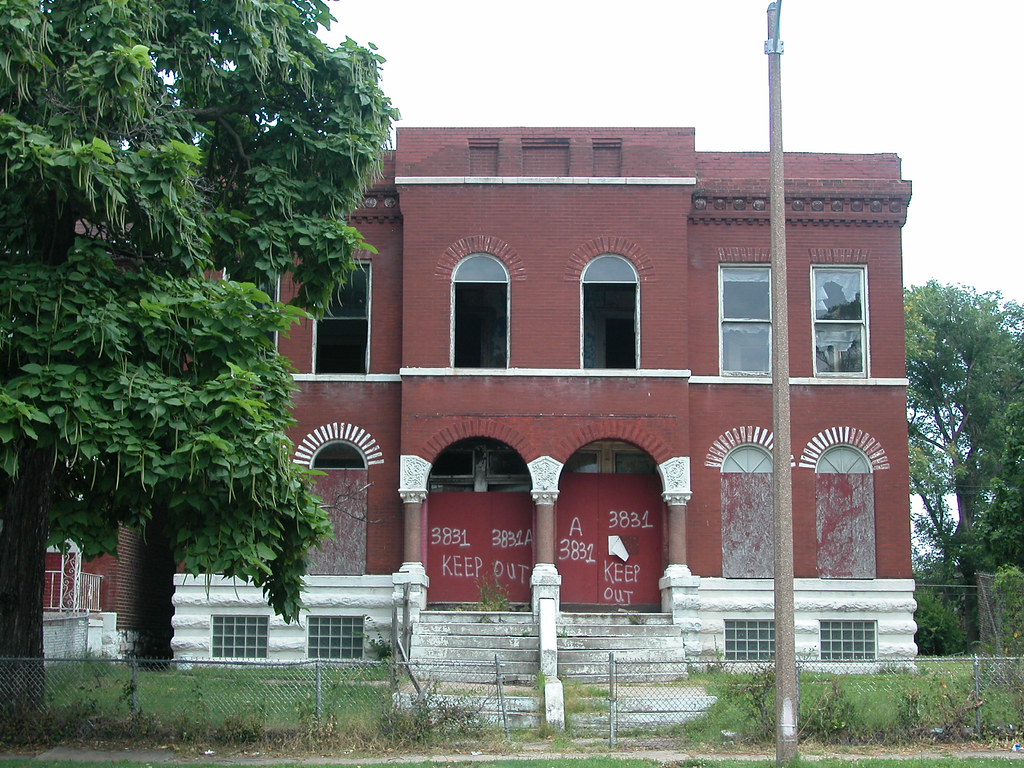
Each time I travel west of on Page Boulevard, I keep an eye out for the double set of flats at 3831 Page. Although vacant for the past five years or more, the building always brings a smile to my face. In a city full of distinguished examples of many popular architectural revival styles, this Romanesque Revival building may not be the showiest or most significant, but it sure sticks in my mind. For one thing, the entrance is grandiose -- polished Missouri granite columns rise from a rusticated white limestone foundation to support carved limestone voussoirs. The voussoirs buttress standard Roman arches of machine-pressed brick. The columns are extravagant on entrances that lead to double doors, signifying that this building houses four middle-class families, not one wealthy one. Beyond the impressive effect created by having Roman arches on all first floor window openings -- and the striking but inappropriate alteration of white-painted bricks in each arch -- the flat-roofed building possesses stock traits.

Yet this building is a great example of the triumph of machine processes in common stock architecture. That rusticated limestone base was cut to "rough" perfection by machine tools. the granite columns polished by machine. The bricks were pressed by a press. Even the carved limestone work is the result of pneumatic chisels, guided by craftsmen but powered by steam. After all, this house dates to a September 18, 1893 building permit reporting a construction cost of $8,000. Mighty St. Louis had already built the Wainwright Building and Union Station, and its craftsmen were deft with new technology. Its residents were full of wealth and the swagger to proclaim the growing city's greatness through every brick laid around town. In the 1890s, the house at 3831 Page was one of a multitude demonstrating the superior industrial and architectural imagination of the river city in the American Gilded Age.

The pedigree of this house also shows the westward creep of the city. Its developer, Charles Schockemiller, was residing at 2228 Biddle near the Kerry Patch. The contractor, Hemminghaus and Vollmer, had offices at 1417 Destrehan in Hyde Park. The architect, German-born Gerhard Becker, maintained an office at 1017 Chestnut Street and was noted for designing factories on the near north side like the Eckhoff factory in present-day Old North and the Standard Stamping Company building on North Broadway. All German names, and all tied to points east but plotting the westward development that would fill the city's boundaries with a plethora of magnificent houses, tenements and even factories.

Friday, September 28, 2007

A few more notes on the demolition permits on MLK

I was disappointed that we lost not one, but five buildings on MLK at the Preservation Board on Monday.

4222 Martin Luther King had to go. I watched it burn--it was terrible and thorough, and complete with a huge collapse. That building was not a building anymore afterwards.

4149-53 MLK had to go, too. They were pretty much just front facades. They were in the kind of state that only heavy subsidy or some wealthy angel of rehab could have turned around, and I didn't see either touching down on that block any time soon, sadly.

4220 and 4224 could have been saved. I really, really think so, call me crazy. (I call your attention to the fact that I just said I'm okay with the other three demolitions--I'm not THAT crazy!) After questioning whether to vote on the buildings individually, the board voted on all five buildings at once. The vote to grant the demo permit was unanimous (with Richardson, Callow, Robinson, Killeen, and Kennedy in attendance).

The first time I went along the length of MLK after moving back to St. Louis several years ago, I was struck by what a beautiful street it was, and how surprisingly intact and varied its collection of storefront buildings was. Going down a street like that, you can just tell from the landscape that it was and is an important place. As I've watched disappearances on the street since that day, one little storefront here, another little storefront there, I just keep thinking This street will be gone before I turn thirty. I mentioned this in my testimony to the Board on Monday. Asked how old I was, I answered: "Twenty-three."

"You've got time," came the answer.

"It won't take that long," I replied.

Making the loss of the buildings of the 4400 block especially sad was the testimony of Alderman Moore, who had brought the buildings up for demolition in the first place. He said he saw people run out of 4222 shortly before it started visibly burning. He said that he just knew they had to be brick rustlers. Brick rustlers have been setting fires in his area and letting the flames and the fire department be the demo crew--the wood is eliminated, and you get loose bricks and conditions where people are less likely to be suspicious if you're palletizing. Sure enough, Alderman Moore said, he went to the building at 8am the next day, and at 9am the brick rustlers showed up and started picking out the good bricks, throwing broken brickbats back into the remains of the ruined building. The Alderman called the police, and he said they showed up briefly but then left without doing anything, letting the brick rustlers go. What I want to know is: If the cops won't even help AN ALDERMAN arrest brick rustlers (9am the morning after a fire! When no demo permit could have possibly been issued yet!), how the hell do the rest of us in the community even stand a chance at stopping brick rustling?

Saturday, July 7, 2007

Hanley's Meadow

Filmmaker Carson Minow's award-winning 48 Hour Film Project entry, Hanley's Meadow, is now available online. Readers of this blog will recognize a few of the actors and many of the locations, which range from St. Louis Place to the Wellston Loop.

EDITED to add: This is Claire butting in to note that except for one scene done in a rural-ish part of Rosemont City, everything else in the movie was filmed North of Delmar. Yay!

Saturday, April 14, 2007

Creating a Preservation Fund


In a post entitled "A Dedicated Fund For Historic Preservation In STL?" at STL Rising, Rick Bonsach raises the point that St. Louis lacks a dedicated emergency historic preservation fund. The existence of such a fund would have aided Old North St. Louis with stabilizing the storm-damaged Mullanphy Emigrant Home (pictured above in the "better" days of December 2006).

Bonasch suggests that the topic be discussed among those who attend tonight's fundraiser for the Mullanphy (at the Schlafly Bottleworks in Maplewood from 5-7:30 p.m.; details here).

The discussion should continue past tonight. With rising interest in historic preservation in north side neighborhoods hampered by strong weather, arson and metal thieves, such a fund could establish a sustainable effort to ensure that some funds are available for emergency stabilization. Such a fund could empower neighborhoods who might otherwise consider demolition as the only practical option. Many neighborhoods on the north side are far from having strong markets for historic buildings, but with assistance will undoubtedly reach that point.

The first response to Bonasch in his comments section is dismissive and seems to presuppose government footing the bill for the fund. Bonasch replies that he envisions the private sector administering the fund. After all, the Mullanphy effort has yet to collect a dollar of city money -- and probably will not. The momentum is building regardless.

(Some have joked that instead of a preservation fund what is most urgently needed is an advocacy group against our new forms of severe weather.)

Bonasch's post raises interesting questions:

Does St. Louis have the energy and vision to continue working for emergency stabilization efforts after the Mullanphy is rebuilt?

Can we sustain the effort foe years to come?

Can we successfully collect money for the effort in the absence of a targeted project like the Mullanphy?

Are there existing organizations or people who may have established a suitable foundation for such work?

Should city government be involved?

Would St. Louisans be willing to have any tax money go into the creation of such a fund?

Are their existing municipal funds that could be used for stabilization instead of demolition?

Friday, July 29, 2005

Hyde Park Regression Continues

Hyde Park continues to suffer from stagnation and loss. Look at these proposed demolition plans:

Shreves Engine Company plans to demolish nine houses for some inane "security wall" plan that Alderman Freeman Bosley supports.

The Phillips 66 gas station at Salisbury and Eleventh, owned by Nidal Othman, wants to tear down the Cordes Hardware buildings. Some may recall the days when Cordes was still open with an old-time charm on par with Marx Hardware down in Old North. (Bosley opposes this demolition, although he has offered no substantial aid to the owner or others trying to renovate destabilized buildings in this neighborhood.)

These projects seriously compromise the intact density of historic buildings in this neighborhood. They must be defeated.

There's also a big stir about a development underway between Natural Bridge, Salisbury and West Florissant avenues on the western end of Hyde Park. Here, Bethlehem Luthern Church has financed a development of new houses and apartments -- not urban in character, of course -- that has involved a liberal use of eminent domain. This development has some Hyde Park residents up in arms due to questionable offers made to affected property owners and the attack on poor homeowners the Church is accused of leading. Last night, a group of 25 neighborhood residents joined with the Citizens' Coalition to Fight Eminent Domain and marched to Bosley's home on Bremen Avenue to make their demands.

Tuesday, July 26, 2005

Talk About a Bridge

The Missouri and Illinois departments of transportation will get the public's ideas about the Mississippi River bridge project at a series of meetings at these locations next month:

Tuesday, Aug. 2
Webster Middle School
2127 North 11th Street
St. Louis
4 to 7 p.m.

Tuesday, Aug. 9
Clyde Jordan Senior Center
6755 State Street
East St. Louis
4 to 7 p.m.

Wednesday, Aug. 10
Venice Recreation Center
305 Broadway
Venice
4 to 7 p.m.

Check out the St. Louis footprint of the bridge on the link above. I'll bet that you didn't realize how, uh, disruptive the bridge will be to the built environment. The good news is that lack of funding will probably doom the huge ugly ramp to 14th Street that would basically wall off the near north side from downtown. There's no way that the renovation efforts in Old North St. Louis and Hyde Park would benefit from the loss of a major street and construction of a suburban monstrosity that would take down more than a few old buildings.

As it is, there's a lot wrong with just the bridge that needs discussion.