
It's an exciting busy day in the city, and an appropriate start to this year's Historic Preservation Month. Open Streets has just wrapped up, and while giving a walking tour on Lindell with Toby Weiss I saw dozens of pedestrians and cyclists taking advantage of the street closure. Can't wait for it to happen again!
Up in the 21st Ward, today is a big blitz of home repair by Rebuilding Together. Alderman Antonio French already has posted a video.
While big rehab projects garner most headlines, most homeowners in the city don't need or can't afford expensive projects. Neighborhood stabilization requires many showcase projects but many more efforts to retain existing residents. Kudos to the volunteers working today in the 21st ward!
Showing posts with label rehabbing. Show all posts
Showing posts with label rehabbing. Show all posts
Saturday, May 1, 2010


Sunday, April 25, 2010
White Roof Coating, Ahead of Summer
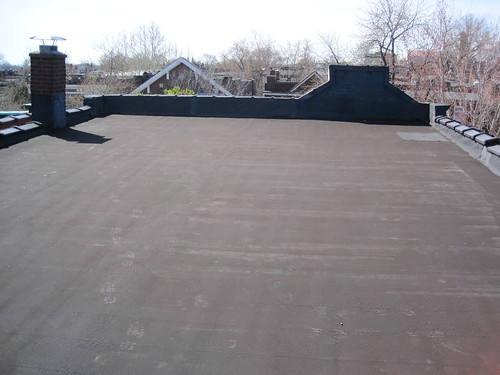 After completing major tuckpointing and chimney rebuilding, we decided to apply a white elastomeric coat to our flat roof this month. This roof was a three-ply modified bitumen roof with a black, heat-trapping emulsion overcoat. The roof was old enough to coat but certainly not getting younger under the toll of ultraviolet rays. A mod-bit roof needs about one year to leech out oils before coating, and ours was well past that mark. Time to coat!
Now why would we go through the trouble of applying a white coat? There are two major reasons:
Energy efficiency and global warming. A white coat can reflect up to 80 percent of solar radiation, reducing overall planet temperature but more immediately reducing building, neighborhood and city temperature. One white roof is small local block against the urban "heat island" effect and many of them can have wide impact. The white roof will reduce the internal temperature and the need for air conditioning, which in turn reduces the electricity usage and so forth. (There is some question about possible heat loss effect of a white roof in winter. At St. Louis' latitude the sun's rays are vertical in the summer and at a low slant in the winter, so the available winter solar heat is much less than the summer heat. At other latitudes, a white roof might not be of such benefit as here and points southward.)
Longevity of the roof. An elastomeric coat will block ultraviolet rays that slowly break down asphalt roofing. Coats should be reapplied every 10 years or sooner if needed. With timely reapplication, the coverage can extend the life of the roof to 40-50 years, reducing cost as well as waste of nonrenewable roofing materials.
While the mason had the scaffolding set up, we used his pulley to hoist up the 5 gallon buckets of coating. We used five $72 buckets of Henry Solarflex 287, which completely covered our 1300 square foot roof. When the scaffolding was down, we used a tall ladder for travel to the roof.
Working with a friend, we spent about eight hours washing the roof and applying the coat. Since we had just had masonry work, the roof was dirty and required over two hours of scrubbing. The mod-bit roof dried quickly, however. We applied the coat with a 4" brush on the parapet sides and 9" rough rollers on the roof. We avoided a few new flashing repairs made around the rebuilt chimneys.
 Most of the roof was covered with two coats, but some areas required three coats. (a one year old roof won't take this much work). We left a spot near the ladder for exit and came back to finish in a half-hour a day later. Now the roof is too bright to look at, just in time for summer. We're not big air conditioning users -- it's expensive and not very sustainable, although certainly necessary for a few weeks -- so we definitely look forward to the building heat reduction.
Thursday, March 18, 2010
ReStore Offers $1 Wooden Window Sashes
For the next few days the ReStore is selling all wooden window sashes (including screen window sash) for $1 each. There is quite a lot of stock right now. In fact, the store frequently receives more in donations than it can sell. That's why the cost is low. Take advantage of the sale for your project!
The ReStore is located at 3763 Forest Park Avenue (between Vandeventer & Spring). The hours are Tuesday: 8am - 5pm; Wednesday-Friday: 8am - 4pm; Saturday: 8am - 5pm.
The ReStore is located at 3763 Forest Park Avenue (between Vandeventer & Spring). The hours are Tuesday: 8am - 5pm; Wednesday-Friday: 8am - 4pm; Saturday: 8am - 5pm.
Wednesday, February 10, 2010
Rehabbing at McRee and Tower Grove
 In 2004, the building at 4301 McRee Avenue (at Tower Grove Avenue) was vacant. The terra cotta wrapped double entrance surround at the corner attract many an eye due to its ornate pediments. The pediments feature a mortar and pestle at center that commemorates the building's original drug store tenant. Yet the rest of the building was rough, with all second floor windows missing. The Garden District Commission had acquired the building, and its future was unknown.
 The unknown future arrived through architects Brent Crittenden and Sara Gibson, who purchased the building in 2006. In 2008, the building was rehabilitated as the home for Crittenden and Gibson's enterprises, Urban Improvement Construction and the Central Design Office.
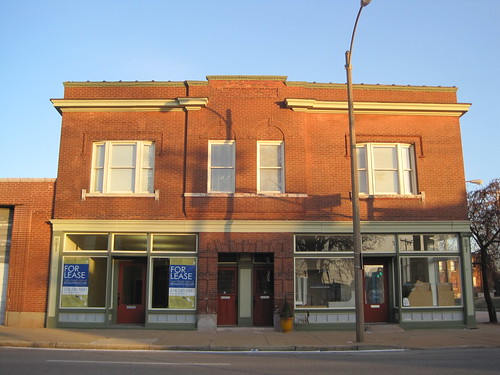 Crittenden and Gibson have a vision for a reborn Tower Grove Avenue in McRee Town, and the corner pharmacy is not their only finished project. When neighborhood anchor Tower Grove Hardware closed -- and this writer was among those who did mourn the passing -- the duo purchased the two-story store building at 1624 Tower Grove Avenue across the street from their offices. Rehabilitation was complete by the end of summer 2009. The large storefront openings now are inviting with large windows, after having been covered in boards for decades. Both this building and the corner building at 4301 McRee Avenue are now contributing resources to the Liggett and Myers Historic District.
Saturday, December 12, 2009
West Cabanne Place Living

The city's West Cabanne Place opened in 1888 as a semi-rural private street, located away from the urban core of St. Louis. Many prominent businessmen and a few architects -- including Charles Ramsey and Theodore Link -- purchased lots and built large homes on West Cabanne. Built in 1889 for E.O. Pope of the Jones-Pope Produce Company, the house at 5927 West Cabanne was one of the earliest residences on the street. The designer of the eclectic home remains unknown. Jane Porter, author of the National Register of Historic Places nomination for West Cabanne Place, suggests that a contractor rather than an architect designed the Italianate-influenced house, which mixes elements rather freely.
 In the 1990s, 5927 West Cabanne Place appeared to be at risk of being lost. Landmarks Association of St. Louis included in the house in its annual Eleven Most Endangered Places list for several years. Eventually, however, the home fell into the hands of an owner who gave the house needed rehabilitation work. The exterior was restored by removing asphalt siding and repairing and replacing wooden elements. Now the spacious residence is for sale for the unbelievable price of $119,000. This truly must be a buyer's market, for a rehabilitated home on West Cabanne Place to be offered at that price!
Wednesday, July 15, 2009
Old North Offering Six Rehab Opportunities

Old North's North Market Place development, started in 2005, focused on constructing new houses like the ones shown here alongside historic buildings rehabilitated for apartments. The Old North St. Louis Restoration Group and its development partner, the Regional Housing and Community Development Alliance, reserved some historic homes in the project area for private investment. Some of those houses and others are now offered for sale to qualified buyers. Those that don't sell immediately as-is will be stabilized and then offered for sale. From Karen Heet, Real Estate Coordinator for the Old North St. Louis Restoration Group:
The Old North St. Louis Restoration Group is a not-for-profit community development corporation whose mission is to revitalize the physical and social dimensions of the Old North St. Louis neighborhood in a manner that respects the community’s historic, cultural, and urban character.
ONSLRG is in possession of six buildings available for purchase and renovation. All six buildings will be offered in a first round of RFPs in their current condition, with a deadline of August 14, 2009 for proposal submissions. If there is no suitable offer for a building, ONSLRG will pay for the stabilization of the building and then offer the building in a second round of RFPs at a purchase price that reflects ONSLRG’s additional costs for stabilization.
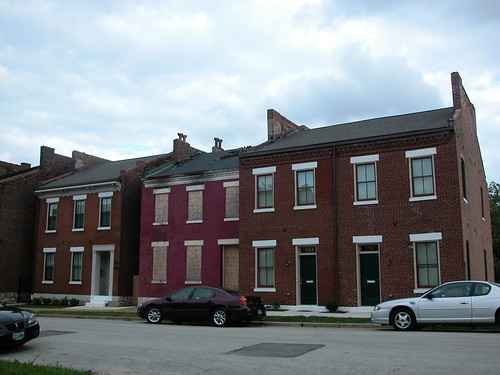
ONSLRG is seeking to increase home-ownership in the neighborhood, so preference will be given to proposals from:
* a developer who will rehab the building and sell to an owner-occupant( s), OR
* an owner-occupant who purchases a building and completes the renovations.
Of special interest will be the applicant’s residential rehab experience, the proposed timeframe for the completion of the project, and the applicant’s understanding of and commitment to compliance with standards for historic restoration.
All buildings are in the Murphy-Blair National Historic District and therefore may qualify for Historic Tax Credits. All buildings are in the N Florissant/N Market/Hadley/ Warren Redevelopment Area and are therefore eligible for property tax abatement. Selected buyers will be encouraged to apply for historic tax credits, property tax abatement, and Neighborhood Preservation Tax Credits.
All proposed construction is expected to be consistent with applicable neighborhood plans and city building codes.
Upon selection, the applicant will have a 3-month option period in which time all construction documents and financing must be finalized prior to the scheduling of a closing date. Construction documents must be sealed by a licensed architect.
ONSLRG will retain an 18-month Right of Re-entry on the property after closing, meaning that if substantial completion has not taken place in 18 months from the date of closing, ONSLRG has the right to take back the property, paying the buyer for any materials and labor for which invoices can be produced.
Please see the attached document for the proposal format and information on the buildings.
Monday, May 4, 2009
Mid-Century Modern Preservation in Grand Center
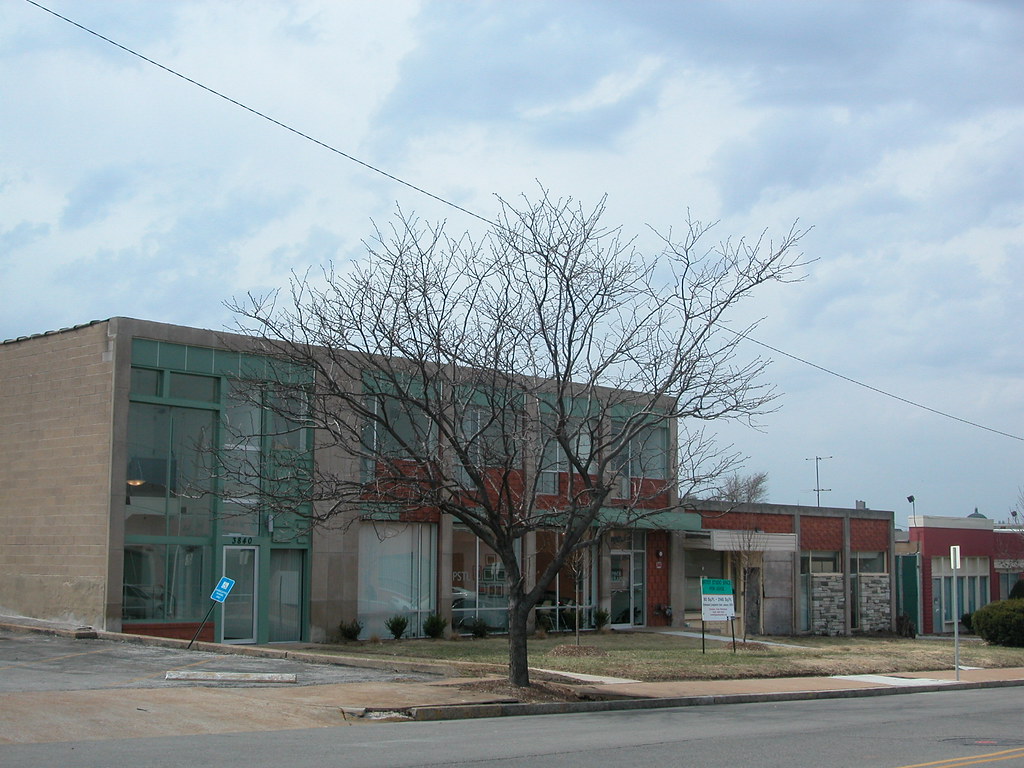 Grand Center, Inc., deserves recognition for a small but important step toward preservation of our mid-century modern architecture. Earlier this year, Grand Center completed renovation of the Loyola Building at 3840 Washington Boulevard just west of Vandeventer. This playfully articulated two-story building and a one-story wing to the west were designed by architect Isadore Shank and completed in 1958. Built as offices, Loyola Academy across the street once used the two-story section for classrooms. The one-story section was owned by a church group. The building is part of a row of modern buildings all enjoying the same setback; see Toby Weiss' post "Mid-Town Washington Boulevard" on B.E.L.T for more information.
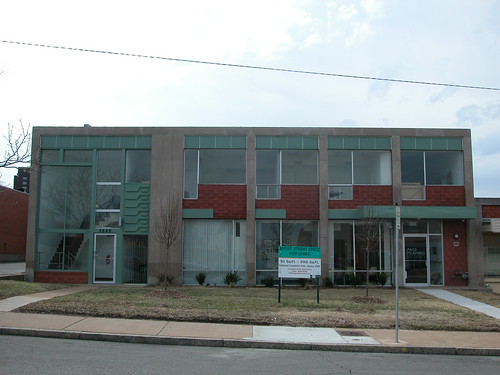 The crisp modern lines are drawn here through smooth limestone. However, there is textural depth added through the patterned brick spandrels and what seems to be a painted wooden spandrel at the main entrance (at left) that reminds me of a patterned fir applique on Shank's Miller House (1963).
The detailing here is not as extensive as on Shank's elaborate DeBalieviere Building (1927) at Delmar and DeBaliviere, but it has similarities. The introduction of wall texture through patterns is similar, as is the breakdown of the potential monotony of repeated patterns through the articulation of the fenestration. This is a cool little building, and not well known among Shank's work.
Grand Center has recycled this office building as artists' studios and the home of the Pace framing company. The redevelopment organization could have done no better -- the Loyola Building did not need a lavish rehab. A little repair and painting renewed the mid-century strut, and all is well in the world.
Monday, April 27, 2009
Shifting the Balance in Hyde Park
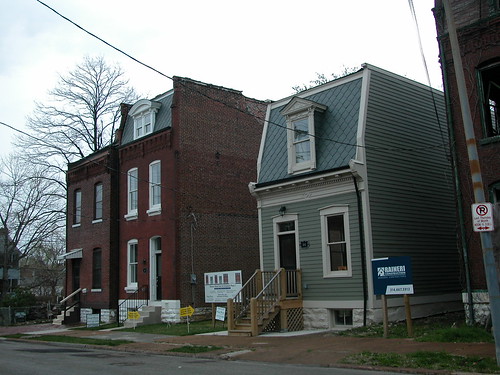 Blue Shutters Development has ambitious plans for the Hyde Park neighborhood. Eventually, the developers would like to rehabilitate dozens of historic buildings in the neighborhood, including the damaged Nord St. Louis Turnverein on Salisbury Avenue. So far, the firm's efforts have been concentrated on the 2000 block of Mallinckrodt Street. Two homes, shown here, have been fully rehabilitated and offered for sale at market rate.
 The house on the right is a great project because it's the type of house many developers would write off -- it's frame, it's small and it has a limited return on investment. Blue Shutters and its principal Peter George deserve credit for preserving it early on.
This work would be impossible without the state's historic rehabilitation tax credit. Relatively small projects like these would have a tough time competing for credits if there was a blanket cap on the program.
Hyde Park often seems like a world of bad news, but a few projects lately have slowly shifted the balance. Let there be more.
Monday, April 20, 2009
Rehabbing Resumed on Bohemian Hill
 In recent weeks, the four-family at 1714 S. 13th Street on Bohemian Hill has received a lot of rehab work. Krystal Group LLC purchased the building in November 2008. While I am no fan of the single-pane windows the investors installed in place of one-over-one windows that had been there, I am glad to see rehab work on Bohemian Hill.
The remaining houses on Bohemian Hill have been under threat of eminent domain for the past three years, and the Land Clearance for Redevelopment Authority had started buying houses on this block in 2007. Gilded Age Development is building a retail project named "Georgian Square" to the west on cleared land, and had originally discussed acquisition of the two blocks east of 13th Street. Those plans now are scuttled.
Meanwhile, Georgian Square is now under construction. At least, the Walgreens store is under construction on Lafayette Avenue across the street from City Hospital.
Monday, April 6, 2009
Spring Rehabbing in Old North
Take a walk, bike ride or drive through Old North St. Louis these days and you might be tempted to ask "what recession?" The hardy north side neighborhood continues to be a construction zone, with activity all over the neighborhood.
Obviously, the Crown Square project (known to most as the "14th Street Mall" project) is moving along swiftly, with most buildings either fully rehabbed or nearing completion. Here's a look at some of the other activity around the neighborhood.
 Up at 1517 Palm Street, a mansard roof long devoid of its original dormers is being restored by a new owner. This house was once owned by the Land Reutilization Authority.
Adjacent to this house is the "three walls" house documented thoroughly by its owners on this website.
 On the south end of the neighborhood, Dan Schuler is overseeing rehab of a house on the 1400 block of Monroe Street that has seen a hard life. A lot of the work is happening inside of the house, but the emerging transformation is big.
 The Gallery at 1318 Hebert, a unique project involving creative reuse and new construction, is approaching completion. Watch for a post on this project soon.
 Across the street from the gallery, the former Ames Elementary School kindergarten building has received the attention of a couple who have spent the last few years doing major masonry work, cornice repair and interior rehabilitation.
See all of the progress for yourself: the Old North St. Louis House & Community Tour will take place on Saturday, May 9, from 10 a.m. to 4 p.m. Advance tickets are $10 and can be picked up in person from the ONSLRG office (2800 N. 14th Street at St. Louis Avenue) or at Crown Candy Kitchen. On the day of the tour, tickets will be available at the registration area at $12 each. As a bonus, Crown Candy once again will offer free ice cream on the day of the tour to all ticket-holders.
Obviously, the Crown Square project (known to most as the "14th Street Mall" project) is moving along swiftly, with most buildings either fully rehabbed or nearing completion. Here's a look at some of the other activity around the neighborhood.
 Up at 1517 Palm Street, a mansard roof long devoid of its original dormers is being restored by a new owner. This house was once owned by the Land Reutilization Authority.
Adjacent to this house is the "three walls" house documented thoroughly by its owners on this website.
 On the south end of the neighborhood, Dan Schuler is overseeing rehab of a house on the 1400 block of Monroe Street that has seen a hard life. A lot of the work is happening inside of the house, but the emerging transformation is big.
 The Gallery at 1318 Hebert, a unique project involving creative reuse and new construction, is approaching completion. Watch for a post on this project soon.
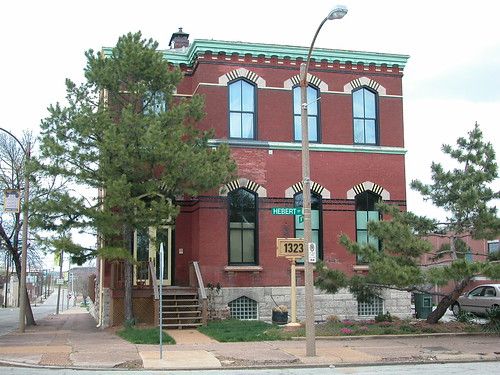 Across the street from the gallery, the former Ames Elementary School kindergarten building has received the attention of a couple who have spent the last few years doing major masonry work, cornice repair and interior rehabilitation.
See all of the progress for yourself: the Old North St. Louis House & Community Tour will take place on Saturday, May 9, from 10 a.m. to 4 p.m. Advance tickets are $10 and can be picked up in person from the ONSLRG office (2800 N. 14th Street at St. Louis Avenue) or at Crown Candy Kitchen. On the day of the tour, tickets will be available at the registration area at $12 each. As a bonus, Crown Candy once again will offer free ice cream on the day of the tour to all ticket-holders.
Friday, October 10, 2008
One Year in the Life of a House on North 14th Street

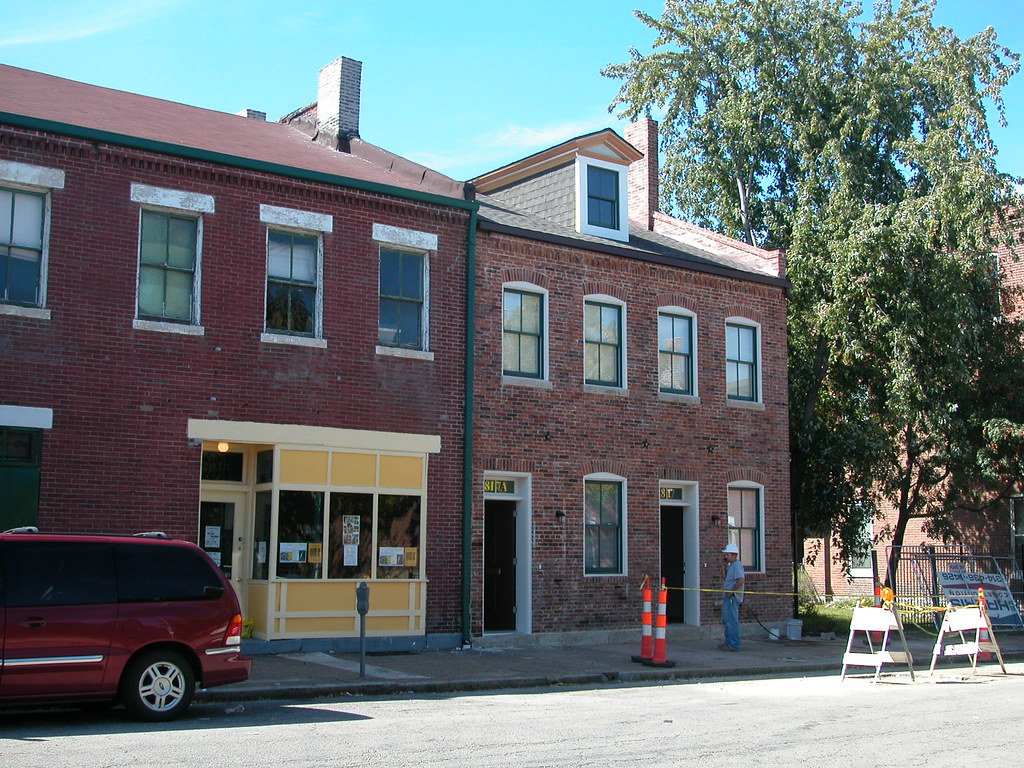
One year can make or break the life of a historic building. Fortunately, for the mid-19th century house at 2817 N. 14th Street in Old North St. Louis, the last year has made the house -- or remade it, to be more exact. One year ago, the building was a mess -- the roof structure was sinking, so much of the building had collapsed inside of itself that access was impossible and wooden bracing was erected against the front wall. (See "Setting a Precedent in Old North," October 17, 2007.)
Today, the building has been rehabilitated as part of the Crown Square redevelopment project and is receiving finishing touches to prepare for its new residents. Of course, along the way there were the complications one would expect with such a decrepit building. During masonry repair, the house suffered a large collapse that caused many neighbors to worry if rehabilitation would continue. The collapse turned out to be all in a day's work for general contractor E.M. Harris Construction Company and the development partnership of the Old North St. Louis Restoration Group and the Regional Housing and Community Development Alliance. The house was rebuilt to original exterior appearance, using all of the original brick that survived the collapse and years of decay. What was one of the worst-looking buildings on 14th Street is now one of the best!
Monday, September 29, 2008
Rehabbers Club Classes Begin This Wednesday
ReVitalize St. Louis and the St. Louis Rehabbers Club are extremely excited to announce that the 2008 Fall Rehabbers Club Classes will be sponsored by St. Louis Chapter of AIA [American Institute of Architects] Bookstore. They are located at 911 Washington Avenue in the Lammert Building downtown. This location is centrally-located, close to MetroLink and MetroBus lines, on-street parking is plentiful and it is fully accessible.
Directions from your location are here.
Classes begin on Wednesday, October 1st at 7:00 p.m. and the semester will run for eight consecutive weeks. Sessions are two hours long and there is time set aside during each class for Q & A. Details and descriptions are provided on the website on
this page
Topics include:
-- Buying A Foreclosure
-- Pioneering Partnerships
-- Funding Your Rehab
-- Working With A Contractor
-- Neighbors in Action
-- Real Estate Law 101
-- Green Rehabbing
-- Smart Landlording
The fee for each class is $10 [$15 at the door] or you can purchase an eight-class package for $70. You may pay online using PayPal.
Directions from your location are here.
Classes begin on Wednesday, October 1st at 7:00 p.m. and the semester will run for eight consecutive weeks. Sessions are two hours long and there is time set aside during each class for Q & A. Details and descriptions are provided on the website on
this page
Topics include:
-- Buying A Foreclosure
-- Pioneering Partnerships
-- Funding Your Rehab
-- Working With A Contractor
-- Neighbors in Action
-- Real Estate Law 101
-- Green Rehabbing
-- Smart Landlording
The fee for each class is $10 [$15 at the door] or you can purchase an eight-class package for $70. You may pay online using PayPal.
Friday, August 29, 2008
Changes
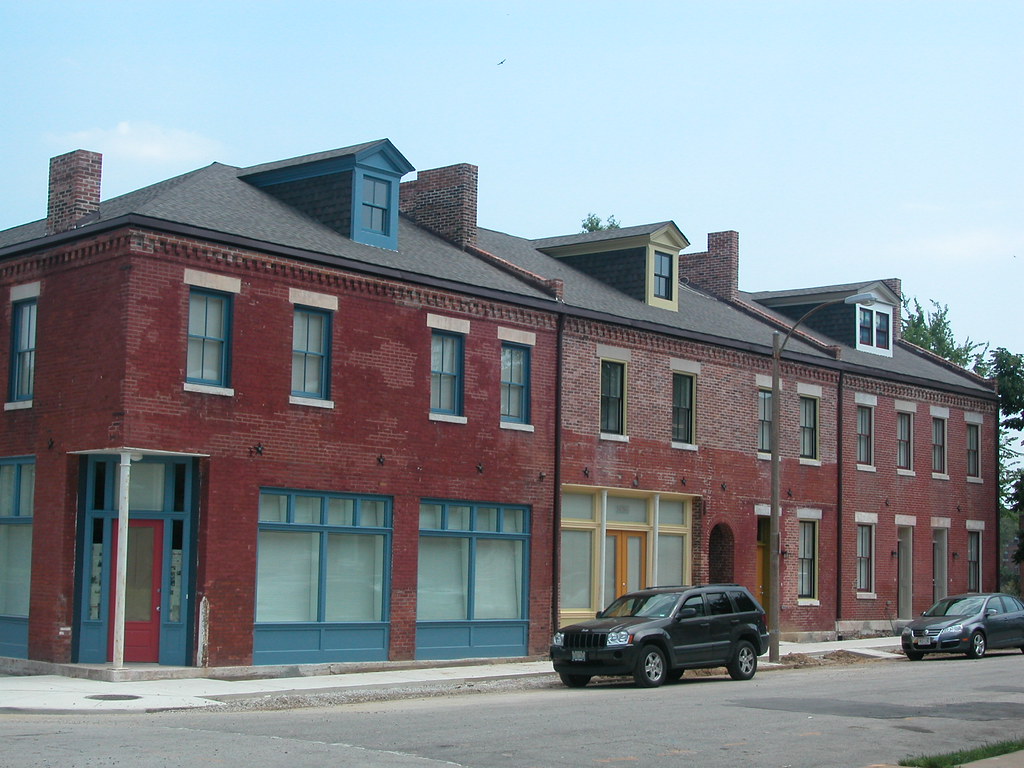 Entitled "Changes," my latest commentary for radio station KWMU aired this morning. The piece reflects on changes both physical and social taking place literally across the street from my house in Old North St. Louis. New residents have moved into the colorfully-painted buildings seen above, which were rehabbed as part of the ongoing Crown Square project transforming the center of the neighborhood. Read or listen to the commentary here.
Wednesday, August 27, 2008
Every Day There's More Progress on 14th Street
The Crown Square project (once known as the "14th Street Mall") marches along in Old North St. Louis, and it's hard to keep up with construction. These photographs are already a few days out of date, but worth sharing.
 A view of the west side of 14th street, looking south.
 A view of the northwest corner of Warren and 14th streets; the second building in from the corner was well-known in recent years because almost all of its front elevation lay on the sidewalk in front of it.
 Here's the storefront building at 2717 N. 14th Street.
 Visitors to Crown Candy Kitchen once gazed upon fabulous urban ruin, and now look southeast across St. Louis Avenue and see glorious renewal.
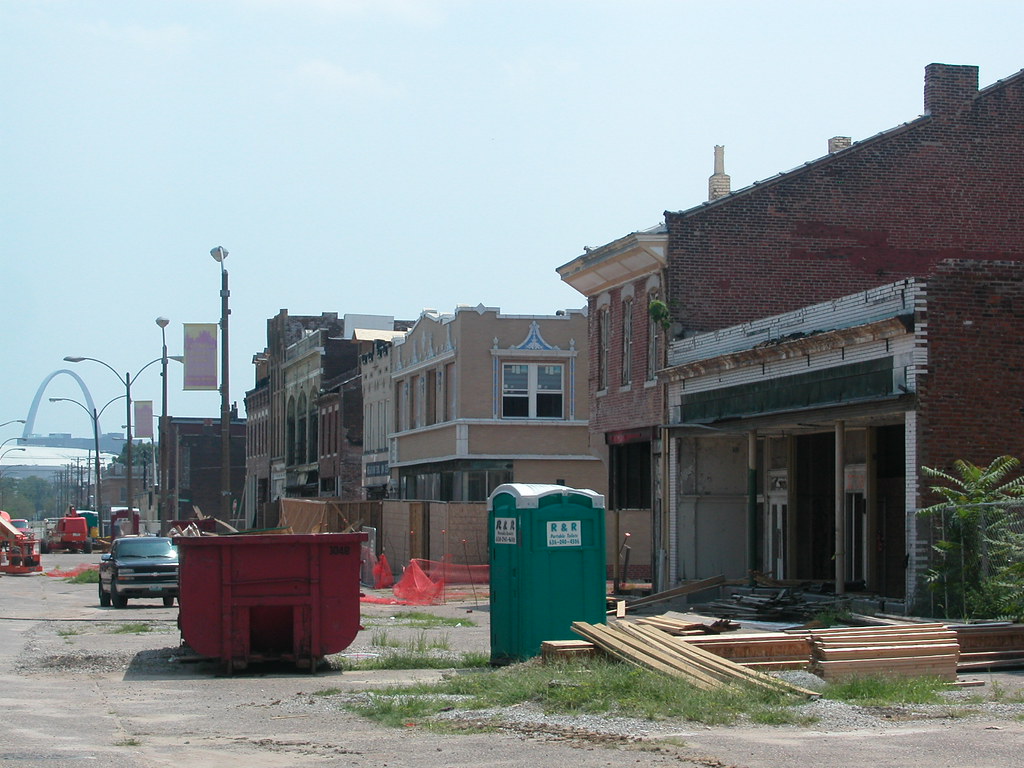 A view of the west side of 14th street, looking south.
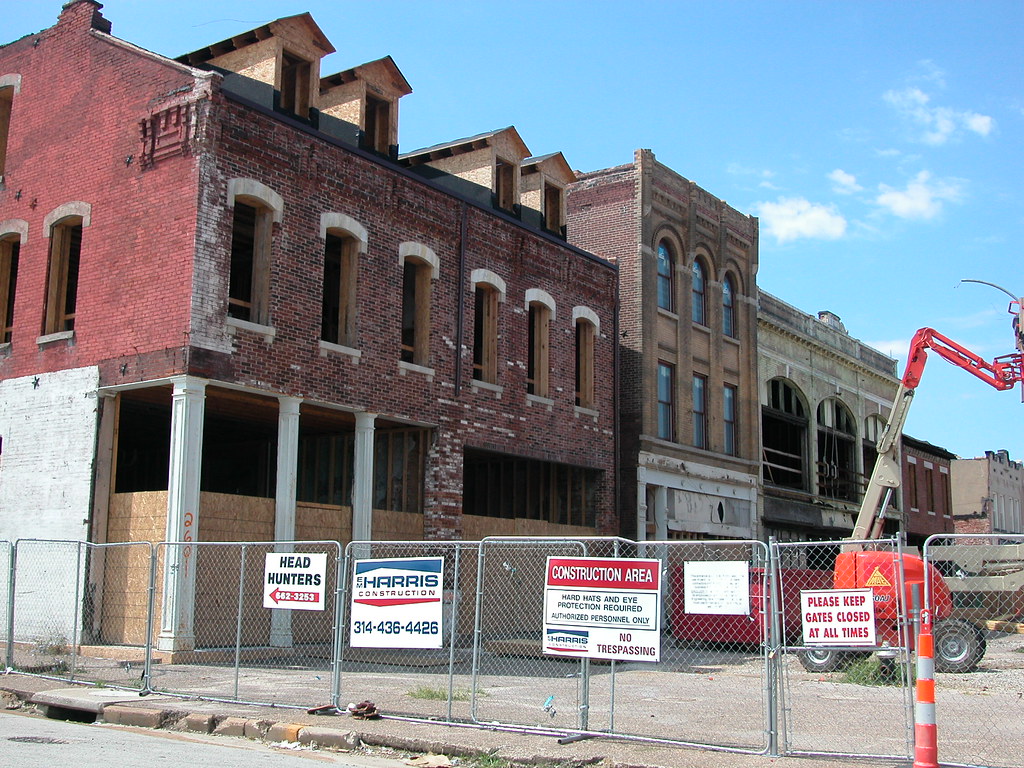 A view of the northwest corner of Warren and 14th streets; the second building in from the corner was well-known in recent years because almost all of its front elevation lay on the sidewalk in front of it.
 Here's the storefront building at 2717 N. 14th Street.
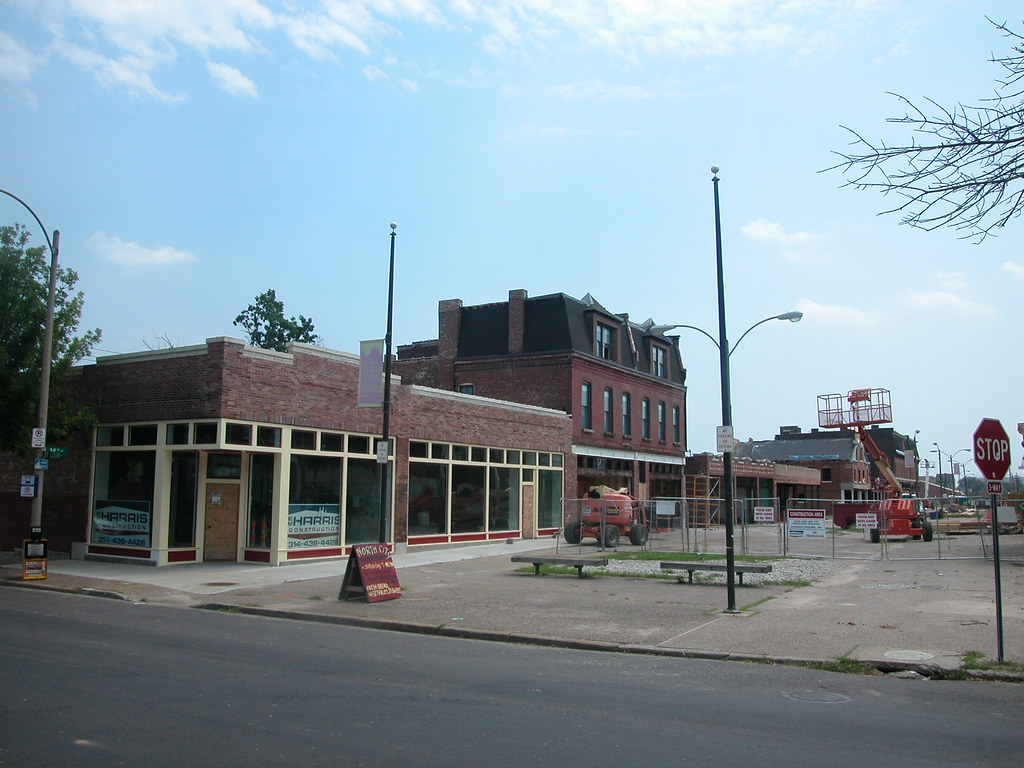 Visitors to Crown Candy Kitchen once gazed upon fabulous urban ruin, and now look southeast across St. Louis Avenue and see glorious renewal.
Tuesday, July 15, 2008
The Phoenix, 14th Street

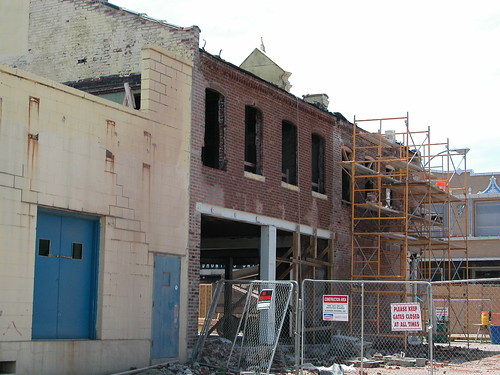
One of the most important local preservation success stories ever is unfolding at the present moment: the rescue and rehabilitation of 26 historic buildings around the 14th Street commercial district in the Old North St. Louis neighborhood. The $35 million project centers on two blocks of the commercial district closed to vehicular traffic in 1977 and redubbed the "14th Street Mall," infamous as an urban ghost town after a majority of buildings fell vacant by the 1990s, with all but two vacant by 2005.
 When I first started exploring the neighborhood, contemplating the purchase of a building, the 14th Street Mall was an eerie void in the heart of a rebounding neighborhood. Rehab activity was eroding the decayed quality of many blocks in the neighborhood, but not the two blocks closed to traffic. These blocks were the exception: blocks getting worse, losing vitality and sucking it away from surrounding blocks. No part of the neighborhood seemed to be as formidable a reminder of the neighborhood's plight -- or as valuable an asset.
For years, neighbors had been trying to revive the commercial district. Without the capacity to reopen the closed streets (14th and Montgomery) and tackle a large number of the buildings at once, the Old North St. Louis Restoration Group had little success at attracting development. A bid by an Atlanta developer to acquire the entire four-block mall area spurred a capacity-building partnership between the Restoration Group and the Regional Housing Community Development Alliance. The impossible became the actual. Acquisition began in 2004, and intricately-arranged financing was ready in fall 2007.
After I moved into Old North in 2005, I always spoke of the 14th Street project in the future tense. Even last summer, as the reality of the project seemed imminent, I noticed a reluctance in the neighborhood to speak about the project in the present tense. As if naming the project were a curse that would doom the ghostly landscape’s chances at revival, people remained cautious. Who could blame people?
Then, all of a sudden, at the end of September 2007, an army of contractors descended. Dozens of buildings were gutted, walls were rebuilt, fences erected and roofs removed. The whole tone of Old North changed – the dead center, 14th Street, was now the hot bed of neighborhood action. Like a phoenix, the heart of Old North began to rise. By spring 2008, a handful of historic buildings on Warren and Montgomery streets had been fully rehabbed and leased to new residents.

By the spring, the streets should be reopened and the rehabbed buildings will house 78 housing units and 6,000 square feet of retail space. The life will continue to grow. For now, even incomplete, the difference is life-affirming for this old neighborhood.

Friday, March 14, 2008
To Do or Not to Do It Yourself
My latest Vital Voice column is in today's edition: Rehabbing -- To Do or Not to Do It Yourself
Friday, February 15, 2008
Kirkwood City Council Chamber Rehabbed in One Week
Toby Weiss, whose day job is marketing coordinator for Mosby Building Arts, points out that Mosby has complete a whirlwind rehabilitation of the Kirkwood City Council chambers, damaged in last week's shooting. Follow along a in a day-by-day account of the project here.
Monday, April 9, 2007
Done Gutting for Now
On Saturday came the last anticipated removal of a plaster ceiling at our house. We have long decided not to extensively gut the house. For one thing, the plaster is remarkably intact and has escaped the major water infiltration that typically dooms it to to the wrecking bar. For another thing, the amount of waste created by gutting gives us pause. Without a clear need for gutting save perfection, the whole deal seems wasteful. Hence, we have only removed three historic plaster ceilings. Season rehabbers can probably guess where these three ceilings are located: under each staircase.
With staircases, gutting is necessity. The bowing of masonry walls leads to the movement of stair stringers tied into those walls. Inevitably, the shims keeping treads and risers tight in their pockets fall and the stairs begin to creak, moan and slip. The only option decades later is to remove the ceilings below and undertake extensive staircase repairs involving shimming the stringers to tighten up the pockets, and then fitting the treads and risers with new shims to keep them snug.
With the first staircase, we had to remove every tread and every riser to rebuild. With the other two, we anticipate easier jobs without as much work. Later, I will post details of the work. For now, rest assured that part of me is ecstatic to have done the final gutting of a plaster ceiling here. Gone are the inevitable scrapes of skin quickly filled with stinging lime; gone are the particles that get past even the best respirator. Gone too is the quick swig of beer to force dust into the digestive system and out of the respiratory.
At least, such moments are gone at this building. With every pry of a lath comes the maddening delusion that the work isn't so bad and that one can do it again and agian until the whole city is rehabbed.
With staircases, gutting is necessity. The bowing of masonry walls leads to the movement of stair stringers tied into those walls. Inevitably, the shims keeping treads and risers tight in their pockets fall and the stairs begin to creak, moan and slip. The only option decades later is to remove the ceilings below and undertake extensive staircase repairs involving shimming the stringers to tighten up the pockets, and then fitting the treads and risers with new shims to keep them snug.
With the first staircase, we had to remove every tread and every riser to rebuild. With the other two, we anticipate easier jobs without as much work. Later, I will post details of the work. For now, rest assured that part of me is ecstatic to have done the final gutting of a plaster ceiling here. Gone are the inevitable scrapes of skin quickly filled with stinging lime; gone are the particles that get past even the best respirator. Gone too is the quick swig of beer to force dust into the digestive system and out of the respiratory.
At least, such moments are gone at this building. With every pry of a lath comes the maddening delusion that the work isn't so bad and that one can do it again and agian until the whole city is rehabbed.
Friday, March 16, 2007
A Strange Marriage
I could be doing anything right now. I could be writing a book, watching a movie, talking to a friend, taking a walk or be traveling.
Instead, I am scrubbing up after hours of work around the house. I have not had a moment to myself in weeks, and may not get the chance for weeks more. However, I am watching a building reverse a 120-year span of decay under my own direction, largely alone although experienced craftspeople have aided with masonry, carpentry and roofing.
What we can take into our own hands is where we build the most change in the world. Obviously, few people choose to take much into their hands -- and many of us end up with far too much in our hands. Yet hesitate to think of what would become of the world if I did not assume this momentary burden. I hope that others do the same, but I know that I can't make them. Not everyone could take up the task of rehabbing a large building with no supervision and little assistance, even if he or she wanted to do so. I'm not sure if the cororllary is that those who can should do so, but I note that those who can most often must do so.
When my neck starts to ache beyond the limits of medicinal Schlafly, I try to think about how each gesture composes the larger plot of one house renwed and revitalized in a neighborhood that is renewing itself in a great city that is seeing a multitude of actions like my own add up to a resurgence of energy...
(Cynically, I could note that these hundreds of hours of labor are punishment for that one moment when I realized that I wanted to live in this house. To want something is always an arrogant proposition.)
Instead, I am scrubbing up after hours of work around the house. I have not had a moment to myself in weeks, and may not get the chance for weeks more. However, I am watching a building reverse a 120-year span of decay under my own direction, largely alone although experienced craftspeople have aided with masonry, carpentry and roofing.
What we can take into our own hands is where we build the most change in the world. Obviously, few people choose to take much into their hands -- and many of us end up with far too much in our hands. Yet hesitate to think of what would become of the world if I did not assume this momentary burden. I hope that others do the same, but I know that I can't make them. Not everyone could take up the task of rehabbing a large building with no supervision and little assistance, even if he or she wanted to do so. I'm not sure if the cororllary is that those who can should do so, but I note that those who can most often must do so.
When my neck starts to ache beyond the limits of medicinal Schlafly, I try to think about how each gesture composes the larger plot of one house renwed and revitalized in a neighborhood that is renewing itself in a great city that is seeing a multitude of actions like my own add up to a resurgence of energy...
(Cynically, I could note that these hundreds of hours of labor are punishment for that one moment when I realized that I wanted to live in this house. To want something is always an arrogant proposition.)
Sunday, March 11, 2007
Smokestack Lighting
One of my most favorite moments of any long day of rehab work on this house is when dusk arrives and the floodlights on the Columbia Brewery smokestack come on. This is a perk of having a flat roof with a great view -- I can go out, beer in hand and wait for the sudden moment when the dark smokestack is almost silver bathed in light. I rarely check the time, because I like the full surprise. (I never guess right when I think I'm moments away.)
Usually, I can see the Continental Building beacon in the far distance blinking as if to wink at my wonder at what is actually a pretty mundane event.
Sometimes, the mundane is magical.
Usually, I can see the Continental Building beacon in the far distance blinking as if to wink at my wonder at what is actually a pretty mundane event.
Sometimes, the mundane is magical.
Subscribe to:
Posts (Atom)


 Posts
Posts

