We've Moved

Ecology of Absence now resides at www.preservationresearch.com. Please change your links and feeds.

Showing posts with label tge. Show all posts

Sunday, April 25, 2010

White Roof Coating, Ahead of Summer

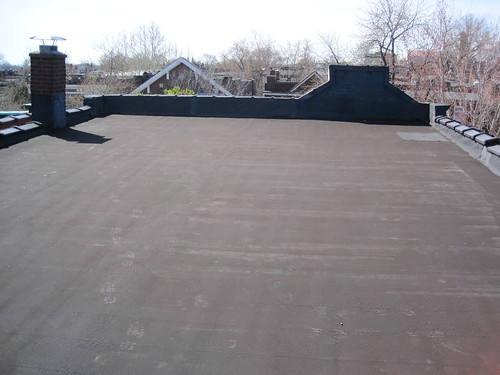
After completing major tuckpointing and chimney rebuilding, we decided to apply a white elastomeric coat to our flat roof this month. This roof was a three-ply modified bitumen roof with a black, heat-trapping emulsion overcoat. The roof was old enough to coat but certainly not getting younger under the toll of ultraviolet rays. A mod-bit roof needs about one year to leech out oils before coating, and ours was well past that mark. Time to coat!

Now why would we go through the trouble of applying a white coat? There are two major reasons:

Energy efficiency and global warming. A white coat can reflect up to 80 percent of solar radiation, reducing overall planet temperature but more immediately reducing building, neighborhood and city temperature. One white roof is small local block against the urban "heat island" effect and many of them can have wide impact. The white roof will reduce the internal temperature and the need for air conditioning, which in turn reduces the electricity usage and so forth. (There is some question about possible heat loss effect of a white roof in winter. At St. Louis' latitude the sun's rays are vertical in the summer and at a low slant in the winter, so the available winter solar heat is much less than the summer heat. At other latitudes, a white roof might not be of such benefit as here and points southward.)

Longevity of the roof. An elastomeric coat will block ultraviolet rays that slowly break down asphalt roofing. Coats should be reapplied every 10 years or sooner if needed. With timely reapplication, the coverage can extend the life of the roof to 40-50 years, reducing cost as well as waste of nonrenewable roofing materials.

While the mason had the scaffolding set up, we used his pulley to hoist up the 5 gallon buckets of coating. We used five $72 buckets of Henry Solarflex 287, which completely covered our 1300 square foot roof. When the scaffolding was down, we used a tall ladder for travel to the roof.

Working with a friend, we spent about eight hours washing the roof and applying the coat. Since we had just had masonry work, the roof was dirty and required over two hours of scrubbing. The mod-bit roof dried quickly, however. We applied the coat with a 4" brush on the parapet sides and 9" rough rollers on the roof. We avoided a few new flashing repairs made around the rebuilt chimneys.

Most of the roof was covered with two coats, but some areas required three coats. (a one year old roof won't take this much work). We left a spot near the ladder for exit and came back to finish in a half-hour a day later. Now the roof is too bright to look at, just in time for summer. We're not big air conditioning users -- it's expensive and not very sustainable, although certainly necessary for a few weeks -- so we definitely look forward to the building heat reduction.

Saturday, April 10, 2010

Operation Brightside Blitz Days

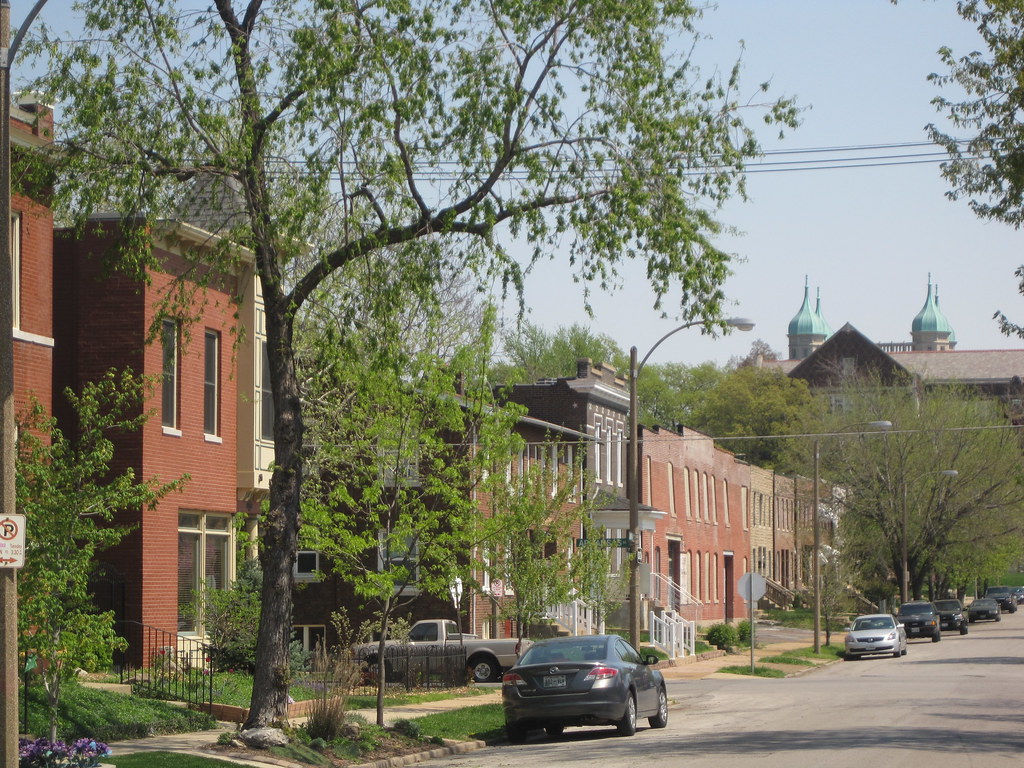
Juniata Street looking east toward Roosevelt High School in Tower Grove East.


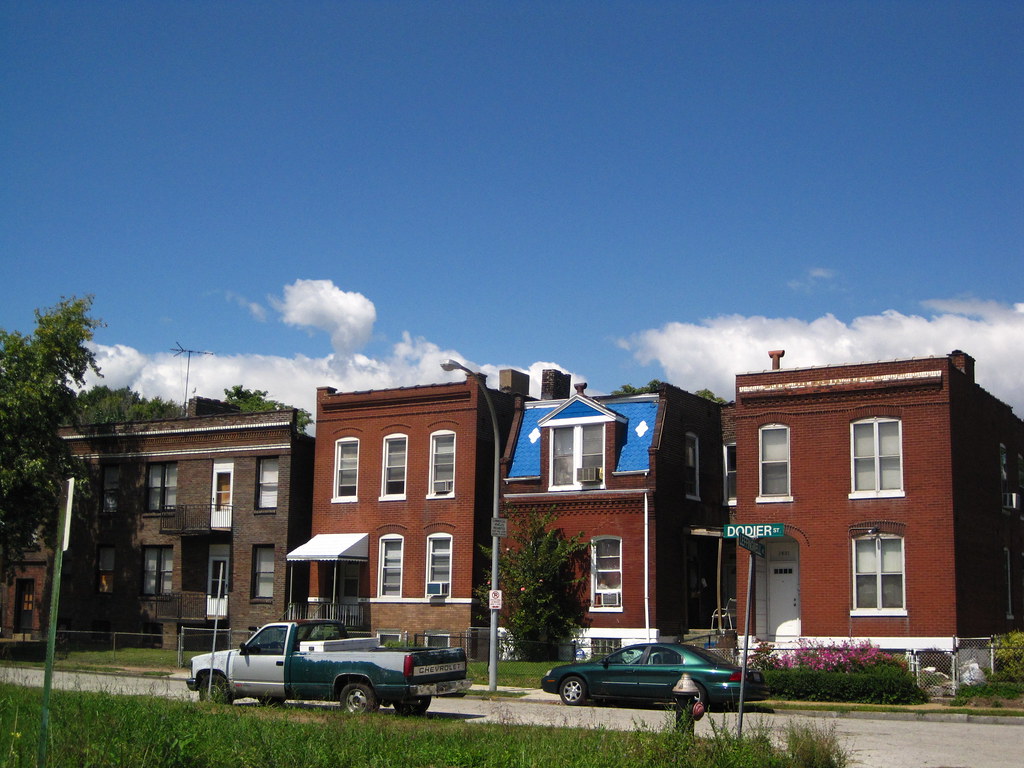
Dodier Street west of Leffingwell Avenue in St. Louis Place.

The two blocks pictured here both were part of today's Operation Brightside Blitz Day. My neighbors and I were out working on our block this morning. Since there is no such thing as a self-cleaning city, citizen cleaning is essential to keeping blocks looking lovely. Government provides the basic services, but citizens create quality of life. We have to be active stewards of our houses and our blocks. No one is going to clean our alleys and sidewalks for us, even in the most ideal world. There are Blitz days coming up in other areas of the city and you should do your part. There's nothing more rewarding than working with neighbors to make St. Louis look beautiful!

Wednesday, February 24, 2010

Historic Districts In and (Mostly) Around Tower Grove East

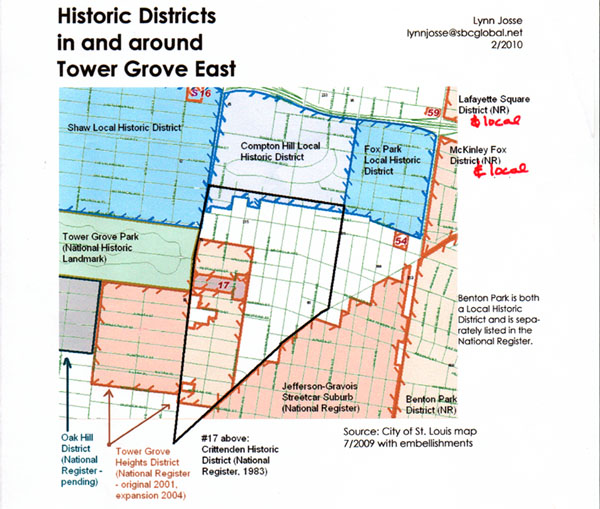
Last night's Tower Grove East Neighborhood Association meeting included a presentation by Lynn Josse on the different types of historic districts, how they work and how they get created. Lynn distributed a flier that included the following map.

As the map shows, a large swath of Tower Grove East and the southern end of Fox Park are surrounded by districts but not included in any. All or part of 45 blocks in Tower Grove East have no historic district status, and thus no availability of rehabilitation tax credits being used all around south city.

Tuesday, August 11, 2009

Doug Hartmann Gets Two Years, Life of Shame

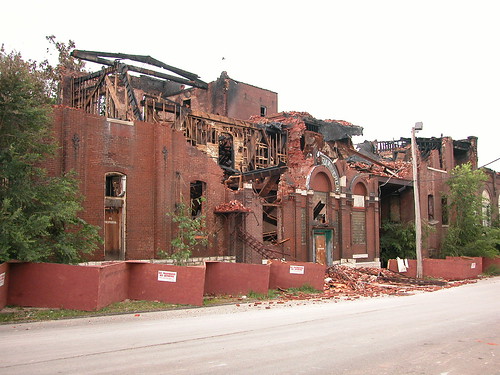
The fire-damaged Nord St. Louis Turnverein is just the most spectacular instance of the impact of Doug Hartmann's real estate empire on the city of St. Louis. During Hartmann's negligent ownership, the Turnverein went up in a huge blaze on July 6, 2006. Hartmann's wild ride was already over, actually, and a sale of the property to developer Peter George was underway. George went on to close, and plans to rebuilt the landmark at great cost. If only Hartmann had been half as generous.

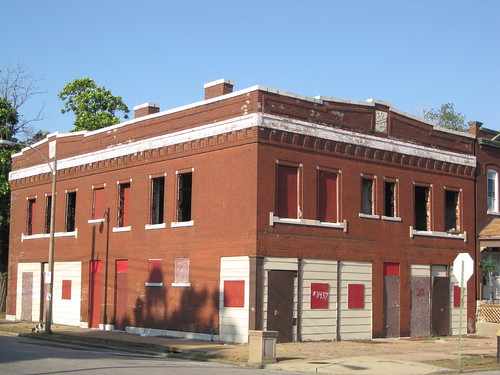
The Turnverein is an egregious example. Most of Hartmann's nearly 150 properties in the city ended up like the corner storefront at the northeast corner of Wyoming and Arkansas avenues in Tower Grove East. Built in 1906, the building was shabby but occupied before Hartmann's DHP Investments purchased it in 2006. Some work took place, including removal of the second floor windows. Then, everything stopped. Eventually, the building reverted to the city's Land Reutilization through tax default. To this day, the weeds regularly grow waist high around the building, and a reuse timeline is not certain.

The building at Arkansas and Wyoming is like others that Hartmann accumulated to keep his Ponzi scheme afloat: occupied when purchased, and left a vacant nuisance. Hartmann's grand plans of taking stable but not gut-rehabbed old buildings and turning them into top-dollar rehabs convinced many investors and banks to finance his fraudulent scheme. In retrospect, the buildings were better off as-is, and the whole mess was a symptom of a momentary development binge.

Last Thursday, Hartmann, of the 1300 block of Crooked Stick Drive in O'Fallon, Missouri, received the lenient sentence for which he had bargained with prosecutors: two years, plus $34 million in restitution that U.S. District Judge Henry Autrey admits will likely never be collected. (Have investigators checked for a Hartmann Swiss bank account?)

Acting United States Attorney Michael W. Reap ought to be ashamed for this pathetic sentence deal. The damage that Hartmann has done to city neighborhoods has taken more than two years to sort out, and much remains to be sorted. Hartmann could be a free man before the corner building at Arkansas and Wyoming is rehabbed.

The sad fact is that the drug runners who use Hartmann's buildings for operations will face stiffer time in the slammer when they get locked up. If only these folks could meet Hartmann in prison! Of course, our white suburban fiend gets the justice that he does not deserve: a slap on the wrist in a cozy white-collar jail for bankrupting good people, cheating investors and leaving neighborhoods more vulnerable. Those who protest the inequity of our justice system are vindicated again. However, Hartmann will hardly be a free man upon return. We know his crimes too well now.

Thursday, February 26, 2009

Shenandoah School May Be Spared

Shenandoah Elementary School at 3412 Shenandoah Avenue in Tower Grove East received a reprieve tonight when St. Louis Public Schools Superintendent recommended to the Special Administrative Board (SAB) that the school remain open in its current building. Although the final decision of Adams' recommendation won't be made by the SAB until March 12, the news is a relief to a neighborhood concerned that the future a community resource might become a huge question mark.

Under the proposal from consultants MGT of America unveiled in January, Shenandoah was set to be combined with Mann Elemantary School in Tower Grove Soth and Sherman Elementary School in Shaw in a new building to be build "near" Shenandoah. Neighborhood residents feared that "near" in a dense, landlocked neighborhood meant "on" and that an architectural gem would be lost. The MGT recommendations came only a year after the SLPS had proposed closing Shenandoah outright.

The school is a remarkable building, known widely for the braided limestone columns of its striking entrance (pictured above). Designed by Rockwell Milligan and built in 1925, Shenandoah School is an excellent example of the eclectic strain in 1920s American architecture. Combining Spanish Revival and Renaissance Revival elements on an imposing buff-brick body with a red tile roof, Shenandoah is an unique school buidling and a treasure to its neighbors.

Unfortunately, Adams' recommendations still include the closure and merger of Mann and Sherman in a new school. This time, Mann is suggested for demolition.

Thursday, February 5, 2009

Storefront Addition: 3146 Shenandoah

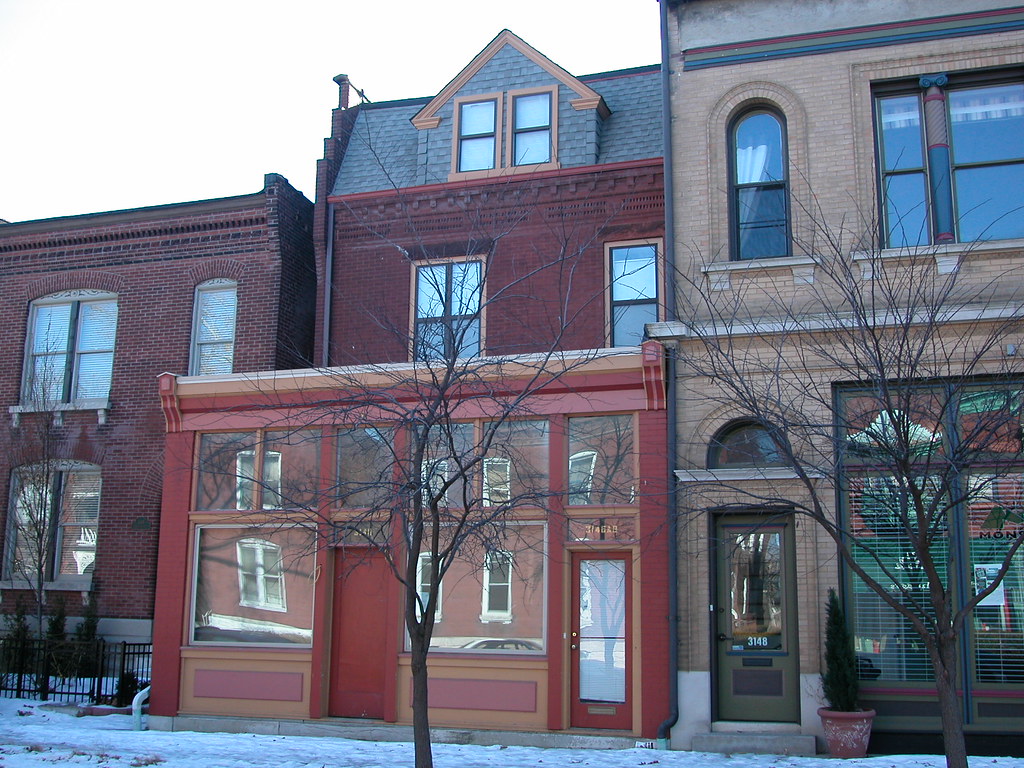
Here is another storefront addition, located at 3146 Shenandoah Avenue in Tower Grove East. The brightly-painted addition features brick pilasters at each side under a simple wooden cornice with decorative caps at each end. The addition is fairly respectful of the house behind it, allowing for a full view of its second and third floors and attractive brick cornice.

Monday, February 6, 2006

3511 Arsenal

One of my favorite houses in the Tower Grove Park area is the two-flat at 3511 Arsenal Street. I love its monochromatic articulation in red brick and terra cotta, and its overdone neoclassical ornamentation, suggestive of South American influences.

Last year, I watched as it was boarded up and renovated. The house had its original windows and appeared to be in good condition; it had been occupied for its whole life until then.

Unfortunately, the result of the renovation is baffling at best (what's with fake nine-over-nine windows?).