
Illinois may yet pass a state historic rehabilitation tax credit this year. On March 18, the Illinois Senate passed SB 2559, which is now heading through the House committee process in the final days of this year's legislative session.
Apparently Governor Pat Quinn (D) is favorable to the bill. Supporters wisely have crafted a substitute that lowers the per-county cap from $25 million to $5 million, requires each project pass a "but for" test and subjects projects to a per-project issuance cap. These are provisions that make the bill -- and the dream that downstate communities like East St. Louis and Alton gain a powerful tool for neighborhood development -- alive. There may be one particular county that generated the per-county cap, and the per-project cap as well, but those are excellent ideas to ensure that the credit gets used where it is most needed -- where development actually needs a stimulus.
Showing posts with label chicago. Show all posts
Showing posts with label chicago. Show all posts
Thursday, April 29, 2010


Tuesday, April 13, 2010
"Saving" a Chicago Church
Over at ArchitectureChicago PLUS, Lynn Becker has posted renderings of a bizarre plan to "save" Chicago's St. Boniface Church by retaining the front elevation and the street face of the crossing, demolishing the rest and constructing a massive six-story apartment building for senior citizens. This has to be one of the ugliest designs that I've seen lately.
There is some grace in retaining parts of a neighborhood landmark on site where those whose lives connected with the church can still have a physical connection. that could be better than total demolition or relocation. The Buffalo, New York archdiocese is preparing to relocate an entire historic church to suburban Atlanta -- another form of preservation that robs the church of a meaningful historic site. Many Buffalo residents oppose the move. The plan for St. Boniface in Chicago seems to be an odd compromise, and one that mocks the parts of the church that will remain.
Who do you think?
There is some grace in retaining parts of a neighborhood landmark on site where those whose lives connected with the church can still have a physical connection. that could be better than total demolition or relocation. The Buffalo, New York archdiocese is preparing to relocate an entire historic church to suburban Atlanta -- another form of preservation that robs the church of a meaningful historic site. Many Buffalo residents oppose the move. The plan for St. Boniface in Chicago seems to be an odd compromise, and one that mocks the parts of the church that will remain.
Who do you think?
Thursday, January 14, 2010
An Update on the Louis Sullivan Film
Two years ago, Mark Richard Smith began filming Louis Sullivan: The Struggle for American Architecture. He visited St. Louis that year, shooting in the city at and Southern Illinois University-Edwardsville, and I spent some time with him talking about the Union Trust Building.
Mark is a remarkably driven first-time filmmaker who spent twenty years as a graphic designer before switching paths. Wanting to make films that visualize history, Mark enrolled in the graduate history program at Loyola University Chicago. In Chicago, Mark saw the photographs of Richard Nickel and their poetic grace drew him to the subject matter of his first film.
Last year, Mark posted a trailer on YouTube.
Then, one month ago, an unfinished scene about the Trading Room of Sullivan's Chicago Stock Exchange.
Mark is a remarkably driven first-time filmmaker who spent twenty years as a graphic designer before switching paths. Wanting to make films that visualize history, Mark enrolled in the graduate history program at Loyola University Chicago. In Chicago, Mark saw the photographs of Richard Nickel and their poetic grace drew him to the subject matter of his first film.
Last year, Mark posted a trailer on YouTube.
Then, one month ago, an unfinished scene about the Trading Room of Sullivan's Chicago Stock Exchange.
Friday, November 27, 2009
Chicago Still Destroying Gropius' Work
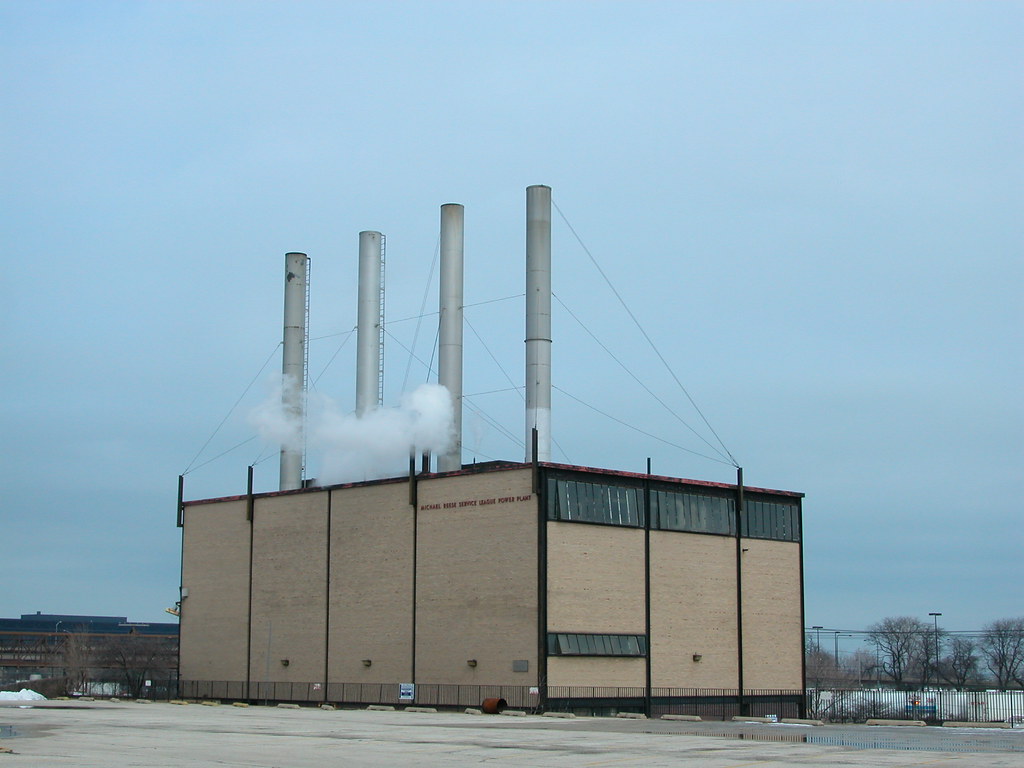
St. Louis has a long way to go to catch up to Chicago. While our Archdiocese senselessly demolished a motel by Charles Colbert this year, Chicago city government has been working to demolish the Michael Reese Hospital campus planned and co-designed by Walter Gropius. This week, the city's wreckers demolished the power plant shown above, which was completed in 1953 and designed by Gropius' The Architects Collaborative. Only five buildings associated with Gropius remain out of the eight that stood earlier this year, and the landscape is ruined.
The Michael Reese campus was Gropius' only work in Chicago. In Chicago during the twentieth century, American eyes gazed upon some of the finest modern architecture in the history of the world, from Louis Sullivan to Frank Lloyd Wright to Mies van der Rohe to Walter Gropius. As we know, the Windy City's regard for the work of Sullivan has been spotty at best. Gropius' work at least enjoys good company in its flagrant disregard.
While the city of Chicago is now bound by its contract with the demolition company, one wonders why the city even rushed to get into such an arrangement not knowing the outcome of its Olympics bid. Why did Alderwoman Toni Preckwinkle deign to play architectural historian and dispute the well-documented role of Gropius? Why did Chicago Mayor Richard Daley, the supposed "Green Mayor," rush to throw away irreplaceable, internationally significant modern architecture and already-built building stock? Don't ask. Irrational acts of destruction lack any rational explanation.
Thursday, October 29, 2009
In Chicago, Walter Gropius' Work is Fair Game
The power plant at Michael Reese Hospital dates to 1953.This story is not happening in St. Louis, but in Chicago. The modern buildings are those that comprise the postwar campus of Michael Reese Hospital on the city's south side. The planner who designed the campus and collaborated on designing eight of the campus buildings is Walter Gropius. (The close proximity of a Gropius-planned campus to a Mies van Der Rohe-planned campus, that of the Illinois Institute of Technology, is unique in North America.) Strange that there would be any confusion over the work of an internationally-renowned modern designer, but in Chicago under the administration of Mayor Richard Daley, such obvious contribution to the worldwide evolution of architecture is no brake on the acts of power. Demolition started yesterday.
Apparently, common sense is also being wrecked, because the original reason for the City of Chicago's acquisition of the Michael Reese campus was to prepare a residential village for the 2016 Olympic Games. After that bid failed -- and many residents of the south side breathed a sigh of relief -- the city ramped up the push for demolition with no real development plan. There is vague talk of "mixed use" development, but nothing that compels demolition now other than the absurd conviction that sticking to a senseless plan is righteous. Only two concessions for "major" buildings have been made -- one early and one, for Gropius' Singe Pavilion, last week. Context eludes the ham fists at Chicago City Hall, however.
Landmarks Illinois even offered a preservation compromise that would have targeted some buildings for preservation and allowed others to be wrecked. Daley's administration had no interest. Never mind that there is a pending National Register of Historic Places nomination for the campus prepared by Grahm Balkany and the Gropius in Chicago Coalition, which will be considered by Illinois state government on December 10. Since no state and federal funds are being used to directly pay the wreckers, there will be no government review of demolition any way.
Showing a better form of conviction than the city of Chicago, the Gropius in Chicago Coalition trudges onward. Although the landscape by Sasaky DeMay and Associates is ruined, and one of the eight Gropius buildings is now lost, there is still something to be spared.
In a move unsurprising to preservationists, the City of Chicago early on decided to spare the main hospital building from 1907 by Schmidt, Garden & Martin from demolition. Widely hailed as a landmark in Chicago's beloved Prairie School style, the main building would have engendered a preservation war.
 However, some perfectly sound pre-Gropius buildings are also threatened, including the one pictured here:
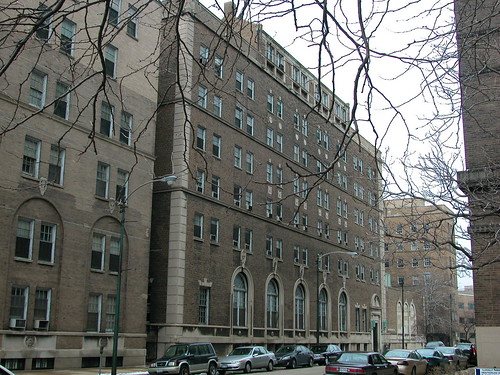 While organized primarily to protect Gropius' legacy, the Coalition has fought to preserve these buildings too. In fact, I expect Grahm to work until every last part of the complex is torn down. To date, his work has resulted in the sounding of every major Chicago voice on architecture, from the Tribune editorial board to the National Trust for Historic Preservation's Midwest Office, in support of preservation. Just this week a letter with impressive signatories went out.
It's not too late to make a difference. Contact information for Mayor Daley and key city officials is posted here. Raise your voice for internationally significant modern architecture.
Wednesday, May 6, 2009
Illinois' Ten Most Endangered -- And the Chicago Landmark Ordinance
Landmarks Illinois has released its ten most endangered places list for 2009; the list and information about each site is online here. There are no sites in southwestern Illinois near St. Louis, although a few southern Illinois sites are included.
Here's the full list:
1. Arcade Building (Riverside)
2. Archer House (Marshall)
3. Aurora Masonic Temple (Aurora)
4. Chautauqua Auditorium (Shelbyville)
5. Davenport, Rock Island and Northwestern Depot (Moline)
6. Lewis Pharmacy Interior (Canton)
7. Michael Reese Hospital Campus (Chicago)
8. Porthole Barns of Greene County
9. Prentice Women's Hospital (Chicago)
10. Shawneetown Bank (Old Shawneetown)
A special eleventh spot is included for the Chicago Landmark Ordinance. On January 31, an appellate court ruled that the criteria for landmark designation under the ordinance was vague and sent the ordinance to trial court for review. The outcome of that review could nullify the ordinance, removing legal protection for 277 landmark sites and 51 historic districts designated under the powers of that ordinance.
Here's the full list:
1. Arcade Building (Riverside)
2. Archer House (Marshall)
3. Aurora Masonic Temple (Aurora)
4. Chautauqua Auditorium (Shelbyville)
5. Davenport, Rock Island and Northwestern Depot (Moline)
6. Lewis Pharmacy Interior (Canton)
7. Michael Reese Hospital Campus (Chicago)
8. Porthole Barns of Greene County
9. Prentice Women's Hospital (Chicago)
10. Shawneetown Bank (Old Shawneetown)
A special eleventh spot is included for the Chicago Landmark Ordinance. On January 31, an appellate court ruled that the criteria for landmark designation under the ordinance was vague and sent the ordinance to trial court for review. The outcome of that review could nullify the ordinance, removing legal protection for 277 landmark sites and 51 historic districts designated under the powers of that ordinance.
Friday, November 7, 2008
Obama's House

Illinois Senator Barack Obama will soon be living in a famous historic home, and for that we are thankful, but his current residence is not unremarkable. Famously an owner of only one house, Obama resides in a spacious, historic home in Chicago's Kenwood neighborhood. The hipped-roof Colonial Revival home and adjacent lot -- regrettably made infamous during the campaign -- are found on a block familiar to millions of urban Americans.
While we all don't live in homes as large as Obama's or in neighborhoods as tony as Obama's pocket of Kenwood Kenwood, us city-dwellers can see ourselves in Obama more so than in any president in our lifetimes. Obama lives in a red brick house close to the sidewalk on a public street in a densely-populated neighborhood. Near the Obama family home is Washington Park, a magnificent but somewhat-untended city park. Washington Park mixes the aesthetics of Gilded Age aspiration with the contemporary reality of human life. Its paths are mostly full of people enjoying the beauty, but it has its share of vice and crime. West of the park is the CTA's Green Line, an elevated train line that carries thousands of Chicagoans to work, school church and nightlife.
To the south, Hyde Park and the University of Chicago place academic refinement smack-dab against neighborhoods where poverty is a real problem. North of Kenwood are neighborhoods whose fortunes are equally mixed. Barack Obama bought a wonderful home for his family, surrounded by the urban reality of his city. Obama's life is sheltered by necessity, but not by location. His home is in the middle of the diversity, wonder, agony and mystery of American urban life -- "real America" to many Americans. At times, cities seem to be as real as it gets.
Many American presidents -- including Richard Nixon and Bill Clinton -- have relocated to New York City at points in their career, but none in the last fifty years have come straight out of an urban neighborhood to the White House. These past fifty years have been terrible years for American cities. Seems like little coincidence that we have had presidents who come from that ether between the real life of the cities and the real life of the rural areas -- one place widely defamed by national politicians, the other mythologized in speech and neglected by policy.
Barack Obama has walked streets like ours and lived in a red brick house in the city. He has called an urban neighborhood in south Chicago home. At last, America has an urban president. At times, Obama will displease urban Americans -- after all, he is governing a nation with a suburban culture that is entrenched in national government. Yet Obama has actually lived urban America, and I can't help but think that will make a crucial difference in transportation policy, housing allocation, block grant funding and other areas.
Of course, Obama holds only the pen that signs the laws. The laws originate with our representatives. We have an urban president, and to make the most of that, urban America needs to step up and make its voice heard. Change doesn't end with Obama, it starts with us.
Tuesday, October 28, 2008
Sullivan Discovery in Chicago Provides Consolation
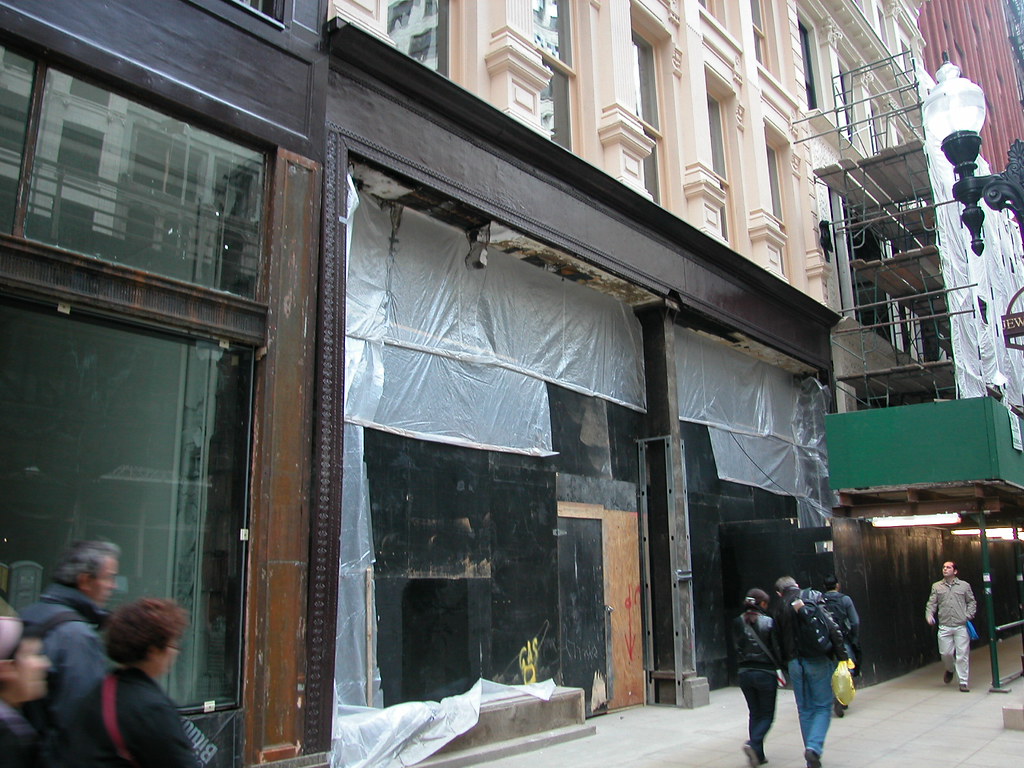 There is great news from Chicago for admirers of the work of architect Louis Sullivan: a storefront recently uncovered on Wabash Avenue has been identified as Sullivan's work. The indefatigable Tim Samuelson found proof that the one-story cast iron front unearthed during renovation of the block containing the former Carson Pirie Scott department store building (under renovation and being renamed the Sullivan Center) was the work of the prarie master, and not an imitation of his hand.
 The elegant, if small, work's discovery brings some consolation after tragic fires at three Sullivan-designed buildings in 2006, 150 anniversary of the architect's birth: Pilgrim Baptist Church, left a stone shell, the Wirt Dexter Building, demolished and the Harvey House, also demolished. Sullivan's vacation cottage in Ocean Springs, Mississippi, designed in collaboration with Frank Lloyd Wright, was severly damaged by Hurricane Katrina in 2005 and his Peoples Savings Bank in Cedar Rapids, Iowa was underwater during this summer's flooding.
The storefront discovery comes at the same time as another bit of good Sullivan news: the completion in October of a thorough restoration of the Wainwright Tomb in Bellefontaine Cemetery in St. Louis, documented by Landmarks Association here.
Friday, August 8, 2008
Richard Nickel's Chicago: A Review
This article first appeared in the Winter 2007 issue of the NewsLetter of the Society of Architectural Historians, St. Louis Chapter.
David Norris, friend of photographer, salvager and historian Richard Nickel, once said that "I think what Richard had to teach was that if you find some way to express your deepest convictions, you should exercise that talent to the very utmost of your ability. . .even if it leads somehow to your destruction." Nickel died in 1972 while rescuing interior ornament from Louis Sullivan’s Chicago Stock Exchange building, then under demolition. The attitude toward life’s work that Norris summarizes is readily apparent in the vivid, arresting images in Richard Nickel’s Chicago: Photographs of a Lost City, published at the end of 2006. The book amasses many of Nickel’s images of condemned Louis Sullivan buildings, as well as his glimpses into other long-gone parts of Chicago: Chicagoans enjoying the carnival at Riverview Park; a Loop landscape prior to the Congress Expressway; downtown offices with stenciled lettering on frosted glass doors; youth making a strong show of protest at Grant Park in 1968; other hallmarks of a vibrant urban culture in which the built environment is both backdrop for human action and a pivotal character.
Richard Nickel’s body of work is the result of chance. After serving in the Army immediately after World War II, Nickel was seeking a mission in life and use of the free tuition the GI Bill offered. Newly-divorced, the young man happened upon photography classes at the Institute of Design, founded and directed by Bauhaus transplant László Moholy-Nagy. There his primary instructors were noted photographers Harry Callahan and Aaron Siskind. Siskind taught a class in which he assigned his students to photograph the surviving buildings of Louis Sullivan. Because he was draft-exempt, Nickel was put in charge of the students’ efforts and an exhibition held at the Institute in 1954. No matter; the young photographer had enthusiastically taken up his assignment, and took steps that made the study of Sullivan’s architecture his life’s work. Under Siskind’s direction, Nickel embarked upon a still-incomplete book entitled The Complete Architecture of Adler and Sullivan. After completing his courses, Nickel continued the book project but began to get sidetracked. Chicago seemed to be disappearing around him, and Nickel responded by documenting doomed buildings (Sullivan’s and others’) through drawing floor plans and taking photographs and then, when demolition was certain, salvaging ornament.
Most of the images in Richard Nickel’s Chicago were never printed in Nickel’s lifetime, making the book a remarkable document. Nickel took some 11,000 photographs in his life, but mostly made contact sheets unless a client was willing to pay for development. Even more remarkable than the book is the way in which Nickel was able to capture so carefully each scene without ever seeing a large print. Somehow Nickel was able to deftly find the drama in the still life of many architectural scenes, and carefully transmit the sorrowful scenes he witnessed directly. Those images are his best known, although most in the book are new to even his admirers. Less known are Nickel’s gentle shots of people at festivals, expressing the glee, anger or longing in what seem to be private moments between subject and photographer. Those images show a breadth to Nickel’s body of work previously unknown.
The architectural images convey both respect and resignation – a painful combination. The parade of lost masterpieces is staggering – Adler and Sullivan’s Schiller Theatre, Meyer Building, Rothschild Building, Babson Residence and Stock Exchange; Burnham and Root’s Church of the Covenant and First Infantry Armory; Holabird and Roche’s Republic and Cable building. Even the photographs of surviving landmarks like the Rookery and the Auditorium Building have a weary gaze, as if the photographer has doubts of their permanence at the hands of his society. Nickel conveys the glory of these buildings while making statements about Chicago’s arrogant disregard for them; he poses wry scenes that are statements of protest in which the beauty of the building makes the loudest statement.
Ever faithful to his subjects, Nickel avoids taking photographs that are easily digested or ignored. Nickel prefers wide views and the occasional vivid close-up to iconic images. At first glance, the photographs can seem carefully workmanlike. Then, a detail jumps out – the postures of men standing in the foreground of a demolition scene, words on a church wall next to a gaping hole made by wreckers, the appearance of a church steeple in a photograph of a roof. As one studies the photographs, the intentional nature of the details becomes apparent. Nickel thought through his capturing of the details of every building he shot, just as the architects who designed them conceived of the intricate parts. Every foreground, background and shadow was chosen. The genius of Nickel emerges; he has taken photographs that reward a multitude of viewings and whose technique emulates the subjects’ complexity as much as any documentation can. Nickel’s photographs teach us the values of patience and observation, and of the power of making careful choices. These were the values that led Nickel to study and defend the works of Sullivan and other Chicago masters. These were the values that could have kept the buildings around as long as the photographs.
Cahan, Richard and Michael Williams, editors. Richard Nickel’s Chicago. Chicago: CityFiles Press, 2006. ISBN: 0-9785450-2-8.
David Norris, friend of photographer, salvager and historian Richard Nickel, once said that "I think what Richard had to teach was that if you find some way to express your deepest convictions, you should exercise that talent to the very utmost of your ability. . .even if it leads somehow to your destruction." Nickel died in 1972 while rescuing interior ornament from Louis Sullivan’s Chicago Stock Exchange building, then under demolition. The attitude toward life’s work that Norris summarizes is readily apparent in the vivid, arresting images in Richard Nickel’s Chicago: Photographs of a Lost City, published at the end of 2006. The book amasses many of Nickel’s images of condemned Louis Sullivan buildings, as well as his glimpses into other long-gone parts of Chicago: Chicagoans enjoying the carnival at Riverview Park; a Loop landscape prior to the Congress Expressway; downtown offices with stenciled lettering on frosted glass doors; youth making a strong show of protest at Grant Park in 1968; other hallmarks of a vibrant urban culture in which the built environment is both backdrop for human action and a pivotal character.
Richard Nickel’s body of work is the result of chance. After serving in the Army immediately after World War II, Nickel was seeking a mission in life and use of the free tuition the GI Bill offered. Newly-divorced, the young man happened upon photography classes at the Institute of Design, founded and directed by Bauhaus transplant László Moholy-Nagy. There his primary instructors were noted photographers Harry Callahan and Aaron Siskind. Siskind taught a class in which he assigned his students to photograph the surviving buildings of Louis Sullivan. Because he was draft-exempt, Nickel was put in charge of the students’ efforts and an exhibition held at the Institute in 1954. No matter; the young photographer had enthusiastically taken up his assignment, and took steps that made the study of Sullivan’s architecture his life’s work. Under Siskind’s direction, Nickel embarked upon a still-incomplete book entitled The Complete Architecture of Adler and Sullivan. After completing his courses, Nickel continued the book project but began to get sidetracked. Chicago seemed to be disappearing around him, and Nickel responded by documenting doomed buildings (Sullivan’s and others’) through drawing floor plans and taking photographs and then, when demolition was certain, salvaging ornament.
Most of the images in Richard Nickel’s Chicago were never printed in Nickel’s lifetime, making the book a remarkable document. Nickel took some 11,000 photographs in his life, but mostly made contact sheets unless a client was willing to pay for development. Even more remarkable than the book is the way in which Nickel was able to capture so carefully each scene without ever seeing a large print. Somehow Nickel was able to deftly find the drama in the still life of many architectural scenes, and carefully transmit the sorrowful scenes he witnessed directly. Those images are his best known, although most in the book are new to even his admirers. Less known are Nickel’s gentle shots of people at festivals, expressing the glee, anger or longing in what seem to be private moments between subject and photographer. Those images show a breadth to Nickel’s body of work previously unknown.
The architectural images convey both respect and resignation – a painful combination. The parade of lost masterpieces is staggering – Adler and Sullivan’s Schiller Theatre, Meyer Building, Rothschild Building, Babson Residence and Stock Exchange; Burnham and Root’s Church of the Covenant and First Infantry Armory; Holabird and Roche’s Republic and Cable building. Even the photographs of surviving landmarks like the Rookery and the Auditorium Building have a weary gaze, as if the photographer has doubts of their permanence at the hands of his society. Nickel conveys the glory of these buildings while making statements about Chicago’s arrogant disregard for them; he poses wry scenes that are statements of protest in which the beauty of the building makes the loudest statement.
Ever faithful to his subjects, Nickel avoids taking photographs that are easily digested or ignored. Nickel prefers wide views and the occasional vivid close-up to iconic images. At first glance, the photographs can seem carefully workmanlike. Then, a detail jumps out – the postures of men standing in the foreground of a demolition scene, words on a church wall next to a gaping hole made by wreckers, the appearance of a church steeple in a photograph of a roof. As one studies the photographs, the intentional nature of the details becomes apparent. Nickel thought through his capturing of the details of every building he shot, just as the architects who designed them conceived of the intricate parts. Every foreground, background and shadow was chosen. The genius of Nickel emerges; he has taken photographs that reward a multitude of viewings and whose technique emulates the subjects’ complexity as much as any documentation can. Nickel’s photographs teach us the values of patience and observation, and of the power of making careful choices. These were the values that led Nickel to study and defend the works of Sullivan and other Chicago masters. These were the values that could have kept the buildings around as long as the photographs.
Cahan, Richard and Michael Williams, editors. Richard Nickel’s Chicago. Chicago: CityFiles Press, 2006. ISBN: 0-9785450-2-8.
Thursday, May 1, 2008
STOP
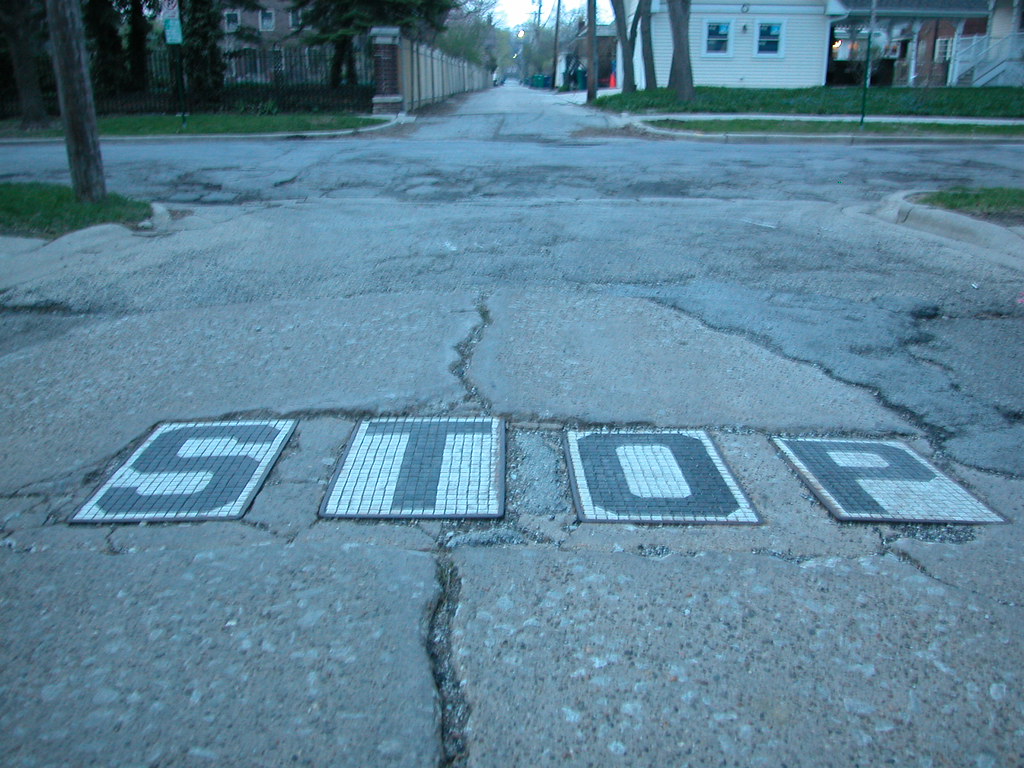
This neat feature alerts drivers in an alley headed north toward Ontario Street between Linden and Euclid avenues in Oak Park, Illinois. Embedded tiles form a sturdy, enduring stop sign.
Sunday, April 13, 2008
A Lonely Stand
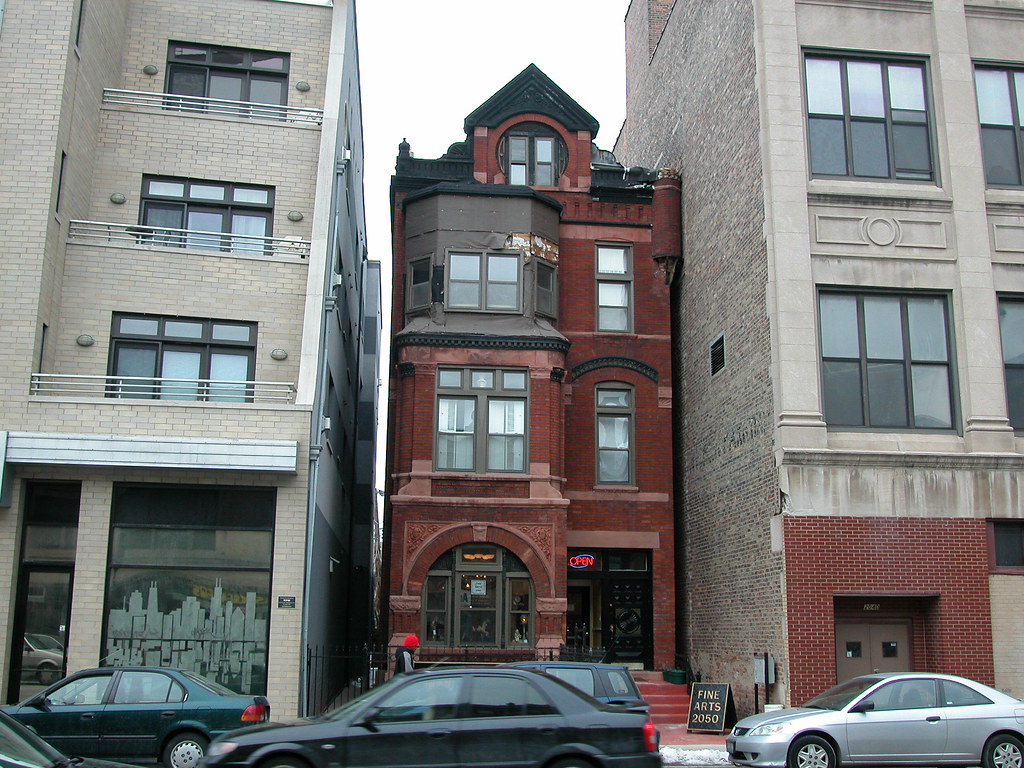
The future is always doubtful to that last historic house on a block in a neighborhood whose primary land use has changed. Neighborhoods just outside of the central business district of American cities that were residential walking neighborhoods typically lost their character in the twentieth century as commercial use crept outward. Large new buildings went up on main thoroughfares, followed by mixed use and apartment buildings on other streets. Old houses became rooming houses, offices and even small factories -- until their narrow lots were added to adjacent lots to make sites for larger buildings. Secondary streets often kept much of the old housing stock, but the main streets emerged from second wave development looking more like downtown than ever.
On some blocks, like the one shown above on North Avenue just west of Milwaukee in Chicago, one will find the houses that survived the development waves. Some of these houses stand alone, adjacent to parking lots. Their futures are doubtful, since they stand apart from the historic context that would make their defense likely should a developer want to take the house and the adjacent lot and build a new building. In Chicago, tear-downs like that seem to happen weekly. The new construction is often an insipid four or five story building with street level retail and condominiums above, rendered in a bland minimalist style or a gaudy postmodernist mess.
Other survivors are more fortunate, like this old Romanesque Revival house. When the building to the right went up in the 1910s, the developer didn't need, want or buy the house. When the building on the left went up, the same story. Neighbors came down, but not the erstwhile little house. The house slipped through both times. With such a small site, and the house being so close to the neighbors, one could guess that the house has escaped demolition. Then again, in urban real estate, nothing is ever certain.
There were years in recent memory when this stretch of North Avenue were devoid of much development interest, and then things changed rapidly. Even if the market is in downturn now, that won't last forever. Some locations hold inherent value that survives the market's cycles. Some buildings do too. Is this house one of those now, by virtue of its escape?
Friday, March 28, 2008
Pilgrim Baptist Church in Chicago Awaits Reconstruction
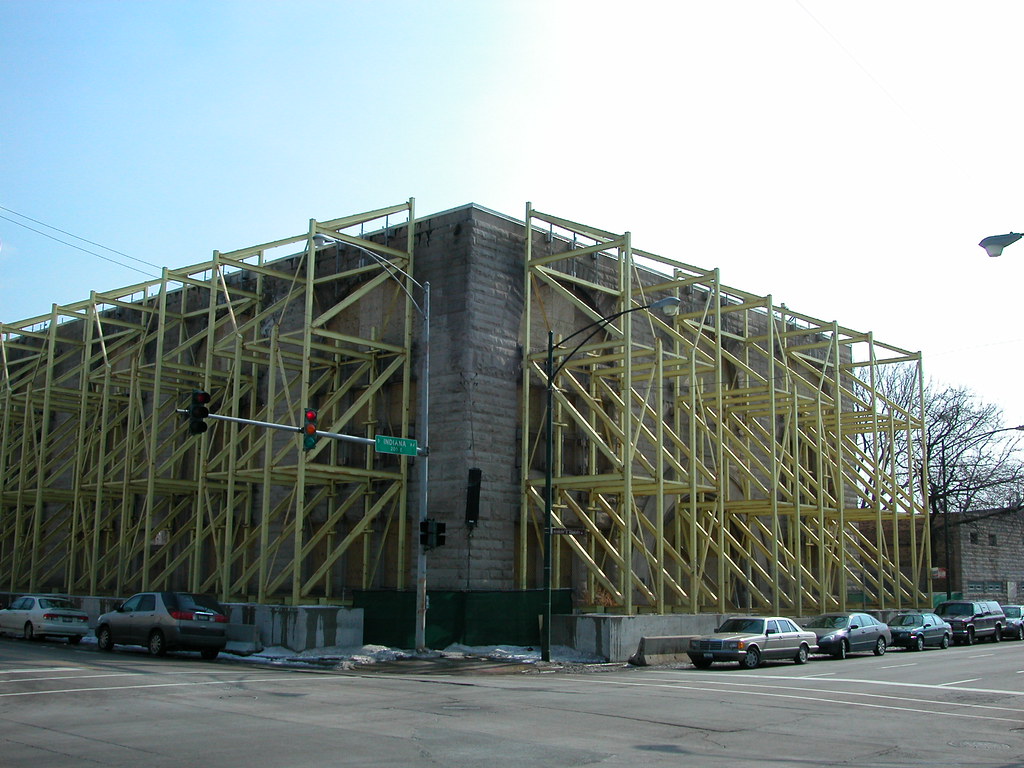
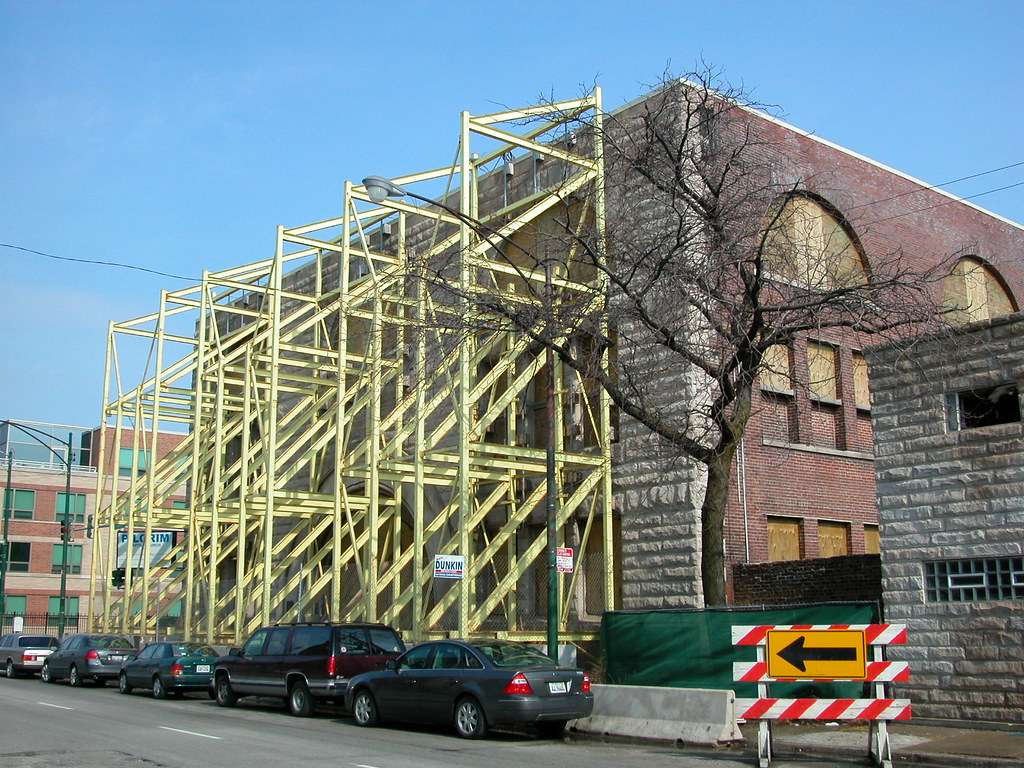
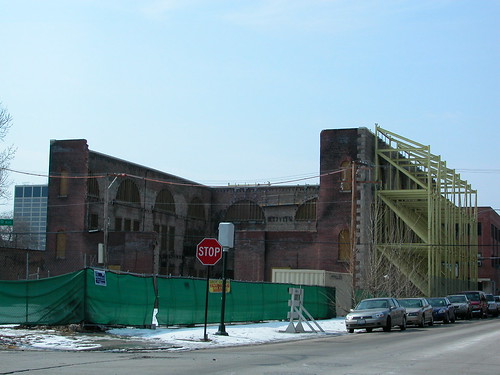
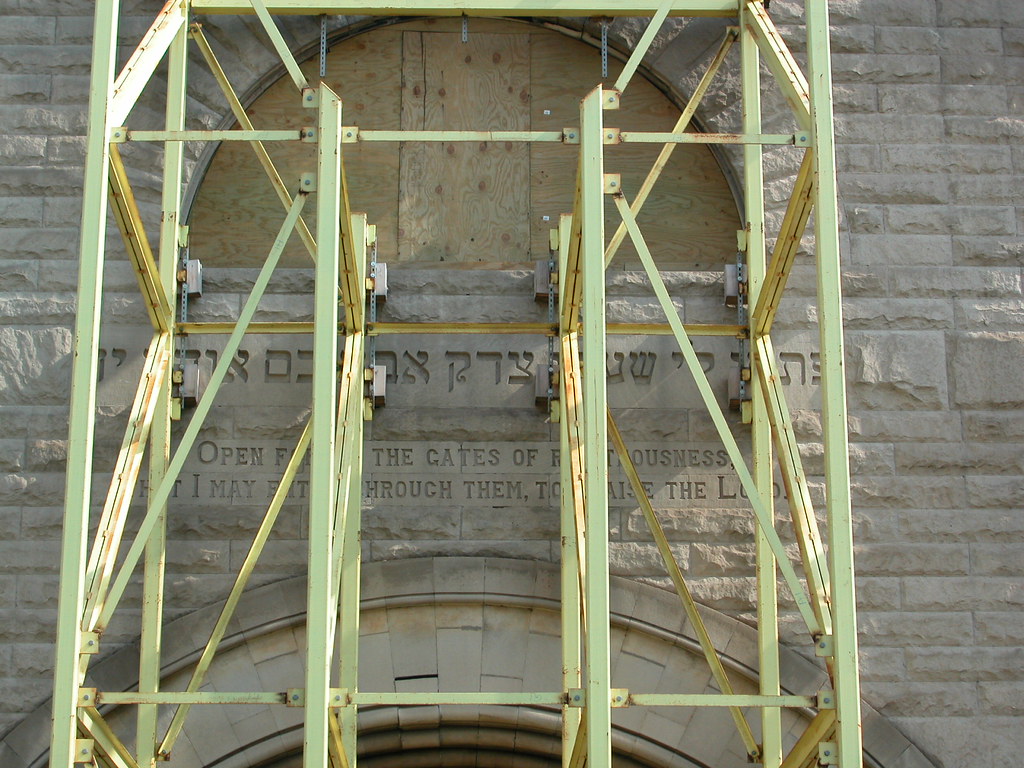 Last month while I was visiting Chicago I stopped by the Pilgrim Baptist Church at Indiana Avenue and 33rd Street in the Bronzeville neighborhood. Built in 1891 as the Kehilath Anshe Ma'ariv Synagogue, this Prairie School masterpiece was designed by Louis Sullivan and Dankmar Adler. In January 2006, a devastating fire struck the building, leaving nothing intact save the limestone and brick walls. The photos below show steel bracing against the street-facing walls. The bracing was required by the Chicago city government to prevent collapse into the public right-of-way. Engineers have determined that collapse is unlikely since the walls remain sound.
Although the church has yet to be able to start reconstruction, they have made some progress with raising money and securing the structure. In 2006, Illinois Governor Rod Blagojevich pledged $1 million in state funds to the church school (since the state can't directly fund the church) to rebuild. Earlier this month, after his administration gave the money to the wrong school, the governor pledged an additional $1 million on top of the previous pledge. Last year, Pilgrim Baptist chose architects Johnson & Lee of Chicago and Quinn Evans of Ann Arbor, Michigan, to design the reconstruction of the ornate Sullivan building. How much of the intricate interior gets rebuilt is undetermined, but the exterior should be brought back fully to original appearance.
Tuesday, March 4, 2008
Under the Layers
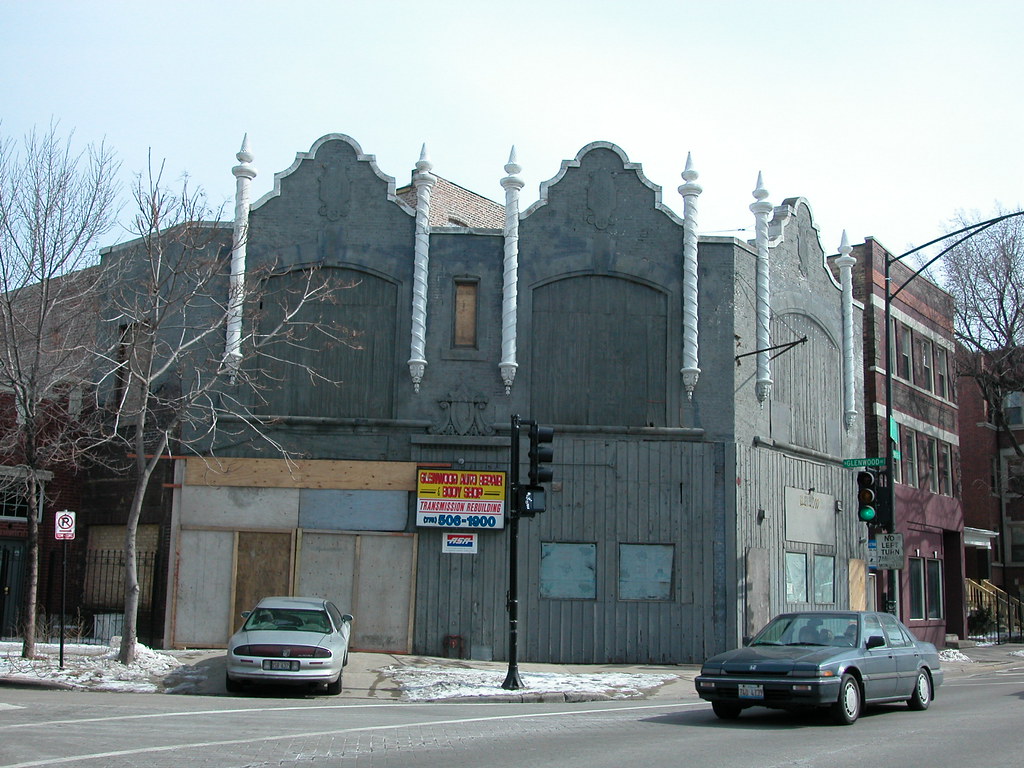
While driving on Ridge Avenue in Chicago over the weekend, I spotted this building. Look at it! We have a Spanish Revival gem hiding out under wooden siding and a coating of gray paint. I like how the owners painted the braided terra cotta finials white to make them stand out. Apparently, the building is in use by an automobile repair shop. Perhaps some day the owner will take off the siding and strip the paint to reveal the full glory of the building. For now, though, the building's soul still manages to whisper through the layers.
Friday, February 15, 2008
Watching and Waiting
City of Destiny offers insightful commentary on the failure of Chicago preservation groups to reach their logical audiences and actually spotlight endangered buildings. Katherine, author of the blog, takes as her starting point the annual endangered buildings lists of Preservation Chicago and Landmarks Illinois:
I feel I should join both these preservation groups because I support their goals, but I'm so frustrated at how little opportunity there seems to be for interaction, for publicizing other buildings that deserve attention, for getting updates on the status of buildings they've put on the lists.
Read all of it here: "Watching the watch lists"
I feel I should join both these preservation groups because I support their goals, but I'm so frustrated at how little opportunity there seems to be for interaction, for publicizing other buildings that deserve attention, for getting updates on the status of buildings they've put on the lists.
Read all of it here: "Watching the watch lists"
Tuesday, January 29, 2008
Preservation Chicago's "Chicago 7" List Includes City's Landmarks Ordinance
Preservation Chicago just released its annual Chicago 7 list of the city's most endangered historic resources. Topping the list is not a building or bridge but the city's Landmarks Ordinance. According to Preservation Chicago, "several recent redevelopment projects endorsed by the city’s planning department and approved by the Commission on Chicago Landmarks call into question whether the integrity of the ordinance itself is in danger of being destroyed."
The ordinance date sto 1968 and has led to local landmark status for 255 buildings and 49 historic districts. Yet recent decisions by the Commission on Chicago Landmarks to allow such travesties as the demolition of the landmarked Farwell Building and the reassembly of its facade on a new, much taller building call into question the level of protection the ordinance provides.
Rounding out the list are the American Book Company, Grant Park, the Devon Avenue commercial district, the Daily News Building, the Booker Building and Norwood Park. The full story is available here.
The ordinance date sto 1968 and has led to local landmark status for 255 buildings and 49 historic districts. Yet recent decisions by the Commission on Chicago Landmarks to allow such travesties as the demolition of the landmarked Farwell Building and the reassembly of its facade on a new, much taller building call into question the level of protection the ordinance provides.
Rounding out the list are the American Book Company, Grant Park, the Devon Avenue commercial district, the Daily News Building, the Booker Building and Norwood Park. The full story is available here.
Tuesday, November 20, 2007
Past the Margins of Chicago
Rob Powers (creator of Built St. Louis) has launched A Chicago Sojourn to chronicle the non-iconic corners of his new home. In his first post, Rob writes that "I've always gravitated to the forgotten: in St. Louis, in Milwaukee, everywhere I go. And so it shall be here."
Beautifully-designed Forgotten Chicago features photo essays on those traces of Chicago's past few celebrate, let alone investigate. Recent topics the Schoenhofen Brewery, pre-1909 street numbering system and Chicago's largest vacant lot, the site of US Steel's South Works. Jacob Kaplan and photographer Serhii Chrucky are the editors.
Beautifully-designed Forgotten Chicago features photo essays on those traces of Chicago's past few celebrate, let alone investigate. Recent topics the Schoenhofen Brewery, pre-1909 street numbering system and Chicago's largest vacant lot, the site of US Steel's South Works. Jacob Kaplan and photographer Serhii Chrucky are the editors.
Thursday, October 25, 2007
I would have called it "Ben Joravsky is all in a TIFf"
There's a nice lil' piece about TIFs and Chicago city government by Ramsin Canon over at Gaper's Block. Behold: Why is Ben Joravsky So Mad? For those of you not so keen on reading about development financing, I assure you this is a nicely readable essay.
St. Louisans, some of the stuff outlined in the article about Chicago shore sounds familiar, hm?
St. Louisans, some of the stuff outlined in the article about Chicago shore sounds familiar, hm?
Thursday, October 18, 2007
A building as useful as it was beautiful: Losing Riis School
My heart broke this morning when I saw this image on Gaper's Block:
http://gapersblock.com/rearview/archives/2007/10/17/
Jacob Riis School in Chicago is finally on its way down. Didn't quite make it to 100.
A 2004 article by Ben Joravsky in The Chicago Reader noted that Mayor Daley plans to build 100 new schools within Chicago in the next several years. Why not make that 99, and revive this sturdy gem? Demolition of such a beautiful and solid building is plainly, foolishly, callously wasteful. The Reader article also noted that the building can't be condo-ized essentially because it's too well built--the internal walls are masonry, and therefore make it tricky to reconfigure. Not only does that mean the building is amazingly structurally tough, but it also means that the structure ought to be used for what it was built to do: Be. a. school.
With Hull House and Maxwell Street already gone (or, um, demolished and repeatedly relocated, at any rate) thanks to my alma mater, the University of Indifferent Commuters, it seems extra cruel somehow to tear down a school named after Jacob Riis. The name of the school always had seemed to me like a nice nod to the area's heritage as a neighborhood of tenements and poor immigrants, and also as a place that had been home to some of the greatest social institutions for the poor in the history of the city of Chicago. In his day, Jacob Riis's photographs brought to light the conditions in which many of New York's poorest immigrants in the later 19th and early 20th century lived. He is probably best known for his book How the Other Half Lives. One more nod to the area's actual heritage, wiped off the map. But I'm sure Chicago needs another faceless, flimsy condo development much more than it needs a sturdy, beautiful brick public school named after a man who devoted his life to improving the lives of the poor.
More Riis shots from Carey Primeau here.
And thanks to David Schalliol for confirming my "Please don't tell me this is what I think it is."
http://gapersblock.com/rearview/archives/2007/10/17/
Jacob Riis School in Chicago is finally on its way down. Didn't quite make it to 100.
A 2004 article by Ben Joravsky in The Chicago Reader noted that Mayor Daley plans to build 100 new schools within Chicago in the next several years. Why not make that 99, and revive this sturdy gem? Demolition of such a beautiful and solid building is plainly, foolishly, callously wasteful. The Reader article also noted that the building can't be condo-ized essentially because it's too well built--the internal walls are masonry, and therefore make it tricky to reconfigure. Not only does that mean the building is amazingly structurally tough, but it also means that the structure ought to be used for what it was built to do: Be. a. school.
With Hull House and Maxwell Street already gone (or, um, demolished and repeatedly relocated, at any rate) thanks to my alma mater, the University of Indifferent Commuters, it seems extra cruel somehow to tear down a school named after Jacob Riis. The name of the school always had seemed to me like a nice nod to the area's heritage as a neighborhood of tenements and poor immigrants, and also as a place that had been home to some of the greatest social institutions for the poor in the history of the city of Chicago. In his day, Jacob Riis's photographs brought to light the conditions in which many of New York's poorest immigrants in the later 19th and early 20th century lived. He is probably best known for his book How the Other Half Lives. One more nod to the area's actual heritage, wiped off the map. But I'm sure Chicago needs another faceless, flimsy condo development much more than it needs a sturdy, beautiful brick public school named after a man who devoted his life to improving the lives of the poor.
More Riis shots from Carey Primeau here.
And thanks to David Schalliol for confirming my "Please don't tell me this is what I think it is."
Wednesday, January 31, 2007
Preservation Chicago's 2007 "Chicago 7" List
Preservation Chicago has released its annual "Chicago 7" list of endangered buildings. Far from a useless cry, the list has always been a measured and prescient examination of true threats to historic buildings of all ages and types. For Chicago urbanists, the list is a rallying cry. For those of us elsewhere, it's the best reference for preservation issues in Chicago. (It's also an inspiring model, much like Landmarks Association of St. Louis' annual Eleven Most Endangered and Eleven Most Enhanced lists.)
One of the great things about the list is that its creators are flexible in what make sup a list item. Often, an item can be a district or neighborhood and this year has a few larger districts.
This year's list features the following buildings:
Farwell Building
Rosenwald Apartments
Archer Avenue District
Wicker Park Commercial District
Julia C. Lathrop Homes
North Avenue Bridge
Pilgrim Baptist Church
I'm delighted that Preservation Chicago is focusing attention on the Archer Avenue district amid Bridgeport's gentrification boom, which may lead to massive demolition for admittedly urban new construction. And I'm doubly delighted to see anyone champion the Julia C. Lathrop Homes, an early low-rise federally-funded housing project that is a descendant of St. Louis' Neighborhood Gardens Apartments. Chicago's loss of the ABLA Homes went largely unmourned, although both the design and construction quality of mid-century low-rise housing projects make them great candidates for reuse.
See the Chicago 7 list here.
One of the great things about the list is that its creators are flexible in what make sup a list item. Often, an item can be a district or neighborhood and this year has a few larger districts.
This year's list features the following buildings:
I'm delighted that Preservation Chicago is focusing attention on the Archer Avenue district amid Bridgeport's gentrification boom, which may lead to massive demolition for admittedly urban new construction. And I'm doubly delighted to see anyone champion the Julia C. Lathrop Homes, an early low-rise federally-funded housing project that is a descendant of St. Louis' Neighborhood Gardens Apartments. Chicago's loss of the ABLA Homes went largely unmourned, although both the design and construction quality of mid-century low-rise housing projects make them great candidates for reuse.
See the Chicago 7 list here.
Monday, January 22, 2007
Rehabbing in Chicago
While searching for information online about coping tiles and flat roofs on historic buildings -- we are preparing to make the leap and add them to our building, which likely has never had them -- I found very few resources.
No matter, because I stumbled upon the delightful Chicago Two-Flat, a rehab chronicle that deals with one couple's efforts to restore one of the blog's namesakes. Their effort is further along than our own, replete with permanent roof, floors one can walk across with bare feet and other comforts. However, their detailed and compelling accounts of the little projects that always overtake any notion of "completion" are so true to life that I can't stop myself from reading despite being in a much more rudimentary stage of rehabbing.
I'm astounded to find such a familiar project from Chicago, which doesn't have the visible and well-organized do-it-yourself rehab community that St. Louis has. A relatively newer housing stock, higher prices and greater population density may keep Chicago from being a major rehab mecca that St. Louis has become, but that doesn't mean no one there is trying. In fact, Chicago Two-Flat's blogroll offers links to other Chicago house blogs covering the twists and turns of taking old buildings into healthier lives.
No matter, because I stumbled upon the delightful Chicago Two-Flat, a rehab chronicle that deals with one couple's efforts to restore one of the blog's namesakes. Their effort is further along than our own, replete with permanent roof, floors one can walk across with bare feet and other comforts. However, their detailed and compelling accounts of the little projects that always overtake any notion of "completion" are so true to life that I can't stop myself from reading despite being in a much more rudimentary stage of rehabbing.
I'm astounded to find such a familiar project from Chicago, which doesn't have the visible and well-organized do-it-yourself rehab community that St. Louis has. A relatively newer housing stock, higher prices and greater population density may keep Chicago from being a major rehab mecca that St. Louis has become, but that doesn't mean no one there is trying. In fact, Chicago Two-Flat's blogroll offers links to other Chicago house blogs covering the twists and turns of taking old buildings into healthier lives.
Subscribe to:
Posts (Atom)


 Posts
Posts

